What Goes Wrong When a Top Rep Changes Roles Without Written Expectations, and How Do You Prevent It?
A rep who hits 135% of quota and then lands on a PIP after a role change almost always got there because nobody wrote down what the new role required. Prevent it with an Accountabilities Document: one or two pages listing what the rep owns, how it's measured and when, agreed before day one. If the rep then misses written expectations, a PIP is fair. If they were never written, it's management's miss.
Key Takeaways:
- A top rep who struggles after a role change is usually missing written expectations, not talent. New product, new manager and no document is a setup for failure.
- Only 49% of U.S. employees strongly agreed they know what's expected of them at work in the first half of 2026, down from a 61% peak in 2015 (Gallup).
- An Accountabilities Document covers the role, the outcomes the rep owns, the numbers and activities, the support you'll provide and how you'll review progress. One or two pages is enough.
- A PIP is fair only when it measures the rep against expectations that were written down and agreed before the work started.
- Every time a role changes, through a promotion, a new product or a new manager, write a new Accountabilities Document before the rep starts the new job.
135% of quota and put on a PIP. Wait, what?
I got a note about exactly this. A salesperson was doing so well that the company carved out a new role for him, selling a different product that was struggling. The new role came with a new manager. Friction came quickly, and the rep ended up on a Performance Improvement Plan.
Here's the problem. He was never given a job description, a written list of what he was accountable for, or the actions he was supposed to take. Nobody wrote anything down.
“If it's spelled out and the salesperson doesn't comply, a PIP is understandable. If it's not spelled out and it's just a subjective attitude, it's management's fault.”
Here's how a top performer ends up there, and how to make sure it never happens on your team.
How Does a Rep at 135% of Quota End Up on a PIP?
A rep at 135% of quota ends up on a PIP when they move into a new role without written expectations. The new manager has one picture of success, the rep has another, and neither is on paper. Friction builds, and the PIP judges the rep against a standard nobody ever stated. The rep didn't change. The job did, and nobody defined it.
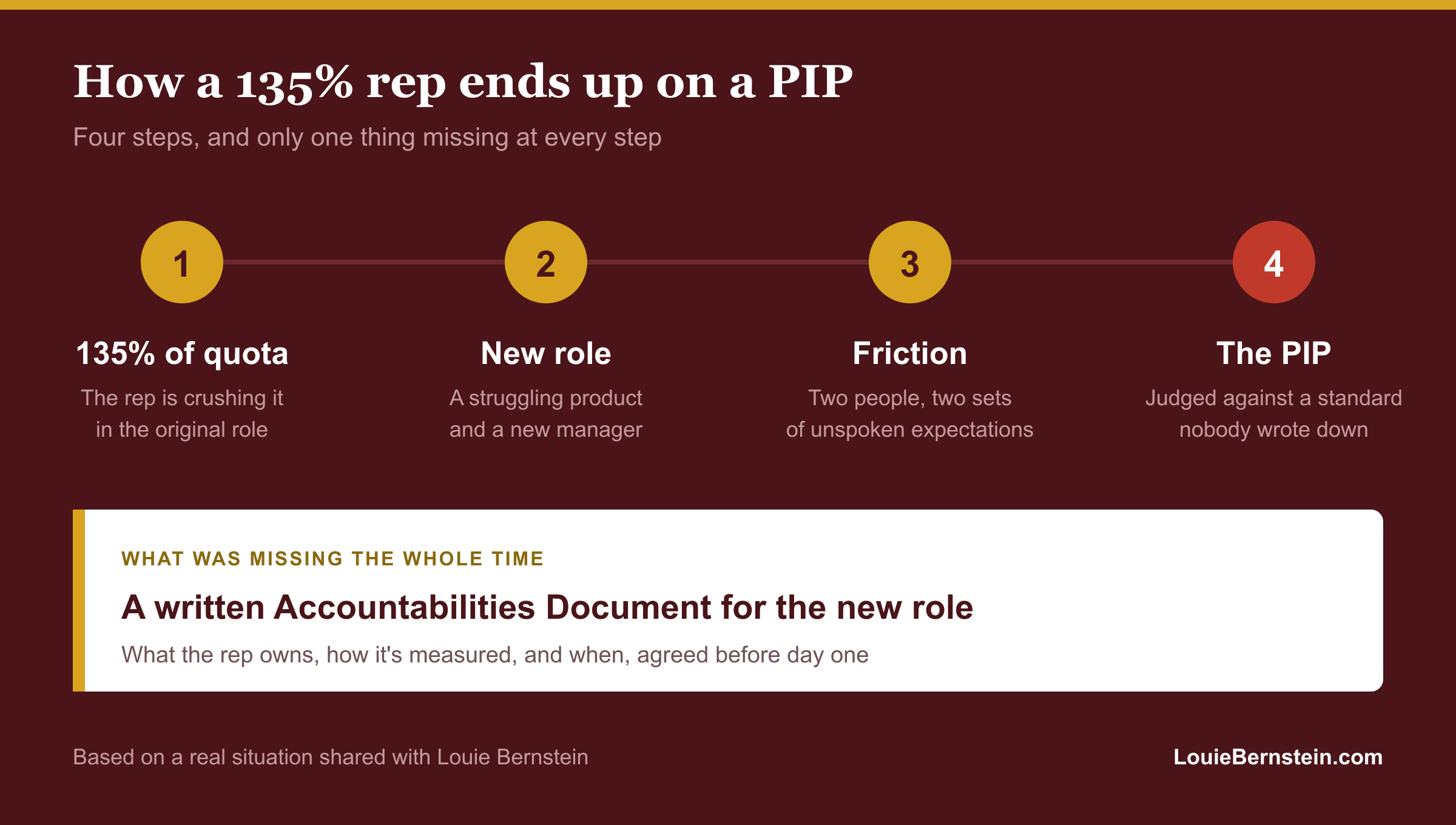
Why role changes are the riskiest moment
Founders write expectations, if they write them at all, when they hire. They almost never rewrite them when a role changes. But a promotion, a new product or a new manager changes the job as much as a new hire does. The rep's track record makes everyone assume they'll figure it out. That assumption is the problem.
Why Do Unwritten Expectations Hurt Sales Performance?
Unwritten expectations hurt sales performance because the rep and the manager end up working toward two different definitions of success. The rep spends time on what they think matters. The manager judges them on what the manager thinks matters. Neither one is wrong, and both get frustrated, because nothing written settles the question.
This isn't only a sales problem. Gallup found that just 49% of U.S. employees strongly agreed they know what's expected of them at work in the first half of 2026, well below the 61% peak in 2015. If half of all employees aren't sure what's expected, a rep who just switched roles has even less to go on.
What it costs when nobody writes it down
- Wasted selling time. Reps put effort into activities you don't value, because you never said which ones you do.
- Friction. You and the rep argue about things that seemed obvious to you and weren't obvious to them.
- Lost good people. Strong reps leave when they feel set up to fail, and replacing them means recruiting and another ramp.
- A weak PIP. A plan built on undocumented expectations is subjective, hard to defend and easy to resent.
What Goes in an Accountabilities Document?
An Accountabilities Document is a one- or two-page list of what a role is responsible for and when. It covers the role and reporting line, the outcomes the rep owns, the numbers and activities that measure them, the support the company provides, and how progress gets reviewed. It's what's expected and when it's expected. Nothing more.
- Role and reporting line. The title, who the rep reports to and who reports to them, if anyone.
- Outcomes the rep owns. Results, not tasks. "Win new customers in this segment," not "make calls."
- Numbers and activities. The quota, the few activities that drive it and how often each one is due: weekly, monthly, quarterly.
- Support you'll provide. Tools, training, leads and your time. The company's side of the deal goes in writing too.
- How progress is reviewed. When you'll meet, what you'll look at, and what happens if the numbers fall short.
My guide to the sales Accountabilities Document walks through each section, and this example shows what a working AE Accountabilities Document looks like with real numbers.
When Is It Fair to Put a Sales Rep on a PIP?
It's fair to put a sales rep on a PIP when you can show the written expectations they agreed to, the gap between those expectations and their results, and what has to change by when. If the expectations were never written down, the PIP measures the rep against your memory. That's subjective, and the miss is management's.
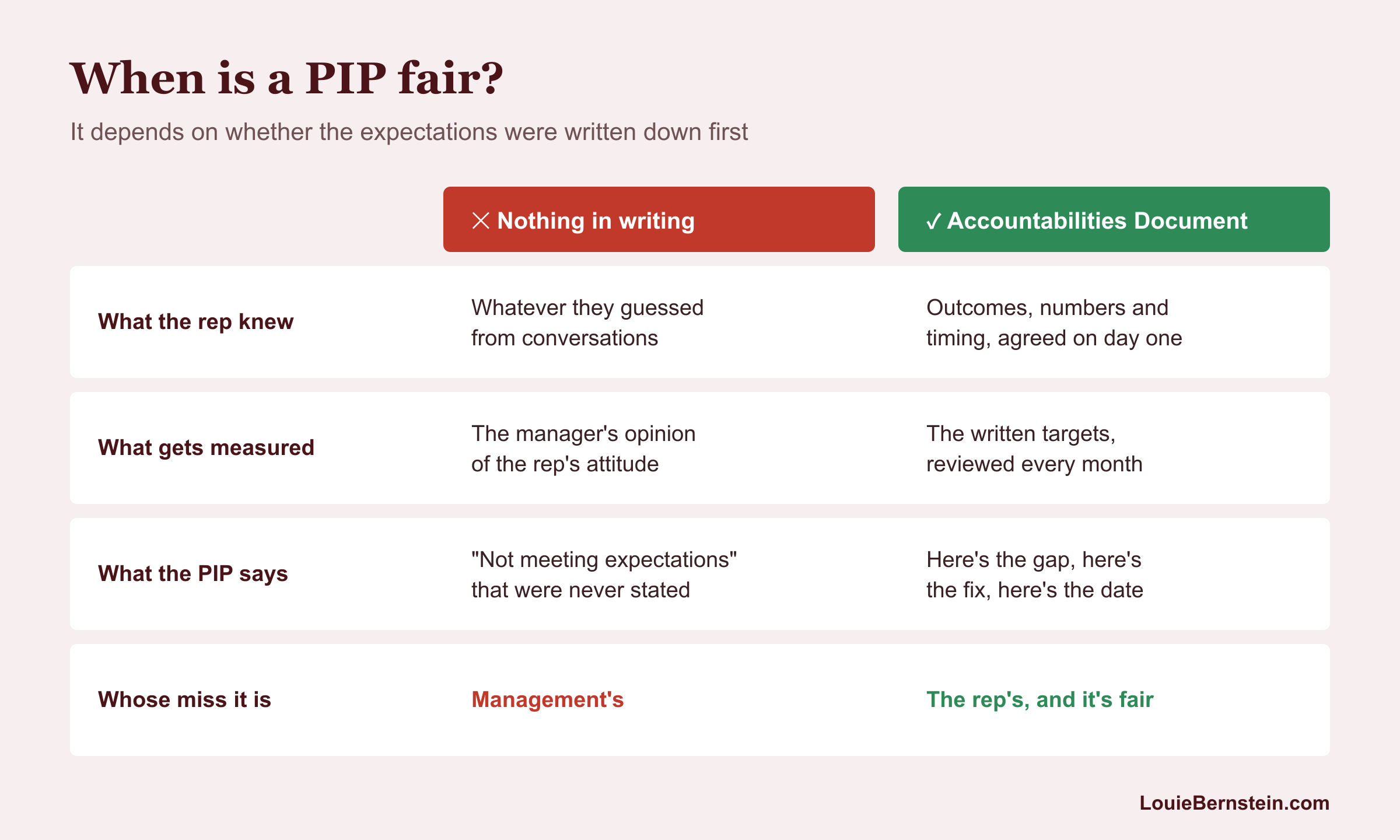
Build the PIP from the document
Start every PIP conversation with the Accountabilities Document on the table. Show the rep what was agreed, what the numbers actually show, and the specific, measurable changes you need with a deadline. That makes the conversation about the work, not about how you feel about the person.
“When you let someone go, it should never be a surprise. A written Accountabilities Document is how you make sure it isn't.”
How Do You Roll Out Accountabilities Documents to Your Sales Team?
Roll out Accountabilities Documents by writing one for every current sales role, reviewing each one face to face with the rep, and updating it the moment a role changes. Then use it in every monthly review. A document that sits in a folder doesn't change anything. A document you review every month changes everything.
- Write one for every current role. Even reps who've worked with you for years carry different assumptions than you do.
- Review it with each rep. Ask what's working, what isn't and what they need from you. Adjust it together so they own it too.
- Update it when the role changes. New product, new manager, promotion: rewrite it before the rep starts the new job.
- Use it in every review. Feedback tied to the written document is specific and fair, and the review goes faster.
- Start every PIP from it. If there's nothing written to point to, fix that first.
Written expectations also make a team consistent. As Neal Reynolds, CEO of BankMarketingCenter.com, put it: "When Louie came on board he wrote and organized our outbound scripts and emails. We now had everyone working off the same playbook, and it gave us consistency."
What Mistakes Do Founders Make With Accountabilities Documents?
The most common Accountabilities Document mistakes are writing a job description instead, waiting until there's a performance problem, never updating it, never reviewing it with the rep, and making it too long to use. Each one turns a working tool into paperwork that nobody reads, and the confusion comes right back.
- Writing a job description instead. A job description lists tasks for a job board. An Accountabilities Document defines the outcomes you'll actually measure.
- Waiting for a problem. Written after the trouble starts, it looks like evidence-gathering. Write it before the rep starts.
- Never updating it. The document from when you were at $2M ARR doesn't describe the job at $5M.
- Never reviewing it. If the rep can't tell you what's in it, it isn't working.
- Making it too long. One or two pages. If the rep can't understand it in one reading, cut it.
Frequently Asked Questions
Q: Do I need Accountabilities Documents if I only have two or three salespeople?
Yes, and maybe more than a big team does. On a small team everyone wears several hats, so it's easy for two people to assume the other one owns something. A one-page Accountabilities Document per person settles who owns what before it costs you a deal.
Q: How often should I update an Accountabilities Document?
Review every Accountabilities Document once a quarter, and rewrite it immediately when a role changes: a promotion, a new product, a new manager or a new territory. If you're not sure a change is big enough to matter, update the document anyway.
Q: What if my rep disagrees with what I wrote?
That's useful, and better now than at review time. Talk it through in your next one-on-one and adjust what's reasonable. The goal is a shared picture of the job, not control over every detail. A rep who helped shape the document is far more likely to own it.
Q: Can I put a rep on a PIP if I never wrote down expectations?
You can, but it isn't fair and it rarely works. Write the Accountabilities Document first, review it with the rep, set a start date, and give them a real chance to meet it. Then, if they miss the written standard, a PIP is clear and defensible.
Q: Does this work for roles outside sales?
Yes. Any role benefits from a written list of what it owns and when, including marketing, operations and customer success. Sales just shows the problem fastest, because the numbers make a mismatch in expectations visible within a quarter.
Put your sales expectations in writing.
If you run a $1M to $10M ARR B2B company and your reps aren't sure what's expected, let's spend 30 minutes on it. We'll sketch the Accountabilities Document for your most important sales role. Learn how Fractional Sales Leadership works at LouieBernstein.com.
Schedule a 30-Minute CallAbout the Author
Louie Bernstein
Fractional Sales Leader since 2017, with 50 years of sales experience helping $1M–$10M ARR companies build scalable, repeatable sales systems. Founder of MindIQ (INC 500). LinkedIn Top Voice in Sales Management, Sales Operations, and Sales Coaching.
Full bio | LinkedIn | Subscribe to The Sunday Starter | YouTube