Key Takeaways:
- A Fractional Sales Leader is a senior sales executive who leads your revenue function part-time, on contract. Unlike a consultant who advises, they execute, installing the playbook, the CRM, and hiring the team.
- The model exists for founders stuck between $1M and $10M ARR who need to escape founder-led sales but aren't ready to bet ~$400K a year on a full-time VP.
- A fractional engagement runs $120K–$240K a year versus roughly $400K all-in for a full-time VP, the same C-level judgment for about half the cost.
- It's the lower-risk path: about 70% of first VP of Sales hires fail within 12 months (SaaStr) and average VP tenure is just ~19 months (Gong). A fractional leader has built this system dozens of times.
- The goal is to make themselves obsolete: build the machine, document it, then hand you the keys, often hiring your full-time replacement to run it.
If you're reading this, you're probably the founder of a B2B company doing between $1M and $10M in ARR, and you're still the best salesperson in the building. You built the product, you know the market, and you close the deals. That's exactly the problem. You can't scale a company when the growth engine is one person, and that person is you.
The instinct is to hire your way out with a big-ticket VP of Sales. But that's a ~$400K-a-year bet on a coin flip: roughly 70% of first VP of Sales hires fail within 12 months (SaaStr), and the average VP lasts just ~19 months in the seat (Gong). Promote a junior rep instead and you get loyalty without the experience to build a department. Neither option is what you actually need yet.
There's a third path that most founders at your stage don't know has a name: the Fractional Sales Leader. Here's what the model is, what it costs, and why it's become the capital-efficient way to build a real sales machine without betting the runway on a full-time executive.
What Is a Fractional Sales Leader?
A Fractional Sales Leader is a senior sales executive who leads a company's revenue function on a part-time, contract basis. The word "fractional" refers to their time, not their seniority, you get a leader who has run and built sales organizations before, but only for the slice of their week your company actually needs. The critical distinction is that, unlike a consultant who advises, a Fractional Sales Leader executes. They install the sales infrastructure, build or clean up the CRM, hire the first reps, and write the playbook that lets the company run without the founder in every deal.
In short, you're buying C-level experience and judgment at a fraction of the cost of a full-time hire, and getting someone with their hands on the wheel, not a slide deck. That single difference, a builder who executes versus an advisor who recommends, is what makes the model work for a company that has revenue but doesn't yet have a repeatable system.
The Founder Bottleneck: Why Growth Stalls Between $1M and $10M ARR
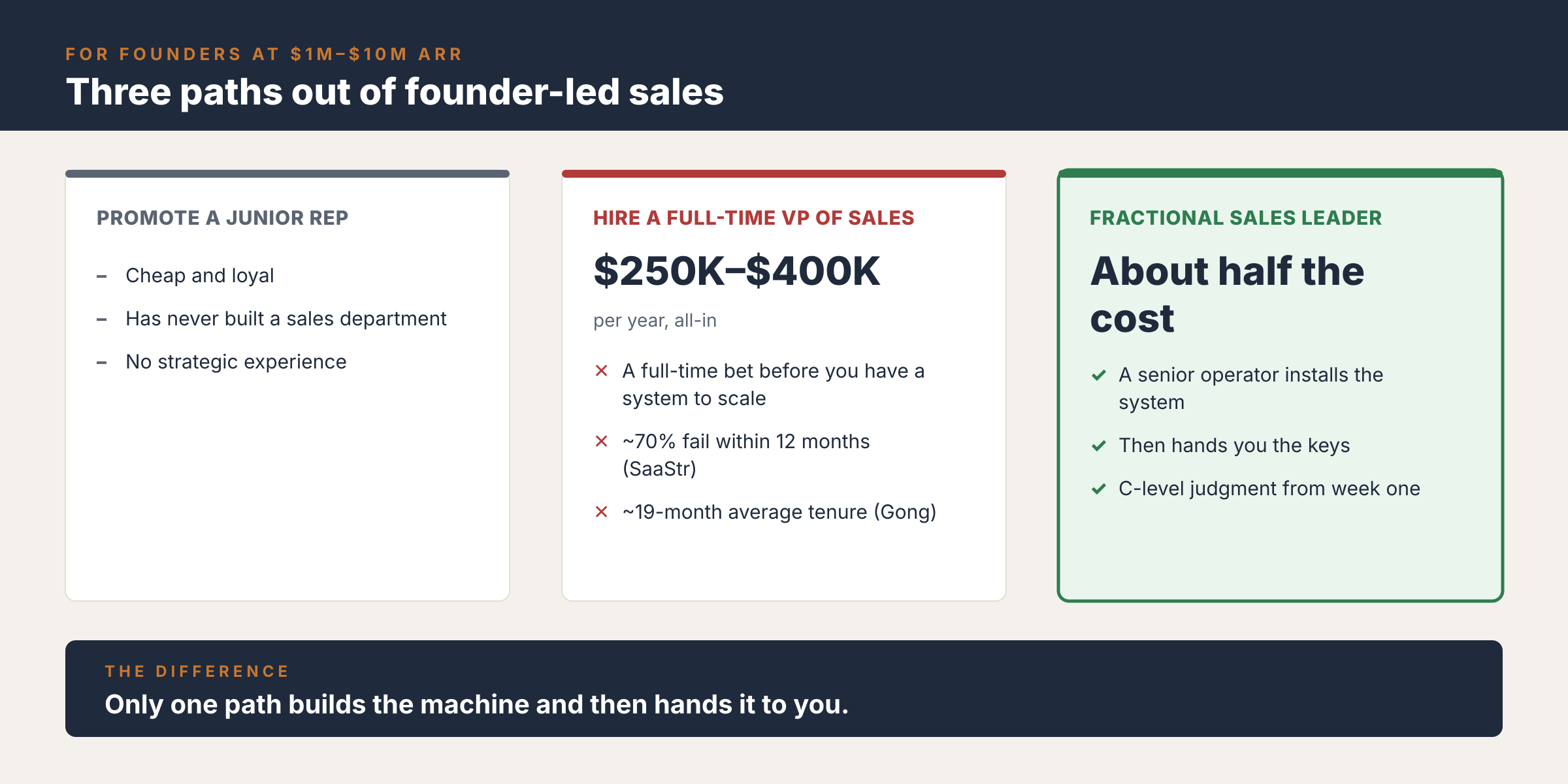
This is the "Founder Trap." You built the product, you know the market, and you close the deals, which means every demo, every follow-up, and every pipeline decision still routes through you. Revenue is real, but it's capped at your personal bandwidth, and you can feel the ceiling. You know you need to hand this off. The trouble is that the two obvious ways to do it are both flawed.
Promote a junior rep and you get someone loyal and affordable who has never built a sales department and lacks the strategic experience to create one. Hire a big-ticket VP of Sales and you're spending around $400K all-in on a full-time bet before you have a repeatable system for them to scale, and the odds are grim: about 70% of first VP hires fail within 12 months (SaaStr), with average tenure near 19 months (Gong). Get the first VP wrong and you burn a hole in the runway, lose 6 to 12 months of momentum, and start the search over.
Buying Experience, Not Hours
The mental shift that makes the fractional model click is this: you're buying experience and outcomes, not hours. When you hire a full-time employee, you pay for 40 hours a week of presence, whether or not those hours move the needle. When you engage a Fractional Leader, you pay for the specific slice of their time that installs systems and drives velocity, typically 10 to 20 hours a week, aimed at the highest-leverage work.
A fractional engagement (mine run 12 weeks, renewable after that) has one job to do: build the sales machine so the business can run without the founder in every deal. Here's what that build actually involves.
What a Fractional Sales Leader Actually Builds
First, they codify your "founder magic" into a playbook. Most founders sell on instinct, you know what to say because you lived the problem. You can't hire reps against instinct, so a Fractional Leader extracts that knowledge into a documented sales playbook: a defined Ideal Customer Profile, a scripted discovery-call framework, clear sales stages, and an objection-handling matrix a new rep can actually run.
Second, they install the infrastructure. You can't scale on spreadsheets, so the fractional leader takes ownership of Revenue Operations, configuring the CRM (not just telling you to buy one), enforcing pipeline hygiene so the stages match reality, building data-driven forecasting to replace "I think we'll close this," and selecting a tech stack that fits your stage without overspending.
Third, they hire and onboard the first scalable reps. Founders tend to hire "mini-me" versions of themselves, which usually fails. A Fractional Leader knows the difference between a builder rep and a maintainer rep for your specific stage, and runs the interviews, the vetting, and the ramp so the hire lands on a runway instead of in a vacuum. If you want the day-to-day picture, I go deeper in what a Fractional Sales Leader actually does.
The Economics: Why It Makes Sense
Now the math. A full-time VP of Sales runs roughly $400K a year all-in once you add base, variable, benefits, and equity. A fractional engagement runs about $120K–$240K a year, the same level of seniority, often deeper since fractional leaders have built this system repeatedly across multiple companies, for roughly half the cost.
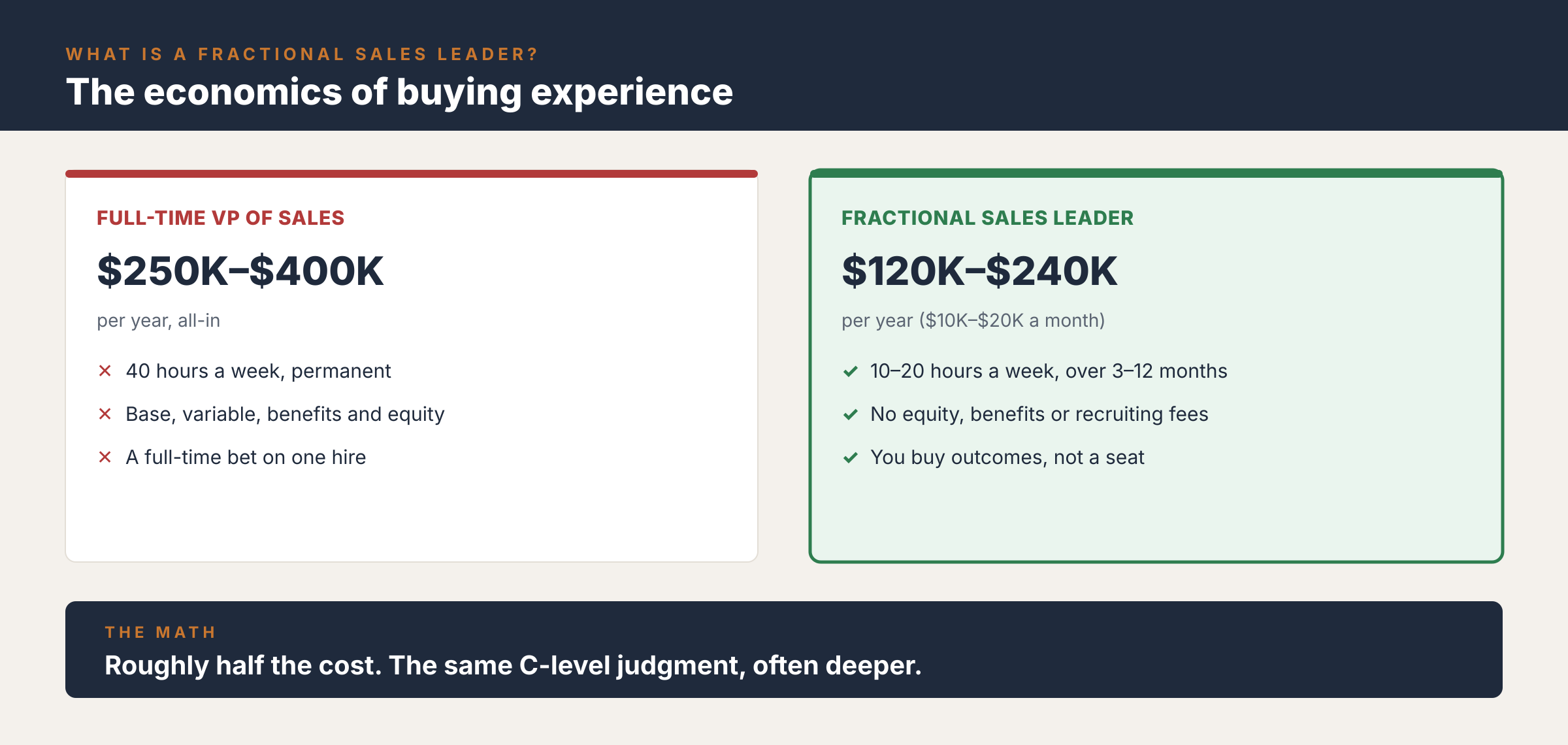
That gap is capital efficiency. Instead of sinking your runway into one expensive full-time bet, you free up cash for marketing or product while the sales engine gets built, and you carry far less risk, because you're not gambling the company on whether a single new executive works out. If you want the full breakdown, see what a fractional VP of Sales costs.
"You get their experience, judgment, and systems, but you only pay for the slice of their time you need. That's the whole model."
Fractional Leader vs. VP vs. Consultant
The fastest way to place the model is next to the two alternatives founders usually weigh. A consultant tells you what to do and hands you a report, you still have to execute. A full-time VP of Sales manages and scales an existing sales org, a bet that makes sense once you already have ten-plus reps and a proven motion to multiply. The Fractional Sales Leader sits between them: they build the system and run it hands-on for a defined window, then hand you the keys.
Put simply, the consultant advises, the VP is a full-time bet you may not be ready to afford or manage, and the Fractional Leader builds the machine and gives it to you. If you're weighing seniority levels specifically, Fractional Sales Leader vs. Fractional VP of Sales vs. Fractional CRO breaks down which altitude you actually need.
Related Reading
Frequently Asked Questions
Q: What is a Fractional Sales Leader?
A Fractional Sales Leader is a senior sales executive who leads your revenue function part-time, on a contract basis. "Fractional" refers to their time, not their seniority, you get someone who has built and run sales organizations before, but only for the slice of their week your company needs. The defining difference from a consultant is that they execute: they install the CRM, build the playbook, and hire the team, rather than handing you a report and leaving you to do it. It gives a founder C-level sales leadership without a C-level salary or a full-time commitment.
Q: When should I hire a Fractional Sales Leader instead of a VP?
Hire a Fractional Leader when you have product-market fit (roughly $1M+ ARR) and need to build the processes, playbook, and first team, but you're not yet ready to manage ten-plus reps. If you need to build the foundation, go fractional. If you already have a proven motion and a large team to scale and manage, that's when a full-time VP makes sense. Leading with a $400K VP before there's a system to scale is how founders end up in the roughly 70% of first VP hires that fail within 12 months (SaaStr).
Q: How much does a Fractional Sales Leader cost?
Most engagements run about $120K–$240K per year, versus roughly $400K all-in for a full-time VP of Sales. You're buying 10 to 20 focused hours a week from someone who has built this system before, not 40 hours of presence, which is why you get the same, or often deeper, seniority for around half the cost. See a full breakdown in what a fractional VP of Sales costs.
Q: How much time does a Fractional Sales Leader spend with my team?
Typically 10 to 20 hours a week, focused on high-leverage activities: pipeline reviews, strategy sessions, process building, coaching, and interviewing. They don't sit in every meeting, they attend the right meetings to drive velocity. The point of the model is impact per hour, not hours logged, so the time goes where it actually moves revenue.
Q: What happens when the engagement ends?
The goal of a Fractional Leader is to make themselves obsolete. By the end of the engagement you should have a documented playbook, a functioning CRM, and a performing sales team, the machine, running without you. Often the fractional leader then helps you hire their full-time replacement, a sales manager or VP, to run the system they built. You keep the infrastructure and the reps; you no longer need the builder once the building is done.
Q: Is a Fractional Sales Leader the same as a fractional VP of Sales or fractional CRO?
They overlap but differ in altitude. A Fractional Sales Leader (or fractional VP of Sales) builds the front-line sales engine for a $1M–$10M ARR company. A fractional CRO operates one level up, aligning sales, marketing, and customer success across the whole revenue org, usually at a later stage. Most founders escaping founder-led sales need the builder, not the executive layer. Here's how to tell which one you need.
Stop guessing. Start scaling.
If you're a founder between $1M and $10M in ARR ready to escape founder-led sales, I'll install a proven revenue engine, playbook, pipeline, and team, without the risk of a full-time executive hire. See how it works at louiebernstein.com.
Schedule a 30-Minute CallAbout the Author
Louie Bernstein
Fractional Sales Leader with 50 years of sales experience helping $1M–$10M ARR companies build scalable, repeatable sales systems. Founder of MindIQ (INC 500). LinkedIn Top Voice in Sales Management, Sales Operations, and Sales Coaching.