Key Takeaways:
- Hiring a Fractional Sales Leader requires vetting for stage-relevant experience, daily availability, and a structured audit process
- Industry experience matters far less than operational competence in the $1M–$10M ARR range
- The right candidate describes pipeline stages and CAC baselines, not "brand alignment" or "corporate synergy"
- A high-quality leader will promise a 30/60/90 day roadmap before making any changes
What is a Fractional Sales Leader?
A Fractional Sales Leader is an experienced executive who takes ownership of the sales function for a company on a part-time, contract basis. Unlike a consultant who only advises, a Fractional Sales Leader is an operator who builds strategy, manages the team, installs infrastructure (CRM, playbooks), and is accountable for revenue targets, typically for businesses between $1M and $10M in ARR. For a deeper dive, see what a Fractional Sales Leader does.
The Founder's Dilemma: Hiring for Impact, Not Just Advice
You are at a revenue plateau. You have reached $2M or $5M in ARR through sheer force of will, founder-led sales, and perhaps a few early hires. But the system is breaking. You are the bottleneck.
You know you need senior leadership, but a full-time VP of Sales commands a $250k+ base salary plus equity—a risk your P&L might not be ready to absorb. The logical bridge is a Fractional Sales Leader.
However, the "fractional" market is noisy. It is filled with consultants who want to give advice from the sidelines and retired executives looking for a low-stress retirement gig. You do not need advice; you need Revenue Operations installed and a team to be managed.
To distinguish between a high-impact operator and a passive advisor, you need to ask the right questions during the interview process. Here is the framework.
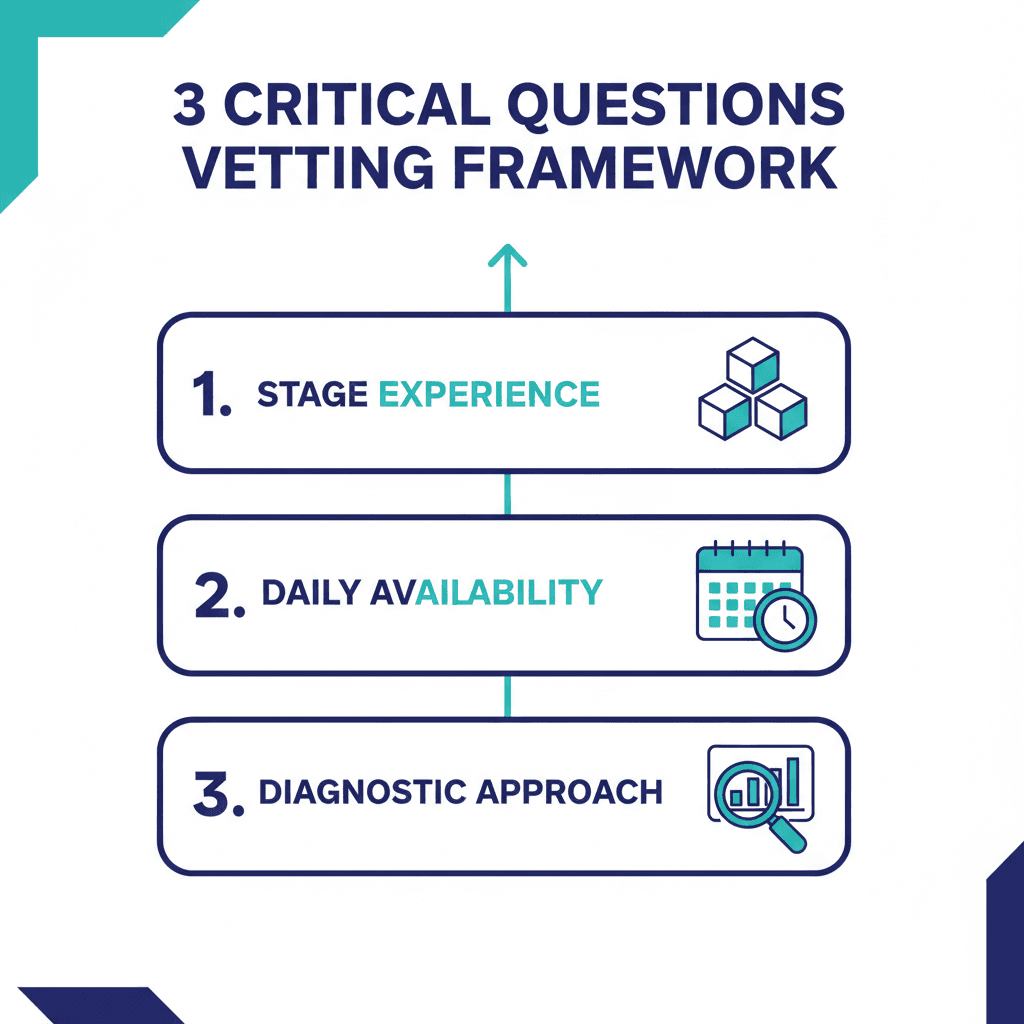 The three questions that separate operators from advisors.
The 3 Questions At a Glance
| Question | Green-Flag Answer (Operator) | Red-Flag Answer (Advisor) |
|---|---|---|
| 1. Have you done this for a company our size? | Describes defining pipeline stages, CAC:LTV baselines, and daily rhythm at a $1M–$10M founder-led company | "I ran a 500-rep division at Oracle" |
| 2. How much time will you spend with our team? | Daily Slack triage, weekly pipeline review + training, monthly metric deep-dive | "I check in once a week to review the numbers" |
| 3. How will you know where to start? | A structured audit (team interviews, CRM, call shadowing) then a 30/60/90-day roadmap | "I'll just come in and shake things up immediately" |
Question 1: "Have you done this before for a company of our size?"
The Trap: Founders often obsess over industry experience ("Have you sold SaaS to dentists before?"). This is a mistake.
The Reality: At the $1M–$10M stage, sales problems are structural, not vertical-specific. A sales process for a $5M manufacturing firm has more in common with a $5M software firm than a $5M software firm has with Salesforce.
What you are looking for: You need Stage-Relevant Experience. You need someone who has taken a chaotic, founder-dependent environment and built a Sales Playbook from scratch.
Ask them to describe a specific scenario where they entered a company with:
- No defined sales stages.
- A CRM that was essentially a digital Rolodex.
- Reps who were "winging it" on every call.
If they start talking about "brand alignment" or "corporate synergy," run. If they talk about defining entry/exit criteria for pipeline stages, establishing CAC:LTV baselines, and implementing a daily standup rhythm, you have found an operator.
The "Red Flag" Answer: "I ran a division of 500 reps at Oracle." Great, but that person has likely forgotten how to build a comp plan or configure a HubSpot pipeline. You need a builder, not a maintainer.
Question 2: "How much time will you spend with our sales team?"
The Trap: Assuming "Fractional" means "Hands-off."
The Reality: Sales is a high-frequency, high-emotion activity. Deals die in hours, not weeks. If your leader is only available for a one-hour strategy call on Fridays, your team will starve for direction.
What you are looking for: You need Daily Availability, even if the hours are limited. A Fractional Sales Leader might only be contracted for 10 hours a week, but those hours must be deployed effectively.
The Operational Rhythm: A competent Fractional Leader should describe a rhythm that looks like this:
- Daily: Available via Slack/Teams for urgent deal triage.
- Weekly: Running the Monday pipeline review and Friday training session.
- Monthly: Deep-dive metric analysis (conversion rates, Pipeline Velocity).
 The cadence of effective fractional leadership: embedded at every level.
They must be embedded in the communication flow. If a rep hangs up the phone after a tough objection, they need to be able to ping their leader for immediate feedback. If the leader is "unavailable" until next week, the learning moment is lost.
The "Red Flag" Answer: "I check in once a week to review the numbers." That is a dashboard monitor, not a sales manager. You can check the numbers yourself. You are paying for active management and coaching.
Question 3: "How will you know where to start?"
The Trap: Hiring a leader who brings a "plug-and-play" playbook without diagnosing your specific bottlenecks.
The Reality: Prescription without diagnosis is malpractice. Every sales organization is broken in its own unique way. One might have a lead generation problem; another might have a closing problem; another might have a CRM Hygiene disaster.
What you are looking for: A structured Sales Audit followed by a 90-day Action Plan.
Before they change a single thing, a high-quality candidate will want to:
- Interview the team: Understand the culture and skill gaps.
- Audit the CRM: Look at historical data, win/loss ratios, and data integrity.
- Shadow calls: Listen to actual sales conversations to hear the "voice of the customer."
The Deliverable: They should promise you a 30/60/90-day roadmap. For example: "First 30 days we fix the CRM and define the stages. Days 30-60 we implement the new script and train. Days 60-90 we hire two new SDRs."
If they cannot articulate how they diagnose problems, they will likely waste the first three months throwing spaghetti at the wall.
The "Red Flag" Answer: "I'll just come in and shake things up immediately." Chaos added to chaos does not equal order.
Why This Matters: The Cost of Getting It Wrong
Hiring a Fractional Sales Leader is a strategic investment. It is often the first time a founder truly lets go of the revenue engine. The stakes are real: the average VP of Sales lasts just ~19 months (Gong), and a mis-hire at the leadership level costs you far more than a salary.
If you hire the wrong person, you lose more than just their retainer fee. You lose:
- Time: 3-6 months of lost growth.
- Team Morale: Good reps leave bad managers.
- Opportunity Cost: Competitors capture the market while you are rebooting.
By focusing on stage-relevant experience, daily availability, and a diagnostic approach, you filter out the consultants and find the partner who will actually build your revenue machine.
Frequently Asked Questions
Q: How much does a Fractional Sales Leader cost compared to a VP?
A: A Fractional Sales Leader typically costs $6,000–$12,000 per month depending on scope, whereas a full-time VP of Sales costs $250,000+ annually (salary + benefits + equity). The fractional model allows you to access VP-level talent for a fraction of the cost, reducing burn rate while you scale.
Q: Can a Fractional Sales Leader manage my existing sales team?
A: Yes. In fact, management is a core responsibility. They should run your weekly pipeline meetings, conduct 1:1 coaching sessions, and hold reps accountable to KPIs. They act as the direct manager, removing that burden from the founder's plate.
Q: How long should I keep a Fractional Sales Leader before hiring full-time?
A: Most engagements last 6 to 18 months. The goal is for the Fractional Leader to build the infrastructure (CRM, playbooks, hiring process) and grow revenue to a point where the company can justify and afford a full-time VP of Sales. Often, the Fractional Leader helps hire their full-time replacement.
Q: What questions should I ask before hiring a Fractional Sales Leader?
A: Ask three: (1) Have you done this before for a company our size?—you want stage-relevant experience building from chaos, not big-logo tenure; (2) How much time will you spend with our team?—you want daily availability and a weekly rhythm, not a once-a-week check-in; and (3) How will you know where to start?—you want a structured audit and a 30/60/90-day roadmap, not a plug-and-play playbook.
Q: What are the red flags when hiring a Fractional Sales Leader?
A: Watch for advisor language instead of operator language: talking about "brand alignment" or "corporate synergy" rather than pipeline stages and CAC baselines; promising to "check in once a week to review the numbers" (that's a dashboard monitor, not a manager); or offering to "shake things up immediately" with no diagnosis. You want someone who installs Revenue Operations and manages the team—not someone who advises from the sidelines.
Related Reading
- What a Fractional Sales Leader Actually Does — the execution behind the answers you're vetting for.
- What Is a Fractional Sales Leader? — the model, economics, and when to hire one.
- What a 90-Day Sales Plan Looks Like — the roadmap a strong candidate should promise.
Ready to Build Your Sales Machine?
You don't have to guess if your sales leadership is working. If you want to see how a structured audit and action plan can transform your revenue trajectory, let's talk.
Schedule a 30-minute consultation call to discuss your specific situation.
About the Author
Louie Bernstein is a Fractional Sales Leader and LinkedIn Top Voice with 50 years in sales and business. He founded and bootstrapped MindIQ—an INC 500 company—for 22 years, and since 2016 has helped $1M–$10M ARR founders build repeatable sales systems, playbooks, and teams so they can escape founder-led sales.