Key Takeaways:
- Maybe 1 product in 1,000 truly sells itself. Almost every founder believes theirs is that one. The math says 999 of them are wrong.
- 42% of startups fail from "no market need" (CB Insights). "Build it and they'll come" isn't a strategy. It's the most common way companies die.
- B2B buyers spend only 17% of their journey with all vendors combined, and 80% of it happens with no salesperson in the room (Gartner). The product doesn't close the gap. A system does.
- Companies with a formal sales process grow revenue 18% faster (HBR). The difference isn't a better product. It's a repeatable way to sell it.
- You don't get to choose whether your product is the 1 in 1,000. You do get to choose whether you build the system that wins without it.
There's a product out there that sells itself. Maybe one in a thousand. It's so obviously better, so perfectly timed, so cheap to switch to, that customers line up and word of mouth does the rest.
In fifty years of selling, I've met a lot of founders. And 95% of them are certain they have that one.
I understand why. You built it. You've seen it change a customer's day. You've watched someone's face light up in a demo. Of course it feels like the world should beat a path to your door. But feeling that way and building a company on it are two very different things, and the second one is where founders between $1M and $10M in ARR get stuck.
Here's the hard part I have to tell people. You're almost certainly not the 1. And that's actually good news, because the thing that wins when you're not the 1 is something you can build. Let me show you the numbers, and then let me show you the system.
Why "It Sells Itself" Is the Most Expensive Belief in B2B
"It sells itself" is really "build it and they will come" wearing a nicer suit. And that idea has a body count.
CB Insights studied why startups die and the number one reason, at 42%, was "no market need." Not bad code. Not a weak feature set. The founders built something and then discovered not enough people cared enough to pay for it. These weren't lazy people with junk products. Many had genuinely good products. What they didn't have was a repeatable way to find the right buyers and move them to a decision.
The market doesn't behave the way you think
Even when there is real demand, the modern buyer makes "selling itself" nearly impossible. Gartner found that B2B buyers spend only 17% of their entire purchase journey meeting with potential suppliers. Split that across the three or four vendors they're weighing, and any single company gets about 5% of the buyer's time and attention. Roughly 80% of the buying journey now happens with no salesperson in the room at all.
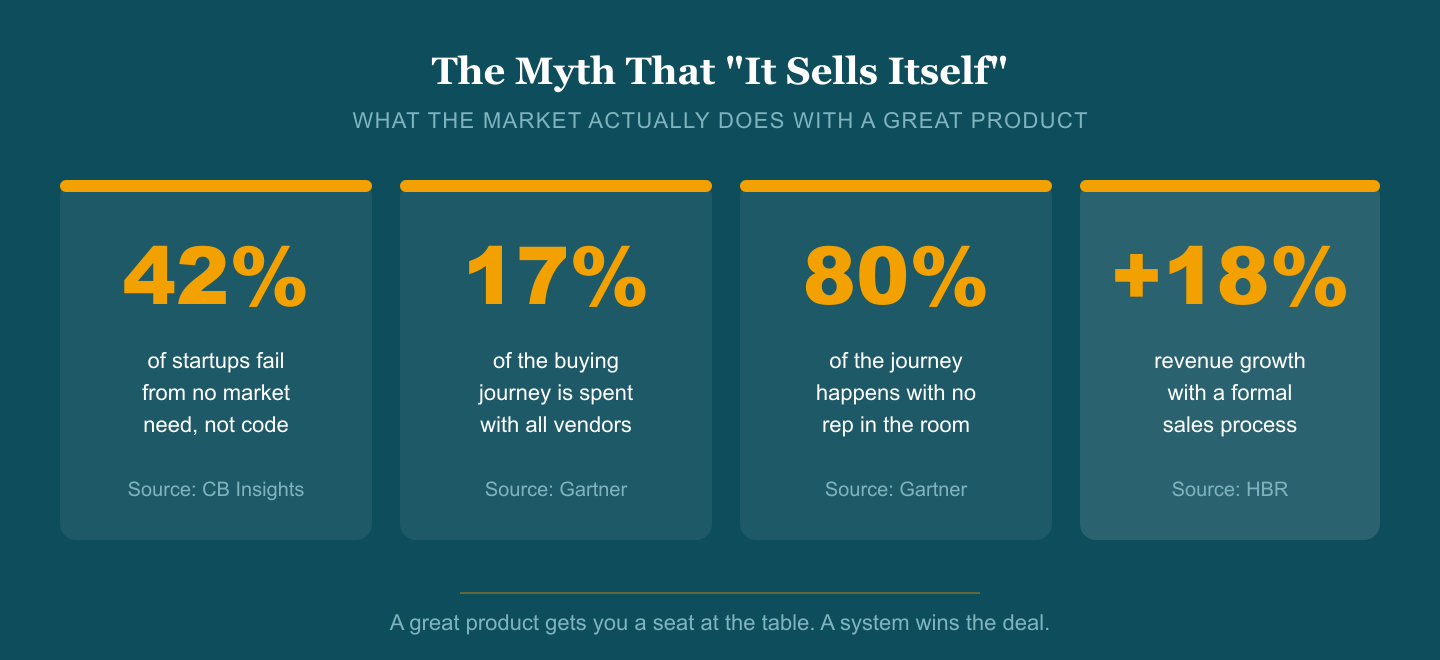
Read those numbers again. If a buyer only spends 5% of their time with you and does 80% of the work alone, then "the product speaks for itself" is a bet that your product will win an argument you're not even present for. That's not a strategy. That's hope. And 77% of buyers say their most recent purchase was complex or difficult, which means they're actively looking for a vendor who makes the decision easier. That's a job for a salesperson, not a feature list.
A great product gets you onto the shortlist. It doesn't get you the signature. The gap between "considered" and "chosen" is exactly where selling lives.
The Bet You're Actually Making
When a founder tells me the product sells itself, what they're really saying is "I don't want to build a sales system." I get it. Building one is harder than believing you don't need one. But let's be honest about the bet on the table.
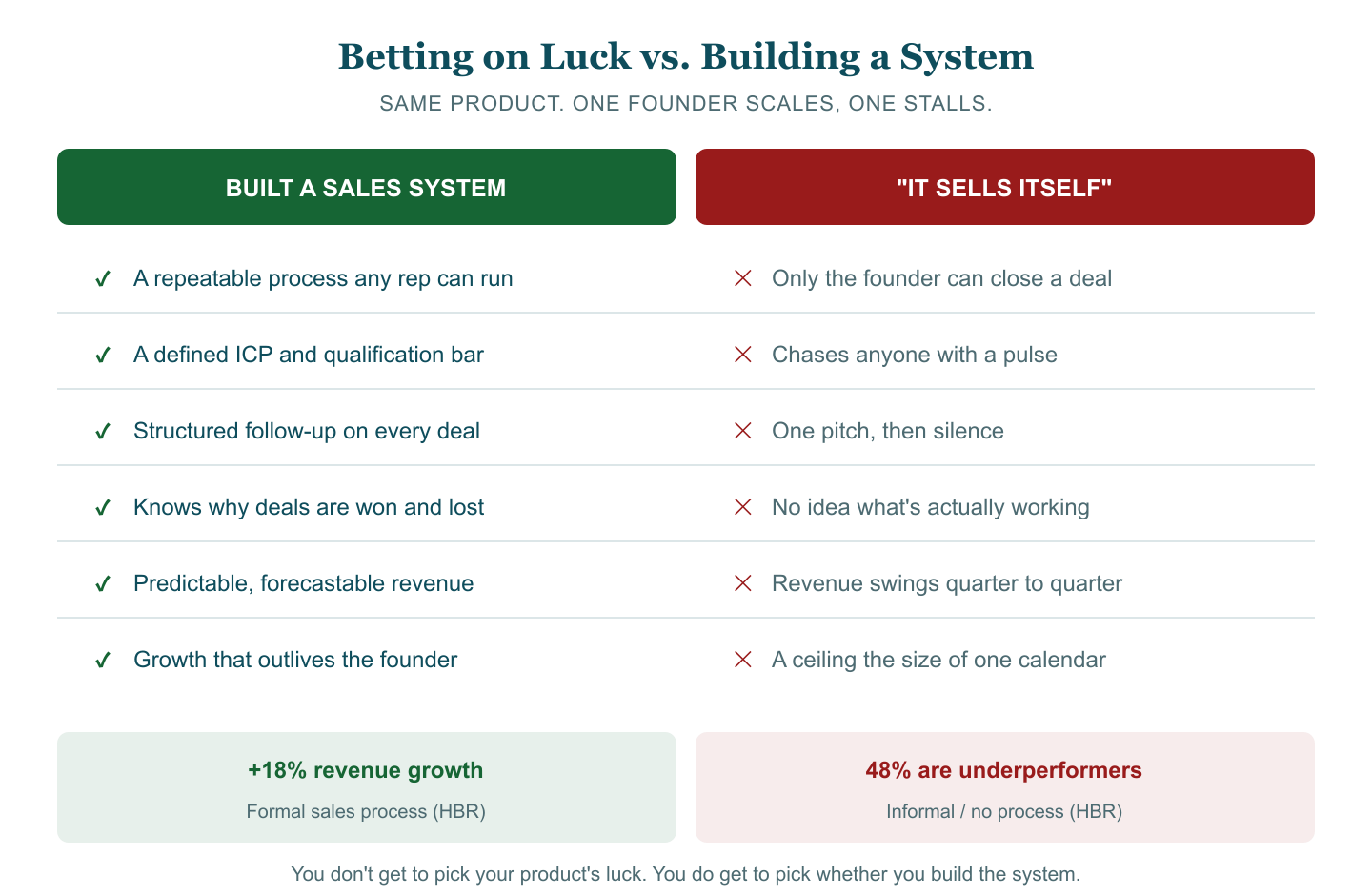
Look at the right column. That's not a strategy, it's a set of things you're hoping don't matter. And the Harvard Business Review data is blunt about how that turns out. 50% of high-performing sales organizations run closely monitored, strictly enforced sales processes. 48% of underperforming organizations have processes that are informal or don't exist at all. The formal-process companies grow revenue about 18% faster. Same market. Same kind of product. Different system.
Founder-led sales hides the truth from you
Here's the trap I see most. Early revenue comes in and you credit the product. "See? It sells itself." But it didn't. You sold it. You just don't see your own selling because it's invisible to you. You answered the hard question on the call. You followed up three times when a rep would've quit after one. You bent the terms to save the deal. The product didn't do any of that. You did.
That's why founder-led sales feels effortless right up until you try to scale it. The day you hand it to your first rep, the "self-selling" product suddenly needs a lot of selling, and nobody wrote down how you did it. This is the moment most founders realize the magic was never the product. It was them, running an undocumented process in their head.
If your product sold itself, you'd be able to leave for a month and revenue would hold. Can you? That's the whole test.
What I Teach Instead: The System That Doesn't Need Luck
If you're not the 1 in 1,000, you win with a system. Not a hero, not a hope, not a heroic founder working eighty-hour weeks. A system. Here's what that actually means, and it's the same handful of fundamentals I install in every company I work with.
1. Define exactly who you're for
A product that "sells itself" to everyone sells itself to no one. The first thing I do is nail down the ideal customer profile: the specific type of company, the specific role, the specific problem where your product is the obvious answer. When you know precisely who you're for, your message gets sharper, your close rate climbs, and your reps stop wasting weeks on prospects who were never going to buy.
2. Write the process down
The selling you do in your head has to become a process on paper. What happens on the first call, how you qualify, what a good discovery looks like, when you send a proposal, how you handle the common objections. A documented process is what turns your personal talent into something a rep can run. It's also the single biggest revenue lever in the HBR data, an 18% growth difference, and it's the one most founders skip because it isn't glamorous.
3. Follow up like the deal depends on it, because it does
80% of sales require five follow-ups. 44% of salespeople give up after one. Sit with that. Nearly half of all sellers quit four touches before the average deal closes. A product that "sells itself" never needs a fifth call. A real business builds follow-up into the process so no deal dies from silence. This one fix alone recovers deals your competitors are leaving on the table every single week.
4. Measure what's actually working
You can't improve what you don't track. Where do deals stall? Which sources convert? Why did you lose the last five? When you measure the pipeline instead of guessing at it, you stop crediting the product for wins and blaming the market for losses, and you start fixing the specific steps that leak. That's how a good quarter becomes a repeatable quarter.
None of this requires a full-time VP of Sales, and at your stage you probably shouldn't hire one yet. This is exactly the work a Fractional Sales Leader does. I build the system, install the process, and get it running with your team, so the growth doesn't depend on you being the 1 in 1,000, or being in every deal.
You're Probably Not the 1. That's Good News.
Here's why I actually mean it when I say this is good news. If your revenue depended on being the 1 in 1,000, you'd be helpless. You either got lucky with your product or you didn't, and there'd be nothing to do about it.
But that's not how it works. The companies that win at your stage aren't the ones with the magic product. They're the ones with the boring, repeatable, well-run sales system. That's learnable. That's buildable. That's within your control, starting this quarter. The 1-in-1,000 founders are counting on luck. You get to count on a system, and a system beats luck over every stretch that matters.
The founders who scale aren't the ones with the self-selling product. They're the ones who stopped waiting for one and built the system instead.
Frequently Asked Questions
Q: Doesn't a truly great product sell itself?
A great product earns you consideration. It rarely closes the deal on its own. Gartner found B2B buyers spend only 17% of their journey with suppliers and complete about 80% of it alone, so even an excellent product spends most of the buying process defending itself in a room you're not in. And 42% of failed startups had "no market need" despite often having solid products (CB Insights). The exceptions exist, but they're roughly 1 in 1,000. Building a company on the assumption that you're that one is the most expensive bet in B2B.
Q: My early sales came from word of mouth. Doesn't that prove it sells itself?
Word of mouth is real, and it's a great start. But it's not a system, and it doesn't scale on its own. Referrals are unpredictable, they come in slowly, and they dry up the moment you need to grow faster than your happiest customers can talk. More importantly, in most early companies the "word of mouth" was quietly powered by the founder selling hard in the background. The test is simple: could you step away for a month and watch revenue hold? If the answer is no, it isn't the product selling itself. It's you.
Q: What does "build a sales system" actually mean?
It means four things working together: a clearly defined ideal customer profile, a written and repeatable sales process, disciplined follow-up on every deal, and real measurement of your pipeline so you know what's working. That's it. It's not a fancy tool or a bigger team. It's turning the selling that lives in your head into a process anyone on your team can run the same way. Companies that do this grow revenue about 18% faster than those that don't (HBR), because the system, not a single person, is doing the winning.
Q: I'm at $1M–$10M ARR. Do I need to hire a VP of Sales to fix this?
Usually not yet, and hiring one too early is a costly mistake. A full-time VP of Sales is expensive, takes months to ramp, and often expects an existing system to optimize rather than one to build from scratch. At your stage you need someone to install the fundamentals and get them running with your current team. That's what a Fractional Sales Leader does, senior sales leadership without the full-time cost or the long-term risk. You get the system built now, and you hire the full-time leader later, once there's a machine worth handing them.
Q: Isn't more marketing the answer instead of more sales?
Marketing gets you onto the shortlist. Sales gets you chosen. They're partners, not substitutes. You can pour money into marketing and still lose every deal at the finish line if there's no process to qualify, follow up, and close. Remember that 80% of sales require five follow-ups and 44% of sellers give up after one. That gap isn't a marketing problem. It's a sales execution problem. Fix the sales system and every marketing dollar you spend converts better, because the leads it generates actually get worked.
Q: How do I know if I'm relying on "it sells itself" without realizing it?
Ask yourself a few honest questions. Is there a written sales process anyone on your team could follow? Can you name your ideal customer profile in one sentence? Does every deal get a structured follow-up sequence, or does it depend on who remembers? Do you know why you won or lost your last five deals? If you're guessing on most of these, you're leaning on "it sells itself" whether you'd say it out loud or not. The good news is every one of those gaps is fixable, and fixing them is exactly the work I do.
Still betting your growth on the 1-in-1,000?
Let's spend 30 minutes on whether your product is really selling itself, or whether you're the one quietly holding it up. I'll show you exactly where a sales system would take the weight off you and make the growth repeatable.
Schedule a 30-Minute CallAbout the Author
Louie Bernstein
Fractional Sales Leader with 50 years of sales experience helping $1M–$10M ARR companies build scalable, repeatable sales systems. Founder of MindIQ (INC 500). LinkedIn Top Voice in Sales Management, Sales Operations, and Sales Coaching.