Key Takeaways:
- Competition is who else your prospect is looking at. Differentiation is what makes you the right choice for them. They are not the same thing, and confusing them is expensive.
- 64% of B2B buyers can't tell one vendor from another (Gartner). When the buyer sees no difference, they default to the only lever left: price.
- 80% of companies believe they're differentiated. Only 8% of their customers agree (Bain). Most founders are sure they stand out. Their buyers can't see it.
- 53% of customer loyalty is driven by how you sell, not by brand, product, or price combined (CEB/Gartner). The sales conversation is your biggest differentiator.
- Never bad-mouth the competition. Make the prospect see what's genuinely different about you, and why that difference helps them and their company.
A prospect says, "We're also looking at a couple of your competitors." Watch what most salespeople do next. They start listing every way they're better than those competitors. Faster. Cheaper. More features. Sometimes they get a little dig in about the other guy.
That's competing. And it's the wrong move.
Competition is who else is in the running. Differentiation is why you're the right answer for this specific prospect. When a salesperson confuses the two, the whole conversation shifts onto the competitor's turf, turns into a feature bake-off, and slides straight toward the one thing you never want it to be about: price.
In fifty years of selling, I've watched this exact mistake cost founders deals they should have won. Let me show you the difference, and how to sell on it without ever saying a bad word about the other guy.
Competition vs. Differentiation: They're Not the Same Thing
These two words get used like they mean the same thing. They don't, and the gap between them is where deals are won or lost.
Competition is a fact. It's not a strategy.
Competition is simply the reality that your prospect has other options. That's it. It's a fact of the market, and knowing who you're up against is useful. But the moment you start selling against your competition, you've handed them control of the conversation. You're now arguing on their terms, comparing your features to theirs, and teaching the prospect to shop you like a spreadsheet. The prospect's brain reduces the whole decision to a grid, and on a grid, the cheapest box usually wins.
Differentiation is about the prospect, not the rival
Differentiation is the answer to a completely different question. Not "how are you better than them?" but "why are you the right choice for me?" That's a question you answer by understanding the prospect's specific situation and showing them what's genuinely different about working with you, and why that difference matters to their business. Notice the competitor never enters the room. Real differentiation doesn't need a villain. It only needs a clear picture of the buyer's problem and an honest account of how you solve it in a way that helps them.
Competition asks, "How do I beat them?" Differentiation asks, "How do I help you?" Only one of those questions makes the prospect want to buy.
Why Confusing the Two Costs You the Sale
Here's the trap. When you compete instead of differentiate, you make yourself comparable. And the data on how buyers see the market should scare every founder who's leaning on "our product is just better."
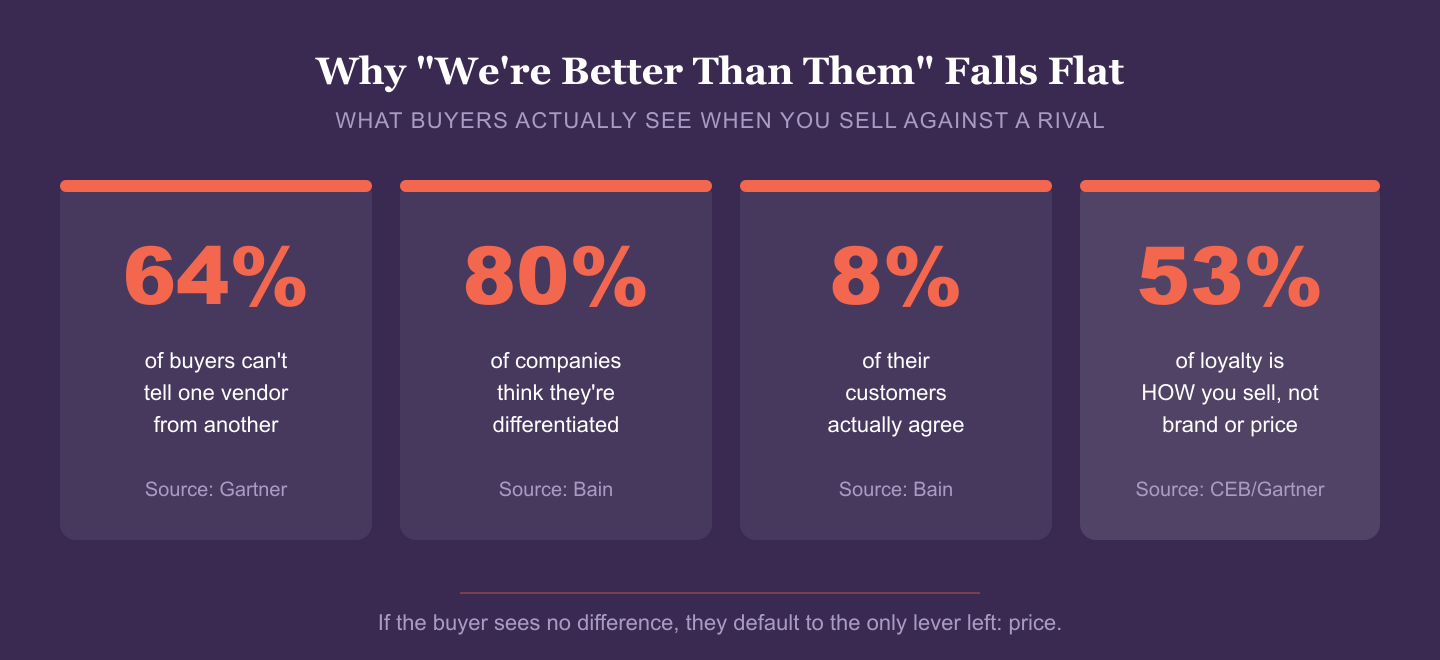
Gartner found that 64% of B2B buyers can't distinguish one vendor's experience from another's. Bain surveyed hundreds of companies and found 80% believed they delivered a superior, differentiated experience, while only 8% of their customers agreed. Sit with that gap. Four out of five founders are certain they stand out. Their customers, almost none of them, can see it. If you're competing on features and claims of "better," you're most likely invisible in exactly the way you think you're not.
And when the buyer can't see a difference, they don't flip a coin. They negotiate. Sameness is what creates a price war. Every discount you've had to give to close a deal was really the bill for a difference the prospect couldn't see. You didn't lose on price. You lost on differentiation, and paid for it at the end.
Price only becomes the deciding factor when the buyer can't find any other difference. If you're constantly getting beaten on price, you don't have a pricing problem. You have a differentiation problem.
Never Bad-Mouth the Competition. Do This Instead.
This is a hard rule for me, and it should be for your team too. You never trash a competitor. Not a jab, not a raised eyebrow, not "well, I've heard things about them." It feels like it helps. It never does.
Why running down a rival backfires
When you bad-mouth a competitor, three bad things happen at once. First, you look insecure, and insecurity doesn't close deals. Second, you insult the prospect's judgment, because they're the one who put that competitor on the list, so you're really telling them they have bad taste. Third, you make the whole conversation about the competitor instead of about the prospect. You've just spent your airtime marketing someone else.
The professional move
When a prospect brings up a competitor, acknowledge it cleanly and redirect to them. Something like: "They're a solid company. A lot of good options out there. What matters more is what you're trying to accomplish. Can I ask what's most important to you in solving this?" You just took the high road, showed confidence, and moved the conversation back to where you win, which is the prospect's problem. You can absolutely draw a contrast. Just draw it around what you do and why it helps them, never around what the other guy does wrong.
How to Differentiate So It Actually Helps the Prospect
Real differentiation isn't a list of features. It's making the prospect feel that you understand their business better than anyone else in the running, and that working with you leads somewhere better for them. Here's how the two approaches play out side by side.
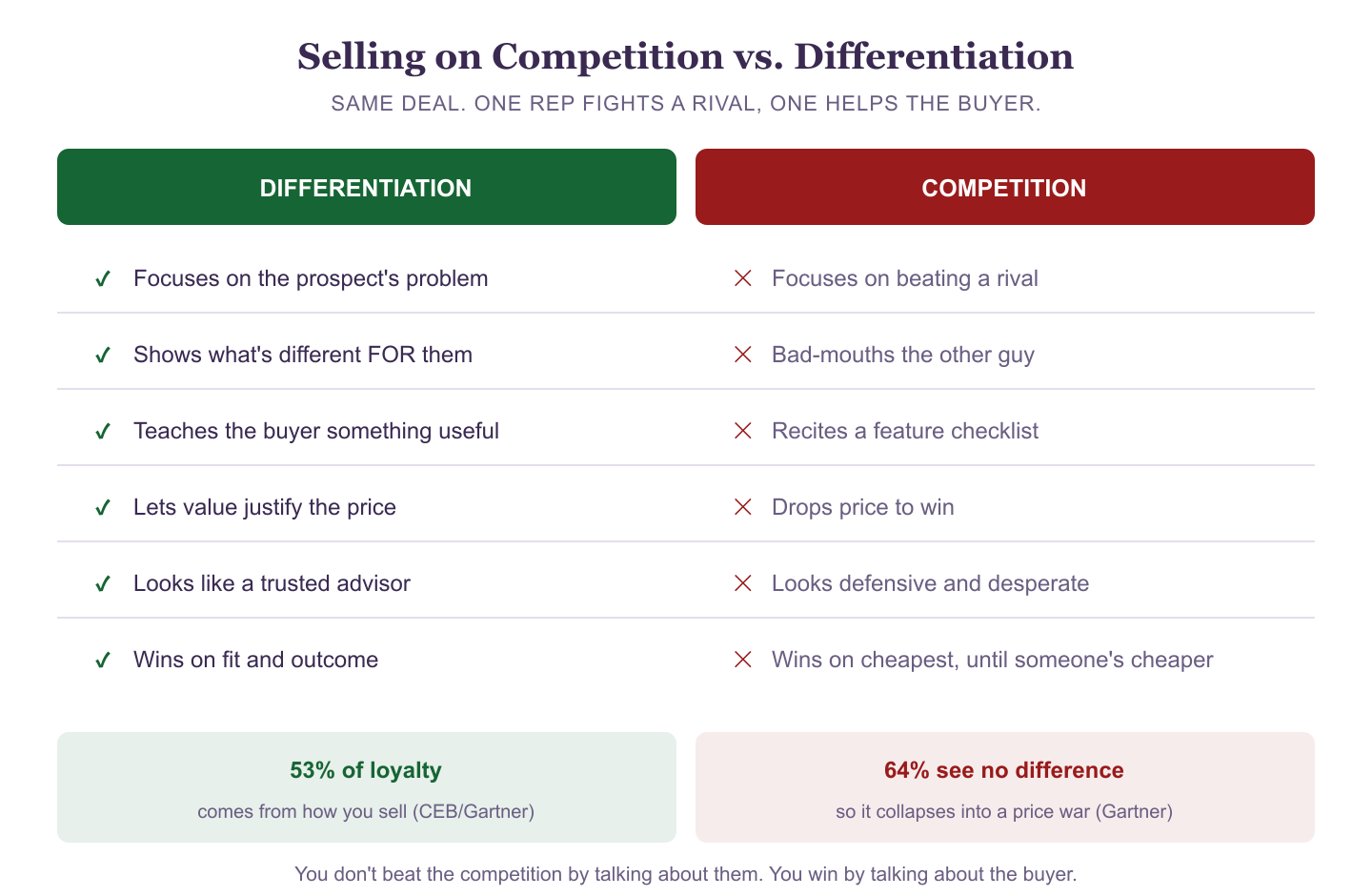
Look at that left column. Every item is about the buyer. And this is where the most important number in selling comes in. The research behind The Challenger Sale, from CEB, now Gartner, found that 53% of customer loyalty is driven by the sales experience itself, more than brand, reputation, product, and price combined. How you sell is more than half the decision. That means your single biggest differentiator isn't buried in your product. It's the conversation you're having with the prospect right now.
So how do you actually do it? Understand their problem more deeply than any competitor bothered to. Teach them something about their own situation they hadn't seen. Connect what makes you different directly to an outcome they care about, revenue, time, risk, growth. When you run a discovery process that good, you're not one of four vendors on a grid anymore. You're the one who gets them. That's differentiation the prospect can feel, and it's the same discipline I install when I run a structured discovery process with a founder's team.
Your product might be similar to three others on the list. The way you sell it never has to be. That's the difference the buyer remembers.
The Real Differentiator Is Usually How You Sell
Here's what I want every founder between $1M and $10M in ARR to take from this. You've probably been trying to differentiate on the product. Better features, more capabilities, a slicker demo. And it's not working the way you hoped, because your buyers, like most buyers, can't tell the products apart.
The differentiation that actually moves deals lives in the selling. In how well you understand the buyer, how you frame the problem, how you guide them to a decision that's right for them. That's not a product feature you have to build. It's a sales skill you can install, and it's exactly the kind of system a Fractional Sales Leader puts into a company. I teach your team to stop competing on the grid and start differentiating on the conversation, so you stop discounting to win and start winning because the buyer sees why you're the right choice.
Frequently Asked Questions
Q: What's the actual difference between competition and differentiation?
Competition is the fact that your prospect has other options to consider. Differentiation is the reason you're the right choice for that specific prospect. Competition points your attention at the rival. Differentiation points it at the buyer. The distinction matters because the moment you start selling against a competitor, you make yourself comparable, the decision turns into a feature grid, and price becomes the tiebreaker. When you differentiate around the prospect's problem instead, the competitor stops being the reference point and you compete on fit and value, not on who's cheapest.
Q: Why shouldn't I point out a competitor's weaknesses?
Because it costs you more than it gains. Bad-mouthing a competitor makes you look insecure, it insults the prospect who put that competitor on their list, and it spends your airtime talking about someone else instead of the buyer. You can still draw a contrast. Just build it around what you do and why it helps the prospect, not around what the other company does wrong. Confidence differentiates. Running down a rival signals the opposite, and buyers read it instantly.
Q: We keep losing deals on price. Is that really a differentiation problem?
Almost always, yes. Price only becomes the deciding factor when the buyer can't see any other meaningful difference. Gartner found 64% of B2B buyers can't distinguish one vendor from another, and when everything looks the same, negotiating price is the only rational move left to them. So if you're constantly getting squeezed on price, the real issue usually isn't your number. It's that the value and the difference weren't made clear enough in the sales conversation. Fix the differentiation and the price pressure eases on its own.
Q: How do I differentiate when my product genuinely is similar to competitors?
You differentiate on how you sell, not just on what you sell. The research behind The Challenger Sale found that 53% of customer loyalty comes from the sales experience itself, more than brand, product, and price combined. That means even in a crowded category, you can stand out by understanding the buyer's problem more deeply, teaching them something useful about their own situation, and guiding them to the right decision. Products in a category converge. The quality of the conversation almost never does. That's where similar companies win or lose.
Q: How do I know what my real differentiator is?
Start by asking your best customers why they actually chose you and why they stay. Their answers are usually different from what you'd guess, and they rarely match the feature list on your website. Bain found 80% of companies think they're differentiated while only 8% of their customers agree, so your own assumptions are the least reliable source. Listen for the outcome you deliver and the experience of buying from you, then build your sales conversations around that. Your differentiator is whatever your customers can feel, not whatever you can claim.
Q: Isn't this something my marketing should handle, not sales?
Marketing sets up the differentiation. Sales is where it either lands or falls apart. Your website can say all the right things, but if your reps walk into the deal and start competing on features and discounting to win, the differentiation never reaches the buyer. Since more than half of loyalty is driven by the sales experience, the person in the conversation carries most of the weight. That's exactly why installing this discipline into your sales team, not just your marketing copy, is what actually moves the numbers.
Losing deals you should be winning?
If your team is competing on features and discounting to close, the difference isn't reaching your buyers. Let's spend 30 minutes finding where your differentiation is getting lost in the sales conversation, and how to fix it so you stop winning on price.
Schedule a 30-Minute CallAbout the Author
Louie Bernstein
Fractional Sales Leader with 50 years of sales experience helping $1M–$10M ARR companies build scalable, repeatable sales systems. Founder of MindIQ (INC 500). LinkedIn Top Voice in Sales Management, Sales Operations, and Sales Coaching.