Key Takeaways:
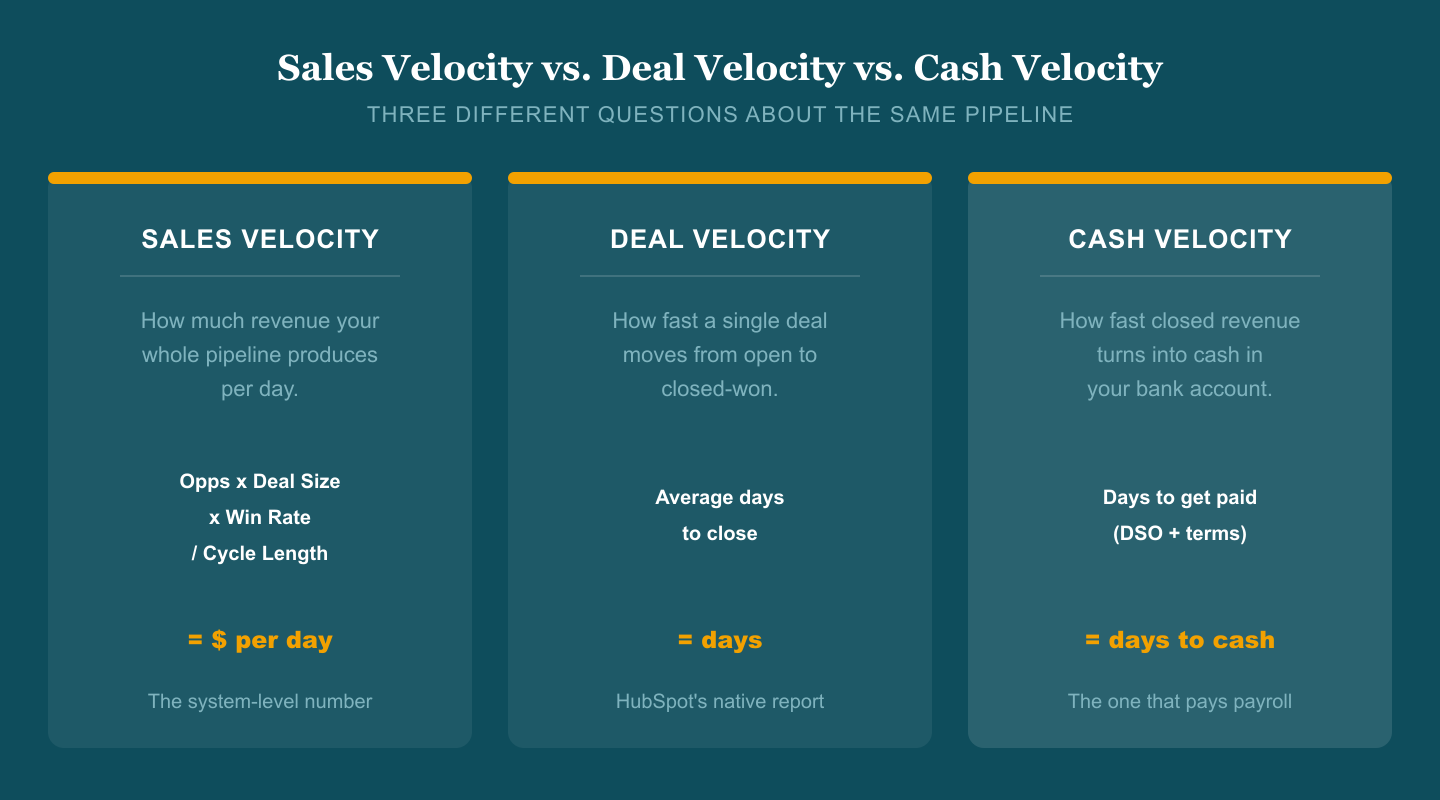
- Sales velocity is a system number. It tells you how much revenue your entire pipeline produces per day, using four levers: opportunities, deal size, win rate, and cycle length.
- Deal velocity is a single-deal number. In HubSpot's native report it means one thing: the average number of days it takes a deal to close.
- The two are often used interchangeably. They shouldn't be. One measures the machine. The other measures a part moving through it.
- Cash velocity is the one nobody talks about and the one that pays your payroll. A deal can close fast and still leave you waiting two months for the money.
- If you're a founder between $1M and $10M in revenue, you can't manage what you've never separated. Track all three, or you'll keep guessing why a "good month" didn't feel like one.
Most founders I talk to use "sales velocity" and "deal velocity" like they're the same word. They're not. And the confusion isn't harmless. It's the reason you can look at a dashboard, see green arrows everywhere, and still wonder why your bank balance is tighter than it was last quarter.
I've spent fifty years in sales. I've watched founders celebrate a record bookings month and then quietly take out a line of credit to cover payroll three weeks later. That gap between "we sold a lot" and "we have money" is the whole reason this article exists.
So let's pull the three terms apart. Sales velocity. Deal velocity. And the one almost nobody puts on a dashboard, cash velocity. Once you can see them as three separate numbers, you can finally fix the right one.
Start With the One Formula That Holds the Answer
Sales velocity is the parent metric, so start there. It answers a single question: how much revenue does my pipeline generate per day? The formula is simple and it has exactly four moving parts.
Sales Velocity = (Number of Opportunities × Average Deal Size × Win Rate) ÷ Sales Cycle Length
Run a real example. Say you've got 40 active opportunities, your average deal is $25,000, you win 30% of them, and your average cycle is 60 days. That's (40 × $25,000 × 0.30) ÷ 60, which comes out to $5,000 a day, or roughly $150,000 a month. The output isn't a count and it isn't a percentage. It's dollars per day. That's the number you're actually managing, whether you've ever calculated it or not.
Here's why that framing matters. Three of those four levers move slowly. You don't change your win rate or your deal size in a week. But cycle length, the denominator, is the one you can influence almost immediately by clearing out the stages where deals stall. I wrote more about that in how pipeline stages drive pipeline velocity, and it's the fastest lever most founders have.
Sales Velocity vs. Deal Velocity: The Distinction That Actually Matters
Here's where the words get slippery, and where even the tools disagree with each other.
What HubSpot actually means by each
If you run HubSpot, this matters in a concrete way. HubSpot's "Sales Velocity" report approximates that four-factor formula above, opportunities times deal size times win rate over cycle length, and gives you revenue per day. But HubSpot's native "Deal Velocity" report measures only one thing: the average number of days it takes a deal to close. One variable. Days to close.
So when someone says "our deal velocity is 47 days," they mean a single deal takes 47 days to go from open to closed-won. When someone says "our sales velocity is $5,000 a day," they mean the whole engine produces that much revenue daily. Same root word. Completely different altitude.
Sales velocity measures the machine. Deal velocity measures one part moving through it. If you confuse the two, you'll tune the wrong thing.
Why deal velocity is getting worse, not better
This isn't an abstract concern. Deals are taking longer to close than they used to. According to industry benchmarks, B2B SaaS sales cycles now average around 84 days, and they've lengthened roughly 22% since 2022 as buying committees grow and budgets get more scrutiny. Deals over $100K routinely run six to nine months. When your deal velocity slows, your sales velocity, the dollars-per-day number, drops right along with it even if nothing else changed.
Win rate is the quiet killer
And it's not just cycle length. Win rates are sliding too. HubSpot's State of Sales data puts the average B2B win rate around 21%, and the 2025 Ebsta and Pavilion benchmark report showed win rates falling to 19%, down from 29% the year before. Top performers still hit 35% or higher. The point for a founder is this: a collapsing win rate can be completely hidden by a growing pipeline. More opportunities make the top of your funnel look healthy while the math underneath quietly gets worse. Sales velocity catches that. A pipeline count never will.
Why Founder-Led Sales Hides All of This
When you're the one closing every deal, you don't feel like you need these numbers. You can feel the pipeline. You know which deals are warm because you're on every call. That instinct got you to $1M, maybe past it.
But instinct doesn't scale, and it doesn't transfer. The day you bring on a rep, your "feel" stops being the company's operating system. Now you need a number a second person can read the same way you do. That's exactly when founders discover they've never actually measured win rate, never tracked cycle length by stage, and have no idea what their sales velocity is. They were running the whole thing on a gut that lived in one head.
Separating sales velocity from deal velocity is the first real step out of founder-led selling. Deal velocity tells your rep where a specific deal is stuck. Sales velocity tells you whether the system as a whole is speeding up or slowing down. You need both before you can hand the wheel to anyone.
You can't delegate a feeling. The moment you hire your first salesperson, your gut has to become a number, or the wheels come off.
And How Does Cash Velocity Come Into Play?
Here's the metric that gets left off every dashboard, and it's the one that decides whether your business actually feels healthy. Cash velocity is how fast a closed deal turns into money in your bank account.
Sales velocity and deal velocity both stop counting at "closed-won." Cash velocity picks up where they leave off. Because a signed contract isn't cash. It's a promise to send cash, eventually, on terms you may or may not have negotiated well. And for a founder funding growth out of operations, that gap is everything.
The data on how long you really wait
The numbers here are brutal, and most founders have never looked at them. The median days sales outstanding across industries sits around 56 days, meaning the typical company waits nearly two months after closing to collect. It gets worse: roughly 44% of B2B invoices are paid late, and by some measures more than half of all U.S. B2B invoiced sales are overdue. Around 56% of small businesses report being owed money on unpaid invoices, averaging about $17,500 outstanding at any given time. Late payments cost the average company close to $39,000 a year just in carrying the gap.
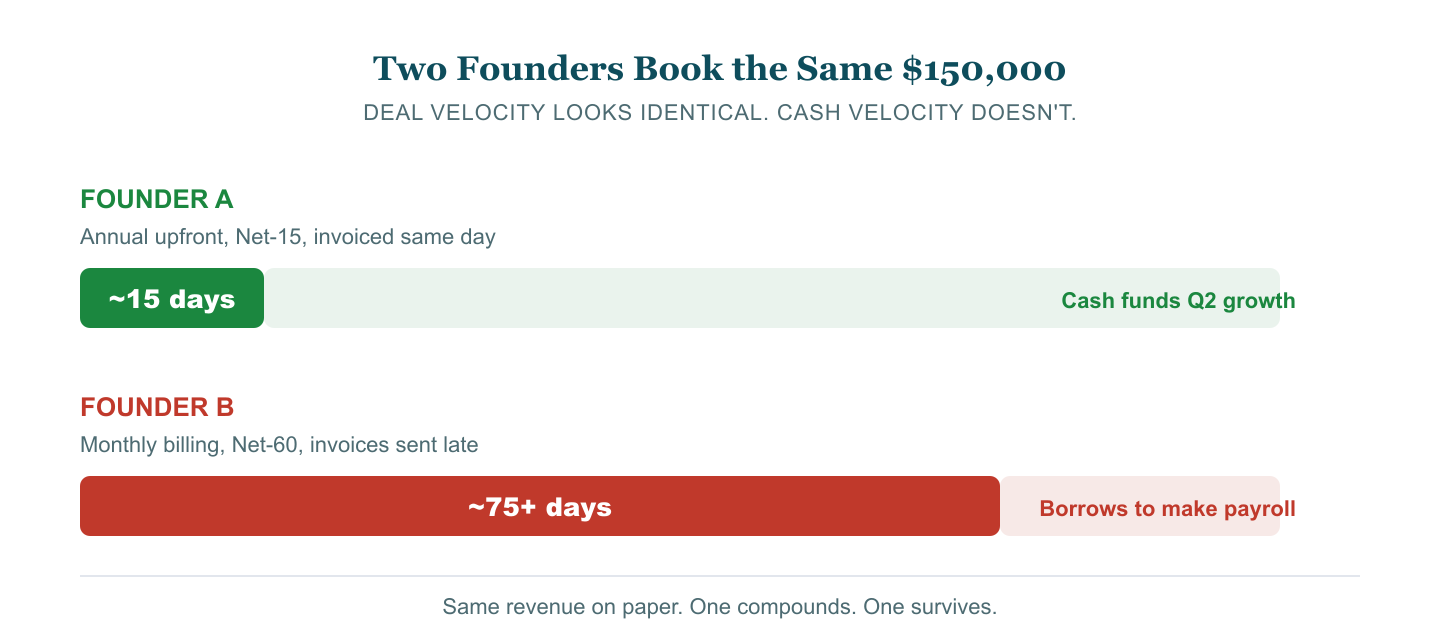
Now connect that to the two founders in the graphic. Both booked $150,000. Identical sales velocity. Identical deal velocity. But Founder A invoices annually, upfront, on Net-15 and sends the invoice the same day. Founder B bills monthly on Net-60 and lets invoices sit for two weeks before sending them. Same revenue on paper. One has the cash to fund next quarter. The other is borrowing to make this month's payroll.
A deal that closes fast but pays slow will starve you while your dashboard says you're winning.
Cash velocity is a sales decision, not just a finance one
Most founders treat collections as an accounting problem. It isn't. It starts in the sale. Payment terms, billing cadence, upfront versus monthly, deposits, these are all negotiated, or given away, on the sales call. The terms your rep agrees to in order to "make the deal easy" are the same terms that decide whether you wait 15 days or 75 for the money. One simple fix the data backs up: sending the invoice within 24 hours of delivery cuts DSO by five to eight days on its own. That's a sales-process change, not a finance one.
How a Fractional Sales Leader Moves All Three
This is the work I do. Not a dashboard you'll glance at once and forget, but a sales system where all three numbers are visible, owned, and improving. Most founders between $1M and $10M aren't ready for a full-time VP of Sales, and they shouldn't be paying $250K-plus for one. But they absolutely need someone who can separate these metrics and act on them.
On sales velocity, I find the constrained lever, usually win rate or a stalled stage, and we attack that one instead of just cramming more leads in the top. On deal velocity, we map cycle time stage by stage so your reps know exactly where deals die and how to move them. On cash velocity, we build the payment terms and invoicing discipline into the sales process itself, so the money shows up faster without anyone chasing it. You can see the foundation of that approach in my deeper breakdown of sales velocity for B2B.
That's the difference between a founder guessing and a founder running a system. And it's the difference between a record bookings month that feels like a win and one that quietly forces you back to the bank.
What is deal velocity?
Deal velocity is the speed at which a single opportunity moves through your pipeline from creation to close, measured in days. A lower number means deals are closing faster; a rising number means a specific stage is stalling.
- Formula: deal velocity = total days in pipeline ÷ deals closed. Track it stage by stage to see exactly where deals get stuck.
- Not the same as sales velocity, which measures revenue speed (opportunities × win rate × average deal size ÷ cycle length). Deal velocity is per-deal; sales velocity is per-dollar.
- It is your earliest warning that a repeatable process is breaking — for a $1M–$10M founder, one slow stage drags the entire forecast.
Frequently Asked Questions
Q: Are sales velocity and deal velocity the same thing?
No, though they're constantly used interchangeably. Sales velocity is a four-factor formula, opportunities times deal size times win rate divided by cycle length, and it outputs revenue per day for your whole pipeline. Deal velocity, especially in HubSpot's native report, measures a single variable: the average number of days it takes one deal to close. Sales velocity measures the system. Deal velocity measures a deal moving through it.
Q: How does HubSpot define deal velocity?
HubSpot's native "Deal Velocity" report measures the average time it takes a deal to close, plain days to close, nothing more. That trips people up, because elsewhere the industry uses "deal velocity" to mean the same four-factor revenue-per-day formula as sales velocity. If you're working inside HubSpot, treat its Deal Velocity report as a speed metric and its Sales Velocity report as the dollars-per-day metric.
Q: What is cash velocity and why isn't it on my dashboard?
Cash velocity is how fast a closed deal becomes money in your bank account. It's missing from most dashboards because sales tools stop counting at "closed-won" and accounting tools start counting at the invoice, so nobody owns the gap between them. With the median company waiting about 56 days to collect and 44% of B2B invoices paid late, that gap is exactly where founders get blindsided. A strong month on paper can still leave you short on cash.
Q: Which velocity should I fix first?
Usually cycle length, because it's the fastest lever to move. Win rate and deal size change slowly, but you can tighten the stages where deals stall almost immediately. That speeds up deal velocity and lifts sales velocity at the same time. Then look hard at cash velocity, since improving your payment terms and invoicing speed can put money in the bank without selling a single additional deal.
Q: How often should I calculate sales velocity?
Monthly at a minimum, and weekly when you're running a growth push or testing a change. Sales velocity is a leading indicator, so it surfaces problems 30 to 90 days before they hit your actual revenue. Checking it once a quarter defeats the purpose. You want to catch a sliding win rate or a lengthening cycle while you can still do something about it.
Q: I'm a founder still closing most deals. Is this overkill for me?
It's the opposite of overkill. It's the groundwork for getting out of founder-led sales. While you're closing everything yourself, these numbers live in your head as instinct. The moment you hire a rep, that instinct has to become a number a second person can read. Building sales, deal, and cash velocity now means you're handing your team a system instead of a guess. That's the whole point of bringing in a Fractional Sales Leader before you need a full-time VP.
You've got bookings. Do you have cash?
If you can't tell me your sales velocity, your deal velocity, and how long it takes a closed deal to become cash, you're flying blind on the three numbers that decide whether growth feels like winning. Let's spend 30 minutes pulling them apart and finding the one that's costing you the most.
Schedule a 30-Minute CallAbout the Author
Louie Bernstein
Fractional Sales Leader with 50 years of sales experience helping $1M–$10M ARR companies build scalable, repeatable sales systems. Founder of MindIQ (INC 500). LinkedIn Top Voice in Sales Management, Sales Operations, and Sales Coaching.