Key Takeaways:
- Quota is not a number you assign. It is the output of a model that starts with the revenue you need and ends with the headcount you have to hire.
- A reasonable, attainable AE quota is derivative of your deal size: roughly $400k a year on small deals, $600k–$700k on mid-size, $1m+ on big ones.
- Apply a yield factor. Not every rep works out, and none of them ramp on day one. Plan on 75% of full quota, not 100%.
- Add the load: managers, SDRs, and ops. One manager per eight reps is the industry benchmark, and those people don't carry quota.
- $10m in net-new revenue, even at a healthy $600k quota, takes about 30 sales professionals. Most founders budget for half that and wonder why they miss.
Founders ask me this question all the time, and they almost always ask it backwards.
"What quota should I give my AE?" As if quota is a knob you turn. Set it high and you'll get more revenue. Set it low and the rep coasts. Pick the right number and you win.
That's not how it works. Quota isn't the input. It's step two of a five-step model, and if you don't run the whole model, you'll either starve your growth or blow up your budget. I've watched both happen to good companies.
Here's the approach I use when I sit down with a founder at $1M–$10M ARR and we figure out what their sales org actually needs to look like next year.
Start With the Revenue You Need, Not the Quota
The first number isn't quota. It's the net-new revenue you have to close in the next twelve months. And here's the part founders skip: it's more than you're closing now.
You're not building a team to hold the line. You're building it to grow. So the target is next year's number minus what your existing base renews on its own. If you want to add $10m in net-new, that $10m is the foundation of everything that follows. Every other number in the model gets derived from it.
Get this number wrong and the whole model is wrong. I'd rather a founder spend an hour being honest about the real growth target than spend a quarter hiring against a target they invented to feel good.
Set a Quota Your Deal Size Can Actually Support
Now, and only now, you calculate a reasonable, attainable quota for your closers. This is generally derivative of your deal size. The bigger your average deal, the more one rep can carry. The smaller your deal, the more deals they have to grind out to hit the same number, and there's a ceiling on how many calls a human can run.
Small deals
If you sell small, your reps may struggle to close $400k a year. Industry data backs this up. A rep working $3k–$10k deals typically lands around $400k–$450k in annual quota, because the deal count required to go higher just isn't humanly sustainable.
Mid-size deals
Middle of the market, think $20k–$40k deals, and a rep can reasonably carry $600k–$700k, sometimes up to $800k. This is where most of my founders live, and a $600k quota is the number I anchor to when I build a model for a company at this stage.
Big deals
Bigger deals, six figures and up, and a field rep can carry $1m, $1.5m, sometimes more. Fewer deals, longer cycles, but each one moves the number meaningfully.
There's a sanity check I run on every quota number: the quota-to-OTE ratio. Across B2B, a healthy ratio sits between 4x and 5x. A mid-market AE on $120k OTE carrying a $600k quota is right in the sweet spot at 5x. If your quota implies a ratio below 3x, you're overpaying for the revenue. Above 6x or 7x and you've set a number nobody will hit, which is its own kind of expensive.
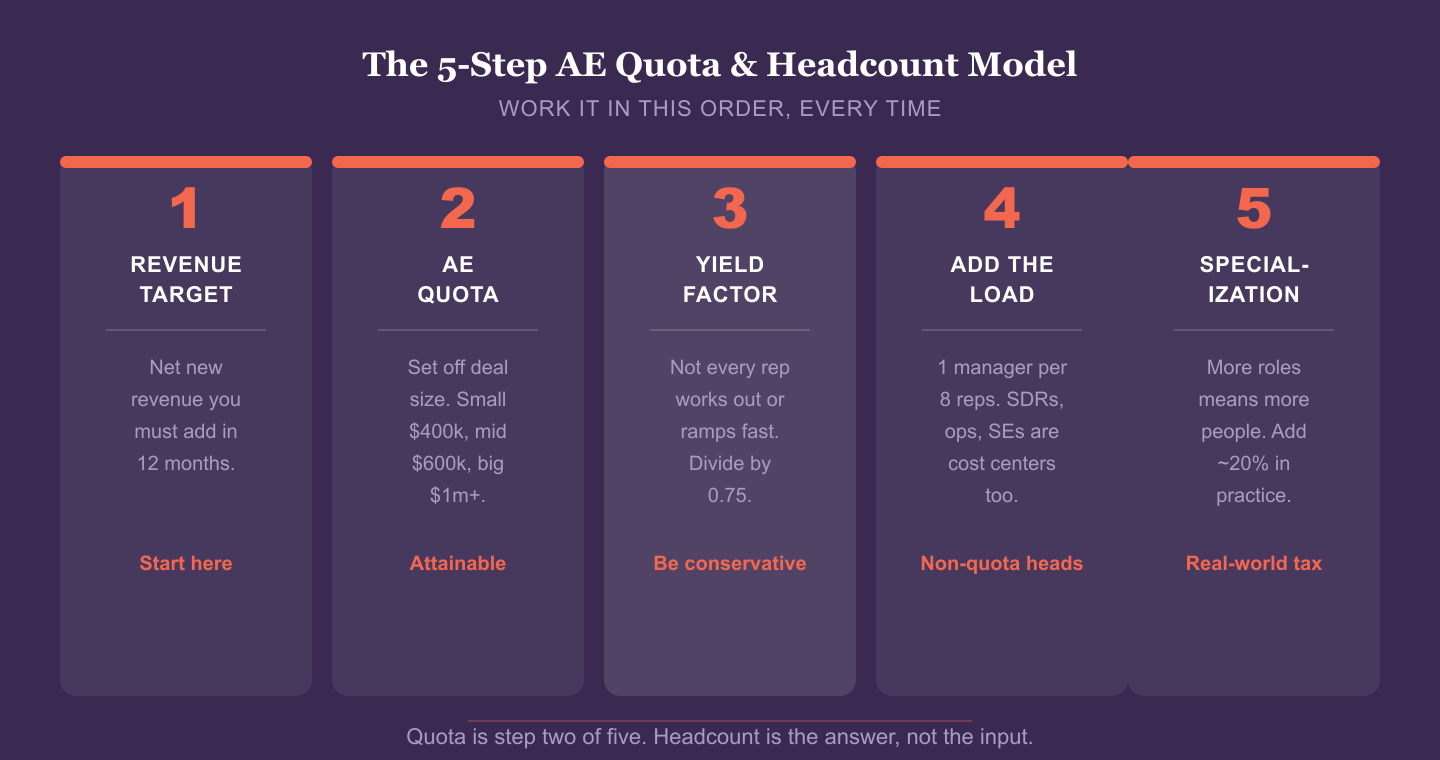
Quota is step two of five. If you stop here, you've priced one seat. You haven't sized a team.
Apply a Yield Factor for the Reps Who Won't Make It
Here's where the model gets honest. Not every rep works out. And the ones who do still take time to scale. So you can't plan as if every seat produces full quota. You have to discount it.
To stay conservative, I assume a 75% yielded quota. Multiply your raw headcount by that factor, or divide your target by it, and you get a number that survives contact with reality.
Is 75% pessimistic? It isn't. CaptivateIQ's 2025 benchmarks put the industry average at roughly 74% of quota attained. So even my "conservative" number is just the actual average. And it gets worse at the seat level: in software, only about 41% of reps reach full quota in a given period, and across the average sales org, roughly half the team is short of their number in any given quarter. Plan for 100% and you're planning for a team that statistically doesn't exist.
Then there's ramp. A new AE doesn't close on contact. The Bridge Group's SaaS benchmark puts average ramp at about 5.3 months, with a median of six, and deals above $50k ACV stretching past nine. A rep you hire in Q1 is barely contributing until Q3. The yield factor absorbs all of that: the misses, the attrition, the ramp. It's the difference between a model that looks good on a slide and one that holds up in December.
Add the Load: Managers, SDRs, and the Cost Centers
Your closers don't operate in a vacuum. Around them sits the load: the VPs, the directors, the sales ops leaders, the sales engineers, the SDRs feeding the top of the funnel. These people are essential, and for the purposes of this model, they're cost centers. They don't carry a closing quota, but you still have to pay them and count them.
Two ratios I use to size the load. Assume one sales manager for every eight sales professionals. That isn't a number I made up. SBI and most span-of-control research land on 8:1 as best practice for a direct sales force, tightening to 6:1 in enterprise and loosening to 10:1 or 12:1 in high-velocity SMB. And assume one head of sales development for every ten SDRs.
Span of control isn't just an org-chart nicety, either. The research is clear that when you stretch managers too thin, coaching drops and ramp slows. Tightening span from twelve reps to nine measurably lifts the percentage of reps hitting 100%. So the load isn't overhead you tolerate. It's the infrastructure that makes the quota attainable in the first place.
The Specialization Tax
The more specialized your sales process, the more bodies you need. SDRs to prospect, BDRs to qualify, AEs to close, SEs to handle the technical win, CSMs to retain. In theory, specialization raises quotas enough to pay for itself, because each role does one thing well. In practice, it rarely nets out clean. It usually adds about 20% to the model.
For a founder at $1M–$10M ARR, the lesson is restraint. Don't specialize before your deal economics can fund it. A common, expensive failure I see is a founder copying the org chart of a company three stages ahead, layering in roles the revenue can't support yet, and watching efficiency crater. Build the specialization the deal size earns, not the one the blog post recommends.
Run the Whole Model: Why $10M Needs 30 People
Let's put it together with real numbers. Say you want to add $10m in net-new revenue next year. Your deals are about $25k in ACV. And we've agreed a $600k quota is reasonable and attainable for that deal size.
Watch what the model produces.
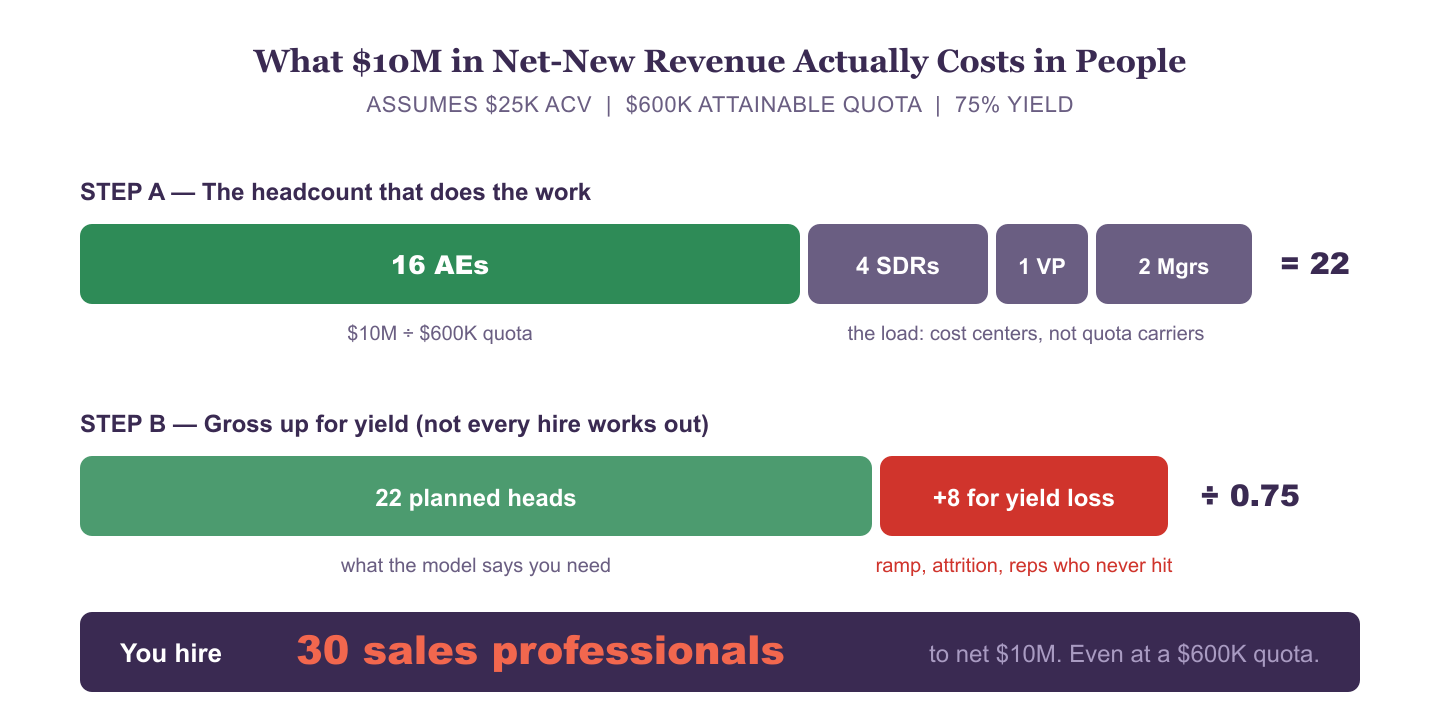
Sixteen fully scaled AEs just to do the closing work ($10m divided by $600k). Four SDRs to screen and feed them. One VP to run the function. Two managers to keep the span of control sane. That's 22 heads on paper. Now divide by your 0.75 yield factor, because a meaningful share of those seats won't produce full quota, and you land at 30.
Thirty sales professionals to add a net $10m in new revenue. Even with a healthy $600k quota. That's the number the "what quota should I give my AE?" question never sees coming.
Most founders, when they imagine adding $10m, picture maybe a dozen reps. The model says 30 sales professionals once you account for the load and the yield. That gap, between what founders imagine and what the math requires, is the single most common reason a growth plan misses. Not effort. Not talent. Arithmetic.
Why Sales Efficiency Drops as You Scale
There's one more thing this model exposes, and it's the part nobody warns founders about. Sales efficiency drops over time, even if you do everything right.
In the early days, you don't need much management. Your effective yield is higher because you hand-picked your first reps. Your magic number looks great. Then you scale. You add the management layer. You add SDRs and ops. Your yield regresses toward the mean as you hire past your personal network. Just the act of scaling, the load and the yield drag alone, will knock your sales efficiency down 30% or more even if everything else stays constant.
This isn't a theory. The B2B SaaS magic number has declined by roughly 57%, and a big driver is that go-to-market teams now cost nearly twice as much to support the same selling capacity, because spend has shifted toward all those non-closing roles. The early performers regressing toward the mean as the team grows is a documented statistical effect, not a hiring mistake.
So when your CFO asks why the new reps don't look as productive as the first two, this is the answer. It's not that the team got worse. It's that scaling itself carries a tax, and a real model prices it in from the start. This is exactly the kind of math I build with founders before they make the hires, not after they've missed the number. If you want help running it on your actual revenue target, that's a thirty-minute conversation, and it's the cheapest insurance you'll buy all year.
Frequently Asked Questions
Q: What is a reasonable quota for an account executive?
It depends almost entirely on your average deal size. On small deals of $3k–$10k, expect a rep to carry around $400k–$450k a year. On mid-size deals of $20k–$40k, $600k–$700k is reasonable. On six-figure deals, $1m or more. A good cross-check is the quota-to-OTE ratio: most healthy B2B teams set quota at 4x to 5x the rep's on-target earnings. If your number falls outside that band, revisit it.
Q: What is a yield factor and why do I divide by it?
The yield factor accounts for the reality that not every rep hits quota and new hires take months to ramp. I plan on 75% yielded quota, meaning I assume the team produces 75% of its theoretical full capacity. You divide your headcount target by 0.75 to find how many people you actually need to hire. It's grounded in data: industry quota attainment averages around 74%, and average SaaS ramp time runs over five months, so a seat rarely produces a full year of full quota.
Q: How many sales managers do I need?
The benchmark is one manager for every eight sales professionals, tightening toward 6:1 in complex enterprise selling and loosening toward 10:1 or 12:1 in high-velocity SMB. Don't stretch it to save money. When managers carry too many reps, coaching suffers and ramp slows, which quietly costs you more in missed quota than the manager's salary would have. For sales development, plan on one head of sales development for every ten SDRs.
Q: Why does $10m in new revenue take 30 people if my quota is $600k?
Because closers are only part of the cost. $10m divided by a $600k quota is about 16 AEs. Add four SDRs to feed them, one VP, and two managers, and you're at 22 heads. Then divide by your 0.75 yield factor to account for ramp and reps who fall short, and you land at 30. The quota number alone only tells you about the closers. The full model tells you about the team.
Q: Should I just set a higher quota to need fewer people?
No, and it's a tempting trap. A quota your deal size can't support doesn't shrink your headcount. It just guarantees nobody hits the number, which tanks morale, drives attrition, and makes your yield factor worse, not better. The result is you need more people, not fewer. Set the quota the deal economics can actually carry, then size the team around it. Inflating the number on a spreadsheet doesn't change what a human can close in a year.
Q: I'm not ready to hire a full-time VP of Sales to build this. What do I do?
This is exactly the gap a Fractional Sales Leader fills. You get someone who has built these models dozens of times to size your team, set attainable quotas, and stand up the management and process, without the $250k-plus full-time commitment before your revenue can support it. For a founder at $1M–$10M ARR, that's the capital-efficient way to scale out of founder-led sales and get the math right before you spend on the headcount.
Before you set a single quota, run the model.
Tell me your revenue target and your average deal size, and in 30 minutes I'll show you the quota, the yield, the load, and the real headcount your growth plan requires, on your actual numbers. It's the cheapest insurance you'll buy all year.
Schedule a 30-Minute CallAbout the Author
Louie Bernstein
Fractional Sales Leader with 50 years of sales experience helping $1M–$10M ARR companies build scalable, repeatable sales systems. Founder of MindIQ (INC 500). LinkedIn Top Voice in Sales Management, Sales Operations, and Sales Coaching.