Key Takeaways:
- A demo is not a presentation. It's a conversation about their problem, using your product as the proof. Nobody buys a PowerPoint deck. They buy help.
- Gong studied 67,149 sales demos. Feature-dumping sinks win rates. The winners were "value-heavy," not "feature-heavy."
- Earn the right to demo. If you haven't run real discovery, you don't know what to show, and you'll show everything. That's the fastest way to lose.
- Open by asking each person on the call what matters most to them. Then show that first. Their agenda beats your script.
- Every demo ends the same way: "What's the next step?" and then, "Then what happens?" No next step, no real opportunity.
- The demo isn't where you talk the most. It's where you prove you were listening the whole time.
They buy help.
That's the whole thing. After fifty years in sales and thousands of demos, I can tell you that no prospect has ever signed because your slide transitions were clean or your feature list was long. They buy because, somewhere in that half hour, they thought to themselves: this person understands my problem, and this product looks like it fixes it.
Here's the data that should stop every founder cold. Gong's team analyzed 67,149 recorded sales demos and found that feature-dumping, showing off everything your product can do, actively lowers win rates. The reps who won moved from being "feature-heavy" to "value-heavy." They talked less about the software and more about the outcome.
If you're a founder between $1M and $10M ARR, you've probably been running demos on instinct. You built the product, so you know every corner of it, and that's exactly the trap. You want to show all of it. But your prospect didn't ask to see all of it. They asked for help with one thing.
This is the exact demo process I've taught for decades and still use today. Follow it and your demo stops being a product tour and starts being the moment a deal moves forward.
Why Most B2B Demos Lose Before They Start
The buyer changed, and most demos didn't. Gartner's research found that B2B buyers spend only 17% of their entire buying journey meeting with potential suppliers, and when they're weighing several vendors, any single sales rep gets just 5% to 6% of that time. By 2026, 67% of B2B buyers said they'd prefer a rep-free buying experience, up from 61% the year before.
Read that again. Your prospect would rather not talk to you at all. So when they do agree to a demo, they're giving you one of the few slices of attention they'll hand to any vendor in the whole process. You cannot afford to waste it clicking through menus.
There's a flip side that works in your favor. Gartner also found that 69% of buyers now turn to sales reps specifically to validate the AI-generated research they've already done. They've read the reviews. They've watched the explainer videos. What they can't get from a chatbot is a human who understands their exact situation and can tell them the truth about whether this will actually work for them. That's the job of the demo now. Not to inform. To confirm and to guide.
"Your prospect has already seen the marketing. The demo is where they find out if you understand them. That's a very different job than showing features."
This is where I see founders and early reps struggle without a Fractional Sales Leader in the room. They treat the demo like a product launch instead of a diagnosis. They've earned the meeting, then they spend it talking instead of confirming. A good demo respects how little time and patience the modern buyer has for a feature tour.
Before the Demo: Earn the Right to Show Anything
You don't earn a demo by scheduling one. You earn it by running real discovery first. If you skip that step, you walk into the demo blind, and a blind demo always becomes a feature dump, because when you don't know what matters to them, you show everything and hope something sticks.
Before every demo, I get two things ready. The first is the room. The second is the plan.
Get the room ready
Have your supporting materials open and one click away. Your pricing sheet, your service agreement, the specific screens you know they'll want to see. Ask permission to record the call so you can send it to the people who weren't there. Open a second screen or a viewer so you can see exactly what the prospect sees, because there's always lag and you never want to be the last one to notice something froze. And share only the application window, not your whole desktop with its inbox notifications and forty open tabs. Sloppy screen-sharing tells a buyer everything about how you'll handle their account.
Get the plan ready
You should already know, from discovery, what problem you're solving and who's in the room. Now build a demo that solves that one problem in a clear line, from where they are today to where they want to be. Everything else in the product is a distraction you'll show later, if at all. The data backs this up hard: teams that personalize at least half of their demos see 40% or higher conversion rates compared to teams running generic, one-size-fits-all walkthroughs.
If your reps are walking into demos without doing this work, that's not a rep problem. That's a system problem, and it's exactly the kind of thing a disciplined discovery process fixes before the demo ever gets booked.
The 5-Step B2B Software Demo
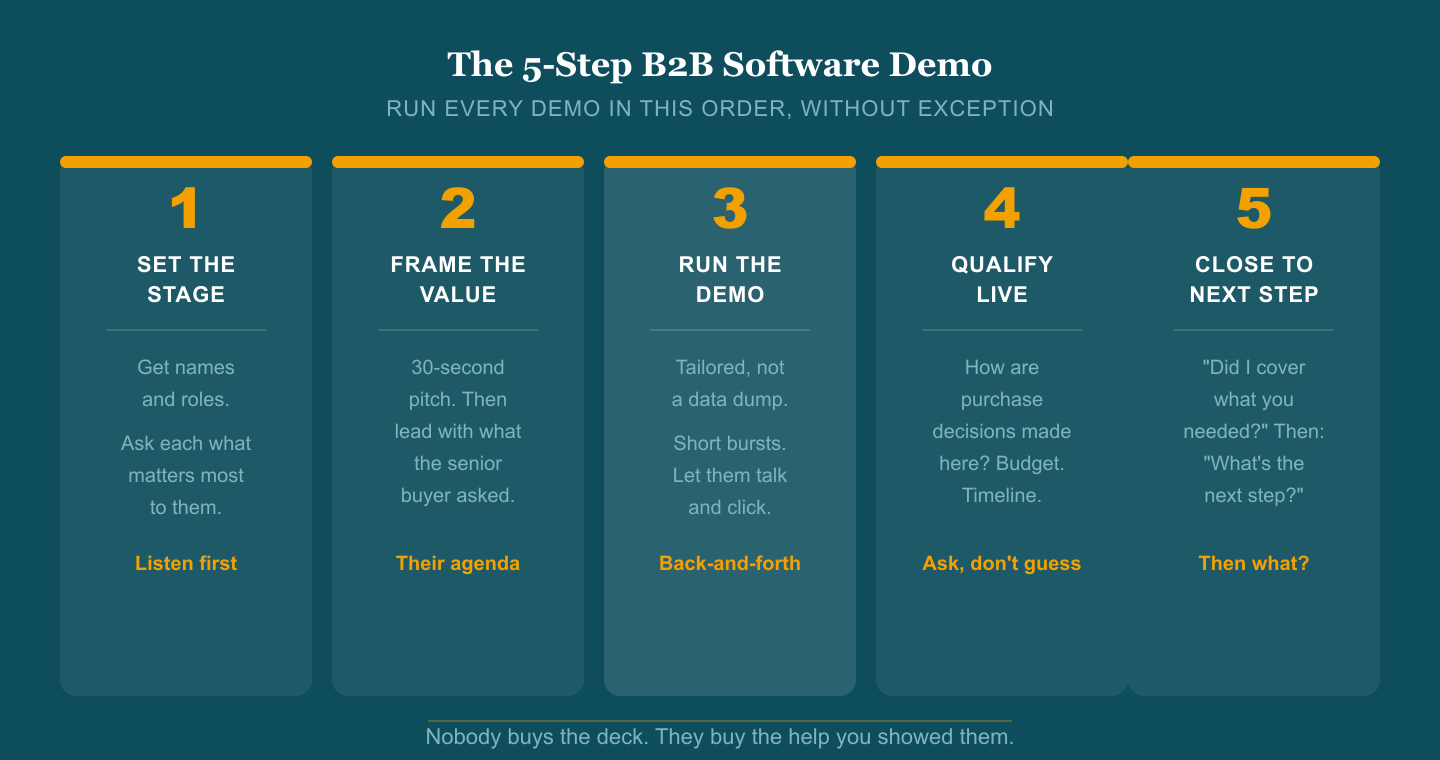
A demo should feel natural, but underneath the natural feel there's a structure. Without one, you ramble, you run long, and you end without a next step. Here's the structure I've used and taught for decades. It's the same bones as a great discovery call, just aimed at proving the fix instead of finding the problem.
Step 1: Set the Stage
Get the names and responsibilities of everyone on the call. You need to know who the decision-maker is, who the user is, and who's there to poke holes. Then ask each person the single most useful question you can ask at the start of any demo: "Given our time today, what's the most important thing I could show you?"
Write down every answer. That list is your demo. Not your slide order, their answers. When you show people the exact thing they told you they cared about, they lean in. When you make them sit through nine features to get to the one they asked about, you lose them by feature three.
Step 2: Frame the Value
Give your 30-second elevator pitch on the company and then get out of your own way. Start the demo with content tied to what the highest-level person in the room told you they wanted to see. You're not building suspense. You're rewarding their attention immediately by proving you listened.
Right after that first piece of value, ask the senior person a real qualifying question: "How are decisions to purchase products like ours made in your company?" Even if you asked it in discovery, the answer often changes once the group is on the line. Ask it again.
Step 3: Run the Demo
Now you work through the tailored path you built, adjusting to cover what each person asked for. This is the part where most people go wrong, so I'll be blunt. Do not narrate every click. Show a piece, stop, and ask a question. Show the next piece, stop, ask again.
Throughout the demo, pepper in the questions that keep it a conversation and keep qualifying: "What are you doing for this today?" "What's driving your interest in solving it now?" "Is this project budgeted?" That last one is a fair yes-or-no question by this point, and the answer tells you how real the deal is.
Show, then tell: handling questions mid-demo
When someone asks about a feature you planned to show later, you have a choice. If that feature builds on things you haven't covered yet, say, "Good question. I'm going to cover that in a bit," and move on. But if it's standalone, just show it right then. If you don't, they'll be thinking about their question when you need them focused on what's in front of them, and they may start to wonder what you're hiding. The one exception: if the decision-maker asks to see something, stop and show it immediately, and compliment them for asking. You never make the buyer wait.
Step 4: Qualify Live
A demo isn't just a show, it's your best chance to confirm this is a real opportunity while everyone's engaged. You need to leave knowing how the decision gets made, who signs, whether there's a budget, and what the timeline is. Don't save it for a follow-up email where it dies. Ask it live, while you've got the whole room.
I learned this the hard way early in my career. If you get deep into a deal without knowing how the order actually flows through the company, you find out at the worst possible moment, usually the day it stalls. Ask early. Ask clearly.
Step 5: Close to the Next Step
Conclude the demo and ask, "Did I cover what everyone wanted to see?" Once they say yes, turn to the decision-maker and ask, "What's the next step?" Let them answer. Then ask the most underused question in all of selling: "Then what happens?"
Those two questions do the work. They make the buyer describe their own buying process out loud, which tells you exactly how real this is and how long it'll take. A demo that ends with "we'll send you some information" isn't a qualified opportunity. It's a nice conversation you'll never hear about again.
The Feature Dump vs. The Value Demo
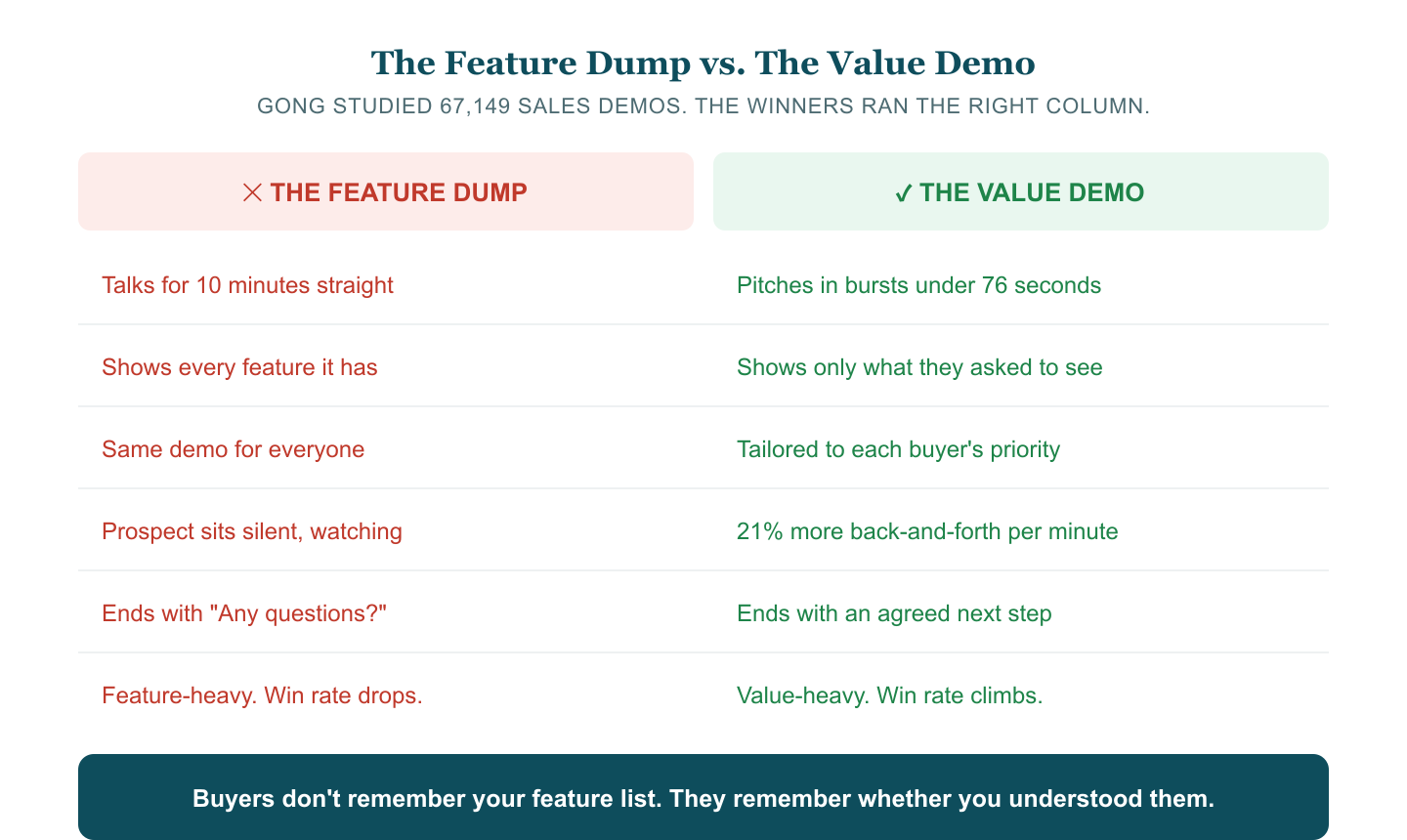
When Gong went through those 67,149 demos, the difference between winning and losing wasn't the product. It was how the rep ran the room. Look at the two columns below. One is what a proud founder does when they love their product. The other is what closes.
Talk in short bursts, not monologues
Here's a number that should live on a sticky note next to every rep's monitor. In Gong's data, not one demo that led to a closed deal contained more than 76 seconds of uninterrupted talking. Not one. The winning demos had 21% more speaker switches per minute, meaning more back-and-forth, more of the prospect chiming in. If you're talking for five minutes straight, you're not demoing. You're lecturing, and the buyer checked out four minutes ago.
Sell the outcome, not the feature
A feature is what the software does. Value is what changes in their business because of it. "This dashboard shows pipeline by stage" is a feature. "This is where you'll catch the deals that were about to slip, the week before they slip, instead of at the end of the quarter" is value. Same screen. Completely different sale. The buyer doesn't remember your feature list. They remember whether you understood their problem.
Spend real time on next steps
The winning demos in Gong's study spent 12.7% more time discussing next steps at the end. That's not an accident. Closers treat the last few minutes as the most important minutes, not as an afterthought while they're already reaching for the "leave meeting" button. Interactive, tailored demos convert about 2x better than passive ones, but only if you land the plane with a clear, agreed next action.
Stop counting how many features you showed. Start counting how many times the prospect talked. If you did all the talking, you did a presentation, and nobody buys a presentation.
The Mistakes That Kill Demos
Demoing before you've done discovery
This is the root cause of almost every bad demo. If you don't know their real problem, you can't build a demo around it, so you show everything. Never agree to demo a prospect you haven't qualified. "Sure, let's hop on a demo" feels like progress. It's usually just a busy calendar.
Showing the product you're proud of instead of the product they need
Founders are the worst offenders here, and I say that with love, because I've done it. You spent two years building that clever feature nobody asked about, and you cannot resist showing it. Resist. If it doesn't solve the problem they told you about, it's noise, and noise lowers your win rate.
Letting the demo end without a next step
If the meeting ends with "I'll follow up," the deal is already leaking. The next step has to be specific, agreed to on the call, and on a calendar before you hang up. Anything you leave to email will die in email.
Talking past the "yes"
For a lot of products, the right move at the end is simple. Ask "What do you think?" and then shut up. If they say they love it, ask for the business: "Great. Do you want to get started?" I've closed deals just by asking. It never hurts to ask, and it always hurts to keep selling after they've already decided to buy.
Frequently Asked Questions
Q: How long should a B2B software demo be?
Aim for 30 to 45 minutes, and protect the last 5 for next steps. The instinct to book an hour and fill it is the instinct that loses deals. Gong's data shows buyers disengage during long stretches of uninterrupted talking, and no demo that led to a closed deal had more than 76 seconds of it. If you can't make your point in 30 focused minutes built around what they asked to see, the problem isn't time. It's that you're showing too much.
Q: Should I run discovery before the demo or combine them?
Run discovery first, as a separate conversation whenever the deal size justifies it. Discovery is where you find the problem. The demo is where you prove you can fix it. Combine them and you'll start showing features before you understand what matters, which is exactly the feature dump that lowers win rates. For smaller, faster deals you can do a tight discovery at the top of the demo call, but you still ask what matters before you show anything.
Q: What's the biggest mistake founders make when they demo their own product?
They show everything. When you built the product, you're proud of all of it, so you want the prospect to see all of it. But the buyer asked for help with one problem, and every extra feature you show dilutes the one that matters. Gong found feature-dumping directly lowers win rates. Discipline yourself to show only what solves their stated problem. Save the rest for after they've said yes.
Q: How do I keep a demo from turning into a one-way monologue?
Show a piece, then stop and ask a question. The winning demos in Gong's study had 21% more speaker switches per minute than the losers, because the rep kept handing the conversation back to the buyer. Build natural pause points into your demo where you ask "Does this match how you'd use it?" or "What would you do differently here?" If you get to the end and realize you did 90% of the talking, you ran a presentation, not a demo.
Q: Buyers say they prefer to buy without a rep. Does the demo even matter anymore?
It matters more, not less. Yes, 67% of B2B buyers told Gartner they'd prefer a rep-free experience, and buyers spend only 17% of their journey with suppliers. But 69% still turn to a sales rep to validate the research they did on their own. They've already read everything. What they need from your demo is a human who understands their specific situation and tells them the truth about fit. That's a confirmation and guidance role, and it's exactly why a generic feature tour falls flat while a tailored, honest demo closes.
Q: When should a founder hand off demos to someone else?
The moment demos become the bottleneck. If you're personally running every demo and it's capping how many deals you can move, you've outgrown founder-led selling. The problem is that most founders hire a rep and hand over the demo without ever writing down the process, so the rep improvises and win rates drop. The fix is to codify the demo into a repeatable system first, then hand it off. That's the work a Fractional Sales Leader does, building the process so it survives without you in the room.
Your reps are demoing right now. Are they presenting, or closing?
If your demos are product tours instead of conversations that end in a next step, you're leaking deals you already earned. Let's spend 30 minutes looking at how your demos actually run and where the deals are slipping.
Schedule a 30-Minute CallAbout the Author
Louie Bernstein
Fractional Sales Leader with 50 years of sales experience helping $1M–$10M ARR companies build scalable, repeatable sales systems. Founder of MindIQ (INC 500). LinkedIn Top Voice in Sales Management, Sales Operations, and Sales Coaching.