Key Takeaways:
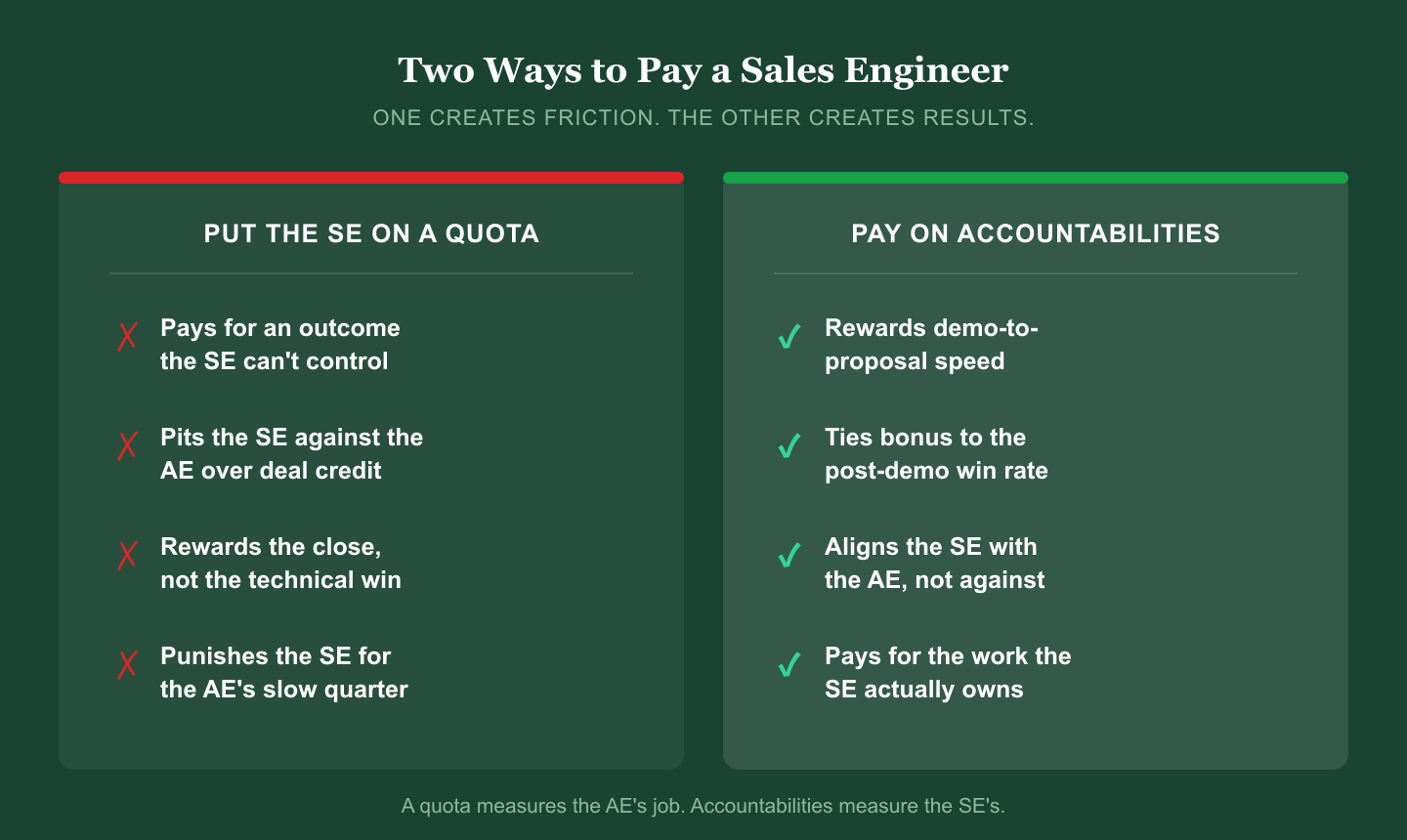
- No, your Sales Engineer should not carry an individual quota. A quota measures the Account Executive's job, which is closing. That isn't the SE's job.
- An individual quota pays the SE for an outcome they don't control and quietly pits them against the AE over who gets credit for the deal.
- The data backs this up. The most common pay mix for SEs is 80/20 base to variable, and the variable should be tied to the revenue of the team they support, not a number they own alone (Everstage, PreSales Collective).
- The better model pays on accountabilities: a clear document of what the SE owns, plus quarterly bonuses tied to leading indicators like demo-to-proposal speed and post-demo win rate.
- Strong presales is one of the highest-leverage things a founder can build. McKinsey found companies with strong presales win 40-50% of new business and 80-90% of renewals. Pay for that, don't tax it with the wrong quota.
A founder asked me this last month. He'd just hired his first Sales Engineer to take the technical weight off his two AEs, and his instinct was to put everyone who touches a deal on a number. "If the SE is helping close business," he said, "shouldn't they have a quota like the reps?"
I understand the instinct. When you're between $1M and $10M ARR, every dollar of payroll has to pull its weight, and a quota feels like the cleanest way to make sure it does. But it's the wrong tool for this role.
A quota measures the AE's job. It does not measure the SE's.
Put a closing number on someone whose job isn't to close, and you don't get more focus. You get friction, finger-pointing, and a great technical hire who starts behaving like a frustrated salesperson. There's a better and more practical way to get sales results from an SE. Here it is.
Why a Quota on Your SE Backfires
The whole point of a quota is accountability for an outcome. That works when the person on the quota owns the outcome. Your AE owns the close. They run the deal, manage the buyer, handle price, and ask for the order. A number on their head makes sense.
The SE doesn't own any of that. They own the technical win. Here's what goes wrong when you forget that distinction.
You pay them for something they can't control
An SE can deliver a flawless demo, answer every security and integration question, and earn the trust of the buyer's technical team. Then the AE fumbles the negotiation, the economic buyer goes quiet, and the deal slips a quarter. On a quota, the SE just missed their number because of work that was never theirs to do. Reward people for outcomes outside their control and you teach them that effort and results are disconnected. That's how you lose a good one.
You turn teammates into rivals
The AE and SE are supposed to operate as a tight-knit team with mutual respect. Put them on competing individual numbers and you introduce a quiet question into every deal: whose quota does this credit go to? I've watched it happen. The AE starts pulling the SE into deals that pad their own number and freezing them out of the messy ones. The SE starts cherry-picking the demos most likely to close. Both of them are now optimizing for the comp plan instead of the customer.
You reward the close, not the technical win
As Garin Hess, the CEO of Consensus, likes to put it, sellers can't close deals, only buyers can. The SE's contribution is making the solution believable to the people who have to live with it after the contract is signed. That's a real, measurable thing. It just isn't "revenue closed this quarter." When your only yardstick is the close, you stop seeing and stop paying for the work that actually de-risks the buy.
A quota answers the question "did you close it?" The SE's real job answers a different question: "did you make it safe to say yes?" Pay for the question the role actually answers.
What the Data Says About Paying Sales Engineers
This isn't just my opinion after fifty years in sales. The benchmarks point the same direction.
Start with the pay mix. The most common base-to-variable split for a Sales Engineer is 80/20, and roughly 85% of SE roles carry some variable component, usually 20-30% of on-target earnings (Everstage, 2026 SE compensation report). Compare that to a closing AE, who is often 50/50 or 60/40. The market has already decided the SE is a base-heavy role, because their impact on revenue is real but indirect.
Now look at what that 20% should be tied to. The PreSales Collective recommends tying 50-60% of an SE's variable pay to the revenue goal of the team, pod, or region they support, precisely because it produces a more harmonious relationship between the SE and their rep counterparts. In other words: shared success on the team's number, not a solo quota that sets them against each other.
And the prize for getting this right is big. McKinsey found that companies with strong presales capabilities consistently achieve win rates of 40-50% in new business and 80-90% in renewals, a 30-50% higher win rate than deals where presales isn't involved ("To Improve Sales, Pay More Attention to Presales"). It matters because buying has gotten crowded. Gartner pegs the typical B2B buying group at 6 to 10 decision-makers, and the SE is the one who wins over the technical members of that group. That's the leverage you're paying for. Don't bury it under a number built for a different job.
The Better Model: Pay for Accountabilities, Not the Close
Here's the model I use with founders. It has two parts: a base salary that respects the role, and a quarterly bonus tied to the leading indicators the SE genuinely controls. No solo quota anywhere in it.
The trick is choosing the right indicators. You want metrics that are close to the SE's actual work, that move before the revenue does, and that the SE can influence on their own merits. Three work well, and they come straight from a real Sales Engineer accountabilities plan I've used.
Proposal-request rate. What percentage of demos lead the prospect to ask for a proposal within five days? This is the cleanest read on whether the SE's demo actually landed. A great demo creates momentum, and momentum shows up as a fast proposal request. Set the bar high, north of 75%, and pay a bonus for clearing it.
Post-demo win rate. Of the deals where the SE ran the technical demo, how many closed? This is the single best proxy for the technical win, with a floor on volume so nobody games it by touching only the sure things. This one earns the biggest bonus, because it's the closest thing to the SE's true contribution.
New-salesperson velocity. How quickly does a newly ramped rep get to their first handful of net-new customers with the SE's technical enablement behind them? The SE is a force multiplier on every rep they support, especially the new ones. Pay them for accelerating the ramp.
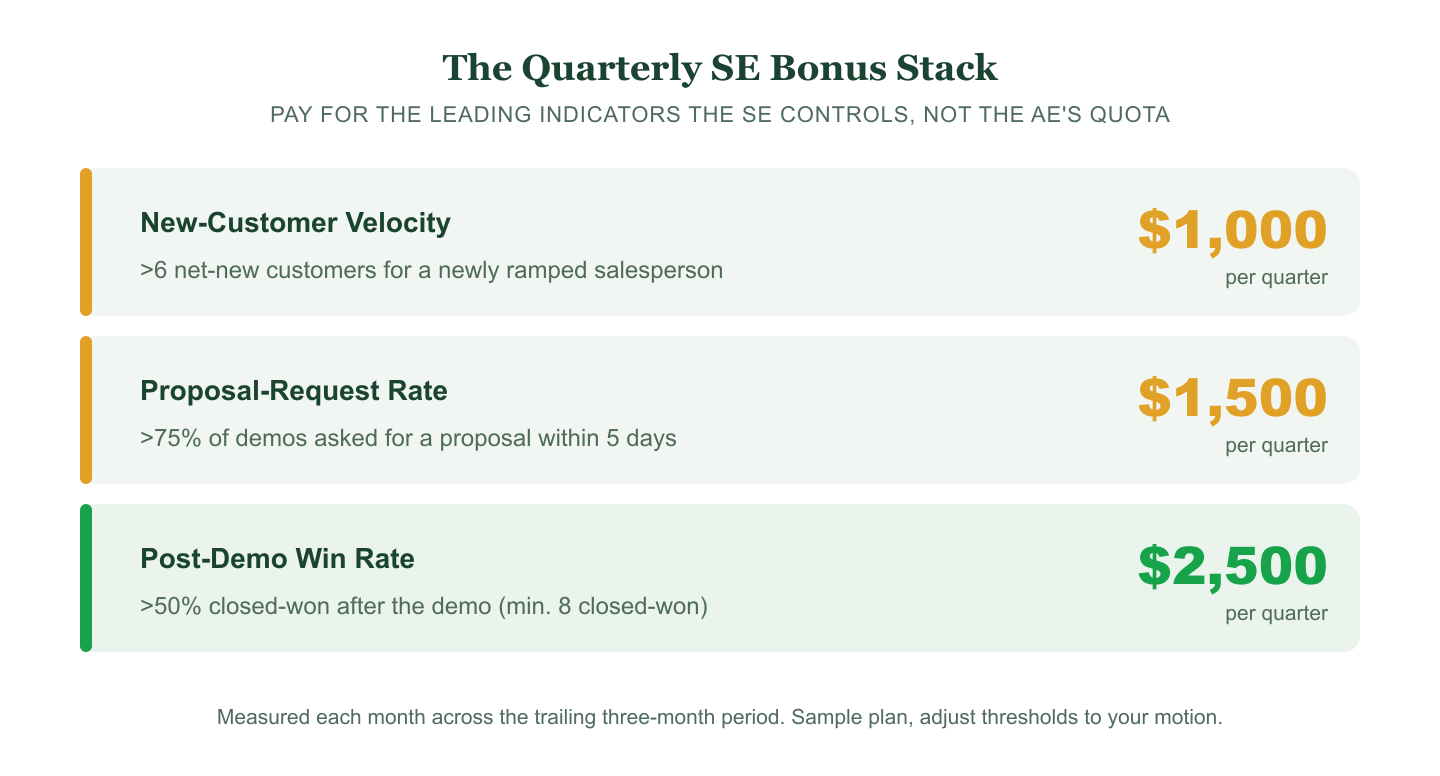
Stack those into quarterly bonuses, measured across a trailing three-month window so one slow month doesn't sink a good quarter. The SE now has skin in the game on exactly the things they can move, and not one dollar of their pay depends on whether the AE remembered to ask for the order.
The numbers above are a sample, not gospel. Set the thresholds to your sales motion and your deal sizes. The principle is what travels: pay the SE for leading indicators they control, not lagging outcomes they don't.
How to Build the Accountability Document for Your SE
A bonus plan without a clear definition of the role is just a number floating in space. Before you talk comp, write the Accountability Document. It spells out what the SE owns day to day, so both of you are measuring the same job. I structure it by cadence.
Daily. Join sales calls alongside the AE to deliver technical presentations and demos. Run needs discovery to pin down requirements. Answer the ad-hoc technical questions, on security, integrations, how the system actually works, that would otherwise stall a deal. Prep and tailor demo environments. Stay current as the product changes.
Weekly. Sit in on pipeline and deal-strategy reviews. Help craft technical proposals and RFP responses. Sync with product to carry feedback in and learn what's coming. Deliver technical enablement to the reps so the whole team gets sharper.
Monthly and quarterly. Review outcomes and refine the approach. Refresh demo assets and technical collateral. Own onboarding for new sales hires and keep a product-knowledge curriculum current. Participate in quarterly planning and sit in on enterprise account reviews from the technical seat.
Notice that none of that is "close X dollars." It's the work that makes closing possible. When the document and the bonus plan point at the same things, the SE knows exactly what good looks like, and so do you. And to be clear, this is an Accountability Document, not a rigid contract. It's a living description of the role you revisit as the motion matures.
What This Means for a Founder Between $1M and $10M ARR
At your stage, the SE is often your first real specialization out of founder-led selling. You've been the technical expert and the closer and the demo engineer all in one person. Hiring an SE is you handing off the technical half so your reps can carry more deals. Get the incentive wrong and you'll undo the very thing you hired for, by turning a collaborator into a quota-chaser.
This is the kind of design decision a Fractional Sales Leader handles all day. The right comp plan, the right accountabilities, the right line between who owns the close and who owns the technical win. You don't need a full-time VP of Sales to figure out how to pay one Sales Engineer. You need someone who has built these plans before and knows where they break. That's the work I do with founders. We get the structure right the first time, so your best technical hire spends their energy winning deals, not arguing about whose number they belong to.
So, should your Sales Engineer carry a quota? No. Give them an Accountability Document, tie a quarterly bonus to the leading indicators they control, and let the AE carry the close. That's how you get sales results from an SE without breaking the team you're trying to build.
Frequently Asked Questions
Q: Should a Sales Engineer carry an individual quota?
No. An individual quota measures closing, which is the Account Executive's job, not the SE's. It pays the SE for an outcome they don't control and creates competition between two people who are supposed to work as a team. Pay the SE a base-heavy salary plus quarterly bonuses tied to the leading indicators they actually influence, like demo-to-proposal rate and post-demo win rate.
Q: What is the right base-to-variable pay mix for a Sales Engineer?
80/20 base to variable is the most common arrangement, and about 85% of SE roles carry a variable component of 20-30% of on-target earnings (Everstage, 2026). The role is intentionally base-heavy because the SE's impact on revenue is real but indirect. Compare that to a closing AE, who is often 50/50 or 60/40. If your SE supports larger, longer enterprise deals, a 70/30 mix is also reasonable.
Q: What should the SE's variable pay be tied to?
Tie it to two things: the revenue of the team, pod, or region the SE supports, and a small set of leading indicators they control directly. The PreSales Collective recommends putting 50-60% of the variable on the supported team's number, which keeps the SE and the reps rowing in the same direction. Layer quarterly bonuses for proposal-request rate, post-demo win rate, and how fast new reps ramp on top of that.
Q: Doesn't paying on metrics instead of a quota let the SE off the hook?
Just the opposite. A quota holds the SE accountable for the AE's job. Leading indicators hold the SE accountable for their own. A proposal-request rate above 75% and a post-demo win rate above 50% are demanding targets. They just happen to measure work the SE actually owns. Accountability means measuring the right job well, not borrowing a number from a different role.
Q: Does presales really move win rates enough to matter at my size?
Yes, and arguably more at your size than at a large company. McKinsey found companies with strong presales win 40-50% of new business and 80-90% of renewals, 30-50% higher than deals without presales. When you're between $1M and $10M ARR and every deal counts, a higher technical win rate is one of the most direct levers you have. The SE is how you pull it.
Q: How do I write an Accountability Document for a Sales Engineer?
Structure it by cadence: daily, weekly, monthly, and quarterly responsibilities. Daily covers demos, technical discovery, and answering prospect questions. Weekly covers pipeline reviews, proposals, and rep enablement. Monthly and quarterly cover refreshing demo assets, onboarding new hires, and planning. Then pair it with a bonus plan that points at the same work. The document defines the job, the bonus rewards doing it well. It's an Accountability Document, a living description of the role, not a rigid contract.
You hired a Sales Engineer to win more deals, not to fight over credit.
If you're not sure how to pay your SE, where the line sits between them and your AEs, or how to write the accountabilities that hold it all together, let's spend 30 minutes on it. I've built these plans before and I know where they break.
Schedule a 30-Minute CallAbout the Author
Louie Bernstein
Fractional Sales Leader with 50 years of sales experience helping $1M–$10M ARR companies build scalable, repeatable sales systems. Founder of MindIQ (INC 500). LinkedIn Top Voice in Sales Management, Sales Operations, and Sales Coaching.