To separate a real salesperson from a great storyteller, stop asking what they would do and ask what they did. Five questions do it: the last deal they lost, their quota math, a dead deal they saved, their prospecting on a thin week, and their cold-call opener, shown live. Then finish with a two-minute role-play.
Key Takeaways:
- Salespeople are trained performers. An unstructured interview rewards the best performance, not the best seller.
- Ask about past behavior, not opinions. What a rep did when a deal went cold predicts what they'll do on yours.
- A structured interview predicts job performance at .51, versus .38 for the gut-feel conversation most founders run (Schmidt & Hunter meta-analysis).
- The two questions storytellers can't fake: the last deal they lost, and their quota math, from memory.
- End every interview with a role-play. Two minutes of watching them sell beats an hour of hearing them describe it.
- Ask the same questions, in the same order, of every candidate. Otherwise you're comparing stories, not people.
You've done this before. Someone walks in and nails it. Confident. A great story for every question. All the right words about pipeline, objection handling, and quota attainment.
You hire them. Three months later, they have nothing to show.
They didn't lie to you. You asked the wrong questions. Interviews are a performance, and salespeople are trained performers. They read the room, they know what you want to hear, and they say it with total conviction. Your job is to get past the performance and find the operator underneath: the one who builds pipeline when you're not watching and is still producing at month nine.
Storytelling wins the interview. Evidence wins the quarter.
Why do most sales interviews hire the wrong person?
Because the questions invite stories. "Tell me about your biggest deal." "What's your greatest strength?" A skilled salesperson has rehearsed those answers since their last job search. Open-ended, opinion-based questions measure how well someone talks about selling. They don't measure what that person does when a prospect goes cold or the quarter looks bad.
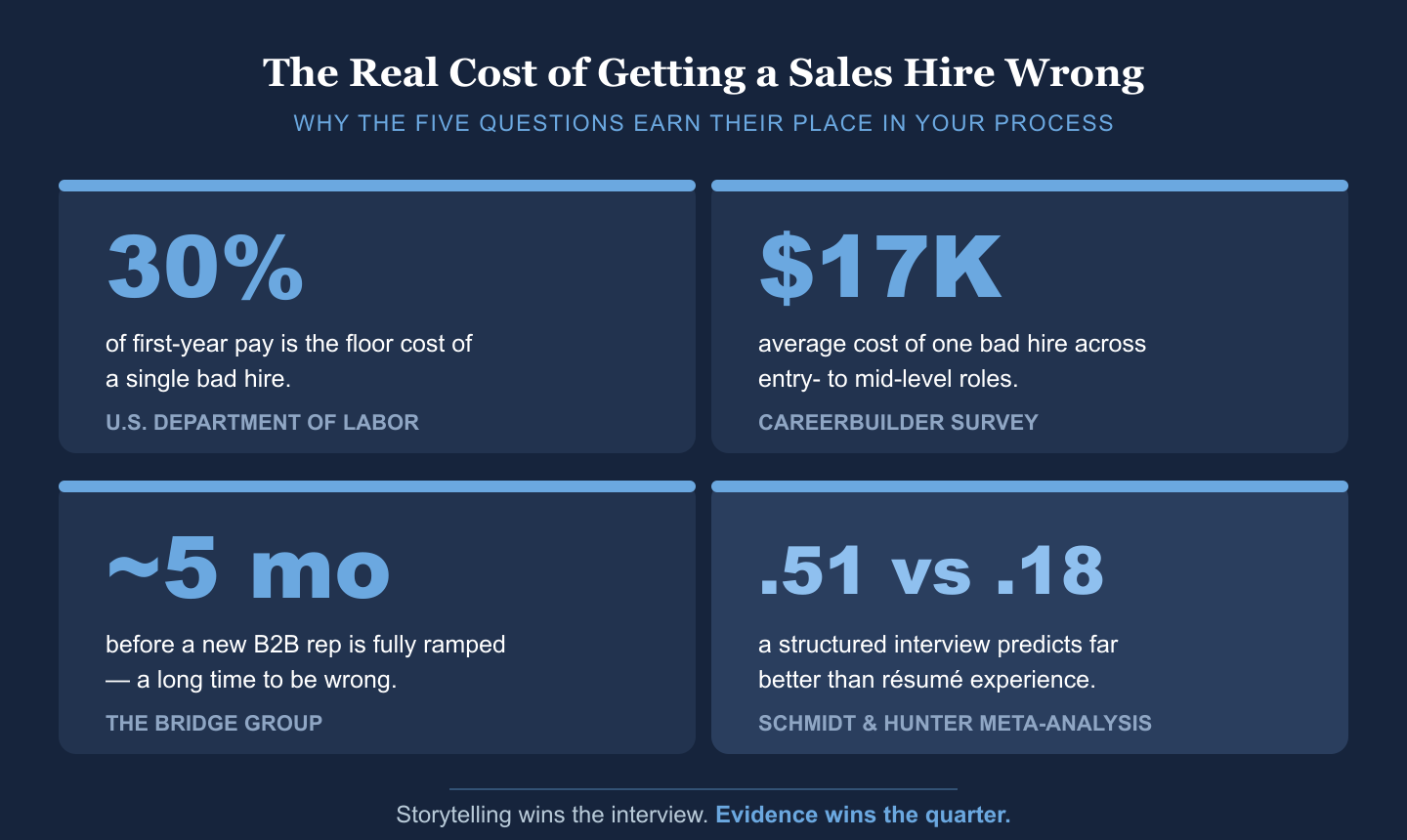
The stakes justify more rigor. The U.S. Department of Labor puts the floor cost of a bad hire at 30% of first-year earnings. CareerBuilder's survey of 2,379 hiring managers put the average loss at about $17,000 per bad hire. And because a new AE takes 5.7 months to fully ramp (The Bridge Group, 2024), a miss can quietly bleed you for two quarters before you can even confirm it was a miss.
The research on how to avoid it is blunt. In Schmidt & Hunter's meta-analysis of decades of hiring studies, a structured interview predicts performance at .51. The unstructured conversation most founders run scores .38. Years of experience on a résumé scores .18. Past behavior predicts future performance. Polished answers just decorate a résumé.
Question 1: "Walk me through the last deal you lost. What happened?"
This is the most revealing question you can ask. Not the last deal they won. The last one they lost. It tests whether the candidate owns outcomes or explains them away. A rep who can name a specific loss, own their part in it, and tell you what they changed next will hold up when your deals get hard.
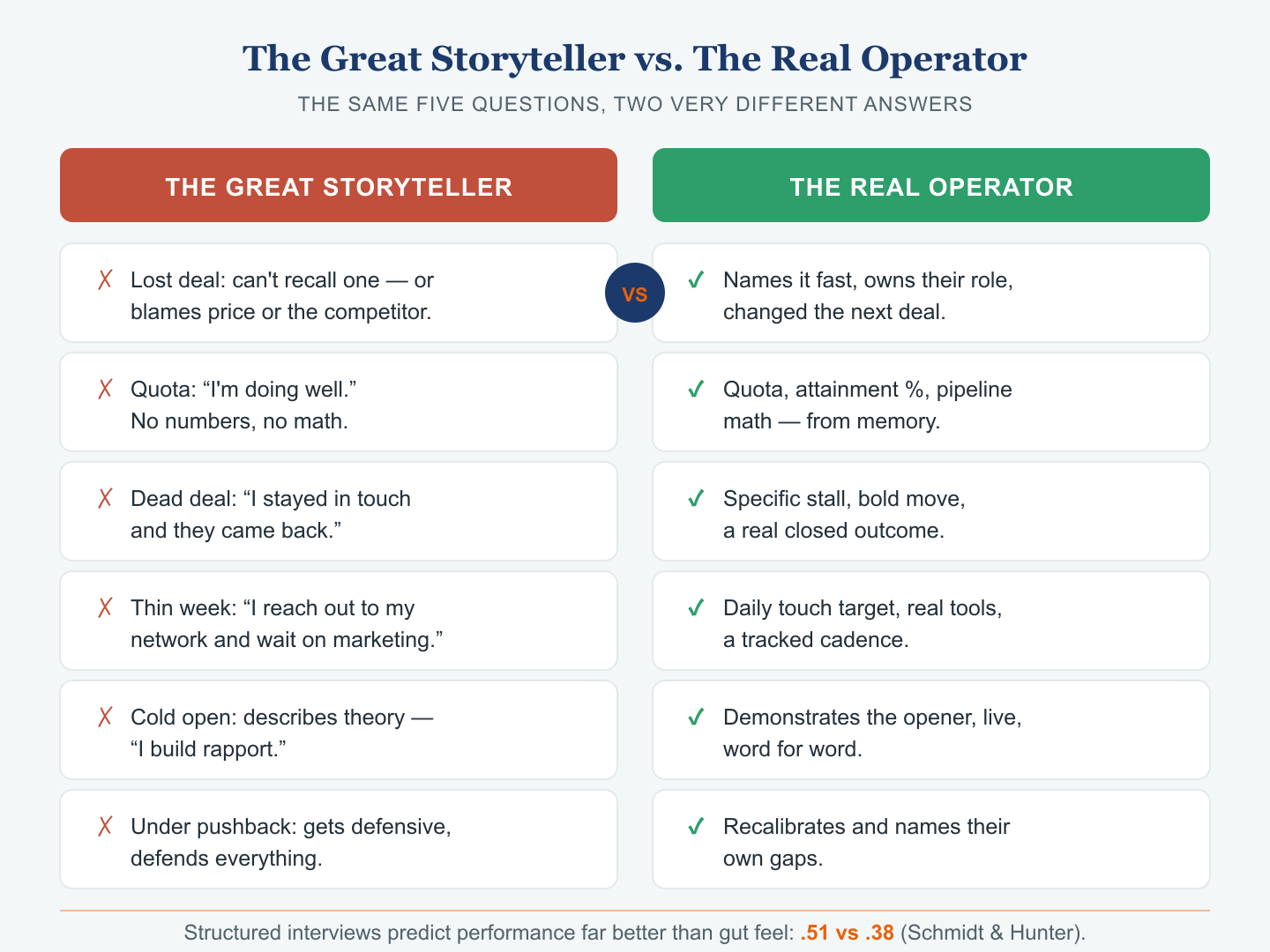
Weak answer: they blame something outside their control ("pricing was off," "the competitor got there first," "they were never serious"), or they can't remember a specific loss. That second one is a red flag on its own.
Strong answer: they name the deal without hesitating. They own their part: "I didn't qualify budget early enough," or "I waited too long to bring in the economic buyer." Then they tell you what they did differently on the next deal because of it.
Sales is a sport of failure. The rep who processes a loss fastest and adjusts is the one who wins. Every deal eventually gets hard. You want someone who has already learned from one.
Question 2: "What's your current quota? Are you on track? Show me the math."
You want three things: the number, the status, and the math that connects them. This is the fastest test of whether a rep actually runs their pipeline or just hopes it works out. A rep who isn't rigorous about their own number won't be rigorous about yours.
Weak answer: "I'm doing well." "We don't really track it that way." Both are evasions, and both tell you everything.
Strong answer: they know their numbers the way a pilot knows altitude. "My quota is $1.2M in new ARR. I'm at $720K through Q2, so 60% with two quarters left. I have $600K in late-stage deals at about a 40% close rate, so I'm on track." If they can't walk through that math without checking their phone, they aren't managing their own business.
A rep who doesn't know their own number from memory won't know yours either.
Question 3: "Tell me about a deal you saved after it was essentially dead."
Every rep has wins. Few can pull a stalled deal back. This question shows whether a candidate takes action when a prospect goes quiet or just waits. At $1M to $10M ARR, every deal matters to your growth. You can't afford a rep who goes silent the moment a prospect does.
Weak answer: "I stayed in touch and eventually they came back." That isn't saving a deal. That's waiting while the prospect decided on their own.
Strong answer: it has three specific parts. A specific stall ("stuck in legal review for three months"). A specific, unconventional move ("I found a mutual contact who could reach the CFO," or "I proposed a 30-day paid pilot"). And a specific outcome ("we closed six weeks later at 80% of the original contract value").
Question 4: "What does your prospecting look like on a week when your pipeline is thin?"
At your stage you aren't hiring a closer. You're hiring someone who builds their own pipeline without waiting for marketing to fill it. This question separates hunters from farmers in about two minutes. Strong candidates describe a repeatable prospecting routine they already run, not one they'd invent once deals dry up.
Weak answer: "I reach out to my network." "I check whether marketing has anything." That isn't a prospecting system. It's what people do when they run out of pipeline and start to panic.
Strong answer: a specific daily outbound target. The tools they use: LinkedIn, a data source, a dialer, structured sequences. How they build and prioritize their target list. And the metrics they watch to know whether the cadence is working. Most $1M to $10M ARR companies need full-cycle reps who generate their own qualified pipeline. This is how you find out if you're talking to one.
Question 5: "What do you say in the first minute of a cold call to keep someone on the line?"
Ask it, then stop talking and wait. This is the only question that makes the candidate show a skill instead of describe it. Strong reps shift straight into demonstration: their actual opener, word for word, adjusted to you as they go. Weak reps give you theory about rapport and value propositions.
Weak answer: "I try to build rapport." "I explain our value proposition." That's a textbook answer from someone who knows the vocabulary but hasn't had to use it under pressure.
Strong answer: a specific, non-generic opener, such as "Hi Dana, this is Sam. I know you weren't expecting my call. May I tell you why I called you?" Then a reason for the call that serves the prospect, and a question that gives them a reason to stay on the line. If they can't show you how they open a cold call, they're winging it on your brand every time they dial.
Across all five questions, the tell is the same. The storyteller reaches for a narrative. The operator reaches for evidence. Here's what that sounds like side by side.
Why should every sales interview end with a role-play?
Because a role-play is a work sample, and work samples are among the strongest predictors of job performance ever measured: .54 in the Schmidt & Hunter data, slightly ahead of the structured interview. Watching someone sell for two minutes tells you more than an hour of hearing them talk about selling.
Give the setup: "I'm a founder still closing most of my own deals. You're calling me out of the blue to set a meeting. Go." Then pick up the imaginary phone, play the skeptical prospect, and push back.
Watch four things. Do they open with a purpose or launch into a pitch? Do they ask qualifying questions or lecture? When you push back, do they crumble or recalibrate? Do they ask for a specific next step or let the call drift?
Then ask, "What would you do differently?" A coachable rep names their own gaps right away. A rep who defends everything they just did is showing you exactly who they'll be when a deal goes wrong in the field.
The role-play isn't a perfection test. It's a pressure test. That's what selling to a skeptical buyer is every single day.
Which red flags should end the interview?
Walk away, no matter how polished the answers, if the candidate can't name a specific lost deal, blames every failure on someone else, or can't state their quota without a device. The same goes for getting defensive in the role-play, or for answers that change between your first and second interview.
Two more are worth watching. A candidate who claims they've never really failed at anything isn't being honest with you or with themselves. And a candidate who asks about compensation before asking what the job involves is telling you their priorities.
One last check no scorecard captures: likeability. Prospects buy from people they enjoy spending time with. If 45 minutes with this candidate feels like work, your best customers will feel the same way.
What do you need in place before the first interview?
Three things: an Ideal Candidate Profile, a structured interview process, and a Sales Playbook. Without them, you're making a gut-feel decision on a $75,000 to $150,000 investment. The five questions work best inside a process that defines who you need and what they'll execute from day one.
An Ideal Candidate Profile. Not a job posting. A written profile of the person who will succeed in your environment: your sales cycle, your deal complexity, how much they'll prospect, and the culture they need to thrive.
A structured interview process. The same questions, asked of every candidate in the same order, scored the same way. That's what makes candidates comparable.
A Sales Playbook. A documented, repeatable process your new hire can run from day one, instead of puzzling it out over 90 days at your expense.
Where does a Fractional Sales Leader fit?
A Fractional Sales Leader builds all three pieces before the first candidate walks in, then sits in on the final interviews. It's the fix for founders at $1M to $10M ARR who have never hired a salesperson and can't yet tell a rehearsed answer from real experience.
If you've never carried a quota, you probably can't evaluate these answers reliably on your own. That isn't a failure. It's just honest. I've heard thousands of these answers, and I can hear the difference between a candidate who has done the work and one who memorized a great answer from a career coaching site.
I've spent 50 years in sales, including 22 years building MindIQ into an INC 500 company. The founders who hire well aren't better at reading people. They run a better process.
Frequently Asked Questions
Q: How many interview rounds should I run for a sales hire?
At least three. A phone screen for the basics: quota history, prospecting approach, and why they're leaving. A full behavioral interview with the five questions and the role-play. And a final round with a second evaluator who will work alongside this rep. Never hire a salesperson after one conversation. A bad hire costs at least 30% of first-year earnings (U.S. Department of Labor).
Q: Should I include a written assignment?
Yes, for full-cycle roles. Ask candidates to research your top two or three competitors and deliver a one-page battle card. It tests initiative, analytical thinking, and the preparation habit good reps bring to every meeting. A rep who won't do homework for a job they want won't do the research your customers deserve.
Q: What if a candidate has a great résumé but struggles in the role-play?
Take the role-play seriously. A strong résumé earns the interview. The role-play shows what happens in front of a skeptical buyer. Years of experience is one of the weakest predictors of performance (.18 in the Schmidt & Hunter meta-analysis). If they fold under mild pressure from you, they'll fold in a real discovery call.
Q: How do I get honest answers from reference checks?
Ask, "On a scale of 1 to 10, how likely are you to rehire this person if you had an open role tomorrow?" Then ask, "What would need to be true for that to be a 10?" The second question surfaces the honest nuance behind a polite reference, and it usually tells you more than either interview.
Q: Isn't a candidate who's great in interviews likely to be great with prospects?
Not necessarily. Interviewing well and selling well overlap, but they aren't the same skill. An interview is a friendly audience with predictable questions. A prospect is skeptical, busy, and has other options. That's why the five questions ask for specific past behavior and why the role-play puts the candidate under real pushback.
Q: Do I need to ask the questions in the same order every time?
Yes. Consistency is what makes an interview structured, and structure is what makes it predictive (.51 versus .38 for an unstructured interview, per Schmidt & Hunter). Same questions, same order, and a simple score for each answer right after the interview, before you compare notes with anyone else.
Q: I have no sales background. How do I judge these answers?
Use the weak and strong answers above as your guide: specifics, numbers, and ownership are good signs; vague stories and blame are bad ones. For the final round, bring in someone who has managed salespeople, such as a Fractional Sales Leader. A second, experienced evaluator catches what a first-time hiring manager misses.
Ready to build a sales hiring process that works?
Before you post the job, let's make sure the infrastructure is in place. In 30 minutes we'll look at your hiring process, where the gaps are, and what to build before the first interview.
Schedule a 30-Minute CallAbout the Author
Louie Bernstein
Fractional Sales Leader with 50 years of sales experience helping $1M–$10M ARR companies build scalable, repeatable sales systems. Founder of MindIQ (INC 500). LinkedIn Top Voice in Sales Management, Sales Operations, and Sales Coaching.