By Louie Bernstein • March 2026
Key Takeaways:
- 36% of companies have no structured onboarding process for new sales hires. The result is predictable and expensive.
- Without a written sales rep onboarding plan, new reps spend their first 90 days figuring out what to do instead of selling.
- An Accountability Document — signed before Day 1 — eliminates the ambiguity that kills most new sales hires before they ever have a chance.
- The goal of onboarding is not orientation. It is getting a rep to their first sale as fast as possible.
- A Fractional Sales Leader builds the entire onboarding infrastructure before your next hire walks through the door.
You hired a great rep. You were relieved. You handed them a laptop, gave them CRM access, introduced them to the team, and told them to start selling.
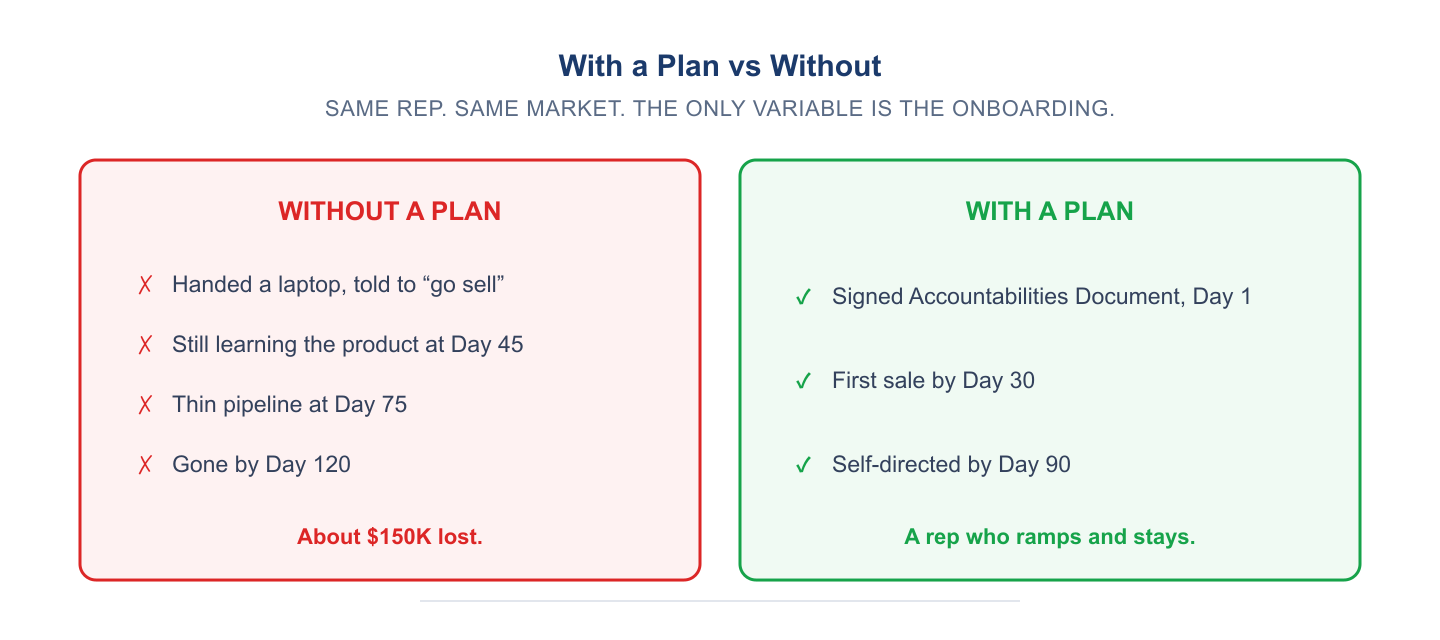
By Day 45, they were still "learning the product." By Day 75, their pipeline was thin. By Day 90, you had a difficult conversation. By Day 120, they were gone.
And you blamed the rep.
You should not have. You should look at what you gave them on Day 1.
Most sales hires do not fail because the rep was wrong. They fail because the onboarding was wrong — or did not exist at all.
Research consistently shows that new hires who complete a structured onboarding process are 58% more likely to still be at the company three years later. Despite that, 36% of companies have no formal onboarding process whatsoever. In my experience with $1M–$10M ARR companies, the real number is closer to 80%.
A great salesperson dropped into an environment with no process, no written expectations, and no structured ramp plan will fail. Every time. Here is what a real sales rep onboarding plan looks like — and why it saves you $80,000 and six months of lost momentum.
What Bad Onboarding Actually Costs You
Before we fix the problem, let's be honest about the full cost of getting it wrong.
The Direct Cost of a Failed Sales Hire
A failed sales hire at the $1M–$10M ARR stage typically costs:
- $55,000–$80,000 in salary (4–6 months before termination)
- $12,000–$20,000 in recruiting fees — typically 15–25% of first-year salary
- $5,000–$10,000 in tools, CRM setup, and onboarding time invested
That is $72,000 to $110,000 before you count the deals they did not close during ramp time.
The Indirect Cost
The indirect costs are where the real damage happens. While this rep was ramping poorly:
- Your pipeline was not being actively worked
- Your best prospects were contacted once or twice, then went cold
- You stepped back in to manage deals yourself, pulling you straight back into the founder-led sales trap
- Your other reps watched the failure and quietly started updating their resumes
Total cost of a failed sales hire: conservatively $150,000 to $200,000 when you include lost revenue opportunity. In most cases, the root cause was not the person. It was the absence of a structured onboarding system.
A great rep placed inside a broken onboarding system will fail. A good rep placed inside a great onboarding system will surprise you.
The Accountability Document: The Document That Changes the Outcome
Most founders give new sales hires an offer letter and consider onboarding started. The offer letter covers compensation, start date, and maybe a job description. It protects you legally. It does not set your rep up to succeed.
An Accountability Document is different. It is a document your new rep reads, discusses, and signs before Day 1 — one that answers every question they will have about what success looks like in this specific role at this specific company.
The Five Sections Every Accountability Document Needs
1. Job Summary
Not the polished language from your job posting. The plain-English version. What does this person actually do all day? What does "success in this role" look like at six months and twelve months?
2. Duties and Responsibilities
Specific and measurable. Not "responsible for generating pipeline." Instead: "Make 40 outbound touches per day. Book a minimum of 8 qualified discovery calls per week. Update all CRM activity by end of business daily." These are the core elements of sales process standardization — and they cannot live only in your head.
3. What It Takes to Succeed Here
The honest version. This is a company with no large brand behind it. Every call is cold. The sales cycle is typically this long. The competition says these things. Tell them now. Do not let them find out the hard way in Month 2.
4. What a Typical Day Looks Like
Walk them through an actual day. 8am: pipeline review. 8:30am: outbound calls against a prioritized target list. 11:30am: follow-up sequences and LinkedIn touches. 1pm: discovery calls. 4pm: CRM hygiene and opportunity notes. End of day: build tomorrow's target list.
When new reps know exactly what their day is supposed to look like, they stop spending three weeks figuring out a routine and start executing one on Day 2.
5. Accountabilities and Measurement Dates
By Day 30, Day 60, and Day 90: what specific numbers are expected? What activity metrics will be reviewed? What happens when they miss, and what does the performance improvement process look like? Leave no ambiguity. None.
An Accountability Document does one thing above all else: it eliminates the ambiguity that kills most new sales hires before they ever have a real chance to prove themselves.
When your rep signs this before Day 1, expectations become mutual. They know what they agreed to. When performance conversations arise, and they always do, there is a written reference point for both parties.
The 30-Day Sales Rep Onboarding Plan: Week by Week
An Accountability Document establishes expectations. The 30-Day Onboarding Plan dictates activity.
Your goal in onboarding is not orientation. It is not product training. It is not getting them set up on Slack.
Your goal is first sale as fast as possible. Every element of a well-built sales rep onboarding plan points toward that single outcome.
Week 1 — Foundation
- Day 1: Company overview, team introductions, CRM access and initial setup
- Days 2–3: Product training focused on outcomes; the 3–5 results your product creates for customers, and why those outcomes matter. Not a feature walkthrough.
- Day 4: Read the Sales Playbook cover to cover. Every word. Ask questions. No exceptions.
- Day 5: Listen to three recorded Gold Calls — calls where a meeting was booked or a deal advanced. Take notes on exactly what was said and why it worked.
Week 2 — Observation and Imitation
- Days 6–8: Shadow every sales call the founder or top rep makes. Take notes on questions asked, objections handled, and closing technique. Debrief after every call.
- Day 9: First role-play. The founder plays the prospect. The new rep runs the discovery call using the Sales Playbook as a guide, not a script.
- Day 10: Role-play round two with feedback applied. Then first live outbound call — with the founder on the line, silent.
Week 3 — Supervised Independent Activity
- First independent outbound calls using an approved, prioritized target list
- Daily debrief: What happened? What worked? What will you change tomorrow?
- First independently conducted discovery call, with the founder available immediately after for a structured debrief
- First qualified opportunity entered into CRM with complete notes
Week 4 — Accountability
- Ramp metrics formally begin. Activity tracking is now live.
Accountability Document KPIs are in full effect.
- Weekly pipeline review: every opportunity reviewed for next action, expected close date, and risk assessment
- First formal one-on-one with the founder to review progress against the 30-day milestones documented in the Accountability Document
- If you hired two reps in parallel: first peer coaching session. What each learned, what worked, what they are each testing next week
A structured 30-day onboarding plan does not guarantee every hire succeeds. But it eliminates every excuse for failure. You gave them everything they needed. The rest is on them.
The Coaching Cadence That Sustains Sales Team Performance
Onboarding is a one-time event. Coaching is a recurring system. You need both, and most $1M–$10M ARR companies have neither.
Without a structured coaching cadence, even reps who start strong will plateau, drift, or quietly start looking for their next job. Here is the minimum viable cadence:
Daily: 15-Minute BDR Standup
Every morning. Fifteen minutes. Listen to one Gold Call together. Gold calls are a recorded call where something went right. Name the specific behavior. Reinforce it. Set the target for the day. This is not a status meeting. It is a daily injection of positive reinforcement that keeps the team's mindset calibrated toward winning.
Weekly: Pipeline Review
Every week without exception. Every active opportunity reviewed for next action, expected close, and risk. One rule that cannot be broken: a prospect's pipeline stage changes only when the prospect takes an action — not when the rep believes or hopes they will. This is the foundation of CRM hygiene and accurate forecasting. No wishful thinking. No stage inflation.
Monthly: One-on-One Development
Once per month, per rep. Not a pipeline review — a development conversation. What is going well? Where are they stuck? What do they need to get better at?
Every rep on your team, including you, should have a self-improvement plan. Ask them where they want to be in 12 months and what they need to learn to get there. Reps who feel they are growing stay. Reps who feel they are stagnating go find somewhere that will invest in them.
The Day-45 Warning Sign You Cannot Ignore
There is one signal that a sales rep onboarding plan has failed, and it appears at Day 45 with uncomfortable regularity.
Your new rep is still telling you they are "learning the product."
By Day 45 of a properly structured onboarding, a rep should have made at least 150 outbound touches, booked at least five discovery calls, and have at least one genuine opportunity in the CRM. If those numbers are not there, the answer is not more product training. It is a direct conversation about what is actually blocking them.
The most common Day-45 blockers I see:
- ❌They have not internalized the Ideal Customer Profile (ICP) and are calling the wrong people
- ❌Their cold call opening is weak and they are getting cut off within 15 seconds
- ❌They are over-indexing on email and avoiding the phone entirely
- ❌They are getting hit with the first objection ("not interested") and hanging up instead of engaging
Every one of these is fixable. None of them require firing the rep. But you cannot fix what you cannot see. That is exactly why the daily standup and weekly pipeline review exist — to surface blockers before they turn into a six-month ramp failure and a $150,000 bad hire cost.
You Do Not Have to Build This Alone
Writing
An Accountability Document , a 30-day onboarding plan, a Sales Playbook, and a consistent coaching cadence from scratch takes real time. If you are still running founder-led sales while trying to build this infrastructure, something important will get cut short.In almost every case, it is the onboarding plan. And then the new rep underperforms. And you wonder why the same pattern keeps repeating with every new hire.
A Fractional Sales Leader builds the entire onboarding infrastructure before your next hire starts. An Accountability Document is written. The Sales Playbook is documented. The 30-day plan is sequenced. The coaching cadence is scheduled.
Your next rep walks into a complete system. They do not have to figure out anything. They just have to show up and execute the proven and repeatable process that is already in place.
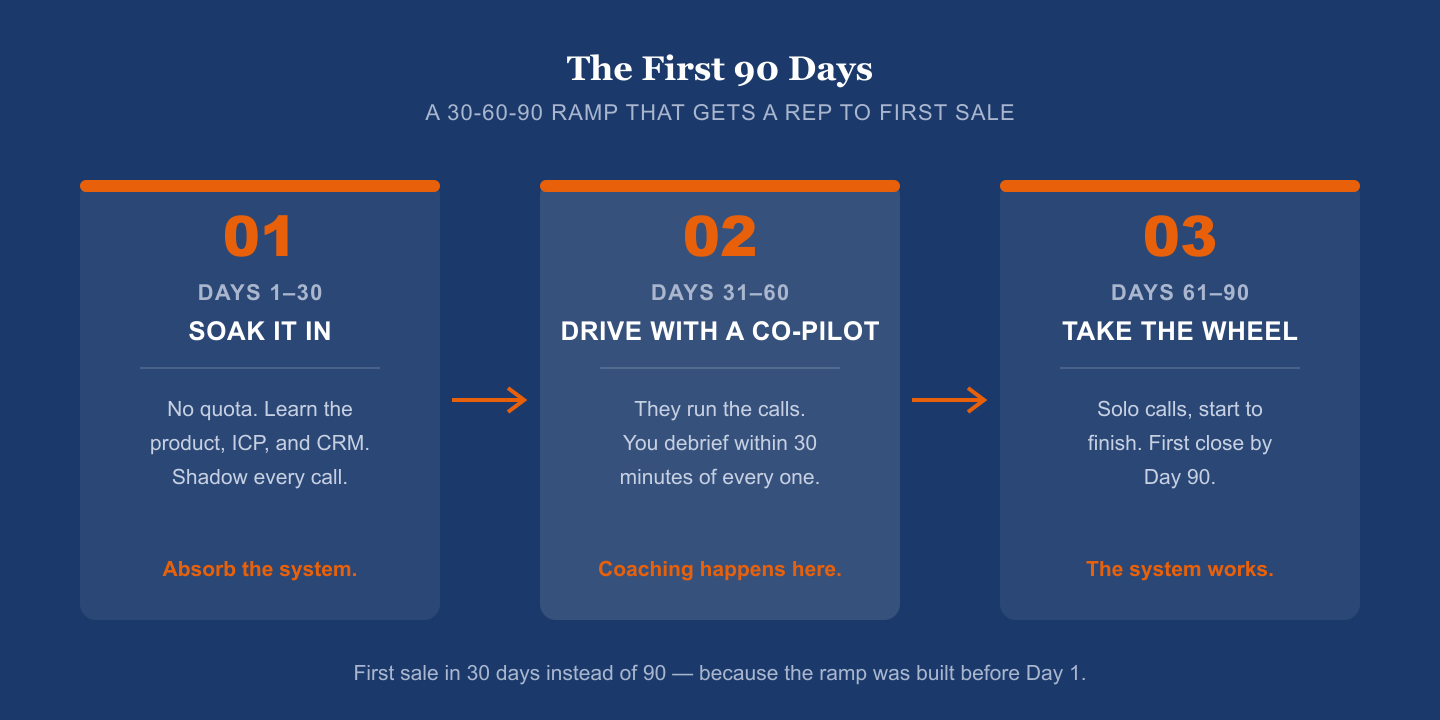
That is how you get to first sale in 30 days instead of 90.
Frequently Asked Questions
Q: How long should a formal structured onboarding process last?
Thirty days for the intensive structured plan, but active ramp support continues through Day 90. The first 30 days build the foundation. Days 31–90 are independent execution with a coaching cadence fully in place. By Day 90, a rep should be self-directed and fully accountable to the activity metrics in their Accountability Document.
Q: What if I do not have recorded calls to use as Gold Calls yet?
Start recording immediately. Most CRMs and dialers include call recording. The absence of recordings is not a reason to skip this step; it is a reason to fix the gap today. In the interim, run live role-plays as a substitute. The practice of reviewing a successful call and naming exactly what worked is the behavioral principle. The recording is the tool, not the point.
Q: Should I build the sales rep onboarding plan before or after I make the hire?
Before. Always before. Building it after you hire means your new rep waits in limbo while you scramble to put it together, which is the opposite of the fast ramp you are trying to create. More importantly, building the onboarding plan forces you to document your own sales process first. That documentation is the foundation of everything that follows.
Q: My last rep said the onboarding process was too rigid. How do I handle that pushback?
Treat the Sales Playbook and onboarding process as a floor, not a ceiling. Require the rep to follow the proven and repeatable process for at least 60 days — long enough to understand why it works. After that, they can propose specific modifications based on what they are actually seeing in the field. Freedom to deviate in Week 1 is not independence. It is an invitation to wing it at your expense.
Q: What is the single most important thing I can do right now to improve my onboarding process?
Write down your own sales process this week. Not a formal document. It's a plain honest description of how you personally close deals. What do you say on the first call? What questions do you ask to qualify? What objections come up and what do you say back? That document is Version 1 of your Sales Playbook, and it is the foundation of every onboarding plan you will ever build. Without it, every new rep starts from zero. With it, every new rep starts from where you already are.
Is your onboarding plan ready for your next hire?
If you are not sure, that is the answer. Let's build it before you post another job listing. A 30-minute call will show us exactly where the gaps are and what to fix first.
Schedule a 30-Minute ConsultationAbout the Author
Louie Bernstein
Fractional Sales Leader with 50 years of sales experience helping $1M–$10M ARR companies build scalable, repeatable sales systems. Founder of MindIQ (INC 500). LinkedIn Top Voice in Sales Management, Sales Operations, and Sales Coaching.