Key Takeaways:
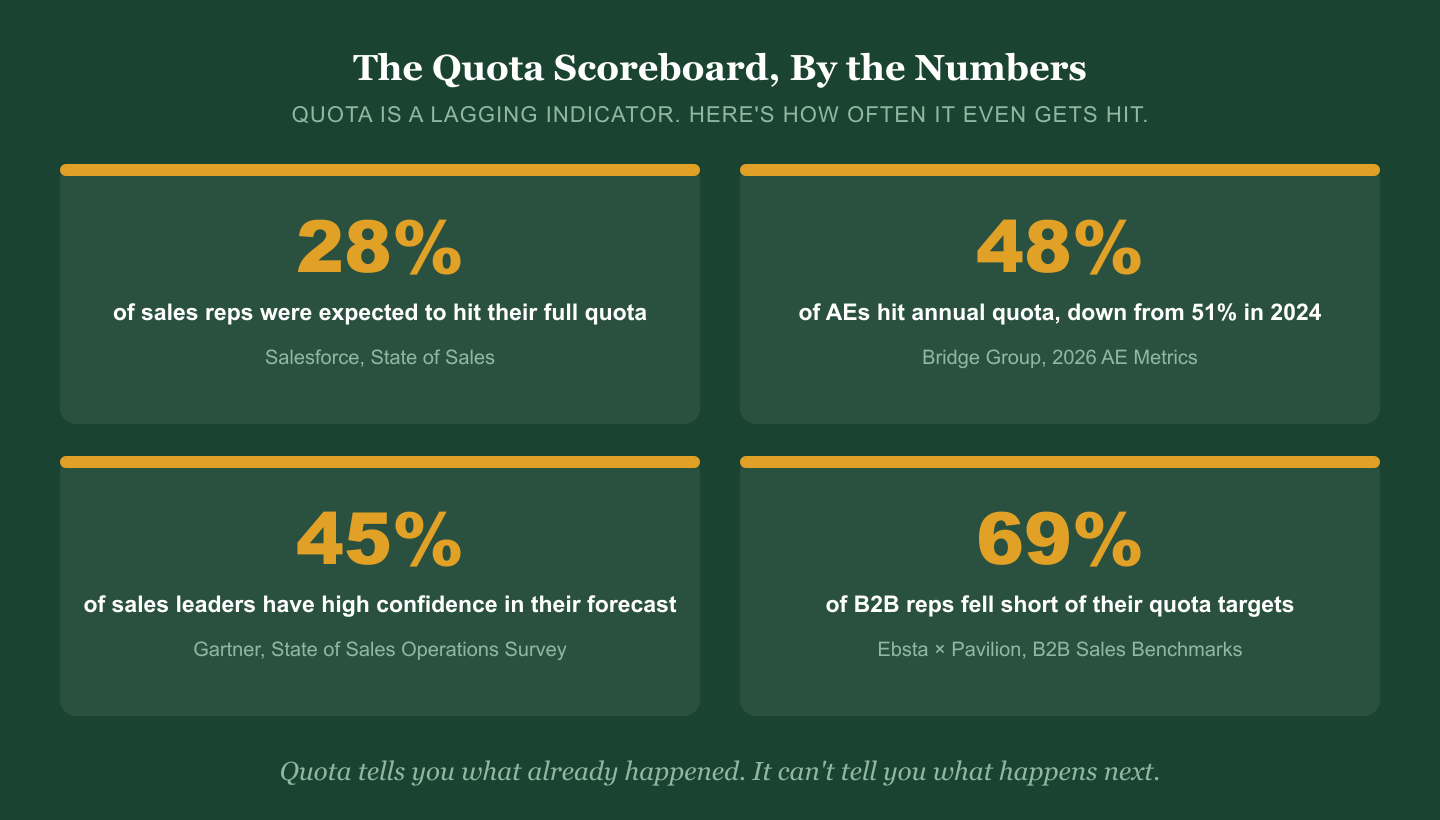
- Quota is a lagging indicator. It tells you what already happened, and it doesn't even do that reliably. Only 28% of reps were expected to hit their full quota (Salesforce State of Sales), and just 48% of AEs actually hit annual quota (Bridge Group, 2026).
- The leading indicator to watch every week is qualified pipeline created: the new qualified opportunities you add to your pipeline each week, measured in dollars or count.
- It works because revenue is delayed pipeline. If your sales cycle runs 90 days, the deals you'll close next quarter are being created, or not created, right now.
- The word "qualified" does all the work. Ebsta and Pavilion's benchmark data showed pipeline generation rising 23% while win rates fell, which means raw volume just fills your CRM with polite strangers.
- The math fits on a napkin: revenue target divided by win rate equals the qualified pipeline you need to create. A Fractional Sales Leader builds the system that keeps that number honest every week.
It's Probably Not What You Think
Ask ten founders what number they watch to know if revenue is coming, and nine of them will say some version of quota. Closed-won this month. Percent to target. The forecast column in the CRM. All of it is the same thing wearing different clothes: a scoreboard that updates after the game is over.
When I ask what actually predicts their revenue, I get a grab bag. Meetings booked. Number of conversations. MQL to SQL conversion. One founder told me, with a straight face, "a good attitude." I love the optimism. It doesn't forecast anything.
So here's the direct answer. The leading indicator to put at the top of your weekly meeting is qualified pipeline created: the dollar value of new opportunities that pass a real qualification bar, added to your pipeline each week. Not total pipeline. Not activity. Not vibes. New qualified pipeline, created, on a clock.
Qualified pipeline created is the front end of a bigger picture. Once deals are in the pipeline, how fast they turn into revenue depends on four levers: number of opportunities, deal size, win rate, and cycle length. That formula is sales velocity, and it's the companion to this weekly number.
If you're a founder running a $1M to $10M ARR company and revenue feels random, I'd bet money you're tracking the wrong end of the funnel. Let me show you the evidence, then the math.
Why Quota Can't Predict Anything
Quota is a rearview mirror with a broken bulb
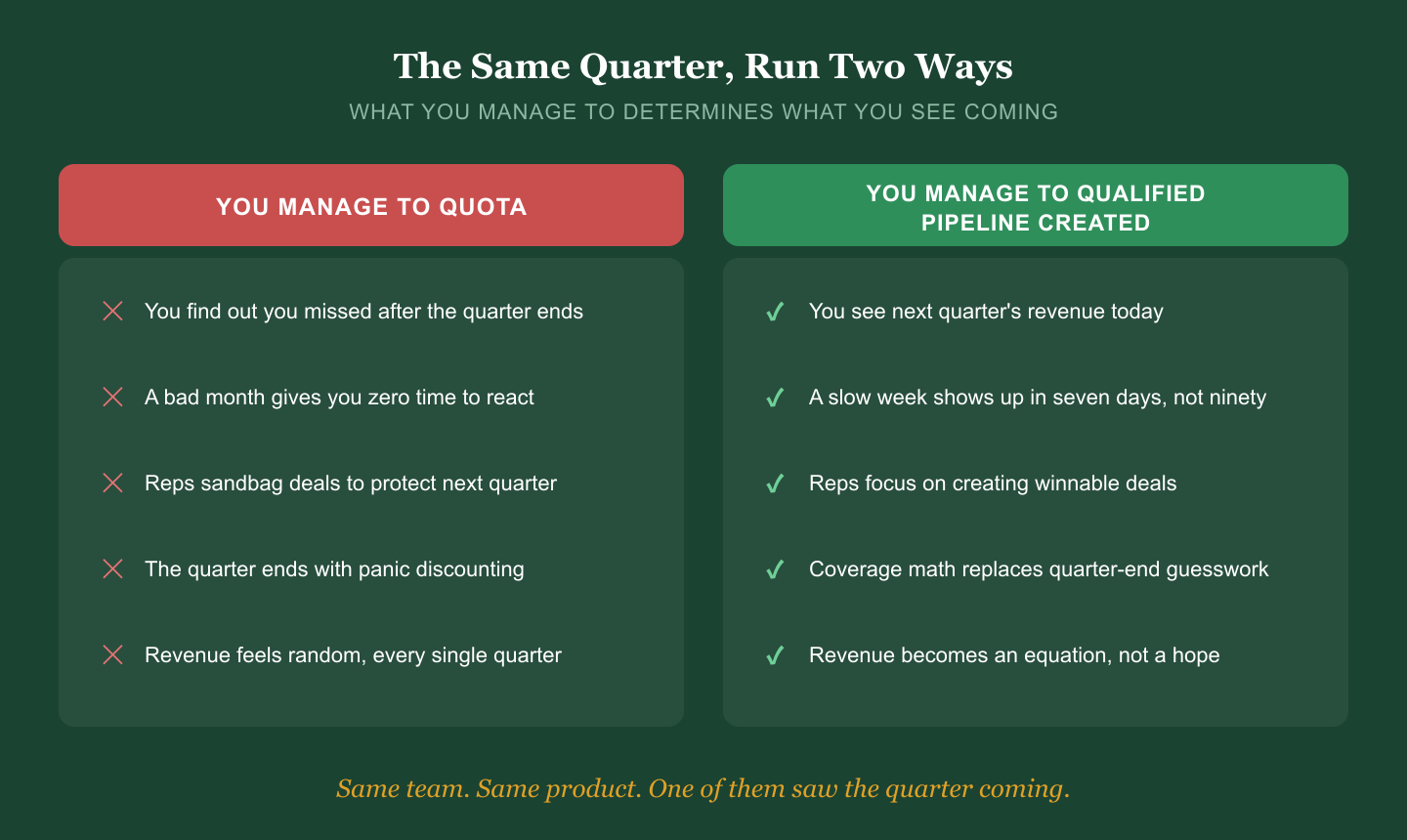
Quota attainment is what analysts call a lagging indicator. It measures output after the fact. By the time your rep misses, the quarter that caused the miss ended 90 days ago, and there's nothing left to manage. You can't coach a closed month. You can't prospect backwards.
And here's the part that should bother you more: quota isn't even a reliable record of the past. Salesforce's State of Sales research found only 28% of sales reps were expected to hit their full quota. The Bridge Group's 2026 AE report, built from 158 B2B companies, put annual quota attainment at 48%, down from 51% in 2024. When a scoreboard says most of the league is losing, the scoreboard isn't measuring skill anymore. It's measuring wishful target-setting.
The forecast built on quota isn't trusted by the people who build it
Gartner's State of Sales Operations survey found that only 45% of sales leaders and sellers have high confidence in their own organization's forecast accuracy. Read that again. The majority of people producing revenue forecasts don't believe their own numbers. Ebsta and Pavilion's B2B benchmarks, drawn from millions of opportunities, showed 69% of reps falling short of quota targets. If quota predicted revenue, none of these numbers could exist.
What Qualified Pipeline Created Is, and Why It Leads Revenue
What it is, exactly
Qualified pipeline created is the total value of new opportunities that entered your pipeline this week and passed a defined qualification bar. Two conditions, both mandatory. It has to be new, created this period, not deals that already existed and moved stages. And it has to be qualified, meaning a real person with a real problem, real authority, and a real timeline agreed to a next step. Count it weekly, in dollars or in number of opportunities. At your size, both fit on an index card.
Why it predicts revenue when nothing else does
Because revenue is delayed pipeline. Every dollar you close this quarter entered your pipeline one sales cycle ago. If your average cycle is 90 days, your Q4 revenue isn't being decided in Q4. It's being decided right now, by how much qualified pipeline you're creating this week. That's not a theory, it's arithmetic. Quota tells you the score after the whistle. Qualified pipeline created tells you the score 90 days before anyone else can see it, while there's still time to change it.
What about meetings, conversations, and MQLs?
Fair question, because those are the usual suspects. Meetings booked, conversations held, MQL to SQL conversion, they're all upstream inputs, and they all matter. But each one can look healthy while revenue quietly dies. You can book twenty meetings with people who'll never buy. You can convert MQLs that were never real. Qualified pipeline created is where every one of those activities either becomes money in motion or gets exposed as noise. It's the single point in your funnel where effort converts to a predictable number. And a good attitude? Keep it. I just can't multiply by it.
Quota is the score after the whistle. Qualified pipeline created is the score 90 days early, while you can still do something about it.
The Word That Does All the Work: Qualified
Here's where most teams break this metric. They hear "track pipeline creation" and start stuffing the CRM. Ebsta and Pavilion's benchmark report caught this on camera: pipeline generation rose 23% while win rates fell. More pipeline, less revenue. That's what happens when volume gets rewarded and qualification doesn't. The same research found 61% of lost deals were reported lost to "indecision," which is what a rep writes down when the deal was never real in the first place.
The four questions that make an opportunity count
An opportunity counts as qualified pipeline when you can answer yes to four questions. Did they describe a problem your product solves, in their own words, with a cost attached? Are you talking to someone who can spend money, or someone who can walk you to that person? Did they give you a reason this gets solved this year and not "someday"? And did they agree to a specific next step with a date on it? Miss any one of those and it's not pipeline. It's a nice conversation wearing a pipeline costume.
A pipeline full of unqualified deals isn't optimism. It's a forecast you'll have to apologize for in 90 days.
How to Track It Without a RevOps Team
The napkin math
You don't need a dashboard, you need division. Say you want $250,000 in new ARR next quarter. Your win rate on qualified deals is 25%, and your average deal is $25,000. Then you need $1,000,000 in qualified pipeline created this quarter, which is 40 qualified opportunities, which is about three per week. That's the whole system. Three per week and you're on plan. Two per week and you already know next quarter misses, ten weeks before quota would've told you.
Make it the first number in your weekly meeting
Whatever your version of three-per-week is, that number opens your Monday sales meeting. Not the forecast, not the deals everyone loves talking about. First question: how much qualified pipeline did we create last week? If the answer is on target, everything downstream is a coaching conversation. If it's short, you know exactly where the fire is, and you found out in seven days instead of ninety. This is also the number that makes hiring honest. A rep can get lucky on closes for two quarters. Nobody gets lucky on pipeline creation for two quarters.
What This Has to Do With Getting Out of Founder-Led Sales
Here's the connection most founders miss. The reason you can't step out of sales isn't that nobody can close like you. It's that all the pipeline creation lives in your head, your network, and your calendar. When you sell, qualified pipeline gets created. When you get pulled into product or fundraising for three weeks, creation stops, and revenue craters a quarter later. You've felt that whiplash. That's not a closing problem. That's a creation problem with your name on it.
This is exactly what a Fractional Sales Leader builds first. Not a fancy tech stack. A pipeline creation system: a qualification bar everyone uses the same way, a weekly creation target derived from your actual win rate and deal size, and a meeting rhythm that inspects it before anything else. Once that number is owned by a system instead of by you, revenue stops depending on your calendar. That's the real exit from founder-led sales, and it costs a fraction of the $250K-plus gamble of a full-time VP of Sales you're not ready for.
You don't need a bigger quota. You need a weekly number that makes quota boring, because by the time the quarter closes, you already knew.
Frequently Asked Questions
Q: What is qualified pipeline created?
Qualified pipeline created is the dollar value (or count) of new sales opportunities added to your pipeline in a given period, usually a week, that pass a defined qualification bar: a real problem with a cost, access to the buyer, a timeline, and an agreed next step. It excludes existing deals that merely changed stages. It's a leading indicator, which means it predicts future revenue instead of reporting past revenue the way quota attainment does.
Q: Is quota a leading or lagging indicator?
Quota attainment is a lagging indicator. It measures results after the selling is finished, so it can't warn you about a bad quarter until the quarter is already lost. It's also unreliable as a benchmark: Salesforce's State of Sales found only 28% of reps were expected to hit full quota, and the Bridge Group's 2026 report put annual attainment at 48%. Leading indicators, like qualified pipeline created, measure the causes of revenue while you can still influence them.
Q: How much qualified pipeline do I need to hit my revenue target?
Divide your revenue target by your win rate on qualified deals. If you need $250,000 next quarter and you win 25% of qualified opportunities, you need $1,000,000 in qualified pipeline created this quarter. Divide that by your average deal size to get a weekly opportunity count. That's your version of the common 3x to 4x pipeline coverage rule, except built from your own numbers instead of someone else's benchmark.
Q: What counts as a qualified opportunity?
Four yeses. The prospect described a problem you solve, in their own words, with a cost attached. You're connected to someone with buying authority, or a direct path to them. There's a reason it gets solved this year, not someday. And they agreed to a dated next step. If any answer is no, keep working it, but don't count it. The moment "maybes" enter your pipeline number, the metric stops predicting anything.
Q: Why not just track meetings booked or MQL conversion instead?
Because activity metrics can all look healthy while revenue dies. Twenty meetings with the wrong people is twenty wasted hours that shows up as a great week on an activity dashboard. Ebsta and Pavilion's data showed pipeline generation rising 23% while win rates fell, proof that raw volume doesn't convert. Meetings, conversations, and MQLs are inputs worth watching, but qualified pipeline created is where they either turn into future revenue or get exposed as noise.
Q: How does a Fractional Sales Leader help with pipeline creation?
A Fractional Sales Leader turns pipeline creation from a founder habit into a company system. That means a written qualification bar every rep applies the same way, a weekly creation target reverse-engineered from your win rate and deal size, a Monday meeting that inspects creation before forecasts, and an Accountability Document so each rep owns a specific number. You get senior sales leadership for a fraction of the cost of a full-time VP of Sales, and revenue stops depending on whether you personally sold that week.
Want to know your number?
If you're a $1M–$10M founder and revenue feels like a coin flip every quarter, let's talk. Thirty minutes. We'll calculate your weekly qualified pipeline target from your real win rate and deal size, and you'll leave knowing exactly what number to watch on Monday mornings.
Schedule a 30-Minute CallAbout the Author
Louie Bernstein
Fractional Sales Leader with 50 years of sales experience helping $1M–$10M ARR companies build scalable, repeatable sales systems. Founder of MindIQ (INC 500). LinkedIn Top Voice in Sales Management, Sales Operations, and Sales Coaching.