Key Takeaways:
- A qualified deal is not a good conversation or a warm feeling. It's a prospect with a real problem, real budget, real decision authority, and a real deadline.
- 67% of lost sales trace back to poor qualification (Surfe). Most reps don't lose on price or product. They lose because the deal was never real.
- Only about 1 in 4 leads is actually sales-ready (Spotio). If your reps chase all of them, they're spending most of their week on deals that were never going to close.
- Qualified leads convert at roughly 40%. Unqualified ones convert at 11% (Leads at Scale). Same effort, four times the return.
- The fastest way to grow revenue isn't more leads. It's a strict, written qualification standard that everyone on your team applies the same way, every time.
Ask five of your salespeople what a qualified deal is and you'll get five different answers. That's the whole problem in one sentence.
One rep thinks it's qualified because the prospect was friendly and asked for a proposal. Another thinks it's qualified because they got a demo booked. A third thinks it's qualified because the prospect said "this looks great, let me talk to my team." None of those are qualified deals. They're conversations. And your pipeline is full of them.
I've spent fifty years in sales, and I can tell you the single most expensive mistake a growing company makes isn't a bad hire or a weak pitch. It's a loose definition of the word "qualified." When nobody agrees on what it means, everybody guesses. And guessing is how a $2M company ends up with a $6M pipeline that closes like a $900K one.
If you're a founder between $1M and $10M in ARR, this is costing you right now. Not someday. This quarter. Let me show you exactly where, and how to fix it.
What a Qualified Deal Actually Is
A qualified deal is a prospect you've confirmed can and will buy. Not one you hope will. One you've verified.
Strip away the jargon and every good qualification framework, BANT, MEDDIC, whatever your team likes, is asking the same four questions. Is there a real problem worth money? Is there money? Is the person you're talking to able to spend it? And is there a reason to act now instead of next year?
The four things that have to be true
A real, quantified problem. Not "it'd be nice to improve this." A problem the prospect can put a number on. If they can't tell you what the problem costs them, they haven't felt it enough to pay to fix it.
Budget that exists. Not "we could probably find the money." Confirmed budget, or a confirmed path to it. 61% of leads that get disqualified fail here first, on budget or authority. The money either exists or it doesn't, and hope isn't a line item.
Access to the real decision-maker. You've either met the person who signs, or you have a committed path to them. A champion who loves you but can't sign anything is not authority. That's the single most common way a "sure thing" dies at the finish line.
A real timeline. An actual event, deadline, or consequence driving the decision. "Sometime this year" isn't a timeline. It's a polite way of saying no that hasn't happened yet.
A deal missing even one of these four isn't a deal yet. It's a maybe wearing a deal's clothes. Treat it like one.
Notice what's not on that list. Whether they liked you. Whether the demo went well. Whether they said "this is exactly what we need." Those things feel like progress, and that's exactly why they're dangerous. They give a rep permission to move a deal forward without checking the four things that actually matter.
The Real Cost of Skipping Qualification
Loose qualification doesn't announce itself. It hides. It looks like a healthy pipeline right up until the end of the quarter, when half of it evaporates and nobody can tell you why.
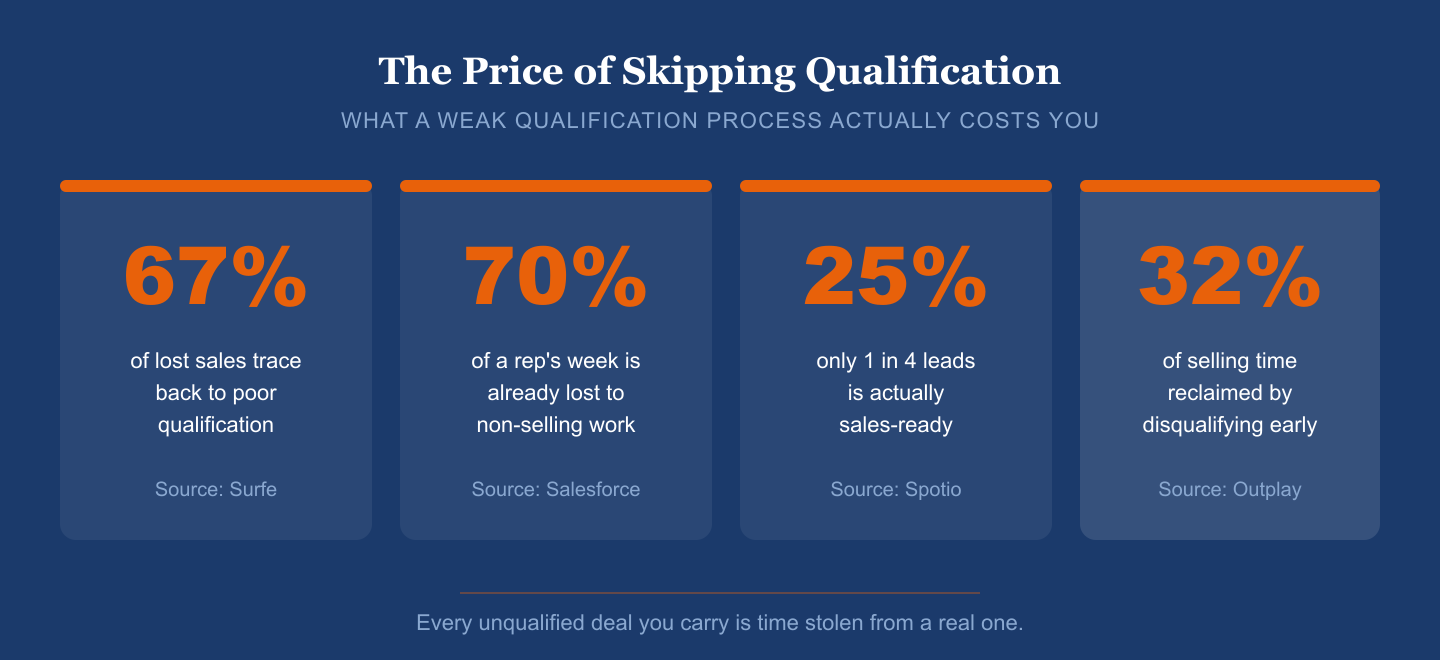
Here's what's actually happening underneath. Your reps are already stretched thin. According to Salesforce's State of Sales research, sales reps spend roughly 70% of their week on things that aren't selling. Admin, CRM entry, internal meetings, research. That leaves them about 30% of their time to actually move deals. Now imagine they spend a big chunk of that precious selling time on prospects who were never going to buy. That's not a small leak. That's the whole boat taking on water.
Where the money actually goes
The numbers are brutal once you line them up. 67% of lost sales trace back to inadequate qualification (Surfe). Only about 25% of the leads handed to sales are truly sales-ready (Spotio), and 79% of marketing-generated leads never convert at all (Trustmary). So if your team is treating every lead as a live deal, three out of four of them are noise, and your reps are burning their limited selling hours sorting it out one call at a time.
Now flip it. When leads are properly qualified, they convert at around 40%. Unqualified leads convert at 11% (Leads at Scale). That's nearly four times the return on the exact same rep, the exact same product, the exact same hours. And teams that disqualify early recover about 32% of their selling time (Outplay). You don't need more leads to grow. You need to stop pouring effort into the wrong ones.
Every unqualified deal you carry is time stolen from a real one. That's the hidden tax. You never see the bill, but you pay it every single month in deals you didn't have time to work.
And it doesn't stop at wasted hours. A pipeline full of unqualified deals wrecks your forecast. You can't plan hiring, spend, or cash flow around numbers that are half fiction. Companies that tighten qualification see the opposite. One firm, Microlise, took its forecast accuracy from 25% to 85% just by putting a disciplined qualification standard in place. That's the difference between running a business on data and running it on hope.
Qualified vs. Unqualified: What the Difference Looks Like
On paper, two deals in your pipeline can look identical. Same logo, same deal size, same stage. But one is real and one is a story your rep is telling themselves. The difference is whether the boxes are actually checked, or just assumed.
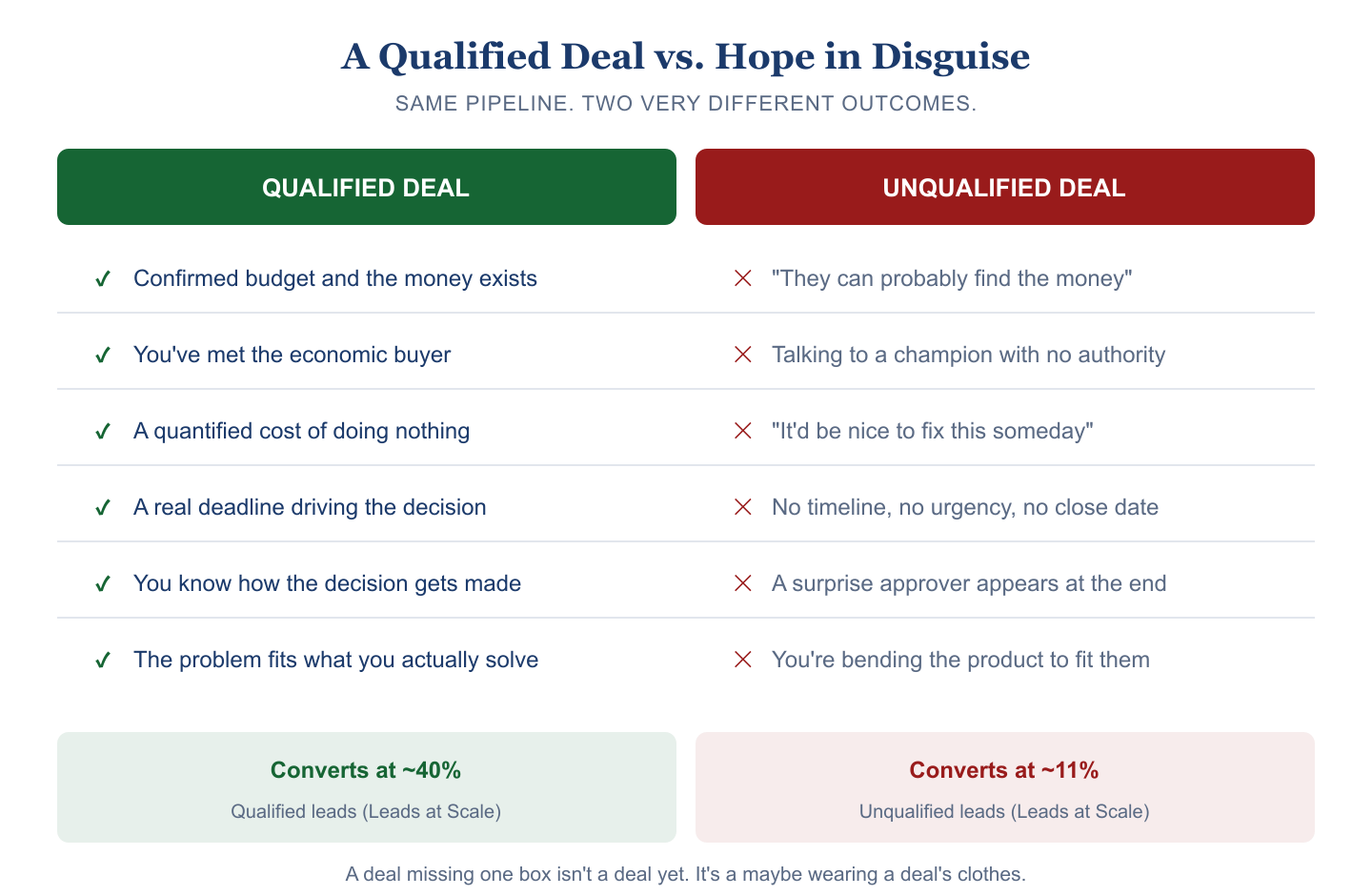
Look at that left column. Every item is something your rep can point to and prove. A confirmed number. A name. A date. The right column is every item a rep fills in with optimism because they don't want to lose the deal by asking a hard question. That fear, the fear of qualifying a deal out, is what keeps bad deals alive.
Why founders get this wrong more than anyone
Here's the uncomfortable part. If you're a founder still running sales, you're the worst offender, and it's not your fault. When you sell, prospects treat you differently. You're the founder. They take your call, they're polite, they say encouraging things, they don't push back hard. Your authority papers over gaps in qualification you never even notice.
Then you hand that "qualified" pipeline to your first sales rep, and it collapses. The rep doesn't have your halo. The prospect who nodded along with you suddenly has objections, no budget, and three other people who need to weigh in. The deals were never real. They just looked real because of who was asking. That's the trap of founder-led sales, and it's why a written standard matters more than any individual's instincts.
How to Build a Qualification Standard That Sticks
A qualification process isn't a framework you print out and forget. It's a standard your whole team applies the same way, on every deal, whether you're watching or not. Here's how you build one that actually holds.
Write it down and make it binary
Qualification criteria that live in someone's head aren't criteria. They're opinions. Write down exactly what has to be true for a deal to enter your pipeline, and make each item a yes or no. "Confirmed the budget exists" is binary. "Seems like they have budget" is a guess. Only about 40% of companies apply their qualification criteria consistently (Spotio), and the ones that don't are the ones with the fiction-filled pipelines. The written standard is what turns qualification from a feeling into a checkpoint.
Qualify on the first real conversation
The best place to qualify is early, on the discovery call, before you've invested hours in a proposal. That's the entire point of discovery. You're not there to pitch. You're there to find out whether this is a deal worth pursuing. Ask about the problem, the cost of that problem, the budget, the decision process, and the timeline. If you can't get real answers, you don't have a qualified deal, and no amount of follow-up will change that.
Make the pipeline reflect reality, not activity
Your pipeline is not a list of everyone you've talked to. It's a list of qualified deals with a real path to closing. If a deal can't clear your written standard, it doesn't go in, no matter how nice the conversation was. A smaller pipeline that closes at 40% beats a bloated one that closes at 11% every quarter of the year. When your reps understand that a clean pipeline makes their own numbers go up, they stop padding it.
The goal of qualification isn't a bigger pipeline. It's a truer one. A forecast you can actually run your business on.
This is exactly the kind of system a Fractional Sales Leader installs. It's not a motivational speech or a new tool. It's a written standard, a pipeline that means something, and a team trained to apply the same bar to every deal. Companies with full qualification discipline see 18% higher win rates and 24% larger deal sizes (MEDDIC benchmark data). That's not from working harder. It's from stopping the waste.
Disqualifying Is a Skill, Not a Failure
Most reps treat a "no" like a loss. It isn't. A fast, clean disqualification is one of the most valuable outcomes a salesperson can produce, because it hands them back their most limited resource. Time.
The reps who hit their numbers aren't the ones who chase every deal to the bitter end. They're the ones who figure out quickly which deals are real and pour everything into those. Disqualifying early isn't giving up. It's aiming. And it's the exact behavior your qualification standard is designed to produce.
Train your team to be as proud of a well-reasoned disqualification as a closed deal. When a rep tells you "I qualified this one out, here's why," that's a rep who understands the job. That's a rep whose forecast you can trust. And a forecast you can trust is worth more to a founder at your stage than almost anything else in the business.
Frequently Asked Questions
Q: What is a qualified deal in sales?
A qualified deal is a prospect you've confirmed can and will buy. Four things have to be true: they have a real, quantified problem; the budget to solve it exists; you have access to the person with authority to say yes; and there's a real timeline driving the decision. If even one of those is missing or assumed rather than verified, the deal isn't qualified yet. It's a conversation that might become a deal, and it shouldn't be treated as, or forecast as, real revenue.
Q: What's the difference between a qualified and an unqualified lead?
A qualified lead has been verified against a real standard: confirmed problem, budget, authority, and timeline. An unqualified lead is anyone who's shown interest but hasn't been checked against that bar. The gap matters more than people think. Qualified leads convert at around 40%, unqualified ones at 11% (Leads at Scale). Only about 25% of the leads handed to sales are actually sales-ready (Spotio), so treating every lead as qualified means most of your team's selling time gets spent on deals that were never going to close.
Q: Why does qualifying prospects early save money?
Because your reps' time is your most expensive and most limited resource. Salesforce research shows reps already spend about 70% of their week on non-selling work, leaving only 30% for actual selling. Every hour spent building a proposal for a prospect with no budget is an hour stolen from a real deal. Teams that disqualify early recover roughly 32% of their selling time (Outplay). Qualifying early doesn't just save hours, it redirects them to the deals that pay.
Q: Isn't BANT outdated? Should I use MEDDIC instead?
Don't get lost in the framework wars. BANT, MEDDIC, and the rest are all asking the same core questions about problem, money, authority, and timing. MEDDIC goes deeper on the economic buyer and decision process, which helps in complex enterprise deals, and teams with full MEDDIC discipline see about 18% higher win rates (MEDDIC benchmark data). But the framework isn't what makes the difference. Applying one consistently is. A simple standard your whole team actually uses beats a sophisticated one nobody follows.
Q: My founder-led pipeline looks strong. Why would it collapse when a rep takes over?
Because founders qualify differently without realizing it. When you sell, prospects treat you with deference. They take your calls, they're encouraging, they don't push back hard, and that politeness hides gaps in budget, authority, and urgency you never test. Your reps don't get that halo. The deals that felt solid with you suddenly surface real objections and hidden decision-makers. It's not that your rep is weaker. It's that the deals were never fully qualified. A written standard everyone applies is the only reliable fix.
Q: How do I get my whole team qualifying deals the same way?
Write the standard down and make every criterion a yes-or-no answer, not a judgment call. "Confirmed budget exists" is checkable. "Feels like a good fit" isn't. Then build the standard into your pipeline stages so a deal can't advance until the boxes are actually checked, and coach reps to disqualify out loud without treating it as a loss. Only about 40% of companies apply their criteria consistently (Spotio). Installing that consistency across a team is one of the fastest wins a Fractional Sales Leader delivers.
How much of your pipeline is actually real?
If you're not sure, that's the answer. Let's spend 30 minutes pressure-testing your pipeline against a real qualification standard and finding the deals that were never going to close, so your team can spend their time on the ones that will.
Schedule a 30-Minute CallAbout the Author
Louie Bernstein
Fractional Sales Leader with 50 years of sales experience helping $1M–$10M ARR companies build scalable, repeatable sales systems. Founder of MindIQ (INC 500). LinkedIn Top Voice in Sales Management, Sales Operations, and Sales Coaching.