Key Takeaways:
- The first 90 days aren't about a heroic turnaround. They're about installing a working sales system, in four phases: diagnose, build, coach, prove.
- Unlike a new rep who needs roughly 4.5 months to fully ramp (Zyverno, 2025), a Fractional Sales Leader is productive in week one. There's no ramp. That's the whole point.
- Before day one, we agree on what "success at day 90" actually means. No baseline and no metrics is the number-one reason fractional engagements fail.
- By day 45 you have an Accountability Document, a written sales process, and a clean CRM. By day 90 you have a forecast you can trust and a cadence that runs without you.
- A fractional engagement runs 30–70% cheaper than a full-time VP of Sales (Vantedge, ActivatedScale), and you get a senior operator on day one instead of a nine-month hiring gamble.
- If your "pipeline" is really just a list of nice conversations, the first 90 days will expose that fast. That's a feature, not a bug.
When a founder asks me what to expect in the first 90 days, what they're really asking is: "How fast will this pay off, and am I about to hand my baby to a stranger who breaks it?"
Fair questions. You're doing $1M to $10M in ARR. You built the whole thing on your own back. You're stretched thin, you know founder-led sales won't scale forever, and you're not ready to gamble $250K on a full-time VP of Sales who might not work out. So you're considering a Fractional Sales Leader, and you want to know what you're actually buying in the first three months.
Here's the honest version. This is about setting expectations for onboarding and the initial results. I won't promise you a hockey-stick chart by day 90. Anyone who does is selling you something. What I will promise is a working sales system where there wasn't one, and enough proof by the end of the quarter that you can see exactly where this is going.
Let me walk you through it, week by week.
Before Day One: We Agree on What "Success" Means
The single biggest reason fractional engagements fail has nothing to do with the operator. It's that nobody defined success before the clock started. The 90-day plan lists activities with no metrics, there's no baseline measurement, and at the end everyone judges it on a feeling instead of a number.
I won't let that happen. Before I start, we sit down and agree on what day 90 looks like. Not vague hopes. Specific, measurable outcomes. A clean, qualified pipeline number. A defined sales process. A weekly cadence the team runs on its own. A forecast that's within a reasonable margin of reality. We write it down, and it becomes the yardstick.
This is also where I set the expectation that matters most: a Fractional Sales Leader is not a full-time executive on a smaller check. I'm not here to run a two-year transformation that needs a big team and a budget. I'm here to fix the highest-leverage thing that's stopping you from scaling, and to do it fast. Focus beats ambition every time in a fractional engagement.
"If we can't agree on how we'll measure success before I start, we're not ready to start. A number you didn't set at the beginning is just an opinion at the end."
Here's the map for the 90 days that follow.
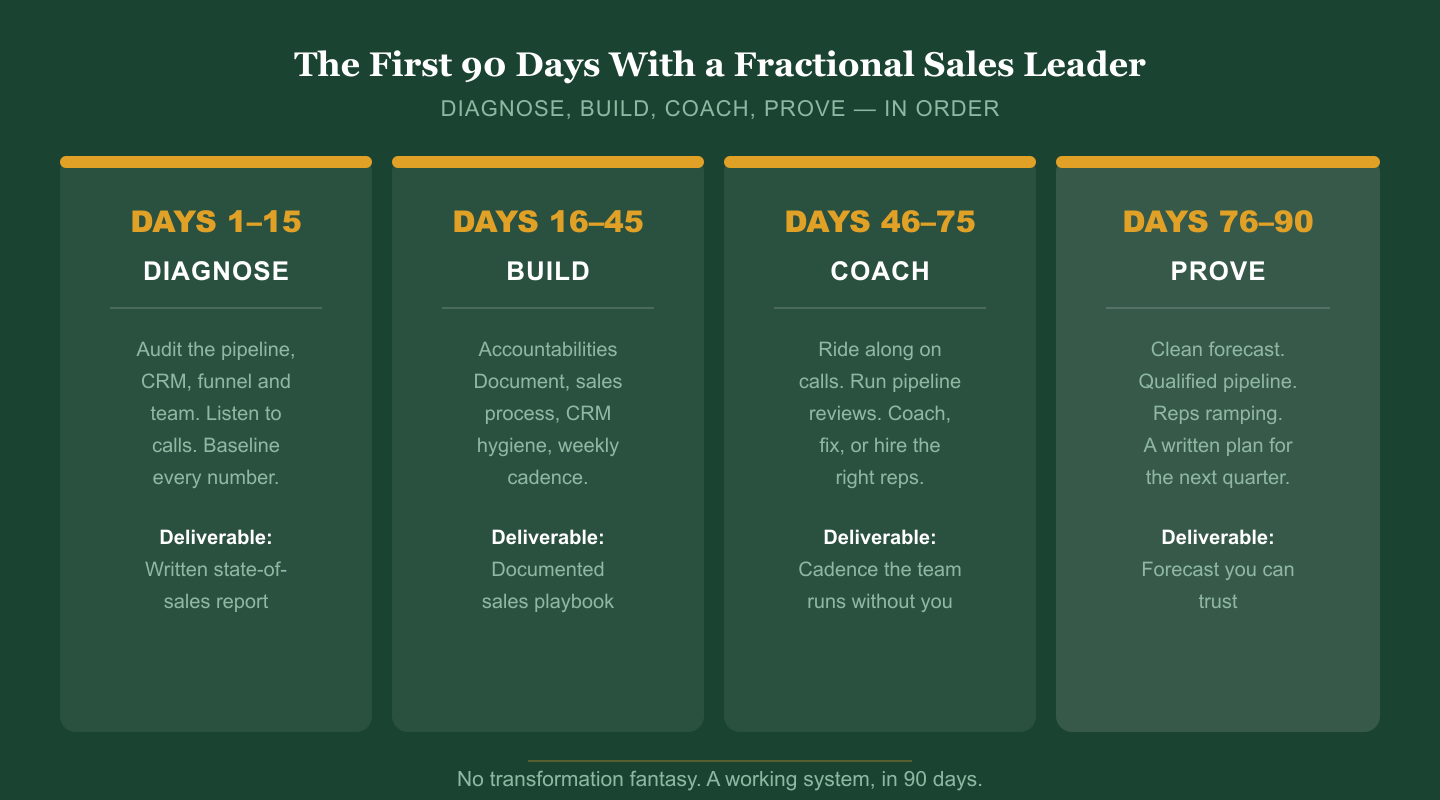
Days 1–15: The Diagnostic
You don't prescribe before you diagnose. The first two weeks, I'm not changing anything. I'm listening, reading, and counting. I want to know exactly what's true right now, in numbers, before I touch a single thing.
The pipeline audit
First thing I do is go deal by deal through your pipeline. Not the summary number. Every deal. Because in most founder-led companies, the pipeline is inflated with deals that were never qualified. That's not a criticism. It's what happens when the founder is charming enough to keep prospects "interested" without ever confirming budget, authority, or a real timeline. Industry data backs this up: 30–40% of the deals sitting in a typical CRM pipeline are phantom or dead (Coffee.ai). We find out which of yours are real.
The CRM and the funnel
Next I look at your data. Where do deals actually come from? What's your win rate by source? How long is your sales cycle, really? This matters more than founders think. When more than a quarter of your CRM data is unreliable, even a good forecast comes out wrong, and 44% of organizations lose more than 10% of annual revenue to low-quality CRM data (Databar.ai). If the numbers aren't trustworthy, fixing that is job one.
The team and the calls
If you have salespeople, I listen to their calls and ride along on their demos. I want to see how they qualify, how they handle objections, and whether they're following any process at all. If you don't have salespeople yet and you're still doing all the selling, I watch you. Either way, by the end of week two I know where the real bottleneck is. It's usually not where the founder thinks it is.
The deliverable at day 15 is a written state-of-sales report. Plain language. Here's what's working, here's what's broken, here's what we fix first, here's the order we do it in. You'll know more about your own sales operation after two weeks than you've known in two years.
Days 16–45: Building the Foundation
Now we build. This is the month where the sales motion stops living in your head and starts living in a system anyone can run. Three things get built.
The Accountability Document
Every seat on the sales team gets a written Accountability Document. It spells out exactly what that role owns, what "good" looks like, and the numbers they're responsible for. No guessing, no "I thought you had that." When people know precisely what they're accountable for, performance problems become obvious fast, and so do your best people. This one document ends more finger-pointing than anything else I install.
The sales process
Then we document the actual sales process. The stages a deal moves through, what has to be true to move from one stage to the next, and what a qualified deal even is. Most founders have never written this down because they've always just known it in their gut. That's exactly why it can't scale. A new rep can't read your gut. They can read a process. This is the difference between a company that can add a salesperson and one that can't.
CRM hygiene and the weekly cadence
We clean the CRM, kill the phantom deals, and set the rules for keeping it clean. Then we stand up the weekly rhythm: a sales meeting with a real agenda and a pipeline review that isn't just a status update. Organizations that fix CRM data quality see forecast accuracy jump 10–15% within 30 days (Coffee.ai). That's not a rounding error. That's the difference between planning your hiring and your cash on real numbers instead of hope.
A process that lives in the founder's head is worth nothing the day the founder gets busy. And you're always busy. That's why you called me.
By day 45, the deliverable is a documented sales playbook. It's the thing you've needed for years and never had time to write.
Days 46–75: Coaching, Cadence, and the Right People
A playbook nobody follows is a document. A playbook the team runs every day is a system. The third month is where I make it stick.
Running the pipeline reviews
I run the weekly pipeline review myself for a few weeks so the team sees what "good" looks like. We inspect deals against the qualification criteria we wrote, not against how the rep feels about them. Deals that don't meet the bar get worked or get killed. This is where founders often exhale for the first time, because they finally see a pipeline number that means something.
Coaching the reps you already have
Most sales problems aren't people problems, they're coaching problems. I work with your existing reps on discovery, qualification, and closing, using the process we built. A lot of underperformers turn out to be perfectly good salespeople who were never given a system. When you give them one, they get better in weeks, not quarters.
Fixing or hiring
Sometimes the answer is a new hire. If we need to add a salesperson, I run the hiring against a scorecard, not a gut feel, so you don't repeat the classic founder mistake of hiring someone you liked in the interview. And I'll tell you straight if someone on the team isn't going to make it. That's a hard conversation founders avoid for months. I don't avoid it, because every month you wait costs you real money.
Days 76–90: Proof, Not Promises
The last two weeks are about proof. We go back to the success definition we wrote before day one and we measure against it. Not vibes. Numbers.
By day 90, here's what you should have in hand: a scrubbed, qualified pipeline where every deal has a real reason to be there. A documented sales process and playbook. A weekly cadence the team runs without you in the room. A forecast that's actually close to reality. And a written plan for the next quarter that says exactly what we do next and what it should produce.
Notice what's on that list and what isn't. A tripled revenue number isn't on it. Ninety days is enough to build the machine and start it running. It's usually not enough to see a full sales cycle close through a brand-new process, especially if your deals take three or four months. What you'll see instead is leading indicators moving in the right direction: better qualified pipeline, shorter stall times, reps following the process, cleaner data. Companies that adopt fractional sales leadership report an average 24% lift in revenue and a 31% rise in sales productivity per rep (FPG), but those show up over the engagement, not in the first 90 days. What the first 90 days buys you is the certainty that it's coming.
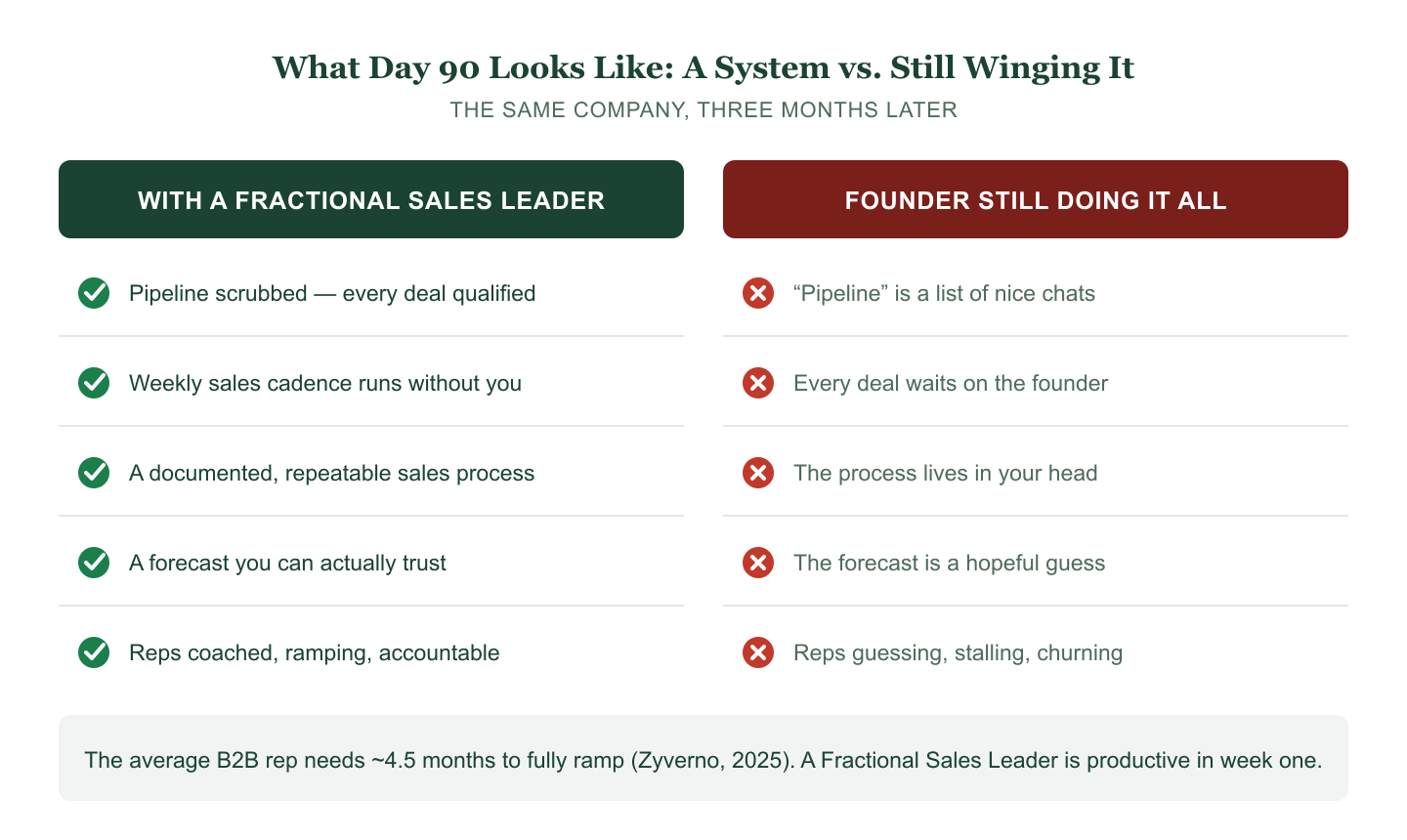
What You Should Not Expect in 90 Days
Let me be as clear about the limits as I am about the wins, because managed expectations are the whole game here.
Don't expect me to close your deals for you. I'm not a fractional salesperson. I build the system and the team that closes deals. If someone tells you they'll personally carry your quota, you're hiring a rep, not a leader.
Don't expect the founder to disappear from sales overnight. Getting you out of founder-led sales is a transition, not a light switch. In the first 90 days we build the system that makes it possible. Handing it off fully comes after, once the process is proven and the people are in place.
And don't expect a big team and a big budget. The whole reason this model works for a company your size is that it's capital-efficient. You get a senior operator, part-time, for 30–70% less than a full-time VP of Sales (Vantedge), and you skip the roughly 4.5-month ramp a new hire needs (Zyverno) plus the very real risk they don't work out at all. I helped one client grow 61% year over year working part-time. That's the model working as designed.
Frequently Asked Questions
Q: How soon will I see results from a Fractional Sales Leader?
You'll see structural results almost immediately: a cleaned pipeline, a written process, and a real forecast within the first 30 to 45 days. Revenue results depend on your sales cycle. If your deals close in a month, you may see movement inside 90 days. If they take three or four months, the first full cycle through the new process closes after the initial quarter. What you get in the first 90 days is proof the system works and leading indicators pointing the right way, not a finished revenue number.
Q: What's the difference between the first 90 days with a Fractional Sales Leader and hiring a VP of Sales?
A full-time VP of Sales needs to be recruited, which takes months, then ramped, which takes months more. The average sales hire needs about 4.5 months to become fully productive (Zyverno). A Fractional Sales Leader is a senior operator who's productive in week one, costs 30–70% less than a full-time VP (Vantedge), and carries none of the severance risk if the fit is wrong. For a company at $1M–$10M ARR that isn't ready to bet $250K on a full-time hire, that's the point of the model.
Q: Will a Fractional Sales Leader close deals for me?
No, and you should be wary of anyone who says they will. A Fractional Sales Leader builds the process, the pipeline discipline, and the team that closes deals repeatably. Someone who personally carries your quota is a salesperson, not a leader, and the day they leave you're back where you started. The goal is a system that outlasts any single person, including me.
Q: How much time will this take from me and my team?
The first two weeks need the most of your time, because I'm learning your business and I need your context. Expect a few hours a week for the diagnostic. After that it drops. Once the cadence is running, you're spending less time on sales, not more, because the meetings have agendas, the pipeline reviews itself against real criteria, and you're not the answer to every question anymore. That reclaimed time is one of the main reasons founders do this.
Q: What if you find out my sales team, or my process, is worse than I thought?
That happens, and it's better to know. The diagnostic is designed to surface exactly that. If a rep isn't going to make it, I'll tell you early instead of letting it drag. If the "pipeline" is mostly wishful thinking, we'll see it in week one. None of that is a reason to panic. It's the reason to have someone senior looking, because every month you don't know is a month you're making decisions on bad information.
Q: What happens after the first 90 days?
We use the day-90 plan we wrote to decide the next quarter. Usually that's executing the system we built: coaching the team deeper, refining the process on real data, and continuing to move you out of day-to-day selling. Some founders keep a Fractional Sales Leader ongoing as their part-time head of sales. Others use the engagement to get the system and the first hires in place, then take it from there. Either way, you own the playbook. It doesn't leave when I do.
You've got 90 days either way.
In 90 days you'll either still be the bottleneck, or you'll have a sales system that runs without you. Let's spend 30 minutes on where your sales operation actually stands and what the first quarter would look like.
Schedule a 30-Minute CallAbout the Author
Louie Bernstein
Fractional Sales Leader with 50 years of sales experience helping $1M–$10M ARR companies build scalable, repeatable sales systems. Founder of MindIQ (INC 500). LinkedIn Top Voice in Sales Management, Sales Operations, and Sales Coaching.