By Louie Bernstein • March 2026
Key Takeaways:
- Hiring a single salesperson is one of the most common and expensive mistakes founders make, and it is entirely predictable.
- One rep creates a single point of failure. When they leave, your entire sales operation resets to zero overnight.
- Hiring salespeople in pairs costs 30–40% more upfront and delivers 10 times the operational stability.
- Two reps create healthy competition, mutual accountability, and the foundation for your first sales manager, all without a VP hire.
- Before you hire anyone, close at least 10 deals yourself and document the process. No salesperson should have to figure it out alone.
You are finally ready to hire your first salesperson.
You have closed 10 deals yourself. You know what works. You have started documenting the process. You are burning out, and you know it is time to get some help.
So you run a sales hiring process. You interview candidates. You hire the best one.
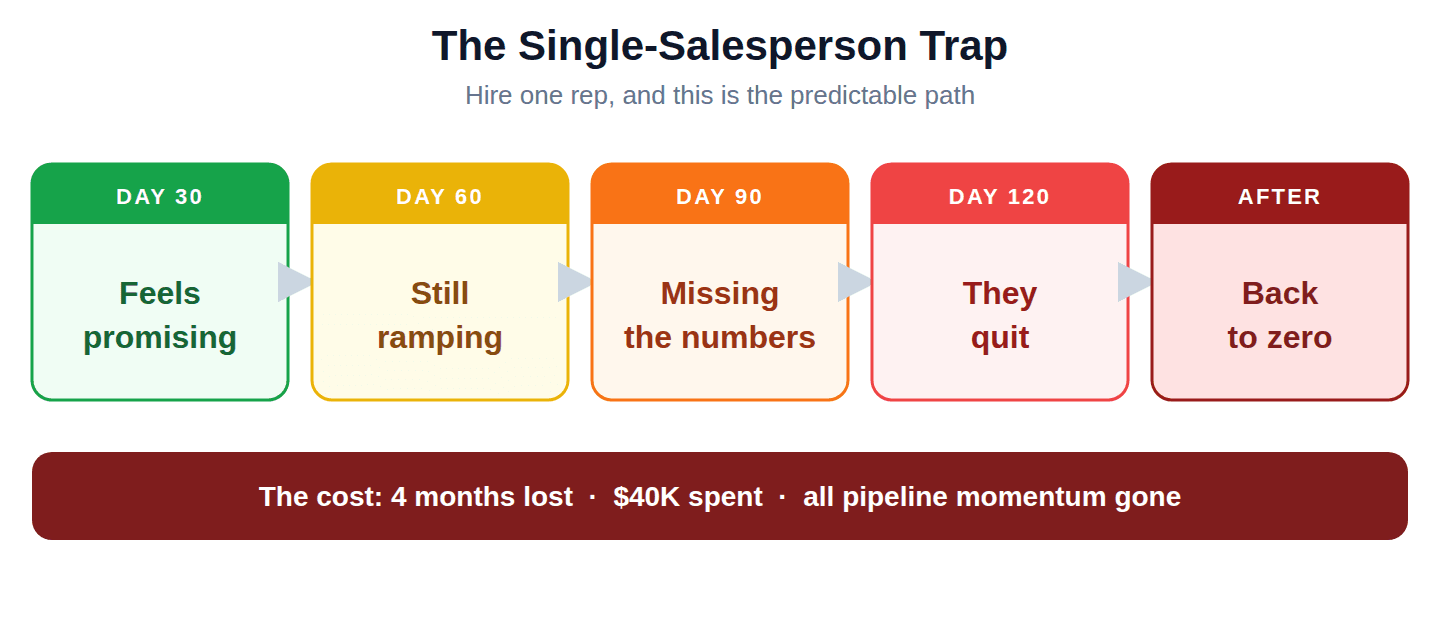
Thirty days in, things feel promising. Sixty days in, they are still ramping. Ninety days in, they are not hitting the numbers you expected. At Day 120, they quit.
And you are right back where you started. Except now you have lost four months, $40,000, and all the pipeline momentum you had built.
This is the single salesperson trap. And it is entirely predictable — once you know to look for it.
Most founders do not realize it: hiring one salesperson is almost always the wrong move. And the fix is simpler and more affordable than you think.
Why One Sales Hire Is a Fragile System
When you hire one salesperson, you have not built a sales team. You have hired a person. And people quit. They get sick. They get recruited by a competitor who pays $10,000 more. They underperform and you have to let them go.
Any one of those events resets your entire sales operation to zero.
Think about what actually happens when your single rep leaves:
- Your pipeline disappears with them
- You step back into every deal they were managing
- You are posting a new job listing while simultaneously closing deals, running the company, and trying to onboard whoever comes next
- You lose 90–120 days of momentum in a business where every quarter matters
You have not just lost an employee. You have lost the entire sales function you spent months building.
Now compare that to what happens if you hired two salespeople and one leaves. Your sales function keeps running. You are not in crisis mode. One rep continues building pipeline while you replace the other.
One rep is not a sales team. It is a single point of failure dressed up as a sales team.
The Math Most Founders Never Run
The objection I hear every time: "Louie, I can barely afford one salesperson. How am I supposed to hire two?"
Fair question. Let's run the numbers honestly.
Scenario A: You Hire One Rep
Year 1 total cost: $70,000 salary + $15,000 recruiting fees + $10,000 ramp cost = $95,000.
They hit quota at 80% in months 7–12. You generate roughly $120,000 in new revenue from their effort. They quit at Month 13. You spend another $15,000 to replace them and lose four months of momentum.
Net: You are roughly breakeven after 18 months with no system to show for it.
Scenario B: You Hire Two Reps
Year 1 total cost: $140,000 salary + $20,000 recruiting + $15,000 ramp = $175,000.
Rep A hits 75% of quota in months 7–12. Rep B hits 85%. Combined new revenue: $210,000. Rep A leaves at Month 14. Rep B covers while you hire. No disruption. No crisis.
Net: A running sales function, a rep who has emerged as your team lead, and the foundation for a high-performing sales team.
Hiring salespeople in pairs does not cost twice as much. It costs 30–40% more and gives you 10 times the stability.
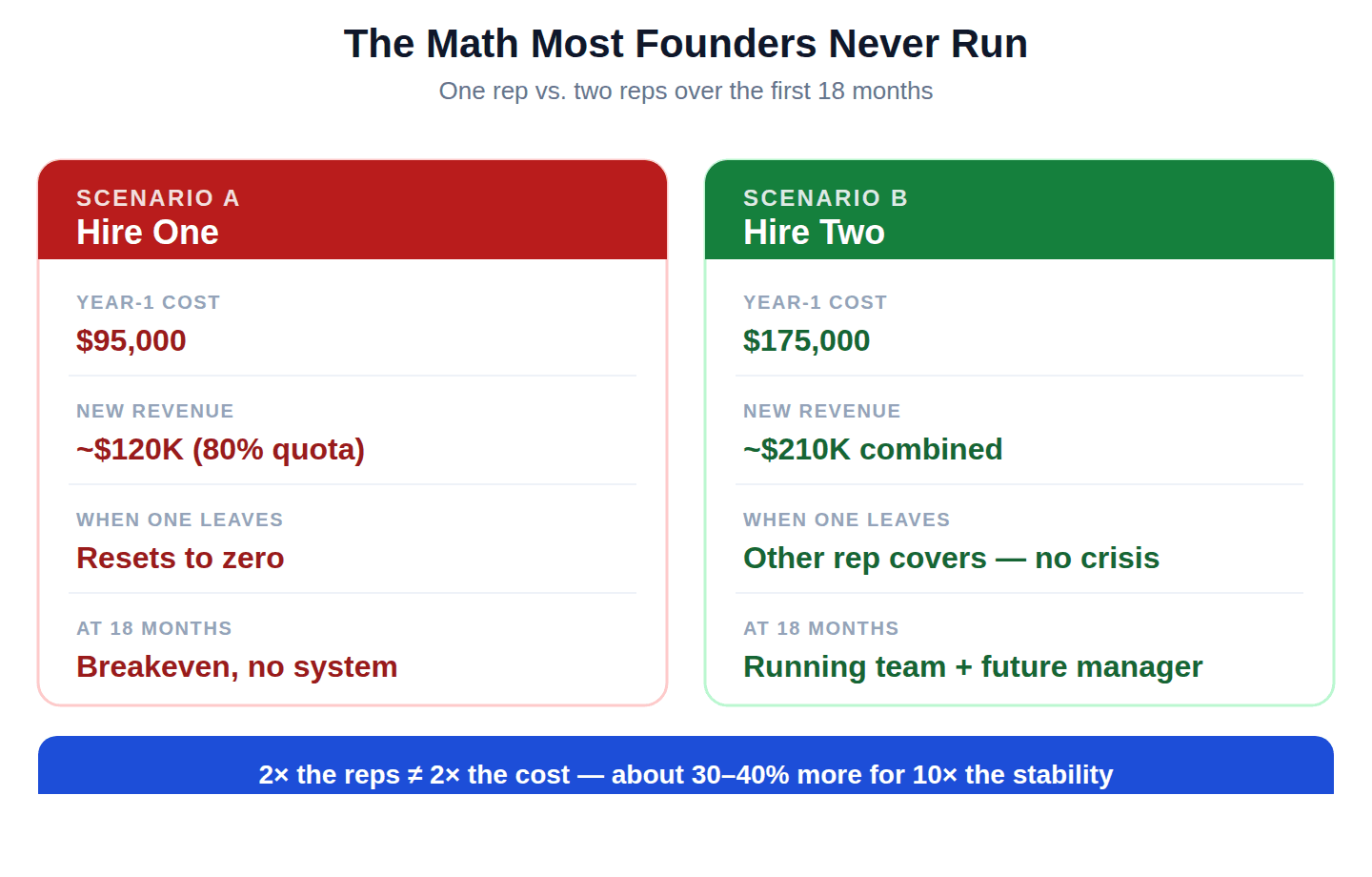
This is the math most founders never run. When you see it laid out clearly, the decision becomes obvious.
The Hidden Benefit: You Get Your First Sales Manager Without Hiring One
Here is what almost no one talks about when it comes to recruiting sales reps in pairs.
If both reps work out — and with a proper sales hiring process, the odds are meaningfully better than a single bet — after 12 to 18 months one of them will naturally emerge as the leader. They are the one the other rep goes to with questions. The one who steps up in the weekly pipeline review. The one who holds the team accountable without being asked.
That person is your first sales manager.
You did not have to post the job. You did not have to pay a VP of Sales salary and equity package. You grew your manager from within your own team — from the reps who already know your product, your customers, and your proven and repeatable sales process.
This is how durable sales organizations get built. Not top-down with expensive executive hires. Bottom-up, by letting the best operator emerge naturally.
The rep who outperforms — and helps their peer do the same — is your future sales manager. Hire two and you have already started building your management bench without a VP hire.
The Competition Effect: Why Two Reps Outperform the Sum of Their Parts
One more effect happens when you hire salespeople in pairs that never gets mentioned in any sales hiring strategy guide.
They push each other.
This does not require a stack ranking or a formal leaderboard. It does not require manufactured pressure or aggressive competition. It just requires visibility into each other's activity.
When Rep A sees Rep B booked four discovery calls on Tuesday, Rep A books five on Wednesday. When Rep B sees Rep A close a deal they had been chasing for six weeks, Rep B works harder to close their own stalled opportunities.
This is human nature. We are wired to respond to peers, not just managers.
A single rep has only their own past performance as a benchmark. That is a weak motivational engine. Two reps create a dynamic where they pull each other toward higher performance simply by being visible to each other.
The founder who hires two reps typically gets more total output than two individual reps would produce independently. That is the competition effect — and it is free.
The Non-Negotiable Prerequisite: Close 10 Deals Yourself First
Before any of this applies to you, there is one requirement that cannot be skipped.
Do not hire any salesperson, one or two, until you have personally closed at least 10 deals and written down what happened in each one.
Why This Is Not Optional
If you hand a new rep a vague product description and tell them to "start selling," you have not hired a salesperson. You have hired a very expensive experiment.
Every rep you hire without a documented process will spend months figuring out what to say, how to qualify, how to handle objections, and how to close. That figuring-out happens on your pipeline and your time.
When you close the first 10 deals yourself, you learn things no one else can tell you:
- Which buyer profile closes fastest and at the highest value — your true Ideal Customer Profile
- What objections surface in every single sales conversation and what actually resolves them
- Which discovery questions unlock the most productive conversations
- What a typical sales cycle looks like and what causes deals to stall
That knowledge becomes your Sales Playbook: a documented, proven and repeatable process that gets new reps producing in 30 days instead of 90.
Version 1 of Your Sales Playbook Needs Four Things
- Your Ideal Customer Profile: A specific written description of who you target and why they buy
- Your discovery questions: The exact questions you ask to qualify and advance a prospect
- Your objection responses: The 5–10 objections that come up in almost every deal, and your proven responses
- Your follow-up sequence: What happens after the first call, the demo, the proposal
Four sections. A competent rep can internalize it in a day and begin applying it in a week. Without it, they are winging it. And winging it is the most expensive thing your sales team can do.
The Structured Hiring Process for Your First Two Reps
Step 1: Write the Ideal Candidate Profile Before You Post Anything
The job posting tells candidates what you need. The Ideal Candidate Profile tells you who to look for, with enough specificity to actually evaluate whether any given candidate is the right fit.
The profile describes: the sales environment they must be comfortable in (early-stage, no brand recognition, outbound-heavy), the activities they will do every day, the metrics they will be held accountable to, and the traits that predict success in your specific culture. When your profile is specific, you attract genuine fits and naturally filter out candidates who will struggle.
Step 2: Run Both Searches in Parallel
Interview for both positions simultaneously. This prevents the most common mistake in sales talent acquisition: settling for a B-plus candidate because you are too desperate to wait for an A.
Recruiting sales reps from a position of urgency is the worst possible position to be in. Running parallel searches keeps your options open and your standards high.
Step 3: Start Both Reps Within Two Weeks of Each Other
Stagger their start dates by no more than two weeks. The reason is simple: shared onboarding is dramatically more effective than solo onboarding.
When two new reps go through structured onboarding together, they role-play together. They compare notes from early calls. They hold each other accountable through the ramp period. A rep who onboards alone either figures it out or does not. A rep who onboards with a peer almost always figures it out faster.
Step 4: Write the 30-60-90 Day Plan Before Day 1
Define success in writing before either rep starts. By Day 30: product knowledge complete, CRM active, first 50 outbound touches made. By Day 60: first discovery calls booked, first qualified opportunities in the pipeline. By Day 90: first late-stage deals with a realistic path to close in month four.
When performance expectations are written down before someone starts, there is no ambiguity. And ambiguity is exactly where underperformance hides.
The One Mistake That Undoes Everything
Founders who hire two salespeople sometimes make one critical error that negates every benefit described above.
They mentally check out of sales the moment the reps start.
The moment you hire two reps, you assume they have it covered. You pivot to product, fundraising, partnerships, whatever is next on your list. But in the first 90 days, your reps need you actively present. They need to watch you close a deal. They need you on calls as a silent observer. They need a debrief after something goes wrong.
You are not handing off sales on Day 1. You are transitioning it. That transition requires 90–120 days of your genuine involvement.
Handing off sales to new reps without a transition period is like handing someone the wheel of a moving car and jumping out the door.
Frequently Asked Questions
Q: What if I genuinely cannot afford two salespeople right now?
Hire one, but build the entire system as if you have two. Create the written Sales Playbook, the structured onboarding plan, the Accountabilities Document, and the accountability framework now. The moment budget exists for the second rep, you are ready to hire immediately. Do not wait until you are desperate to build the infrastructure — that is when bad hires happen.
Q: Should I hire two BDRs, two Account Executives, or one of each?
For most $1M–$5M ARR companies, hire two full-cycle reps. These are people who can both prospect and close. At this stage, you do not have the operational infrastructure to run a split BDR/AE model effectively. Keep it simple. Hire people who own the entire sales motion from first outbound touch to signed contract.
Q: What if one rep is clearly outperforming the other early in the ramp?
Good. That is exactly what the system is supposed to produce. The stronger rep will push the weaker one. If the weaker rep is not improving meaningfully by Month 4, you have objective data for a performance conversation, and your sales function is not disrupted while you have it, because you still have one producing rep.
Q: How do I prevent the two reps from competing destructively?
Define territories, verticals, or lead source ownership clearly from Day 1. Both reps should know exactly which accounts belong to them. When the lines are clear, there is no basis for destructive competition. Reinforce collaboration by recognizing and rewarding shared wins. These are situations where one rep helps the other advance or close a deal.
Q: When should I promote one of them to sales manager?
When they are consistently at or above quota, when the other rep genuinely goes to them for guidance without being directed to, and when your team has grown to at least four reps total. Promoting someone to manager when you only have two reps creates overhead without leverage. Wait until management creates genuine force multiplication. Caution: make sure that rep wants to get into sales management. If not, compensate accordingly and keep them in front-line selling.
Not sure if you are ready to hire your first two salespeople?
Let's find out in 30 minutes. A discovery call will tell us whether your sales hiring process and infrastructure are in place. If not, we'll discover what needs to be built before you bring anyone on.
Schedule a 30-Minute ConsultationAbout the Author
Louie Bernstein
Fractional Sales Leader with 50 years of sales experience helping $1M–$10M ARR companies build scalable, repeatable sales systems. Founder of MindIQ (INC 500). LinkedIn Top Voice in Sales Management, Sales Operations, and Sales Coaching.