Key Takeaways:
- Your best rep doesn't quit over money. Research on high-performer turnover puts compensation near the bottom of the list, and leadership and culture issues, especially micromanagement, at the top.
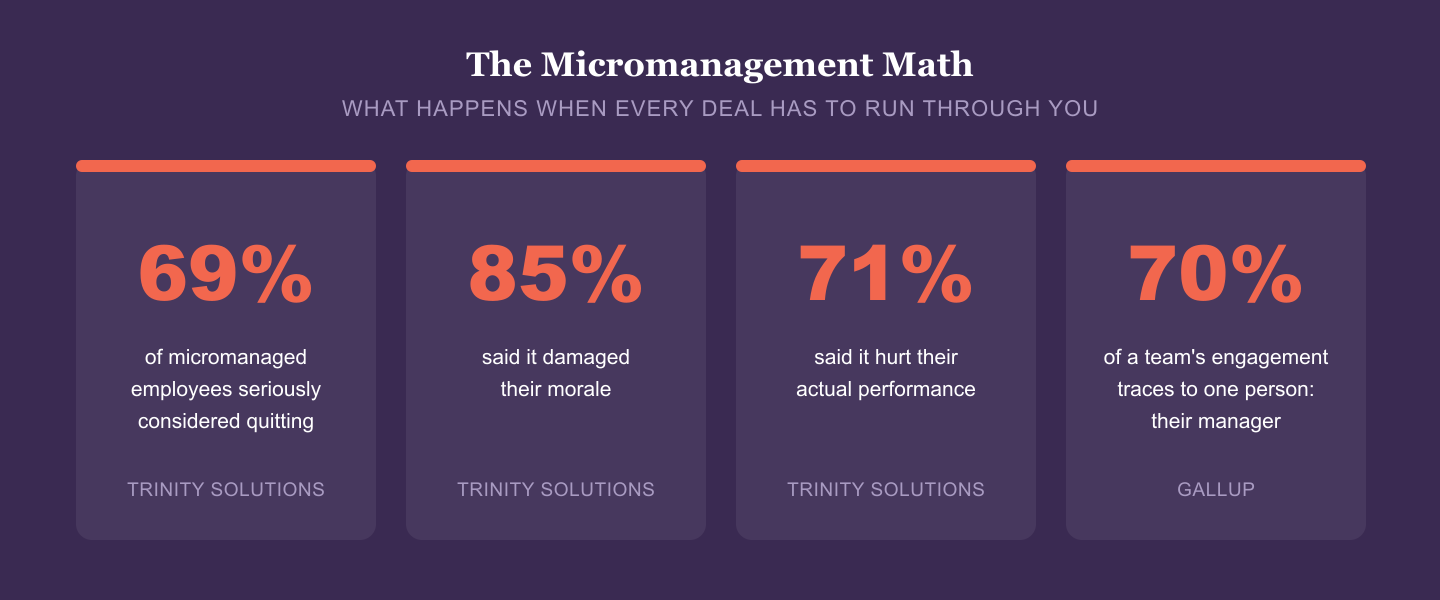
- 69% of micromanaged employees seriously considered leaving their job, and 85% said it damaged their morale, according to the widely cited Trinity Solutions survey.
- Quiet quitting doesn't announce itself. It shows up as silence in the deal review, a rep who stops volunteering ideas, and a calendar that gets thinner while the numbers still look fine.
- Founders don't micromanage the metrics. They micromanage the art, the tone of an email, the pace of a call, the way a discount gets framed, because that's the part they used to do themselves.
- The fix isn't to stop managing. It's to manage the outcome and coach the craft, which is exactly the shift a Fractional Sales Leader is trained to make.
Your best rep isn't burned out. They're being managed out.
I put out a piece a while back about a top sales rep in crisis, and the response caught me off guard. Founders didn't write in asking how to pay their best rep more. They wrote in describing something quieter. A rep who used to argue with them in deal reviews and now just nods. A closer who used to bring three ideas to every pipeline meeting and now brings none. Someone who's still hitting quota, technically, but who feels like they've already left the building even though they show up every day.
That's not burnout. Burnout looks like exhaustion. This looks like withdrawal, and withdrawal has a cause you can usually find if you're honest with yourself.
If you're a founder running a company between $1M and $10M in ARR, you almost certainly built the sales process yourself. You closed the first fifty deals. You know exactly how a call should go, how a discount should be framed, how an email should read before it goes out. So when you finally hire someone good, someone who can actually sell, you don't hand them the keys. You hand them your playbook and then you sit in the passenger seat correcting their driving. That's the thing that's quietly costing you your best rep, and it has nothing to do with what you're paying them.
The Quiet Quitting Nobody Sees Coming
Here's the trap. You're watching the dashboard, and the dashboard looks fine. Quota's getting hit. Activity's logged. So you assume everything's fine, because you're measuring the one thing that lags the problem by months.
The tell isn't the resignation letter, it's the silence in the deal review
Gallup's research on quiet quitting found that the least effective managers have three to four times as many disengaged, checked-out direct reports as the most effective managers do. That's not a small gap, that's the whole story. Disengagement isn't random. It's manufactured, one overridden decision at a time, and it shows up as silence long before it shows up as a two-weeks-notice email. Your best rep stops pushing back on your read of a deal. They stop asking "can I try it this way instead." They start doing exactly what you tell them, precisely because arguing stopped being worth it.
Five signals founders miss because the numbers still look fine
Watch for these, because none of them will show up on a scorecard: they stop volunteering ideas in pipeline review and just answer what's asked. They stop customizing their pitch and start reciting your script word for word, even when it clearly doesn't fit the prospect. They play it safe on live calls instead of taking the creative swing that used to win you deals. They ask for approval on things they used to just decide. And they go quiet on Slack and in the group chat, the informal energy that used to come from them just isn't there anymore. Individually, each one looks like nothing. Together, they're a rep who's already decided you don't trust their judgment, so they've stopped using it.
A rep who stops arguing with you hasn't started agreeing with you. They've started managing you, and that's a far worse position to be in than an open disagreement.
The Real Reason: You're Micromanaging the Art, Not the Metrics
Most founders would tell you they don't micromanage. They'd point to the CRM, the pipeline stages, the weekly numbers, and say "I just want visibility." I believe them. But visibility into the metrics isn't what's driving this. It's the thing sitting right next to the metrics: control over the craft.
Your best rep doesn't sell like you, and that's the point
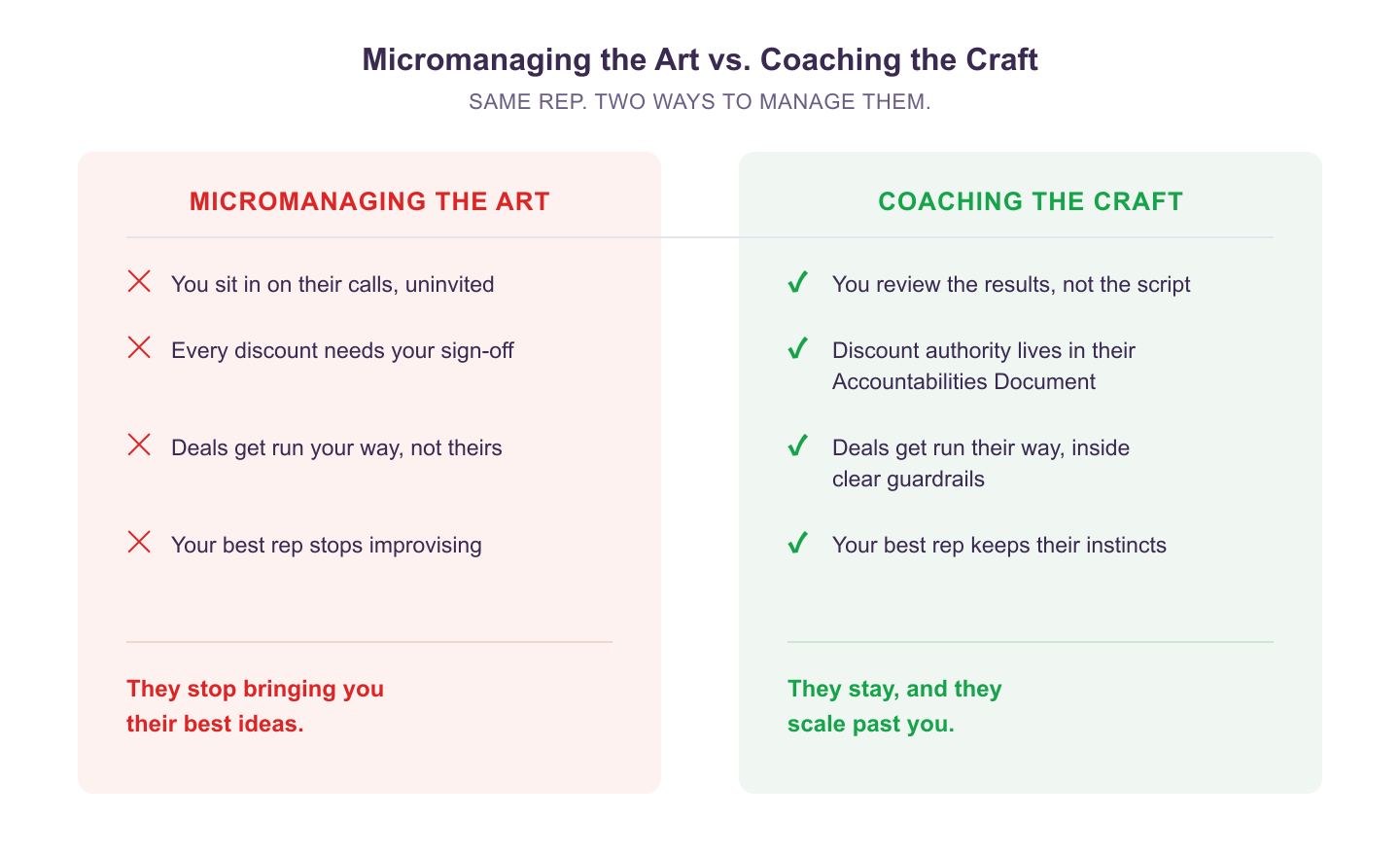
You hired them because they're good at selling, not because they're good at selling like you. But when you sit in on their calls uninvited, rewrite their emails before they go out, or require sign-off on a discount they were fully capable of judging themselves, you're not managing a metric. You're editing their instincts in real time. Sales is part science and part art, the read of a room, the timing of a pause, the specific phrase that lands with this specific buyer. When you insist that part be run through you, you're telling a proven closer that their judgment doesn't count, and that message lands every single time you do it.
What "process discipline" turns into when a founder can't let go
Process discipline is real and it matters, I've spent decades building it into companies. But there's a line between a documented process and a founder who can't stop narrating. On one side of the line: clear stages, clear accountabilities, clear guardrails. On the other side: a founder reviewing call recordings looking for what they'd have said differently, correcting tone in emails that already closed, treating every deal as a referendum on whether the rep did it "right," meaning your way. The research backs up how badly this lands. In the Trinity Solutions survey, 69% of employees managed by a micromanager seriously considered quitting, 85% said it hurt their morale, and 71% said it actively interfered with their job performance. Your best rep isn't immune to that math. If anything, they feel it faster, because they know exactly how good they are without you standing over their shoulder.
Why This Hits Your Best Rep Hardest
Here's the part founders get backwards. They assume their weakest rep is the flight risk, so they focus their attention, and their control, on the person who's actually thriving. It's the opposite. Micromanagement is most corrosive to the people who've already proven they don't need it.
Top performers have already proven they don't need your script
A struggling rep might genuinely want more oversight, more guardrails, more of your voice in their ear. A top performer has already closed enough deals their own way to know their instincts work. Layering your process over a proven method doesn't add safety, it adds friction. Research on high-performer attrition backs this up directly: when analysts isolate why your best people leave, as opposed to your average people, the leading causes are almost entirely leadership and culture, no growth path, managers who can't coach, tolerance of underperformers, and micromanagement. Pay barely registers. Your top rep isn't chasing a bigger number elsewhere. They're chasing more room to operate.
Autonomy is the currency top performers actually get paid in
Gallup's manager research found that managers explain roughly 70% of the variance in how engaged a team is, more than compensation, more than company brand, more than the product itself. If you're the manager, and you're a founder, that number is entirely on you. Separate research on autonomy backs this up from another angle: employees who get real say in what they work on and how are dramatically less likely to burn out and disengage than employees who don't. Your best rep isn't asking to be left alone. They're asking to be trusted with the part of the job you already know they're good at.
You don't lose your worst reps to micromanagement. You lose your best ones. The ones who could get a job anywhere else tomorrow are the ones who feel it first, and act on it fastest.
The Fix: Manage the Outcome, Coach the Craft
None of this means stop managing. It means changing what you manage. There's a real difference between a founder who's disciplined about outcomes and a founder who can't stop narrating the process, and your best rep can tell the difference in the first thirty seconds of a conversation with you.
Replace call-scripting with an Accountability Document
If you're correcting your rep's calls in real time, it's usually because there's no written agreement on what they own. Build an Accountability Document that spells out the outcomes they're responsible for, the activity that's expected, and the boundaries they operate inside, discount thresholds, deal-size approvals, escalation triggers. Once that exists in writing, you stop needing to be in the room, because there's something other than your memory holding the line.
Sit in to learn their style, not to correct it
There's nothing wrong with listening to calls or reviewing recordings. The question is why you're doing it. If you're listening for what you'd have said differently, you're auditioning your rep for a role they already have. If you're listening for what's working in their delivery so you can reinforce it, you're coaching. Same activity, completely different effect on the person on the other end of it.
Give creative license inside guardrails, not a script
A guardrail tells a rep where the road ends. A script tells them exactly where to put the wheel every second. Your best rep needs the first, not the second. Define the non-negotiables, pricing floors, compliance language, the things that genuinely put the business at risk, and then get out of the way on everything else. The tone of the email, the pacing of the call, the specific objection-handling language, that's the art, and it's theirs to own.
What It Costs You If You Wait
Founders tend to treat this as a soft problem, something to address "when things calm down." It's not soft, it's a line item. Sales roles already turn over at close to 35% a year, nearly triple the average across all other roles, and replacing a salesperson specifically tends to cost well over 100% of their annual compensation once you count recruiting, ramp time, and the pipeline that goes cold while the seat is empty. That's before you count what it does to the reps who watched it happen and are now quietly recalculating their own options.
This is exactly the gap a Fractional Sales Leader closes. Not because I take your best rep off your hands, but because I build the structure that lets you let go without losing control: the Accountability Document, the pipeline discipline, the coaching cadence, all of it built by someone whose job is to develop your rep's judgment instead of overriding it. You get to keep the parts of selling that only you can do, the strategic relationships, the vision, the big swings, while someone else makes sure your best closer never has a reason to go quiet on you again.
You didn't build a company to run every deal yourself forever. If your best rep is going quiet, the fix isn't tighter control. It's a system good enough that control stops being the thing holding it together.
Frequently Asked Questions
Q: What are the early signs a top sales rep is quietly quitting?
Watch for behavior, not numbers, because the numbers are the last thing to slip. Look for a rep who stops volunteering ideas in pipeline review, who starts reciting your script instead of adapting it, who asks for approval on decisions they used to make on their own, and who's gone quiet in the group chat or standup. Quota can look completely healthy while all of this is happening, which is exactly why founders miss it. If your best rep has gone from arguing with you to just agreeing with you, that's not harmony. That's disengagement.
Q: Isn't it my job as founder to know exactly what's happening in every deal?
Knowing what's happening and controlling how it happens are two different jobs, and conflating them is where founders go wrong. Visibility into pipeline health, stage movement, and forecast accuracy is exactly what you should have. Rewriting your rep's emails or requiring sign-off on judgment calls they're fully capable of making isn't visibility, it's a vote of no confidence delivered one small correction at a time. You can have full transparency into outcomes without owning every decision along the way.
Q: My top rep hasn't complained. How do I know this is even happening?
Top performers rarely complain before they leave, they just quietly start job hunting. In the Trinity Solutions research, 69% of micromanaged employees seriously considered quitting, but complaining wasn't part of that pattern, disengaging was. If you can't remember the last time your best rep pushed back on you in a deal review or brought you an idea you hadn't already thought of, that silence is the complaint. It's just not spoken out loud.
Q: What's the difference between coaching and micromanaging?
Coaching develops a rep's own judgment. Micromanaging replaces it with yours. A coach listens to a call and asks "what were you going for there, and did it land?" A micromanager listens to the same call and says "here's what I would have said." Both involve paying close attention. Only one of them leaves the rep more capable, and more trusted, than they were before the conversation.
Q: If I stop controlling every detail, won't my sales process fall apart?
A process that only survives because you're personally enforcing it every hour isn't a process, it's a dependency. The fix is to put the discipline into something durable, a documented Accountability Document, clear pipeline stages, defined discount and deal-size guardrails, so the standard holds without you standing over it. That's genuinely harder to build than just correcting people in real time, but it's the only version that scales past your own bandwidth.
Q: How does a Fractional Sales Leader help with this specifically?
A Fractional Sales Leader gives you a layer of senior sales management between you and your rep, someone whose entire job is developing that rep's judgment rather than defending their own way of selling. They build the Accountability Document, run the coaching cadence, and hold the guardrails, which means you get the oversight you actually need without your best rep feeling like every deal is being second-guessed. It's the structure that lets a founder let go without the business losing discipline in the process.
Don't wait for the resignation letter to find out you were the reason.
If you're a $1M–$10M founder and your best rep has gone quiet, let's talk. Thirty minutes. We'll figure out where you're managing the art instead of the outcome, and build the structure that lets you let go without losing control.
Schedule a 30-Minute CallAbout the Author
Louie Bernstein
Fractional Sales Leader with 50 years of sales experience helping $1M–$10M ARR companies build scalable, repeatable sales systems. Founder of MindIQ (INC 500). LinkedIn Top Voice in Sales Management, Sales Operations, and Sales Coaching.