Key Takeaways:
- Buyers lose 40–60% of deals to "no decision" (The Jolt Effect), not to a competitor. Founders do the same thing with their own sales problems.
- "We'll figure it out internally" and "things will pick up on their own" are the two most expensive stories founders tell themselves.
- Founder-led sales problems compound instead of correct: the founder gets more burned out, the reps get more underdeveloped, and the pipeline gets less reliable every month.
- It's a structure problem, not an effort problem. Working harder speeds the loop up. Only a system breaks it.
- Every founder who came back to me a year later said the same thing: "I wish I had done this sooner."
You came to me. We had good conversations. You told me things about your business you probably haven't told many people: the stress of being in every deal, the reps who keep missing, the pipeline that never quite adds up the way you need it to.
And then you disappeared.
I've seen this enough times to recognize what happened. You didn't find a better option. You didn't decide I was wrong for the job. You went back to what you know. You decided, consciously or not, to keep doing what you're doing and hope things improve on their own.
It's the same thing your prospects do to you. The Jolt Effect, Matt Dixon and Ted McKenna's study of 2.5 million recorded sales conversations, found that 40–60% of qualified deals are lost to "no decision," not to a rival (I break that down in "No Decision" Is Your Biggest Competitor). When the problem is your own sales engine, you're the buyer, and "no decision" is winning.
I respect your right to make that call. But I want to be direct with you, because that's what you deserve after the conversations we had. The problem will not fix itself. It never does. And I can show you why.
The most expensive decision in sales is the one never made. That's true for your prospects. And it's true for you.
Why Founders Tell Themselves the Problem Will Fix Itself
This isn't a character flaw. It's a survival mechanism. You built this company by figuring things out. When the product broke, you fixed it. When a customer left, you found a new one. When money got tight, you found a way through. Your whole identity as a founder rests on pushing through problems with will and creativity.
So when you hit a wall in sales, your instinct is the one that has served you for years: push harder, stay the course, trust that it will come together. The problem is that founder-led sales isn't a wall you can push through. It's a structure problem. And structure problems don't respond to effort. They respond to redesign.
What "Keep Doing What We're Doing" Actually Produces
Here's what happens when a founder decides to stay the course. I've watched it play out dozens of times, and the sequence barely changes.
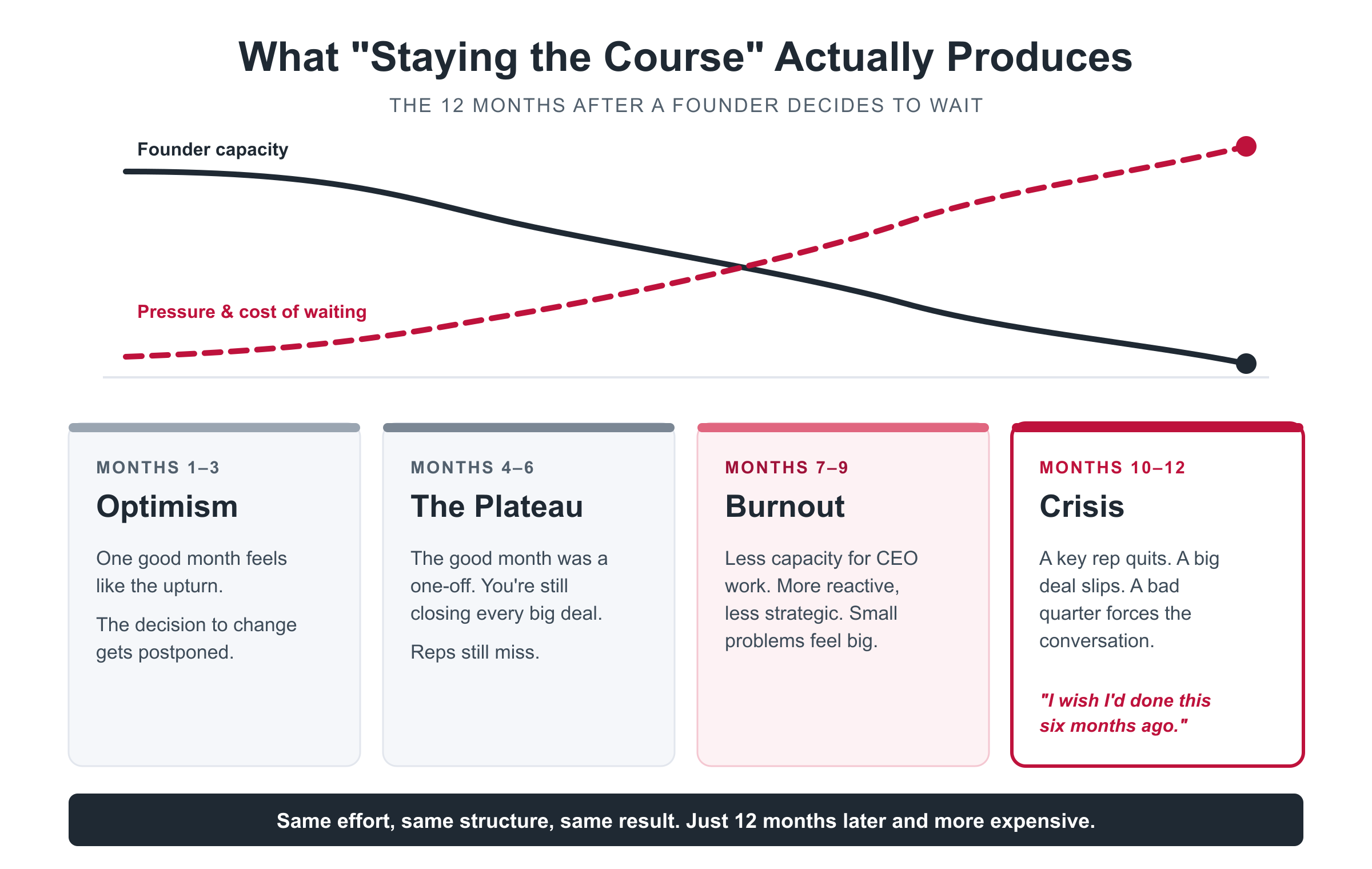
Months 1–3: Optimism. Things look roughly the same. Maybe one good month convinces you the upturn is coming. You feel validated, and the decision to change stays postponed.
Months 4–6: The plateau. The good month was a one-off. Pipeline is inconsistent again. You're still closing the big deals yourself, your reps are still underperforming, and you're still the person everyone calls when a deal needs to move.
Months 7–9: Burnout compounds. You're now six months more tired than when we talked. You have less capacity for the CEO-level work your company needs. You're more reactive and less strategic, and small problems feel bigger because your reserves are thinner. (If you want to put a number on that, run the founder burnout calculator.)
Months 10–12: A crisis forces the issue. A key rep quits. A major deal falls through because nobody followed up. A quarter ends badly enough to force a real conversation about what has to change. And you call me again, or someone like me, and the first thing you say is: "I wish I had done this six months ago."
I hear that every time. Not occasionally. Every single time.
The founders who waited always wish they hadn't. Not one of them has ever told me "I'm glad I waited." Not once in 50 years.
Why the Problem Compounds: The Mechanics
Founder-led sales problems are self-reinforcing. Three forces feed each other, and every turn of the loop makes the next one tighter.
The founder gets more burned out, not less. Every month you stay in founder-led sales, the gap between where you are and where you need to be grows. You're not standing still, you're accumulating fatigue. Burned-out founders make worse decisions, miss more opportunities, and get less effective at the one thing keeping the company alive: their own ability to close.
Salespeople without a system get worse, not better. A rep without a documented process, regular coaching, and clear accountability doesn't gradually figure it out. They develop bad habits. They avoid the hard calls. They build a pipeline full of hope instead of qualified opportunities. By the time you admit there's a problem, you have reps who need to be retrained, which is harder than training them right the first time.
The pipeline gets less reliable over time. Without a consistent outbound system, pipeline depends on inbound luck and the founder's bandwidth. Both have a ceiling. As you get more stretched and inbound fluctuates, the gaps widen and revenue gets less predictable. That creates more pressure on you, which creates more stretch, which creates more gaps.
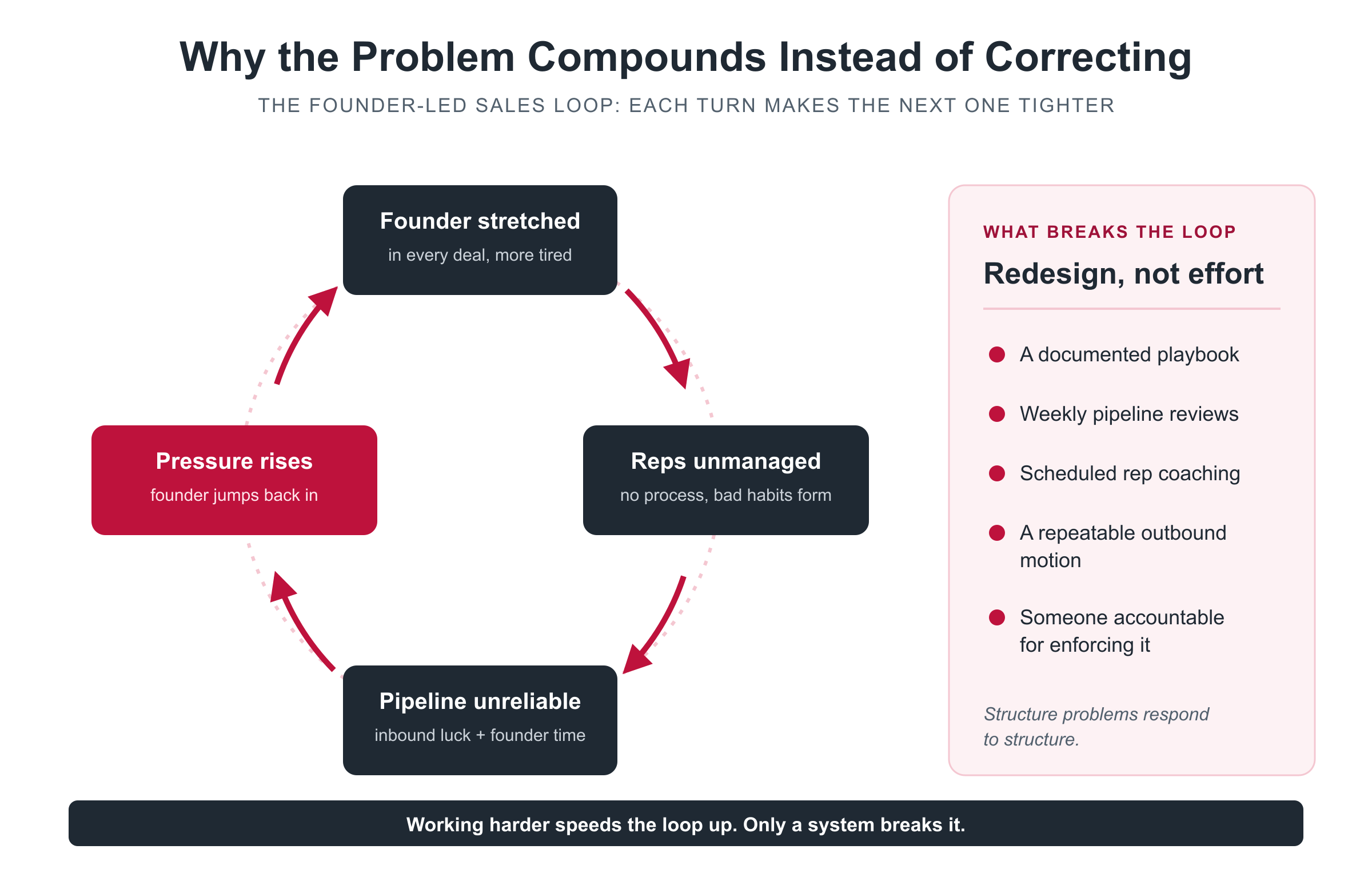
That cycle doesn't break without an intervention. It just gets tighter. The way out is to stop being the person who closes every deal by building the structure that lets someone else close them.
The Honest Question I Want You to Answer
If you keep doing what you're doing today, what specifically will be different in six months? Not what you hope will be different. What will actually be different, based on actions you're taking right now that you weren't taking before?
If the answer involves working harder, following up more diligently, or hoping the team figures it out, that's not a plan. That's a wish. If there's a concrete change you're making, a new system, a new process, a new hire with a real onboarding plan, then maybe the problem improves. But if the answer is essentially "more of the same," the outcome will be essentially the same too.
You know this. That's why you reached out to me in the first place.
What I've Seen Happen When Founders Act
One client came to me after 18 months of telling himself things would improve. He was at $2.5M ARR. His pipeline was inconsistent. His one salesperson was producing about half of what the company needed. He'd been meaning to build a playbook for two years.
We built the playbook in the first four weeks. The salesperson's close rate went up 30% in the first quarter, not because they got smarter, but because they finally had a process to follow. By month nine, they'd hired a second rep into a real onboarding system. Revenue grew 61% over the engagement, and the company had its first profitable year in years.
That founder told me afterward: "The hardest part was deciding to start. Once we started, it was obvious." That's what I hear every time. The hardest part is starting. Everything after that is execution.
Staying in motion isn't the same as moving forward. Busy and productive are not the same thing.
Related Reading
Frequently Asked Questions
Q: What if things genuinely do improve on their own in the next few months?
That happens. Occasionally a good quarter comes along and feels like the corner has been turned. The test is whether the improvement is structural or circumstantial. If you had a good quarter because one big deal closed, that's circumstantial. If you had a good quarter because your reps are executing a documented process consistently, that's structural. Only the second one compounds. The first leaves you in the same position next quarter.
Q: We have some internal changes coming that might fix the problem. Should I wait?
"Internal changes coming" is one of the most common reasons founders postpone fixing their sales infrastructure, and one of the least reliable. Internal changes almost always take longer than expected and address symptoms rather than root causes. If the sales system is broken, a product launch, a new hire, or a new market won't fix it. The system needs to be fixed separately, and the sooner it is, the more those other changes can build on a solid foundation.
Q: I tried to build the system myself last year and it didn't stick. What's different this time?
The most common reason internal attempts fail is accountability. You write the playbook, it gets used for two weeks, then everyone reverts to old habits because nothing enforces the new behavior. A Fractional Sales Leader is the enforcement mechanism. The pipeline review happens every week whether the team likes it or not. The coaching happens on schedule. The accountability is built into the engagement, not left to willpower.
Q: What if I just need a few more months to get ready?
What specifically will you be more ready for in a few months that you aren't ready for today? If the answer is cash, that you need more revenue before committing, that's a real constraint and we can talk about it. If the answer is bandwidth, that you're too busy right now, the honest answer is that you'll always be too busy. Founders are never not busy. The ones who build great sales systems do it while they're busy, not after.
Q: How do I know if my sales problem is structural or just a slow stretch?
Ask three questions. Can anyone besides you close a big deal? Do your reps follow the same documented process? Can you predict next quarter's revenue within a reasonable range? If the answer to two or more is no, it's structural. A slow stretch recovers when the market does. A structural problem stays put, and gets more expensive, until you change the structure.
If nothing changes, nothing changes.
You already know what staying the course produces, because you've been living it. Let's spend 30 minutes on what a different outcome looks like for your business. See how I work at louiebernstein.com.
Schedule a 30-Minute CallAbout the Author
Louie Bernstein
Fractional Sales Leader with 50 years of sales experience helping $1M–$10M ARR companies build scalable, repeatable sales systems. Founder of MindIQ (INC 500). LinkedIn Top Voice in Sales Management, Sales Operations, and Sales Coaching.