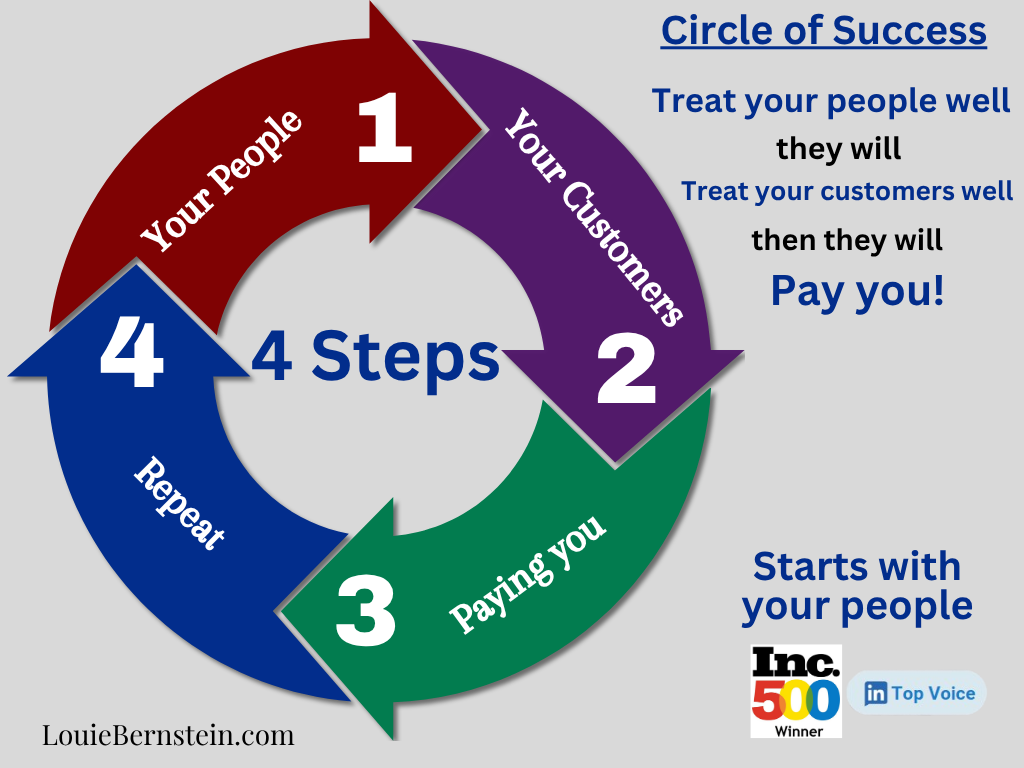
Five moves. Skip one and the circle breaks. Run all five and you build a team you can actually hand your customers to.
01
Treat Them Exactly How You Want Them to Treat Your Best Customer
This is the whole formula in one sentence. Think about how you want your salesperson to treat your biggest account: with respect, straight answers, patience, and follow-through that never slips. Now ask whether you give them that same treatment. You can't hand a customer something you never handed the person selling to them. If your salespeople feel rushed, second-guessed, and kept in the dark, that's exactly how your customers will feel on the other end of the call. The way you treat the team is the ceiling on how they treat the market.
What You Get: Salespeople who treat your customers the way you would, because they've been treated that way themselves.
02
Give Them Clarity Before You Give Them a Quota
Most people don't underperform because they're lazy. They underperform because nobody ever told them, in writing, what winning looks like. Before you hand a salesperson a number, hand them clarity: what they own, how they're measured, what a good week looks like, and what happens when a target is missed. I put this in an Accountabilities Document so it lives on paper instead of in my head. When the standard is written down, people stop guessing what you want and start hitting it. Clarity is a kindness, and it's also the fastest path to performance.
What You Get: A team that knows the target on day one, so onboarding takes 30 days instead of six months of guesswork.
03
Pay Them Like Partners in the Outcome, Not Costs to Minimize
If you build the comp plan to protect your margin at every turn, your salespeople will do the same thing to your customers. They'll nickel-and-dime the deal, hold back, and treat every account like a transaction, because that's the game you taught them to play. Pay people like partners in the result you're chasing and they'll chase it with you. This is the reward step in the circle, and it isn't charity. When your people win because your customers won, everyone is pulling in the same direction. A comp plan is a values statement disguised as a spreadsheet.
What You Get: Salespeople who fight for the customer's outcome because their own outcome is tied to it.
04
Coach Them Every Week. Don't Just Inspect Them
There's a difference between a weekly review that feels like coaching and one that feels like an interrogation. Both look at the same pipeline. One sends people out energized and one sends them out defensive. Sit down every week, look at the deals together, and ask what you can do to help move them. Catch people doing things right, not just things wrong. Salespeople who feel developed stay and get better. Salespeople who feel audited update the CRM to survive the meeting and learn nothing. The weekly rhythm is where you either build a team or slowly train them to hide from you.
What You Get: A weekly cadence that surfaces problems early and turns your average reps into good ones instead of chasing them out the door.
05
Hold Them to a Standard, Not to Your Mood
The fastest way to lose good people is to be warm one day and cold the next, so nobody ever knows which founder is walking in. Consistency is what people actually mean when they say they want a good boss. Write the standard down, apply it to everyone the same way, and apply it to yourself first. When the rules are fair and predictable, people take risks, tell you the truth, and bring you the bad news early while you can still do something about it. When the rules move with your mood, they manage you instead of managing their deals. A standard you keep is worth more than a speech you give.
What You Get: A team that tells you the truth early, because the standard is fair, written, and the same every single day.