Free ICP Checklist for B2B Founders

ICP Checklist:Does Your Customer Filter Work?

Can your team identify the right accounts without asking you?

Use 15 yes/no checks to review whether your Ideal Customer Profile is written down, grounded in customer evidence, and used in everyday selling. Find the missing rule before you buy more leads or add another rep.

Start the Free Checklist

Free. Confirm your email to see your score and next steps.

By Louie Bernstein · Published · Updated
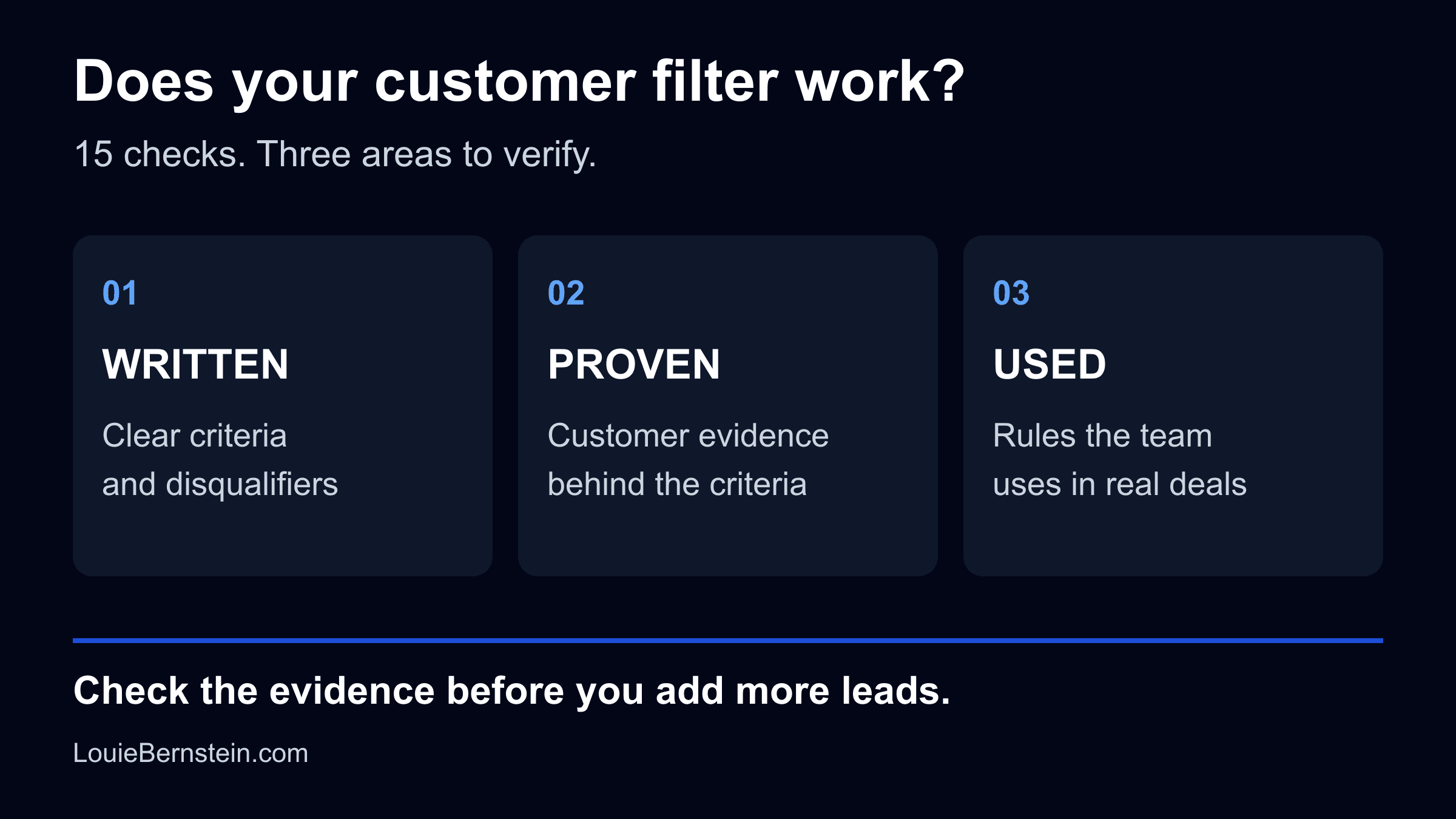
ICP checklist for B2B founders: 15 checks across written criteria, customer evidence, and daily use.

Short answer

An ICP checklist tests whether your Ideal Customer Profile helps your team choose accounts worth pursuing. Review the written criteria, the customer evidence behind them, and how those criteria enter your CRM and sales decisions. Use this 15-question self-assessment to find gaps, then verify the weakest area against real customers and opportunities.

Key Takeaways

  • An ICP defines the companies you can serve well. A buyer persona describes the people involved in buying.
  • The checklist has 15 questions across three areas: written criteria, customer evidence, and use by the team.
  • Your 0-15 score summarizes your answers. It does not predict revenue, rank you against other founders, or validate your target market.
  • Use your No answers to choose one missing rule, give it an owner, and test it against live opportunities.

What will the ICP checklist help you check?

Your written customer criteria

Check whether the team has a usable document with company characteristics, the problem you solve, buying roles, and disqualifiers. A profile should help two reps reach the same fit decision using the same evidence.

The evidence behind the criteria

Compare customers who bought and succeeded with customers who created delivery problems, churned, or never bought. A closed-won logo alone does not prove that an account was worth winning.

Whether the team uses the filter

Look at prospect lists, qualification notes, and actual pipeline decisions. A document has little practical value if a rep can ignore its disqualifiers and advance a deal without an explanation.

Take the 15-question ICP Clarity Checklist

Answer for the way your business works today. Choose Yes only when you can point to a document, customer evidence, or a repeated team practice. If you cannot verify an answer, choose No for this review and write down what you need to check. The score counts Yes answers; it does not weight any question as more important than another.

The ICP Clarity Checklist

15 checks across written criteria, customer evidence, and daily use.

0 of 15 answered

Choose Yes only when you can verify the statement today. Choose No for a missing or unverified practice.

Section 1: Is your ICP written down?
  • 1. Our Ideal Customer Profile is a written document that the sales team can find.
  • 2. The profile names the industries or use cases we serve well.
  • 3. The profile includes evidence-backed company size or revenue ranges where relevant.
  • 4. We document the typical budget owner, champion, and people who can block a purchase.
  • 5. The profile states the conditions that disqualify an account.
Section 2: Is the profile built on evidence?
  • 6. Our criteria draw on closed deals and what happened after customers bought.
  • 7. We can name the business problems our best-fit customers hired us to solve.
  • 8. We have evidence of the events or changes that make buyers consider a purchase.
  • 9. We have asked customers why they chose us and compared their answers with deal records.
  • 10. We have reviewed poor-fit customers and losses to test the limits of our profile.
Section 3: Does the team use the profile?
  • 11. Salespeople can explain our customer criteria without the founder supplying the answer.
  • 12. We record fit evidence and missing information before advancing a deal in the CRM.
  • 13. We use a clear disqualification or approved-exception process when an account does not fit.
  • 14. We check outbound target lists against the written customer criteria.
  • 15. We review current opportunities for fit and update the profile when evidence changes.

Answer all 15 questions to unlock your score.

How do I turn the score into a useful sales decision?

Use the Written, Proven, Used test: an ICP rule must be written clearly, supported by customer evidence, and used in actual selling. This is the working framework for this checklist, not a research-validated model. The score helps you find questions to investigate; the evidence decides which rule to change.

  1. Read the No answers by section

    A total hides where the work is. You might have strong documentation and weak evidence, or good customer knowledge that nobody else can use. Mark each No as missing, unverified, or deliberately not applicable. Keep the original answer so you can explain why the score changes at the next review.

    Choose the section with the most consequential gap, rather than assuming the lowest total tells the whole story.

  2. Compare good customers with difficult ones

    Review what happened after the signature. Look at adoption, delivery effort, retention, payment, and whether your team could deliver the promised outcome. Include losses and no decisions to challenge the profile. A founder can win an unusual account through personal effort without creating a sales motion another rep can repeat.

    Write the evidence beside each proposed criterion. Label assumptions and record when the available customer set is small.

  3. Write one inclusion rule and one disqualifier

    Turn a broad description into a decision the team can make. A company size range may help identify possible accounts, but a required capability or supported use case can be more decisive. Separate a hard disqualifier from an unanswered question. Missing information means investigate; confirmed poor fit means stop or approve an exception.

    Use this format: pursue companies with this problem under these conditions; decline accounts with this confirmed constraint.

  4. Put the rule into the sales routine

    Add the criterion, supporting evidence, and any unknowns to your qualification notes or CRM. Decide who approves exceptions and where the reason is recorded. Apply the same rule to outbound lists and inbound leads. A required field is useful only when the team knows what evidence belongs in it.

    Review the next eligible opportunities with the rep. Coach the decision instead of taking the deal away and closing it yourself.

  5. Check whether the rule helps the team

    Set a review date and inspect whether reps use the rule consistently. Compare similar opportunities and note changes in source, offer, or segment before attributing a result to the ICP. A new criterion may need revision. Keep a dated version so you know which profile guided each group of deals.

    Start with a monthly review of the new rule and a quarterly profile review. Adjust the cadence when your offer or market changes.

What makes an ICP useful when the founder steps back?

A useful ICP lets a salesperson explain why an account fits without asking the founder to make the call. Define the account first, then map the people involved in buying. HubSpot's distinction between an ICP and a buyer persona follows the same company-versus-person split. If you need to build the document from scratch, use the guide to creating an Ideal Customer Profile and return to this checklist to inspect how the profile is used.

A good-fit company can still lack a current project, funding, or a reachable approval process. Keep account fit separate from readiness to buy. Check the buyer's situation in discovery and record what remains unknown. Use your qualified-deal definition to decide whether an opportunity belongs in the active pipeline. Otherwise a rep can check every industry and size box while spending weeks on an account with no buying decision underway.

Source: HubSpot on ICPs and buyer personas

What changes when an ICP becomes a working filter?

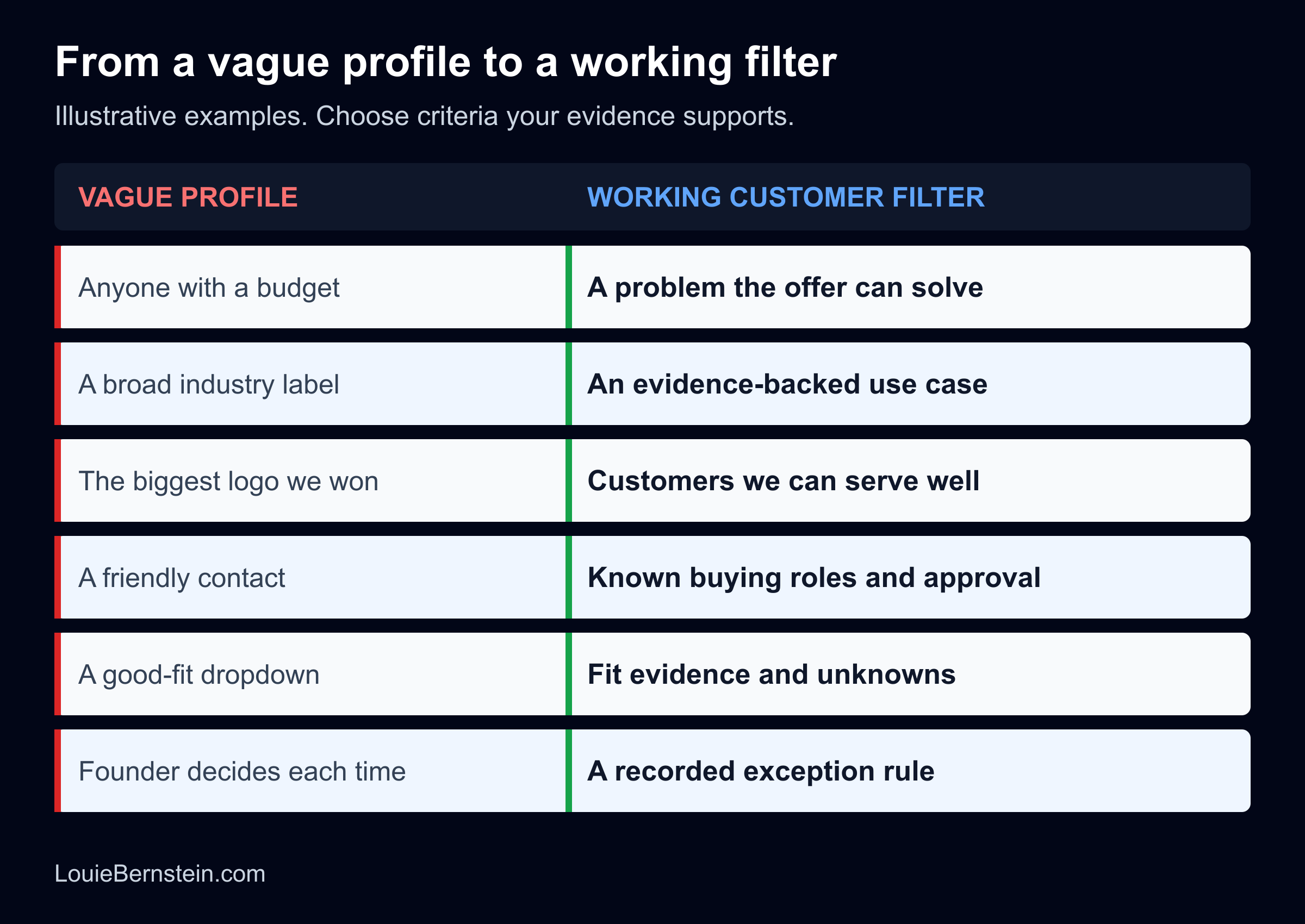
A working filter connects each customer criterion to evidence and a decision. The examples below show how to replace vague descriptions with usable questions. They are illustrations, not fixed requirements for every company. Choose the criteria that your offer and customer records support, and keep unknown information visible.

ICP checklist comparison of six vague profile descriptions with evidence-based customer filters.
What changes when an ICP becomes a working filter?
Vague profileWorking customer filter
Anyone with a budgetA named problem the offer can solve
A broad industry labelA use case supported by customer evidence
The biggest logo we wonCustomers who buy and can be served well
A friendly contactKnown buying roles and an approval path
A dropdown marked good fitFit evidence, unknowns, and disqualifiers
The founder decides every exceptionA clear owner and a recorded exception rule

What does my ICP Clarity Score mean?

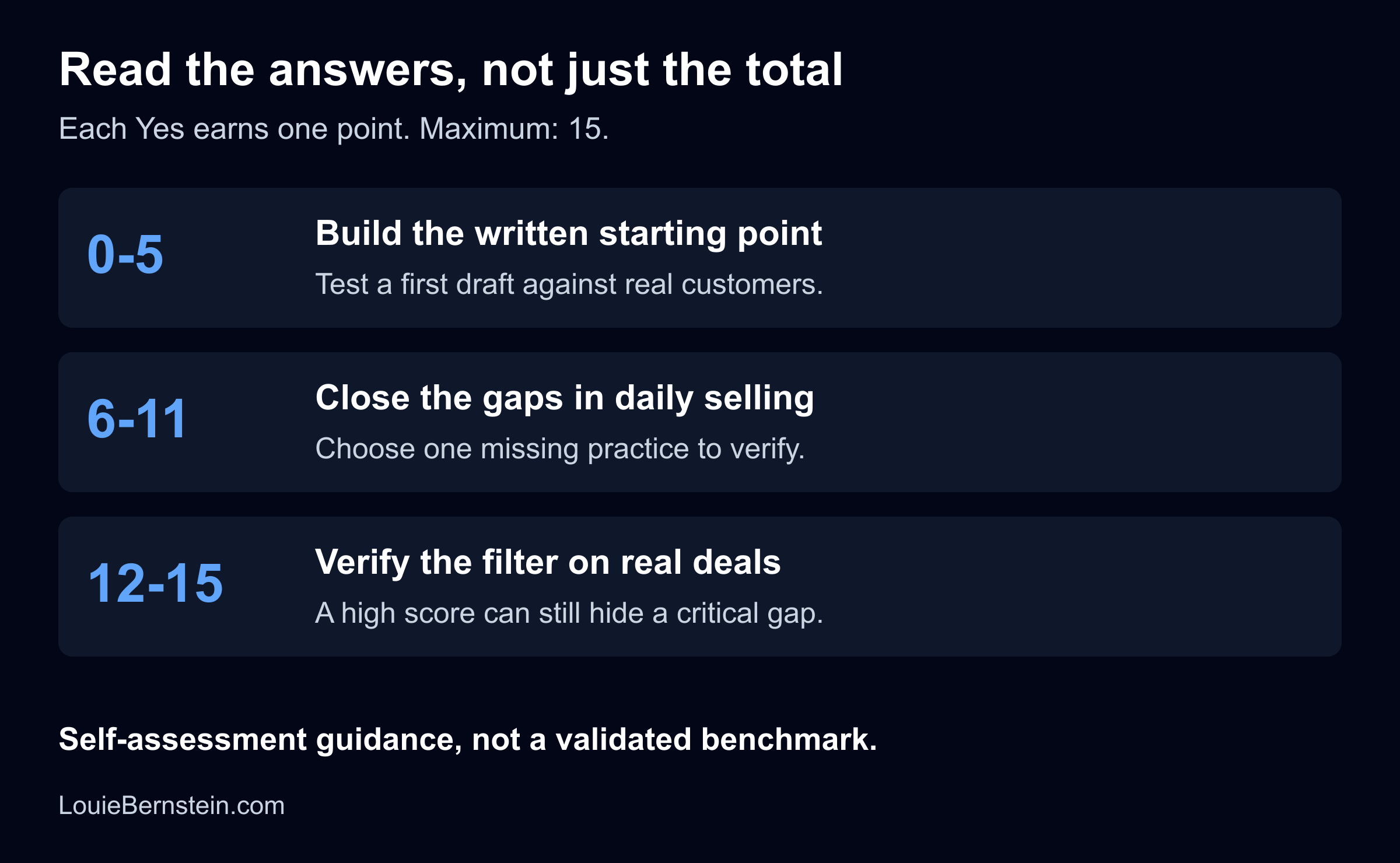
The ICP Clarity Score is the count of Yes answers across 15 equally weighted questions. The three bands organize next steps; they do not measure sales competence or establish market fit. Review the individual answers before acting. Twelve Yes answers can still leave an important customer-evidence question unanswered.

ICP checklist score bands: 0-5 build the starting point, 6-11 close gaps, 12-15 verify the filter; self-assessment guidance, not a validated benchmark.

The bands are practical guidance created for this checklist. They have not been validated against revenue, win rate, customer retention, or a comparison group of founders. Repeating the checklist can show which reported practices changed, but a higher score alone does not prove that sales performance improved.

Who built this ICP checklist?

Louie Bernstein, Fractional Sales Leader who helps B2B founders at $1M–$10M ARR escape founder-led sales.

I founded MindIQ in 1986, ran it for 22 years, and built it into an INC 500 company. I've been a Fractional Sales Leader since 2017. Those facts don't make a checklist score a guarantee. They explain why I want founders to build sales rules that another person can understand and use.

Systems before people means documenting how you sell before asking a new hire to repeat it. Your customer filter belongs in that system alongside discovery, qualification, and the Sales Playbook. Use the checklist to make the missing work visible, then teach the team how to do the work. The goal is a better decision without the founder having to make every decision.

ICP Checklist Questions

Is this ICP checklist free, and do I need to give my email?

The checklist is free. You can answer the 15 questions on the page. To see the calculated score and next steps, enter your first name and email and confirm your address. The form also explains that you will receive sales-building notes and can unsubscribe.

What if I only have a few customers?

Use the customer evidence you have and label the profile provisional. Compare outcomes, speak to buyers, and record which criteria are assumptions. A small customer set can suggest useful questions, but it cannot establish a dependable benchmark for a whole market.

Can I have more than one Ideal Customer Profile?

You can use separate profiles when different offers or customer segments require different buying and delivery rules. Name the offer and segment on each profile. Review each separately so results from one group do not conceal poor fit in another.

Should AI write my ICP for me?

AI can organize authorized customer notes and suggest patterns for review. Check each criterion against real records and buyer feedback. An AI-generated description does not establish that an account will buy or succeed, and missing customer evidence should stay labeled as missing.

Does a high ICP score mean I should hire a salesperson?

A high checklist score alone is not a hiring signal. Check whether the sales process is documented, opportunities are qualified consistently, and someone can coach a new rep. The score covers reported ICP practices, not demand volume, hiring readiness, or available management time.

Related Reading

Build a customer filter your team can use

Bring your No answers and a few customer or deal records. We'll discuss which criteria need evidence and how to turn the first useful change into a repeatable sales practice.

Talk to Louie for 30 Minutes

Share this article: LinkedIn · Twitter

View All Articles →