Key Takeaways:
- You do not have to like cold outreach to be good at it. You need a plan you can run for one hour a day, not more nerve.
- Ninety days is enough to go from a thin pipeline to a repeatable motion, if you break it into three 30-day phases instead of one big push.
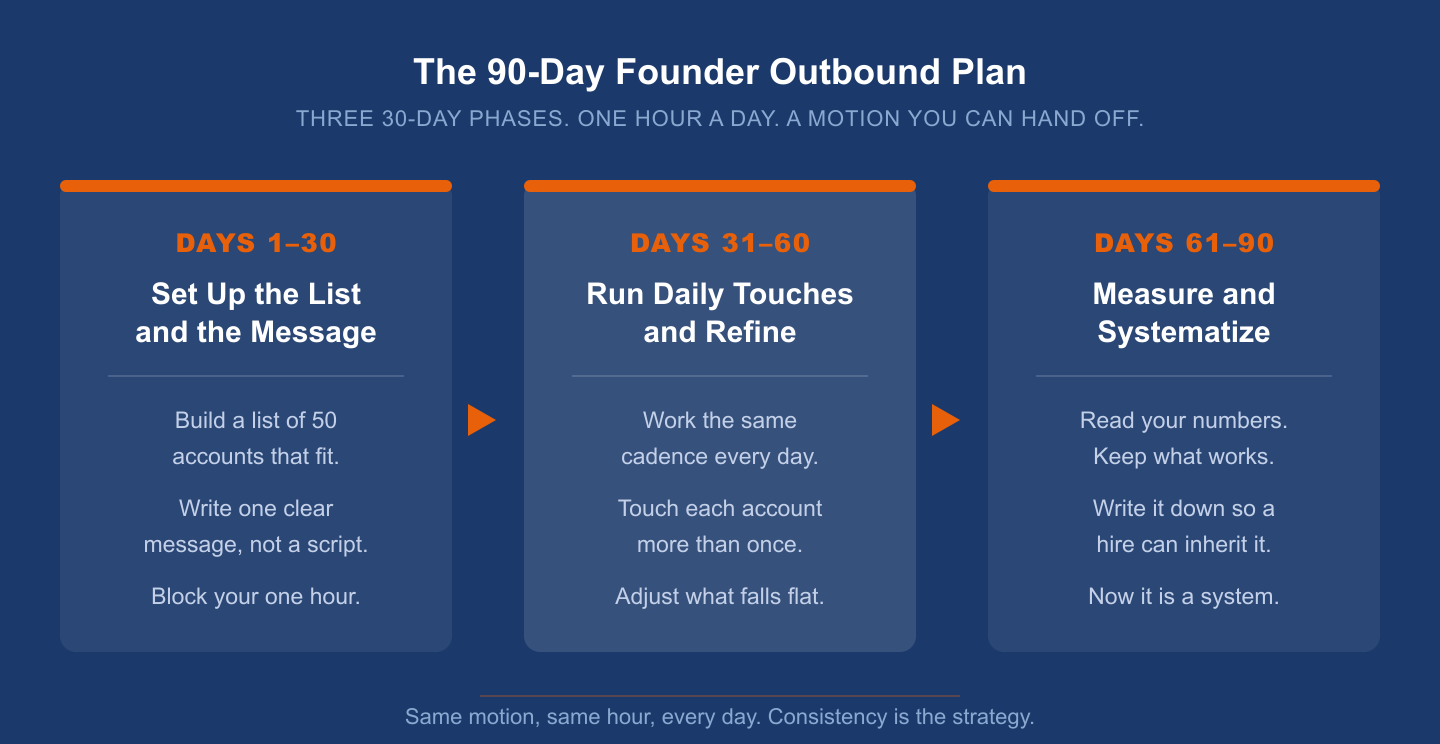
- Days 1–30: build a list of 50 and write one message. Days 31–60: run the daily cadence and refine it. Days 61–90: measure it and write it down.
- Most of the dread comes from doing outbound with no system. A short list, one message, and a set hour remove the guesswork that makes it feel bad.
- One focused hour a day beats a heroic burst you never repeat. Consistency is the strategy.
- If it isn't in the CRM, it never happened. Track every touch so the motion becomes an asset you can hand to a hire, not a habit that lives in your head.
You are good at a lot of things. Cold outreach is not one of them, and you would rather do almost anything else. You built the product. You can talk for an hour about the problem you solve. But the thought of emailing a stranger, or worse, calling one, makes you find something more urgent to do. Every time.
So the pipeline stays thin. Referrals slow down. Inbound is a trickle. And you keep telling yourself you will get serious about outbound once you feel more comfortable with it. Here is the hard part. That day is not coming. Comfort is not the thing standing between you and a full pipeline.
I have spent over fifty years in sales, and I have coached plenty of founders at $1M to $10M ARR who felt exactly the way you do. The ones who broke through did not learn to love cold outreach. They built a plan small enough to run on the days they hated it, and they ran it anyway. That is the whole trick.
This is that plan. Ninety days, split into three 30-day phases, one hour a day. By the end you will not be a different person. You will have a motion that works whether you feel like it or not, and a record of it you can hand to someone else. Here is how the ninety days break down.
“You will not think your way into liking cold outreach. You will act your way into being good at it. The plan does the work your motivation will not.”
Why Cold Outreach Makes You Cringe (and Why That's Fixable)
Before the plan, it helps to name what you are actually dreading. Most founders think they hate outbound because they are not natural salespeople. That is almost never the real problem. The real problem is that they are doing it with no system, so every message feels like a gamble and every no feels personal.
It feels like begging. It should not.
If outreach feels like begging, you are aiming it at the wrong people, or leading with yourself instead of them. You solve a real problem for a specific kind of company. Reaching out to a company that has that problem is not an imposition. It is a favor most of them will never admit they needed. Change who you contact and what you open with, and the whole thing stops feeling like an apology.
You are dreading the wrong thing
The dread is rarely about the one email. It is about the blank page every morning: who do I contact, what do I say, is this worth it, what if they say no. That is decision fatigue, and it is exhausting. Once the list is built and the message is written, the daily work is not deciding. It is just sending. You would be surprised how much of the fear lives in the deciding, not the doing.
A plan beats willpower
You cannot willpower your way through something you dislike for ninety days. Nobody can. What you can do is shrink the daily ask until it fits through the door on a bad day. One hour. A list already built. A message already written. When the task is that small and that defined, you do it even when you do not feel like it. That is the point of a plan. It removes the negotiation with yourself.
Days 1–30: Set Up the List and the Message
The first month is not about volume. It is about removing every reason you will give yourself to quit in month two. You build the list once, write the message once, and claim the hour on your calendar. Do this now and the hard part of the next sixty days is already done.
Build a list of 50, not 5,000
You do not need a database. You need 50 companies that look like the customers you already serve best. Look at who gets the most value from you, renews without a fight, and refers others. That is your target. If you have never written it down, start with your ideal customer profile, then find the 50 closest matches on LinkedIn, an industry directory, or a competitor's customer logos. This is an afternoon of work, not a project.
For each account, find the one person who owns the problem you solve, and write one line on why they belong on the list: a recent hire, an expansion, a job posting that names your problem. That one line becomes the first sentence of your outreach. It is also the reason the message will not feel like begging, because it is about them.
Write one message, not a script
A script is a wall you have to memorize and dread. One clear message is something you can send today. It says three things: I know who you are, here is a problem companies like yours have, here is what I would like to do about it. Keep it short. If it runs longer than a text you would actually read from a stranger, cut it.
Do not spend a week polishing it. Write it in twenty minutes and let the replies teach you. If cold calling is the part that makes you cringe most, start with email and LinkedIn while you find your footing, and work up to the phone. The cold call gets easier once you have had a few real conversations and know the message lands.
Book your one hour before day one
Open your calendar and put a one-hour block on every weekday for the next twelve weeks. Same time each day. Title it something you will not skip. Treat it like a customer meeting you cannot move, because that is exactly what it is: a meeting with your future pipeline. If the hour is not on the calendar, it will not happen, and the plan is over before it starts.
Days 31–60: Run the Motion Every Day
Month two is where most founders would either burn out or drift. You will not, because the work is now small and defined. You are not deciding anymore. You are running the same play every day and letting the numbers pile up.
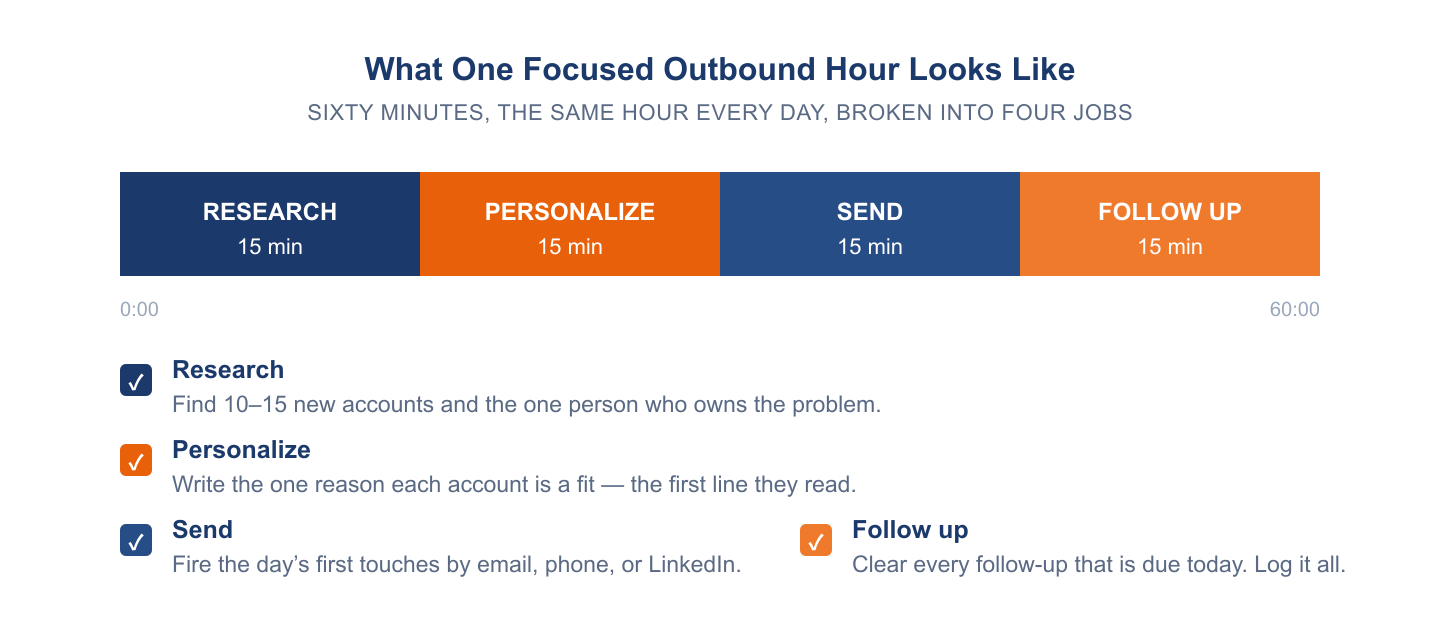
What one focused hour looks like
The hour has four jobs, and none of them require you to feel inspired. You research a few new accounts, personalize the reason each one is a fit, send the day's first touches, and clear the follow-ups that are due. Fifteen minutes each. When the hour is up, you stop. The discipline is in showing up daily, not in grinding for three hours once a week and calling it outbound.
Touch each account more than once
A single message is not outreach. It is a lottery ticket. Buyers miss the first one, ignore the second, and answer the fourth. So each account gets a short sequence of touches across email, phone, and LinkedIn over about a week. If there is no reply, you pause, then come back later with a different reason to talk. The founders who give up after one email conclude that outbound does not work. It works. They quit before it had a chance to.
Refine as you go, do not restart
You will be tempted to tear it all down and start over when the first week is quiet. Do not. Change one thing at a time. Tighten the opening line. Try a different title. Swap the ask. Small edits to a motion that is already running beat a dramatic relaunch that resets you to zero. You are tuning an engine, not rebuilding it.
“The founders who win the next 100 deals are not the ones who love cold outreach. They are the ones who showed up for the hour on the days they hated it.”
Days 61–90: Measure It and Make It a System
By month three you have real activity behind you, which means you finally have something to measure. This phase turns two months of daily effort into a system you understand and can repeat. This is where a stack of outreach becomes an asset.
Read the numbers, not your mood
Some days will feel like nothing is working. Your log will tell you the truth. How many accounts did you contact? How many replied? How many turned into a conversation? Those three numbers matter more than how the week felt. Move accounts through your stages based on what actually happened, not on how you feel about them. “They seemed interested” is not a stage. “Booked a call for Thursday” is.
Cut what fails, double the rest
Now you can act on evidence. Which targets never replied? Drop them. Which message got the most conversations? Send more like it. Which channel actually worked for your buyers? Lean into it. You spent sixty days gathering this data by hand. Use it. This is the difference between busy and effective, and you can only tell them apart once you have kept score.
Write it down so you can hand it off
The final step is to write down what works: the target, the message, the cadence, and what a good week looks like in real numbers. That document is worth more than any single deal it produced. It is the job description and the training plan for the first person you hire to do this, so you do not have to.
This is systems before people, and it is the whole reason to run the ninety days yourself first. If you hire someone to run a motion you have never run, you are guessing, and you cannot coach what you have not done. Run it, prove it, document it, then hire to scale it. And when you do hire, remember this: salespeople do not quit companies, they quit chaos. Hand a new rep a proven motion and a list that converts, and they can win early. Hand them a blank page, and you will lose them in a quarter.
“Ninety days of one boring hour a day does not just fill your pipeline. It builds the system that lets you finally stop being the one who fills it.”
Frequently Asked Questions
Q: I really do hate cold calling. Can I just do email and LinkedIn?
Yes, start there. Email and LinkedIn are a fine way to build the habit and get your first replies without the part you dread most. But do not rule out the phone forever. Once you have had a few real conversations and know your message lands, a call is far less scary, and it still gets answers the other channels miss. Ease into it. The goal is a mix that works for your buyers, not avoiding one channel for good.
Q: What if I get almost no replies in the first 30 days?
That is normal, and it is not a reason to stop. The first month is about building the list, the message, and the habit, not about volume of replies. Most of your early sends are also your first drafts. Change one thing at a time, the opening line, the target, or the ask, and keep going. Quiet is data, not a verdict. The founders who quit here are the ones who decide outbound does not work before the motion has run long enough to prove anything.
Q: Isn't 90 days too slow when I need pipeline now?
You will start creating conversations in the first few weeks, not on day 90. The ninety days is how long it takes to turn those conversations into a repeatable system you understand and can hand off. If you only need a few deals this month, a burst of outreach might get them. If you want a pipeline that keeps filling without you living in your inbox, you need the system, and the system takes about a quarter to build.
Q: How is this different from just telling myself to do more outreach?
“Do more outreach” is a wish. It has no list, no message, no set time, and no way to measure it, so it dies the first busy week. This plan removes all four excuses in the first thirty days and then asks for one defined hour a day. You are not relying on motivation. You are relying on a small, boring routine that runs on the days motivation does not show up. That is why it survives past week two.
Q: Do I need a CRM and a stack of tools to start?
No. A spreadsheet with the account, the contact, the dates you reached out, and what happened is enough to start this week. The discipline of logging every touch matters far more than the tool. If it isn't recorded, it never happened, and a motion you cannot see is one you cannot improve or hand off. Add a real CRM once the motion is running and you know what you need it to do, not before.
Q: When do I hand this off to a hire?
When the motion is repeatable and written down: a target that converts, a message that gets replies, a cadence with real numbers, and a clear picture of a good week. At that point you are handing someone a proven system instead of a blank page, which is what lets a new rep win early and stay. Run it yourself for the ninety days first. You will hire better, coach better, and know immediately whether a slow month is the plan or the person.
You do not have to love outbound. You have to start it.
If cold outreach makes you cringe and your pipeline shows it, Fractional Sales Leadership can help you build the 90-day motion, run it, and hand it off. Let's spend 30 minutes on where your next 100 deals actually come from.
Schedule a 30-Minute CallAbout the Author
Louie Bernstein
Fractional Sales Leader with 50 years of sales experience helping $1M–$10M ARR companies build scalable, repeatable sales systems. Founder of MindIQ (INC 500). LinkedIn Top Voice in Sales Management, Sales Operations, and Sales Coaching.