How Much Revenue Concentration Is Too Much for a Growing B2B Company?
Yes. Two or three big customers put your company at risk when their combined spending supports costs you couldn't cover after a shared setback. Separate logos don't guarantee separate risks: customers can share an industry, parent company, budget cycle, or renewal window. Measure the top three accounts together, then test simultaneous spending cuts and payment delays against your cash needs and the time required to win replacement business.
Key Takeaways
- Two or three large customers can create dangerous combined exposure even when no single account dominates revenue.
- Measure your top three customers' combined share of revenue, gross profit, and unpaid invoices. Each measure answers a different question.
- In an illustrative $3M business, three customers representing 45% of revenue can cut company revenue by 11.25% if all three reduce spending by 25%.
- Map shared ownership, industry exposure, budget approvals, and renewal dates before treating three logos as three independent revenue sources.
- Run a combined downside test this week and assign a named owner to new-customer selling outside the exposed group.
You have three good customers. They pay. They renew. Each buys a little more every year. You feel better than the founder whose business depends on one giant account.
Then all three customers freeze hiring, reduce seats, or delay projects during the same quarter. Nobody leaves. Your revenue still takes a hit your payroll wasn't built to absorb.
Three logos don't give you three layers of protection if the same event can shrink all three budgets.
For a founder at $1M to $10M ARR, the useful question goes beyond account size. How much of the company can move in the same direction at the same time?
How Do You Measure the Combined Risk of Your Top Three Customers?
Measure combined customer exposure by adding revenue from your three largest customers and dividing by total company revenue for the same period. Then repeat the calculation for gross profit and open receivables. For a growing B2B company, the three results show dependence on sales, operating contribution, and incoming cash.
Start with one consistent period
Use trailing 12-month recognized revenue for a revenue concentration calculation. If you sell subscriptions, also calculate contracted ARR concentration at the same snapshot date. Keep the two views separate. A signed annual subscription and last year's project revenue tell you different things about next year's exposure.
Here's an illustrative $3M annual revenue business:
| Customer | Annual revenue | Share of total |
|---|---|---|
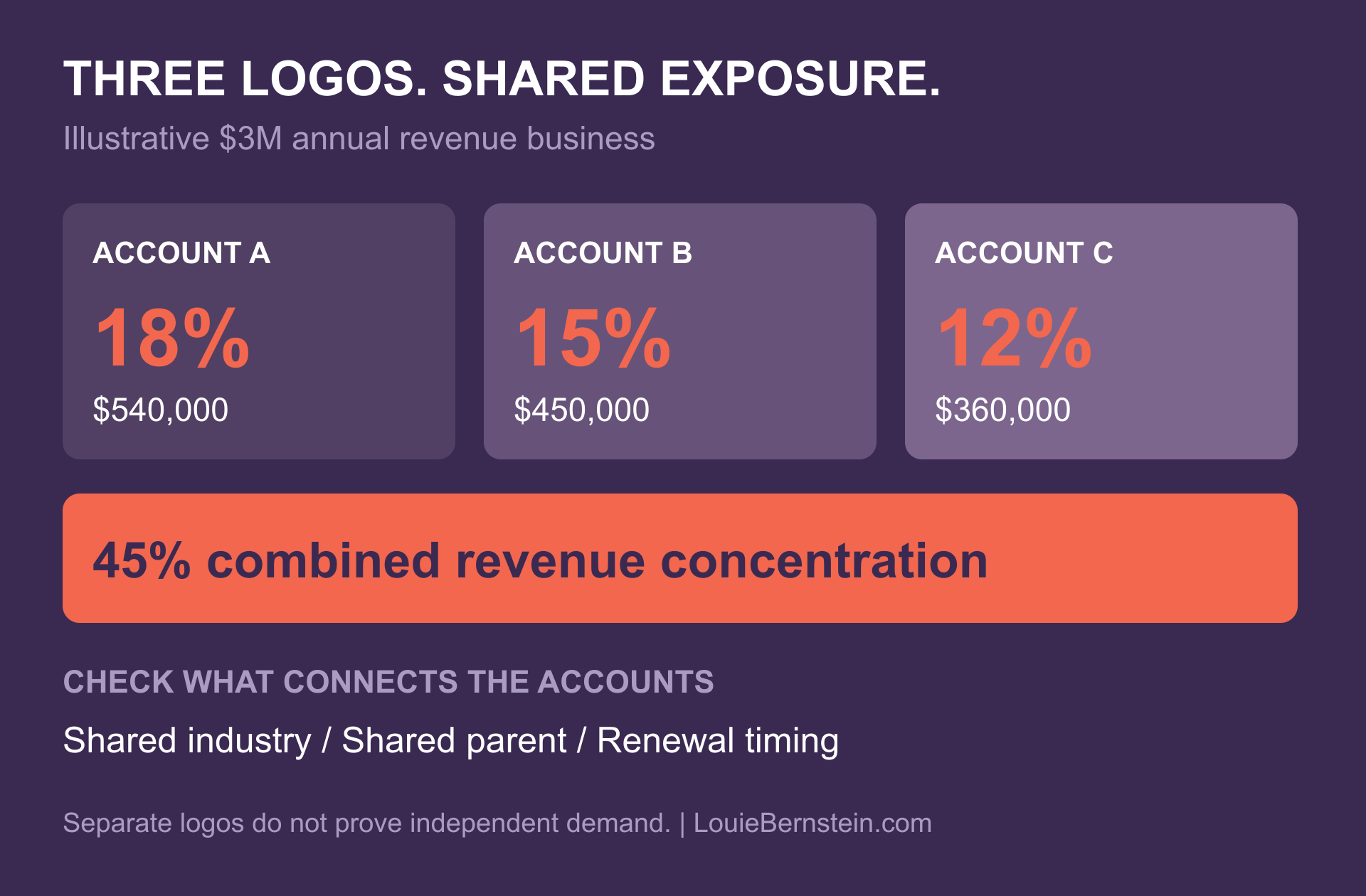
| Account A | $540,000 | 18% |
| Account B | $450,000 | 15% |
| Account C | $360,000 | 12% |
| Top three combined | $1,350,000 | 45% |
No account reaches 20%. Together, three buying decisions govern almost half the business. A dashboard that shows only your biggest account misses the combined exposure.
Don't confuse revenue with money available for payroll
A labor-intensive account can produce a large revenue share and a smaller gross profit share. A high-margin subscription can do the reverse. Calculate both before deciding which group could hurt the business most.
Receivables add another view. A customer may represent 15% of annual sales but a much larger share of invoices awaiting payment today. Atradius explains how large-customer payment delays can strain working capital even while the commercial relationship continues. Put invoice aging beside the sales number.
How Much Combined Revenue Concentration Is Too Much?
Combined revenue concentration is too high when a plausible setback across your largest accounts would outrun your cash buffer and replacement sales capacity. A percentage should trigger investigation, rather than certify safety. For B2B founders, the deciding evidence is what the business could absorb before new customers begin paying.
Use a threshold to start the review
Chief Outsiders offers a rough top-three guide: under 20% is relatively healthy, 20% to 40% deserves attention, and above 40% calls for active risk reduction (Chief Outsiders, September 2026). These are advisory ranges, not a regulation or a measured failure probability.
Use the guide to put the issue on your leadership agenda. A company with three independent customers on staggered contracts faces different exposure from a company with three cancellable projects in one struggling industry, even at the same percentage.
Compare recovery time with the cash clock
If a new customer takes months to close and additional time to implement and pay, your recovery plan must cover the whole interval. An optimistic pipeline close date doesn't pay wages. Existing commitments, delivery capacity, collection timing, and accessible cash belong in the decision.
Ask your finance lead to show the downside month by month. If the company would need emergency financing, layoffs, or a rushed sale before replacement revenue arrives, the combined concentration needs a written response now.
Why Can Three Different Customers Still Behave Like One Risk?
Three customers can behave like one risk when a common event changes all their buying decisions. Shared ownership, industry conditions, funding sources, or purchasing cycles can connect otherwise separate accounts. A founder should map those connections because a logo count alone doesn't show how many independent sources of demand the company has.
Map the event that could hit the whole group
- Shared parent: Different subsidiaries may face the same procurement policy or group spending freeze.
- Shared industry: Three construction suppliers may all reduce discretionary projects when their end market slows.
- Shared renewal window: Separate customers may all reconsider spending just before your seasonal cash low.
- Shared dependency: Several customers may need the same platform, grant program, or large end buyer to keep operating.
Shared exposure doesn't prove the accounts will cut spending together. It identifies a scenario worth testing. Write down the connection, the evidence, and what would have to happen for spending to change.
Make customer knowledge part of the sales job
My course, How to be a Professional Salesperson, includes understanding the customer's business and making a value call. The homework asks managers to quiz salespeople on their accounts and the key people involved. Apply the same discipline to concentration: your rep should explain what funds the purchase and what could interrupt it.
That teaching approach is covered in helping salespeople understand their customers' businesses. Ask the rep to investigate and report back. If the founder supplies every answer and makes every call, the company still depends on the founder to notice trouble.
What Happens If All Three Big Customers Cut Spending?
Simultaneous spending cuts across three major customers can damage profit far more than the headline revenue decline suggests. Fixed costs don't automatically fall with sales. For a founder-led B2B company, model both reduced spending and delayed collections, then compare the remaining operating contribution with commitments you must still pay.
Run a partial-loss scenario before a total-loss scenario
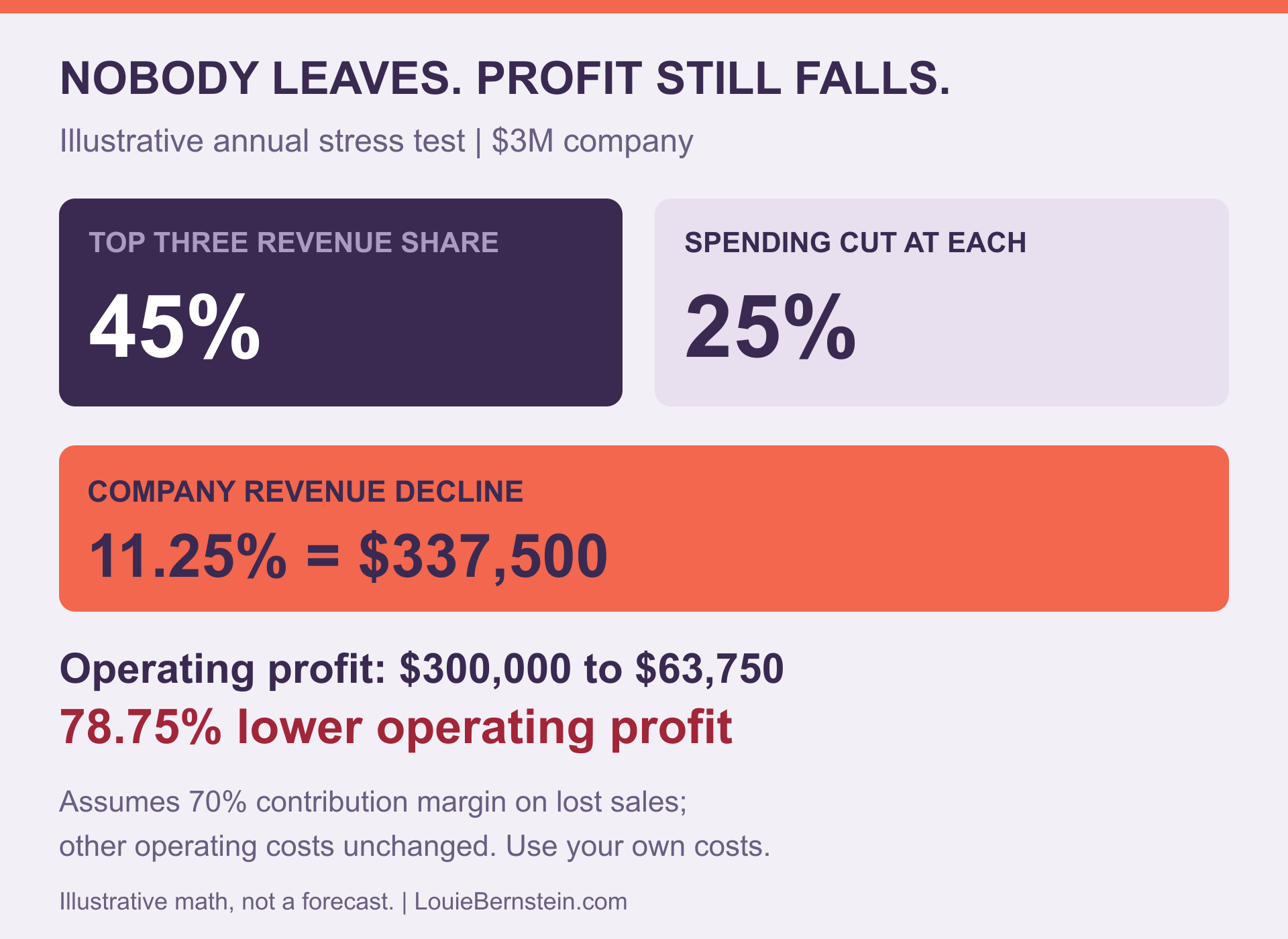
Return to the illustrative $3M company whose top three accounts produce $1.35M, or 45%, of revenue. Suppose all three cut purchases by 25%. Annual revenue falls $337,500, an 11.25% decline across the company. No customer has left.
Assume the lost sales carry a 70% contribution margin after costs that actually disappear with the work. Lost annual contribution is $236,250. If annual operating profit was $300,000 and other operating costs stay unchanged, profit falls to $63,750. That's a 78.75% reduction in operating profit.
The example is arithmetic, not a forecast or an industry benchmark. A 70% contribution margin may suit some businesses and be wrong for yours. If the relevant delivery costs remain on payroll, less cost disappears and the immediate hit can be worse. Use your own avoidable costs with finance.
Separate a lost sale from a late payment
A late invoice doesn't automatically reduce recognized revenue, but it can leave you short of cash. In a second scenario, delay collections from the exposed accounts and show which payments the business would still owe. Don't count the same invoice twice as both a permanent loss and a timing delay.
Model a third case where one account leaves and another trims spending. Write the assumed dates, cost responses, and cash effects beside every scenario. A useful downside model makes assumptions visible enough to challenge.
How Do You Reduce Shared Exposure Without Neglecting Good Customers?
Reduce shared customer exposure by protecting existing relationships while building profitable demand that doesn't depend on the same budget decision. Give account coverage and new-customer selling clear owners. For a growing B2B company, the aim is a wider base of dependable contribution, with enough cash to support the transition.
Turn the percentage goal into a sales requirement
Suppose the top three accounts hold at $1.35M and you choose a 30% combined concentration target. Total revenue would need to reach $4.5M: $1.35M divided by 0.30. From a $3M starting point, that's $1.5M of additional annual revenue outside those accounts, assuming you retain all other revenue.
For a subscription business, apply the same calculation consistently to ARR. At $100,000 ARR per new account, $1.5M means 15 additional accounts. At $50,000, it means 30. Those are planning examples, not a reason to chase smaller customers that don't fit.
Build the required pipeline from your own deal size, win rate, sales cycle, and ramp time. Use a documented Sales Playbook so the next accounts don't require the founder to invent the process again.
Make the first 90 days specific
- Days 1 to 15: Finance and sales build the exposure table, identify shared risks, and run the cash scenarios.
- Days 16 to 30: Account owners confirm business conditions, renewal requirements, and relationships beyond one champion. Discuss feasible changes to timing or terms with customers.
- Days 31 to 60: Assign new-customer targets outside the exposed group. Define the buyer profile, prospecting routine, qualification rules, and accountable owner.
- Days 61 to 90: Inspect qualified opportunities, customer commitments, collections, and concentration trends. Adjust the plan using evidence.
The 90 days establish a working routine. They don't promise complete diversification. If your sales cycle is longer, progress should show up first in qualified opportunities and buyer commitments.
Stay close to your big customers. Teach account owners to bring useful business questions, document answers in the CRM, and flag changes early. A written Accountabilities Document makes ownership clear when everyone is busy.
Keep earning the big customers' business. Build enough independent demand that their next budget meeting doesn't decide your entire year.
Related Reading
How Much Revenue Should Your Biggest Customer Be? →
Frequently Asked Questions
Q: Should I count a reseller or the end customers behind it?
Track both views. The reseller may control your commercial agreement and payment, while end customers determine underlying demand. A large end-customer count doesn't remove dependence on one reseller's decision to carry your product.
Q: Does concentration matter if customers prepay annually?
Yes. Prepayment can improve current cash availability, but you still owe delivery and face renewal exposure. Keep enough resources to meet those obligations, and test the cash position after the next renewal rather than treating prepaid cash as permanent protection.
Q: Should we diversify into a completely new industry?
Only when you can serve and win customers there profitably. Start with adjacent buyers whose needs fit your offer but whose budgets depend on different conditions. Entering an unfamiliar industry can add selling costs and delivery risk before it reduces concentration.
Q: Will adding more contacts at each account solve combined exposure?
More relationships reduce dependence on one champion and improve your visibility. They don't prevent an industry downturn or a parent company's spending freeze. Use wider account coverage alongside independent demand and a cash response plan.
Q: What should I show a potential buyer or investor?
Show customer-level revenue, margins, contracts, renewal dates, retention history, and the diversification plan. Include common exposures and documented account relationships. BDC's due-diligence guidance specifically calls for examining customer concentration and understanding whether key customers' purchasing could change.
Can your team build demand beyond the same three accounts?
If you're still handling the biggest relationships and closing the new business yourself, Fractional Sales Leadership can help build the Sales Playbook, coaching routines, and accountabilities your team needs. Let's look at where demand depends on you and what the team can learn to own.
Schedule a 30-Minute CallAbout the Author
Louie Bernstein
Louie Bernstein is a Fractional Sales Leader with 50 years of sales experience and has provided Fractional Sales Leadership since 2017. He helps B2B founders build repeatable sales systems and teach their teams to sell without depending on the founder.