When Does a Large Customer Become a Revenue Concentration Risk?
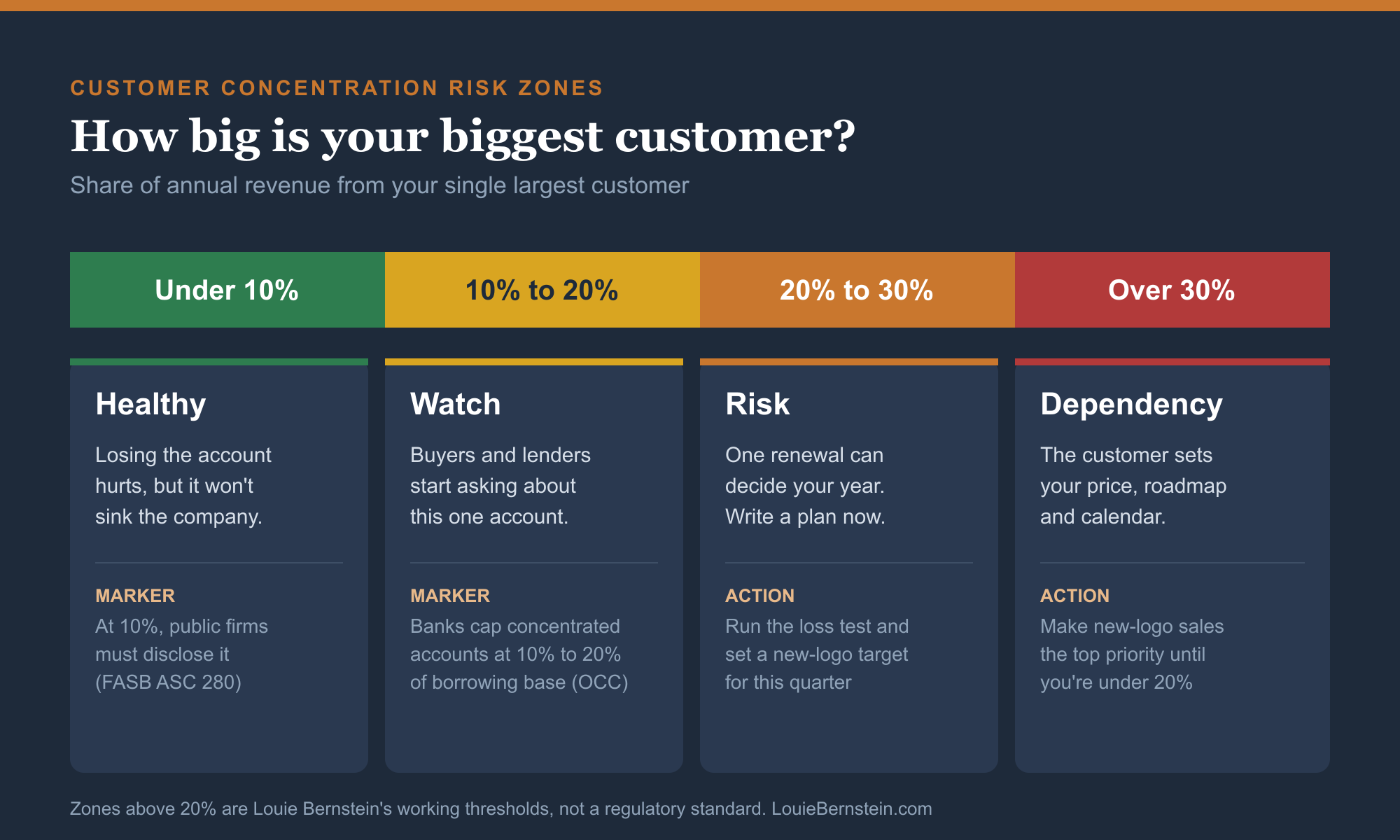
Your biggest customer should be under 10% of annual revenue. Between 10% and 20%, you're in a watch zone. Above 20%, you have a customer concentration risk that needs a written plan, and above 30%, that one customer effectively controls your price, roadmap and calendar. The 10% line isn't arbitrary: it's where public-company accounting rules (FASB ASC 280) and bank lenders (OCC) start treating one customer as a separate risk.
Key Takeaways
- Keep your biggest customer under 10% of annual revenue. Treat 10% to 20% as a watch zone and anything above 20% as a customer concentration risk.
- Public companies must disclose any single customer that produces 10% or more of revenue (FASB ASC 280), and bank examiners consider receivables concentrated at that same 10% line (OCC).
- Run the loss test this week: if your biggest customer gave notice tomorrow, calculate how many months of cash you'd have and whether you'd have to cut people.
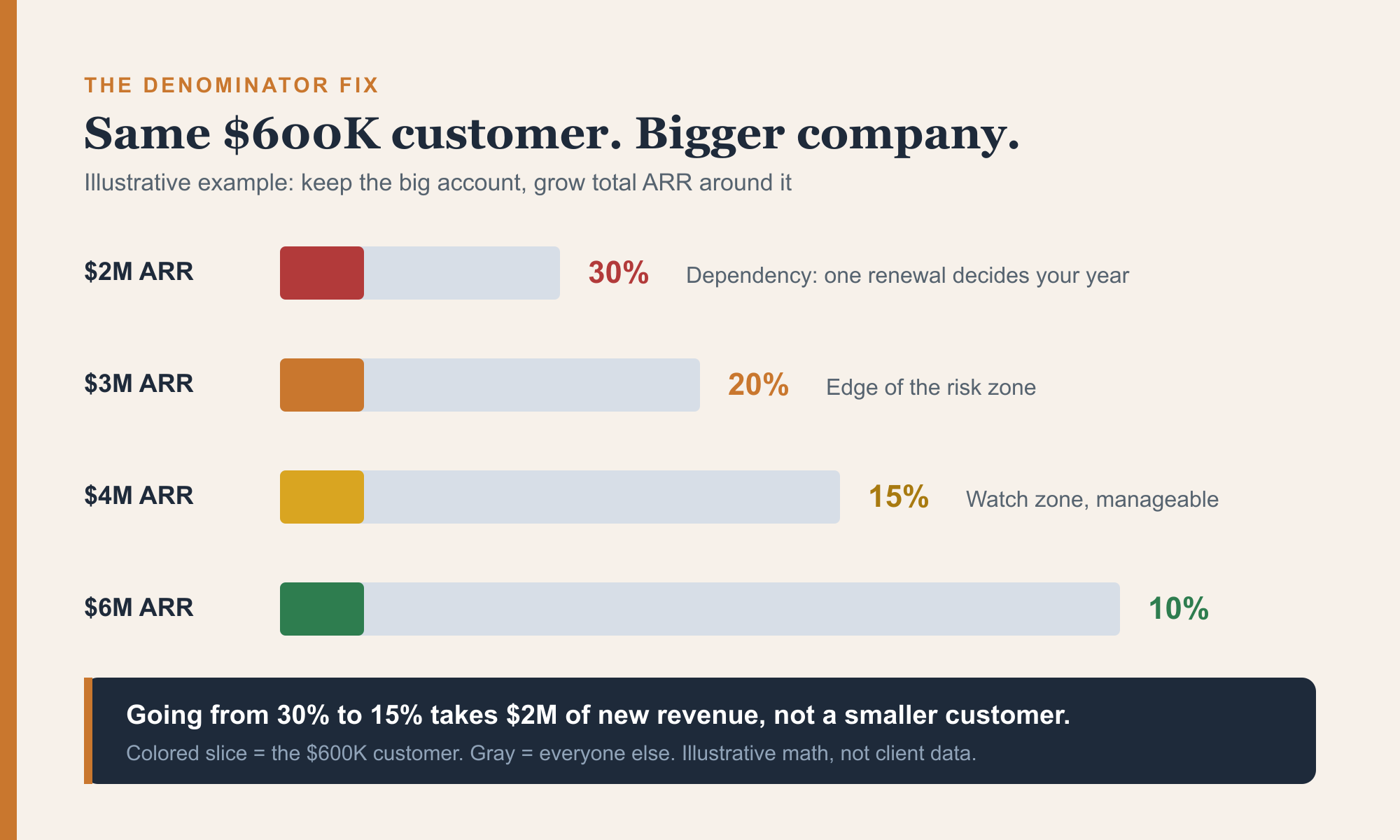
- Reduce concentration by growing the rest of the business, not by shrinking the big account. A $600K customer drops from 30% to 15% of revenue when total ARR grows from $2M to $4M.
- In founder-led companies, concentration is usually a sales-system problem: the founder owns the big relationship, services it personally, and stops selling new logos.
Every founder loves the day the big one signs. The logo goes on the website. Payroll suddenly feels easy. For a year or two, that customer is the best thing that ever happened to the company.
Then the customer's new VP of Procurement asks for a 15% price cut at renewal. Or a merger puts a competitor in charge of the buying decision. Or the champion who loved you retires. Now one email can decide whether you make payroll.
A customer that's 30% of your revenue is a business partner who never signed the partnership agreement.
For B2B founders between $1M and $10M ARR, this is one of the most common hidden risks I see. The numbers below will tell you where you stand and what to do about it.
What Percentage of Revenue Should Your Biggest Customer Be?
A B2B company's biggest customer should be under 10% of annual revenue, with 10% to 20% acceptable only while you're actively diversifying. Above 20%, losing one account can force layoffs or a cash crisis. The 10% figure matters because accountants, auditors and bank lenders already use it as the line where one customer becomes its own risk.
The four customer concentration zones
- Under 10%: Healthy. Losing the customer hurts, but the company survives without emergency cuts.
- 10% to 20%: Watch. Buyers, lenders and investors will ask about this account by name. Have a diversification target.
- 20% to 30%: Risk. One renewal can decide your year. You need a written plan for new-logo growth and a cash plan for losing the account.
- Over 30%: Dependency. The customer sets your pricing, your product priorities and a big share of your calendar, whether you admit it or not.
The first two lines come from outside standards. Under FASB ASC 280, a public company must disclose the fact when revenue from a single external customer reaches 10% or more of total revenue, along with the amount (FASB ASC 280-10-50-42, per Deloitte's guide). Private companies don't have to file that disclosure, but buyers, auditors and lenders think in the same terms.
Banks draw the same line. The OCC's Comptroller's Handbook on receivables lending says lenders normally consider receivables concentrated when a single account is 10% or more of the portfolio, and recommends limiting concentrated accounts to 10% to 20% of the borrowing base (OCC, Accounts Receivable and Inventory Financing). The 20% and 30% thresholds above are my own working rules from decades of watching companies, not a regulation.
When Does a Large Customer Become a Revenue Concentration Risk?
A large customer becomes a revenue concentration risk when losing it would force you to cut staff, miss payroll or abandon your growth plan. The percentage is only the starting signal. Gross margin, renewal timing, contract terms and who owns the relationship decide how dangerous a 20% customer really is.
Run the loss test
- Write down the gross profit your biggest customer produces in a year, not just the revenue.
- Subtract it from your annual gross profit and compare what's left to your fixed costs.
- Divide your cash on hand by the monthly shortfall. That's your runway if the customer leaves.
- Check the contract: notice period, renewal date, termination for convenience, and any exclusivity you agreed to.
- Name everyone at the customer who knows your value. If the list is one person, you're more exposed than the revenue number suggests.
If the answer to step 3 is less than six months, treat the account as a concentration risk regardless of its percentage. A 15% customer with a 30-day termination clause and one champion can be more dangerous than a 25% customer on a three-year contract with five relationships.
Four warning signs beyond the percentage
- Your best margin lives there. The account produces a bigger share of gross profit than of revenue.
- The renewal is inside 12 months. Concentration risk is highest right before the customer decides again.
- The product roadmap bends toward one customer. Features nobody else asked for keep getting built.
- The founder is the relationship. If you're the only one the customer calls, the account depends on your calendar too.
That last sign connects directly to founder-led sales. When the founder holds the biggest relationship, concentration risk and founder dependency become the same problem.
Why Do Buyers and Lenders Discount Customer Concentration?
Buyers and lenders discount customer concentration because one customer's decision can erase a large share of the cash flow they're paying for or lending against. Research on public-company deals shows acquirers bid less often for concentrated targets and earn lower returns after buying them. Lenders limit how much one customer's invoices can count as collateral.
What the research says about concentrated companies in acquisitions
A study of US public-company mergers found that acquirers buying a customer-concentrated target saw significantly lower stock market returns and worse long-run operating performance (Dong, Li and Li, Journal of Corporate Finance, 2021). The effect was stronger when the target's customers had low switching costs. That's the exact position of many small B2B vendors: easy to replace.
A second study found acquirers place fewer bids for targets with higher customer concentration and use more stock instead of cash in their offers (Cheng, Jaggi and Young, Journal of Business Finance and Accounting, 2022). Paying in stock shifts part of the risk back to the seller. If you plan to sell someday, the article on what your company is worth if it can't run without you covers the related owner-dependence discount.
The research isn't one-sided
Big customers aren't automatically bad. A 2012 study of public suppliers found that a concentrated customer base was associated with lower selling and administrative costs per dollar of sales, faster asset turnover and better overall performance, despite lower gross margins (Patatoukas, The Accounting Review, 2012). Close relationships with large buyers can make a supplier more efficient.
The difference is scale. A large public supplier can survive losing a 15% customer. A $3M company usually can't absorb losing a 30% customer without layoffs. The efficiency is real, but so is the fragility, and the fragility is bigger when you're small.
A big customer makes you efficient. Too big a customer makes you fragile. The job is to keep the first without the second.
How Do You Reduce Customer Concentration Without Losing the Big Account?
Reduce customer concentration by growing revenue from new and existing smaller customers, not by pushing the big account away. Concentration is a fraction, and the fastest healthy fix is a bigger denominator. A $600K customer is 30% of $2M ARR but only 15% of $4M ARR, without losing a dollar.
The denominator fix, step by step
- Set a concentration target with a date. For example: biggest customer under 20% of revenue within 18 months.
- Translate the target into new revenue. Divide the big customer's revenue by your target percentage. At $600K and 20%, you need $3M total, so $1M of growth from everyone else.
- Build a new-logo pipeline for that number. Work backward from average deal size and win rate to the number of qualified opportunities you need each quarter.
- Write the sales process down. A documented sales playbook lets someone other than the founder sell to the next 20 customers.
- Widen the big account's relationships. Add three or more contacts beyond your champion and move day-to-day service off the founder.
- Review concentration monthly. Track the top customer and the top five customers as a share of trailing 12-month revenue.
What not to do
Don't raise the big customer's price to "even things out," and don't quietly give them worse service so smaller accounts get attention. Both damage the relationship that's paying your bills. Don't sign exclusivity or most-favored-customer terms to win a renewal either. Those clauses make the concentration harder to fix later.
Also don't chase every small deal just to lower the percentage. Ten customers who don't fit your ideal customer profile will cost more to serve than they're worth. Grow the base with customers who look like your best ones.
Where Founders Usually Get Customer Concentration Wrong
Founders usually treat customer concentration as an account-management problem when it's really a sales-system problem. The big customer rarely grows too large on its own. It grows large because new-customer selling stalled while the founder's time went to keeping the biggest account happy.
What I see when I audit sales teams
In 50 years of B2B sales, the pattern I've watched repeat is simple. The biggest account almost always came through the founder's personal network. The founder runs the quarterly reviews, takes the escalation calls and answers the late-night emails. Nobody else on the team has a real relationship there.
Meanwhile, the new-logo pipeline gets thinner. The market didn't dry up. The person who closes deals is spending the week servicing one customer. When I look at these companies, the concentration percentage and the founder's calendar tell the same story.
The fix isn't a better account plan for the whale. It's a sales system that finds, qualifies and closes the next 20 customers without the founder in every meeting. That's the work a Fractional Sales Leader does: build the process, coach the people, and get the founder out of the deal flow. My fee is $14K a month for 20 to 35 hours a week, roughly half the cost of a full-time VP of Sales at $250K to $400K a year.
You don't fix a concentration problem by loving the big customer less. You fix it by building a company that could live without them.
Related Reading
Should You Chase Bigger Deals Yet? →
Frequently Asked Questions
Q: Should I measure concentration by revenue or by gross profit?
Measure customer concentration both ways. Revenue share is what buyers and lenders see first, but gross profit share tells you how much of your ability to cover fixed costs depends on one customer. If a customer is 18% of revenue and 28% of gross profit, plan as if it's 28%.
Q: What about my top five customers combined?
Track your top five customers as a share of trailing 12-month revenue alongside your single largest customer. If five customers produce most of your revenue, you have concentration risk even when none of them crosses 20% alone. Watch the trend every month, not just the snapshot.
Q: Should I turn down a new customer who would become 30% of revenue?
Usually no, but negotiate the terms with concentration in mind. Ask for a longer initial term, a meaningful termination notice period and no exclusivity. Then commit, in writing, to the new-logo growth that will bring that customer below 20% within a set timeframe.
Q: How long does it take to reduce customer concentration?
Reducing customer concentration from 30% to 20% requires total revenue to grow by half while the big account stays flat. At 50% annual growth in total revenue, that takes about a year. At 25% annual growth, it takes just under two years. A documented sales process and someone other than the founder selling are what raise that growth rate.
Q: Does customer concentration matter if I'm not planning to sell the company?
Yes. Customer concentration affects your bank line, your pricing power at renewal and your ability to survive a lost account, not just your exit value. A company you never plan to sell still has to make payroll the month after its biggest customer leaves.
Is one customer carrying your company?
If your biggest customer is more than 20% of revenue and you're still the one closing every new deal, let's talk. We'll look at your concentration numbers and what it would take to build a sales system that grows the rest of the business.
Schedule a 30-Minute CallAbout the Author
Louie Bernstein
Louie Bernstein is a Fractional Sales Leader with 50 years of sales experience and has provided Fractional Sales Leadership since 2017. He helps B2B founders build repeatable sales systems so their teams can sell without depending on the founder.