Key Takeaways:
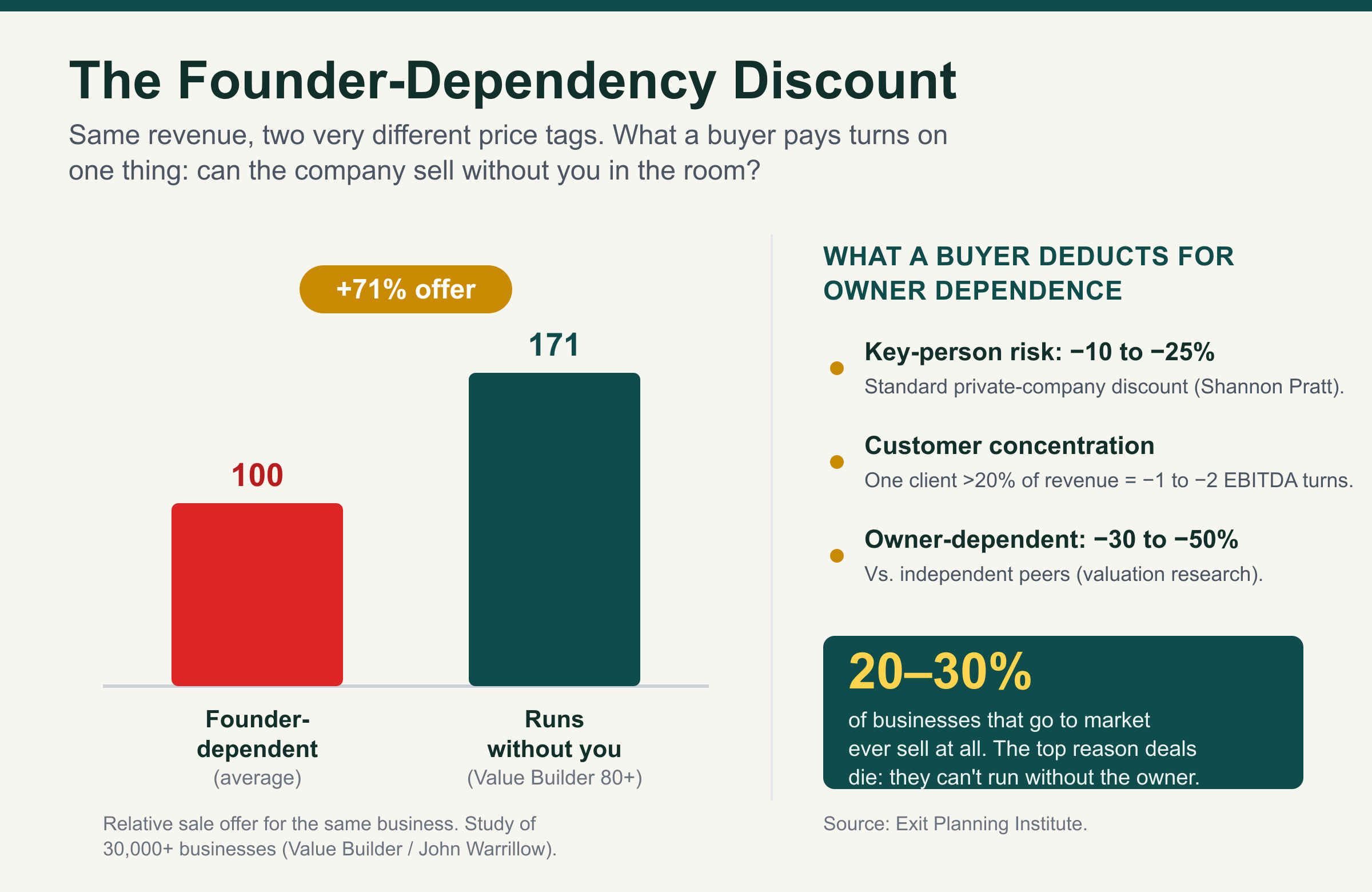
- Only 20–30% of businesses that go to market ever sell, and owner-dependent operations are one of the top reasons deals collapse in diligence (Exit Planning Institute).
- A "key-person discount" of 10–25% is standard in private-company valuation (Shannon Pratt). Heavy owner dependence pushes owner-run companies to sell for 30–50% less than independent peers.
- Founder-led sales is the most expensive dependency of all, because it concentrates your entire revenue engine in one person: you.
- The upside is just as real. Businesses that reach a Value Builder Score of 80+ sell at a 71% premium over average-scoring peers, across a study of 30,000+ companies (The Value Builder System).
- This isn't only an exit issue. A company that runs without you is one you can step back from, take a real vacation from, and sleep at night owning, whether you sell it or not.
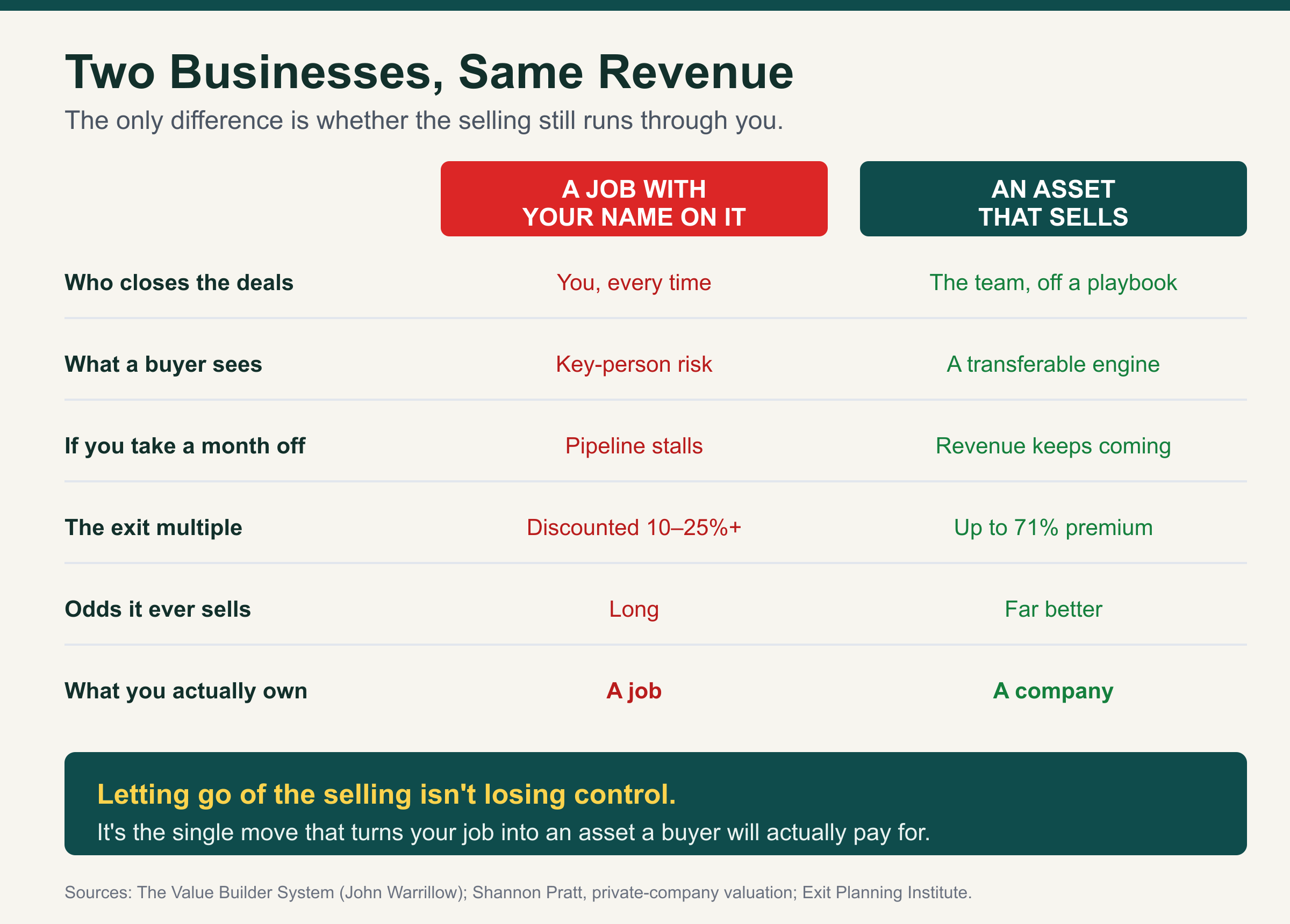
- Letting go of the selling isn't losing control. It's the single move that turns a job with your name on it into an asset a buyer will actually pay for.
Here's a number that should stop you cold. Of all the businesses that go to market to sell, only 20% to 30% ever actually find a buyer (Exit Planning Institute). Most never sell at all. And one of the reasons that comes up again and again in diligence is brutally simple: the business can't run without the owner.
If you're a founder between $1M and $10M ARR and you're still the one closing most of the deals, that sentence is about you. I know, because I spent 22 years running a company I bootstrapped, and for a long stretch I was the sales department. It felt like control. It was actually a ceiling, and a discount I couldn't see.
So let's answer the question directly. What is your company worth if it can't run without you? Less than you think, and here's exactly why, in the numbers buyers actually use.
The Discount You Can't See Until You Try to Sell
When a buyer looks at your company, they aren't buying last year's revenue. They're buying next year's, and the year after that. The single question underneath every valuation is: does this revenue keep showing up if the founder walks out the door? If the honest answer is no, they price the risk. That's the founder-dependency discount, and it's not a soft, emotional thing. It has a well-established range.
The key-person discount is real and it's on the books
A "key-person discount" of 10% to 25% is standard in private-company valuation when one individual is central to the business (Shannon Pratt, the definitive reference on valuing closely held companies). That's the baseline. When that individual isn't just important but is the person who personally generates the revenue, it gets worse. Businesses that genuinely can't run without the owner routinely sell for 30% to 50% less than independent peers with the same revenue and margin. Same top line. A fraction of the price.
A job doesn't have a multiple
Here's the reframe that lands with every founder I say it to: a company that only grows when you're in the room isn't a company yet. It's a job with your name on it, and a very demanding one. Jobs don't get acquired. Systems do. The buyer isn't being cruel when they discount you. They're being accurate, because what they'd actually be buying is your calendar, and your calendar leaves with you.
Founder-Led Sales Is the Most Expensive Dependency of All
Founders accept that operational dependency matters. What they miss is that sales dependency is the most dangerous kind, because it sits directly on top of revenue, the exact thing a buyer is paying for.
Think about how acquirers treat customer concentration. When a single customer accounts for more than about 20% of revenue, buyers routinely knock one to two turns of EBITDA off the price, because too much of the future depends on one relationship they can't control (customer-concentration research is consistent on this). Now look in the mirror. When you personally own every key relationship, close every important deal, and hold the whole pipeline in your head, you are the concentration risk. You're not one customer worth 20%. You're the common thread behind 100% of the revenue.
A buyer will forgive a lot. What they won't pay full price for is a revenue engine with one moving part, and that part is a person who's about to leave.
This is why "I'm great at sales" quietly becomes the thing that caps your company's value. The better you are as the founder-seller, the more the business leans on you, and the more it leans on you, the less it's worth without you. Your greatest strength, left unaddressed, becomes the line item that gets discounted hardest.
The 71% Swing Going the Other Way
Now the good news, and it's bigger than the bad. The same lever that's costing you works powerfully in reverse the moment you pull it. John Warrillow's Value Builder System analyzed more than 30,000 businesses and found that companies which reach a Value Builder Score of 80 or higher receive offers 71% larger than average-scoring businesses. One of the heaviest-weighted drivers of that score is exactly what we're talking about: how well the company runs without its owner.
Read that again, because it reframes the whole project. Getting yourself out of the day-to-day selling isn't a lifestyle nicety you earn someday. It's the highest-return work you can do on the enterprise value of your business. A repeatable sales system that runs without you is the asset that both frees your calendar and commands the premium. Freedom and valuation turn out to be the same project.
This Matters Even If You Never Want to Sell
Maybe you have no plans to exit. Maybe you love this thing and intend to run it for another decade. The founder-dependency discount still matters, because valuation is just a scoreboard for a deeper truth: a business that can't run without you controls your life. You can't take a real vacation. You can't get sick. You can't chase the next idea, because the pipeline needs you back on the phone by Monday.
The valuation number is simply the market pricing your freedom. When you build a company that runs without you, you get an asset worth more and a life you actually own in the meantime. The founders who ignore this don't just leave money on the table at exit. They pay for it every single week they stay chained to the close. If you want to understand why that grip is so hard to loosen, I wrote about the five fears that keep founders holding the baby. It's rarely a logic problem. It's an identity one.
How to Close the Gap
You don't close the founder-dependency discount by working harder. You close it by making yourself replaceable in the parts of the sale that don't actually require you, which is most of them. Here's the order that works.
1. Get the sales process out of your head and onto paper
The reason every deal needs you is that the operating manual for how deals get won lives only in your instincts. Record your next ten calls. Write down how you qualify, how you handle the hard objection, how you know a deal is real. That document is the asset that starts to replace you, and it's the thing a buyer is actually paying for.
2. Hand off in the right order, least attached first
Most founders try to hand off closing first, it goes badly, they panic, and they yank it all back. Reverse it. Let go of lead generation and qualifying first, then discovery and demos, and keep your marquee relationships and closes for last, introduced deliberately, never dropped. I walk through the full sequence in the article on getting out of the bottleneck.
3. Build a revenue engine a buyer can inherit
A documented process, a hired-and-ramped team, a healthy CRM, and a pipeline that doesn't depend on your personal charm. That's what turns "trust me, the deals close" into "here's the machine that closes them." It's the difference between a story and an asset.
The goal was never to make you sell less. It was to make the company able to sell without you, so that selling becomes a choice, not a life sentence, and your equity becomes worth what you always thought it was.
None of this requires the $250K full-time VP of Sales you're probably not ready for at this stage. It requires someone who's built this system before to install it, part-time, and hand it back to you running. That's precisely the work a Fractional Sales Leader does: extract the selling from your head, turn it into a repeatable process, and remove the discount that's been quietly attached to your life's work.
Frequently Asked Questions
Q: What exactly is the founder-dependency discount?
It's the amount a buyer knocks off your company's value because the business depends too heavily on you personally. In valuation terms it starts as a "key-person discount," commonly 10% to 25% (Shannon Pratt), and grows from there when you're not just important but are the person generating the revenue. Businesses that genuinely can't run without the owner routinely sell for 30% to 50% less than comparable independent companies. The discount is invisible while you're running the business and becomes very visible the moment you try to sell it.
Q: I'm the best salesperson in my company. Isn't that a good thing?
It's a great thing for this quarter and a liability for your enterprise value. The better you are as the founder-seller, the more the business concentrates around you, and concentration is exactly what buyers discount. Think of yourself the way an acquirer thinks of a single customer worth more than 20% of revenue, a risk worth one to two turns of EBITDA. Except you're behind all of the revenue, not 20% of it. The fix isn't to sell less well. It's to make your skill repeatable by others so the company owns it, not just you.
Q: How much more is a company that runs without the founder actually worth?
The clearest data point comes from John Warrillow's Value Builder System, which studied over 30,000 businesses and found that those reaching a Value Builder Score of 80+ received offers 71% higher than average-scoring companies. Owner independence is one of the most heavily weighted factors in that score. So you're not choosing between a 10% and a 15% improvement. Done well, reducing founder dependency can move your valuation by a large multiple of the effort it takes, which is why it's the highest-return work most founders never get to.
Q: I don't plan to sell. Does any of this matter to me?
Yes, because valuation is really just a proxy for how much your business controls your life. A company that can't run without you can't be left, even for two weeks, without revenue wobbling. You carry it in your body, in the missed vacations and the Sunday-night dread. Building a business that runs without you buys back your time now and creates a more valuable asset later, whether or not you ever cash it in. The discount is priced in your quality of life long before it ever shows up on a term sheet.
Q: Won't handing off my customer relationships hurt the business, and the value, in the short term?
Only if you do it abruptly. Done right, a handoff is an orchestrated introduction, not an abandonment: you vouch for the new person, stay reachable for genuinely strategic moments, and frame it as the customer getting more coverage, not less. Your best accounts value being well taken care of more than they value your specific calendar. Handled deliberately, you strengthen the relationships and remove the key-person risk at the same time. That's the opposite of a value hit, it's how you build the transferable revenue base a buyer pays a premium for.
Q: I'm at a few million in ARR closing most deals myself. Where do I even start?
Start by writing down what only you know. Record your next ten sales calls and codify how you qualify, run discovery, and close. That single document begins converting founder dependency into a company asset. Then hand off in order of least attachment to most, top of funnel first, closing last. If you want that done faster and correctly, a Fractional Sales Leader installs the whole system part-time, without the cost or commitment of a full-time VP of Sales you likely don't need yet at $1M to $10M ARR.
Your company is probably worth more than it can prove right now.
If you're a founder between $1M and $10M ARR still closing most of the deals yourself, the founder-dependency discount is quietly attached to everything you've built. Let's spend 30 minutes finding where your business depends on you, and mapping the order to hand it off, so your equity becomes worth what you always thought it was. If a real sales system won't move the needle for you, I'll tell you that too.
Schedule a 30-Minute CallAbout the Author
Louie Bernstein
Fractional Sales Leader with 50 years of sales experience helping $1M–$10M ARR companies build scalable, repeatable sales systems. Founder of MindIQ (INC 500). LinkedIn Top Voice in Sales Management, Sales Operations, and Sales Coaching.