Key Takeaways:
- You're not the bottleneck because you're bad at letting go. You're the bottleneck because the sales knowledge lives in your head, not in your company.
- Staying in every deal caps growth at your calendar, discounts the value of your company, and burns you out. Those costs compound quietly.
- Most of what feels like "only I can do this" is really "I've never written down how I do this." Those are two very different problems.
- Hand off in the right order. Start with the parts of the deal you're least attached to. Your relationships and your closes go last, introduced, not dropped.
- A documented, repeatable sales process is the asset that replaces you. It also happens to be what makes the business worth more.
- You don't stop being the bottleneck by working less. You stop by turning what's in your head into a system someone else can run.
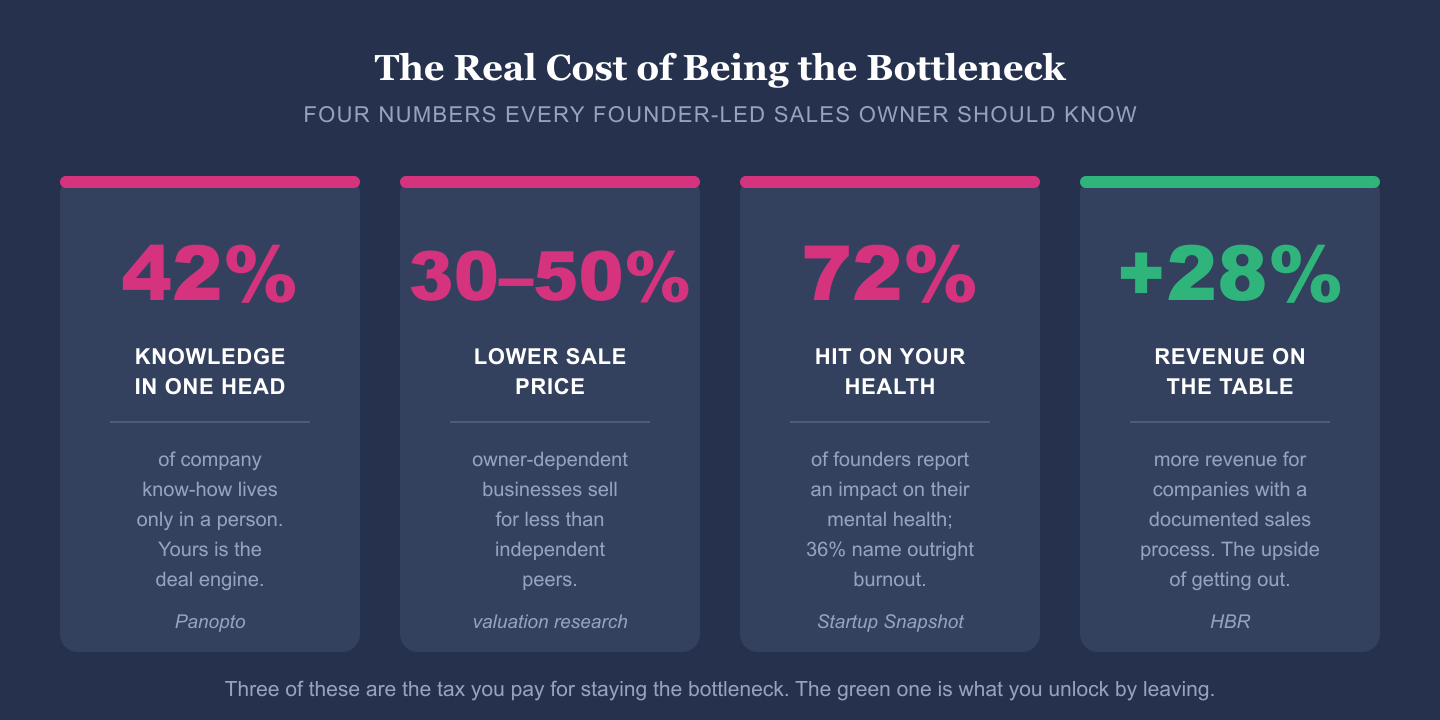
Here's a number that should stop you cold. Roughly 42% of the knowledge a company runs on lives only inside people's heads, never written down anywhere (Panopto). In a founder-led sales org, a big chunk of that undocumented knowledge is you, how you qualify, how you handle the hard question, how you know when a deal is real.
So when you say "every deal still needs me," you're right. It does. Not because your team is weak. Because the operating manual for how deals get won at your company was never written. It's improvised, live, by you, on every call.
I've been in sales for fifty years, and I've watched a lot of talented founders get stuck in this exact spot. They built something people want. They can sell it in their sleep. And that gift is now the ceiling on the whole company.
The good news: this is a solvable, mechanical problem. Let me show you how I'd get you out of it.
Why You Became the Bottleneck (It's Not a Character Flaw)
Every founder I meet who's stuck here assumes it's a personal failing. They think they micromanage, or they can't delegate, or they secretly like being needed. Almost always, that's not it.
You became the bottleneck because in the early days, being the bottleneck was the fastest path. You knew the product cold. You had the relationships. You could read a prospect in ten seconds and adjust. Handing any of that to someone else would've slowed you down, so you didn't. You just kept closing. That was the correct call at $500K. It's the thing killing you at $3M.
You didn't build a bottleneck. You built a shortcut.
Think about what actually happens on your calls. You qualify without a checklist because you just know. You handle the pricing objection differently every time based on feel. You decide which deals to chase and which to let go on instinct. None of that is written down, because it never had to be. It all runs on you.
That's tacit knowledge, the kind that transfers through experience, not by reading a document. And here's the trap: tacit knowledge doesn't survive a handoff unless you deliberately convert it into something explicit. Hire a rep and hope they "pick it up on calls," and you'll spend a year watching them guess at decisions you make automatically. Then you'll pull the deals back, because of course you will. The deals were never going to survive that.
The problem isn't that your team can't sell. It's that you never gave them the thing you're using to sell, because it only exists in your head.
What Being the Bottleneck Actually Costs
Founders underestimate this because the cost is quiet. Nothing breaks. Deals still close. You just never grow past what one person's calendar can hold, and a few expensive things happen in the background.
Growth is capped at your calendar
There are only so many hours, and you're the only person who can move a deal to close. That's a hard ceiling. You can hire marketers, build product, raise money, and none of it matters, because the last mile of revenue still funnels through one human being. Every deal waits in line for you.
Your company is worth less
This is the one founders never see coming. When revenue depends on one person, buyers and investors apply a discount. A "key-person discount" of 10% to 25% is standard in private-company valuation (Shannon Pratt), and heavier owner dependence pushes it further, businesses that can't run without the owner routinely sell for a fraction of what independent peers command. A company that only grows when you're in the room isn't a company yet. It's a job with your name on it.
It's costing you your health
72% of founders report an impact on their mental health, and 36% name outright burnout (Startup Snapshot). When you're the only close, you can't take a real vacation, you can't get sick, and you can't build anything else, because the pipeline needs you back on the phone. That's not sustainable, and deep down you already know it.
Now the upside. Companies with a documented, repeatable sales process generate up to 28% more revenue than those winging it (HBR). The work of getting out of the bottleneck is the same work that unlocks that growth. You're not choosing between freedom and revenue. They're the same project.
The Diagnostic: Which Parts of the Deal Actually Need You?
Before you fix anything, get honest about one thing: most of what feels like "only I can do this" is really "I've never written down how I do this." Those feel identical from the inside. They're not the same problem, and they don't have the same fix.
Run the two-column test
Take your last ten closed deals. For each one, list every point where you personally stepped in. Then sort each into one of two columns:
- Real dependency — things that genuinely require your authority, history, or relationship. A ten-year friendship with the buyer. A board-level trust call. Founder-to-founder credibility on a strategic bet.
- Felt dependency — things that only need you because the how-to lives in your head. Qualifying. Running discovery. Handling the standard objections. Building the proposal. Following up.
When founders actually do this, the result is always the same. The "felt" column is enormous, and the "real" column is short, usually a handful of genuine relationships and a couple of high-stakes moments. That short list is what you keep for now. Everything in the "felt" column is a documentation problem wearing a disguise, and it can leave your calendar far sooner than you think.
"Only I can do this" is almost never true. "Only I know how I do this" is true constantly, and it's fixable in an afternoon of writing.
The Extraction System: Getting It Out of Your Head
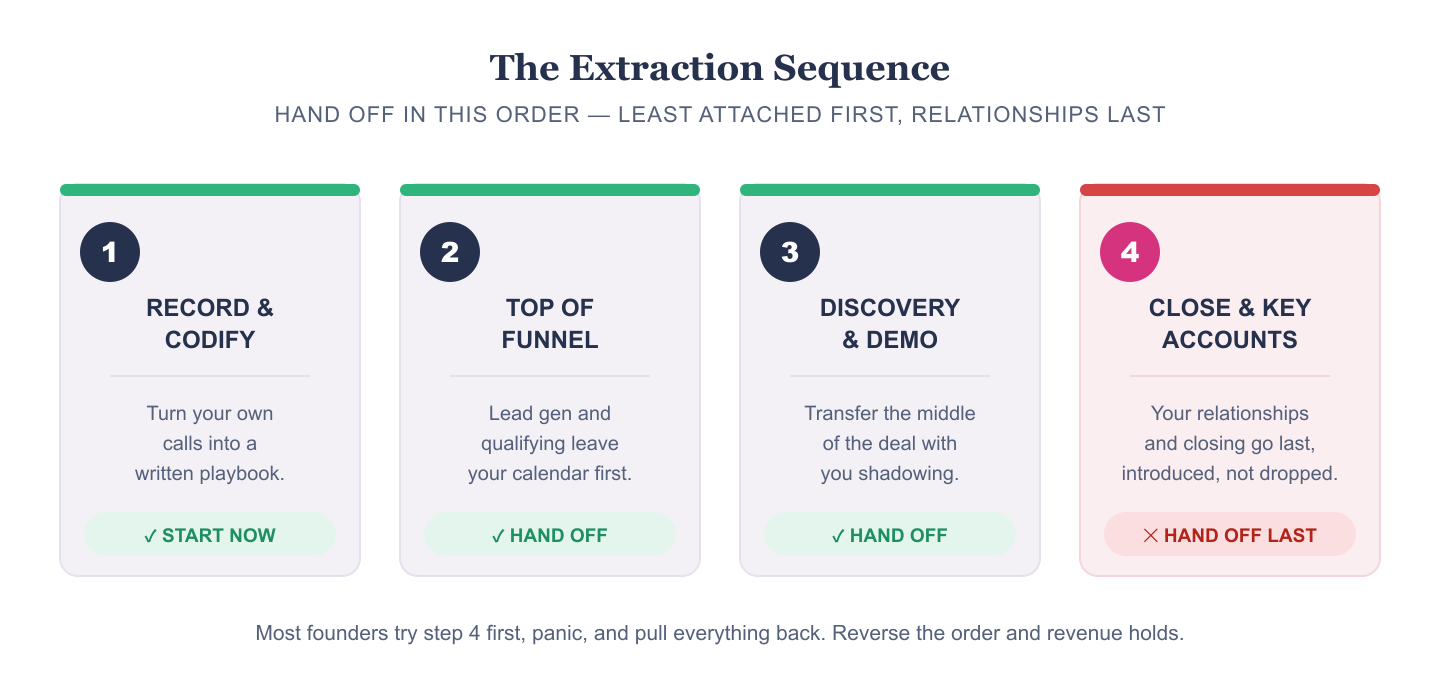
This is the part almost everyone gets backwards. They try to hand off closing first, the hardest, most relationship-heavy piece, it goes badly, they panic, and they yank everything back. Then they conclude nobody can sell like them. They proved the wrong thing.
Reverse it. Hand off in order of least attachment to most. Here's the sequence.
Step 1: Record and codify (start this week)
You already have the training material. It's your calls. Record your next ten. Then watch them and write down what you actually did: the questions you asked, the order you asked them, how you handled each objection, the exact moment you knew a deal was qualified or dead. That document is the operating manual your company has been missing. It doesn't need to be pretty. It needs to exist outside your head.
Step 2: Hand off the top of the funnel
Lead generation and initial qualifying are the least relationship-dependent parts of your day, and the easiest to systematize. Give someone your qualifying checklist (you just wrote it) and let them run first calls. You're not risking real revenue here, you're risking early-stage conversations. If a rep can reliably tell a real opportunity from a tire-kicker using your criteria, that's proof the extraction is working.
Step 3: Transfer discovery and demos
This is the meat of the sale, and it's more teachable than you think, because you've now written down how you do it. Have your rep run discovery while you shadow. Then you run it while they shadow. Then they run it and you review the recording after. The average account executive takes around five months to fully ramp (Bridge Group), so don't judge this on week two. Judge it on the trend. Are the calls getting closer to how you'd run them? That's the signal.
Step 4: Hand off closing and key accounts (last)
Your closes and your marquee relationships go last, and they get introduced, never dropped. You bring your rep into the relationship while you're still the lead. You tell the customer, in person, that this person now has your full trust and backing. You stay reachable for the genuinely strategic moments from your "real dependency" list. Done this way, the customer feels upgraded, they now have a dedicated person plus you, instead of downgraded.
Where a Fractional Sales Leader Fits (and Where It Won't)
Everything above is doable on your own. The reason most founders don't get it done is simple: you're too busy closing deals to build the system that would free you from closing deals. It's a chicken-and-egg trap, and it's exactly the gap a Fractional Sales Leader fills. Someone who's built this system before comes in, extracts what's in your head, writes the playbook, hires and ramps the team, and runs the handoff sequence, without pulling you off the revenue you still need to protect. You get senior sales leadership for a slice of the cost and commitment of a full-time VP of Sales, which is the wrong hire at $1M to $10M ARR anyway.
Now the honest part, because I'd rather you trust me than hire me for the wrong reason. If you have no sales systems or processes at all, no defined ICP, no repeatable pitch, no idea why you win or lose, then a Fractional Sales Leader is still the right call, but understand what the first ninety days actually are: foundational build, not scale. We're not plugging a leader into a machine. We're building the machine. That work is real and it's worth it, but if you're expecting someone to walk in and instantly double a pipeline that doesn't exist yet, no fractional leader, and no full-time VP, can do that. The system has to come first. The bottleneck problem and the "no systems" problem get solved by the same work, in the same order.
The goal was never to make you sell less. It's to make the company able to sell without you, so that selling becomes a choice, not a life sentence.
Frequently Asked Questions
Q: How do I stop being the bottleneck in my own sales process?
Turn what's in your head into a written system, then hand off the deal in order of least attachment to most. Start by recording your own calls and codifying how you qualify, run discovery, and handle objections. Hand off lead generation and qualifying first, then discovery and demos, and keep closing and your key relationships for last, introduced deliberately, not dropped. The bottleneck is undocumented knowledge, not a character flaw, and documentation is the fix.
Q: Won't my customers feel downgraded if I hand them to someone else?
Only if you do it sloppily. A handoff where you disappear feels like abandonment. An orchestrated introduction, where you personally vouch for the new person, stay reachable for strategic moments, and frame it as the customer getting a dedicated point of contact plus you, feels like an upgrade. Your best accounts value being taken care of more than they value your specific calendar. Give them more coverage, not less, and they'll feel it as a gain.
Q: Should I just hire a VP of Sales to fix this?
At $1M to $10M ARR, usually not yet. A full-time VP of Sales is a $250K+ commitment who expects an existing team and system to lead. If you're still the bottleneck, there's no machine for them to run, so they either start selling deals themselves (you've hired an expensive rep) or they stall. A Fractional Sales Leader is built for exactly this stage: senior enough to build the system and extract what's in your head, without the full-time cost or the wrong-hire risk.
Q: How long does it take to get out of every deal?
Plan on months, not weeks, and that's fine. The average account executive takes around five months to fully ramp (Bridge Group), and you're transferring hard-won judgment, not just tasks. But you'll feel relief much sooner. The moment lead generation and qualifying leave your calendar, you get hours back. Each stage you hand off compounds. The mistake is expecting it all to happen at once, judging a rep on week two, and pulling everything back before the system has a chance to work.
Q: What if I actually do have relationships only I can hold?
Some you do, and you keep those. That's the whole point of the two-column test, to separate genuine, authority-and-history relationships from everything that just feels irreplaceable because it was never documented. When founders run this honestly, the truly irreplaceable list is short, a handful of accounts and a few high-stakes moments. You stay on those. You get out of everything else. Holding a few strategic relationships is leadership. Holding all of them is a bottleneck.
Q: What if I have no real sales process to hand off in the first place?
Then building one is step zero, and it's still the same work. Recording your calls and codifying what you do is how you create the process you don't think you have. You've been running a process this whole time, it just lived in your instincts. If there's genuinely nothing repeatable yet, no defined ICP, no consistent pitch, a Fractional Sales Leader's first ninety days are foundational build, not instant scale. Be honest with yourself about which situation you're in, because it sets the right expectation for how fast this moves.
You already know every deal still needs you. The question is what you're going to do about it.
Let's spend 30 minutes on your actual pipeline, find the parts of the deal that only feel like they need you, and map the order to hand them off. See how it works at louiebernstein.com.
Schedule a 30-Minute CallAbout the Author
Louie Bernstein
Fractional Sales Leader with 50 years of sales experience helping $1M–$10M ARR companies build scalable, repeatable sales systems. Founder of MindIQ (INC 500). LinkedIn Top Voice in Sales Management, Sales Operations, and Sales Coaching.