Key Takeaways:
- If every important deal still closes through you, you don't have a growth problem. You have a single-point-of-failure problem, and it caps how big the company can get.
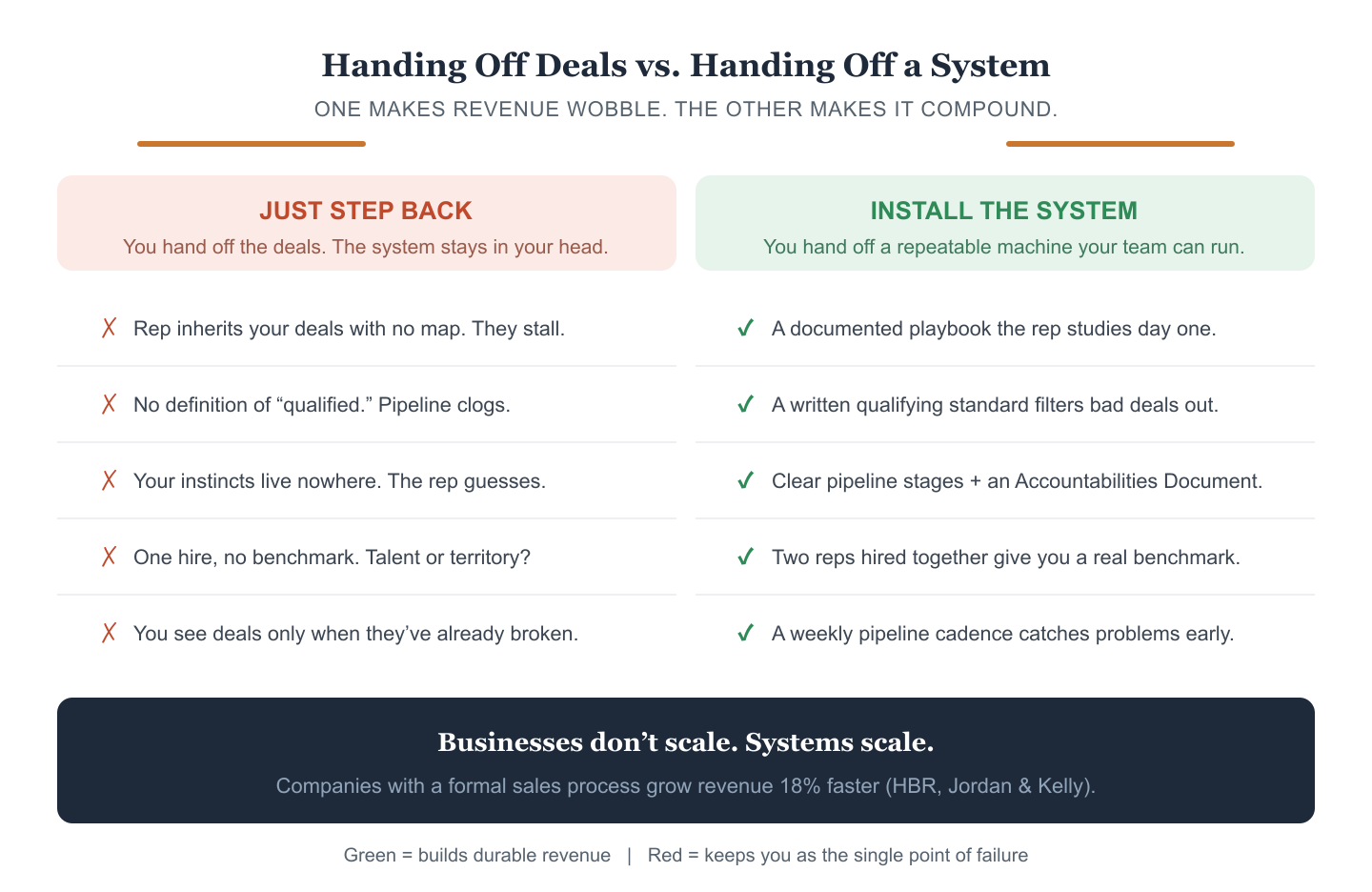
- Revenue collapses when founders hand off the deals but keep the system in their head. The fix isn't handing off harder. It's building the machine first.
- Companies with a formal, documented sales process grow revenue 18% faster than those without one (HBR, Jordan & Kelly). Process is the thing that scales, not your personality.
- Transfer the close in stages: you close and they watch, you co-sell, they close and you coach, they own it. A gradual handoff protects the revenue a hard cutover would drop.
- Six things have to exist before you step back: a documented sale, a real process, an Accountability Document, two hires (not one), a genuine ramp, and a weekly cadence.
- Your job isn't to be the hero on every call. It's to transfer the "why" to someone else, so the company can grow beyond you.
I've watched this happen to a lot of founders over fifty years in sales, and I did it to myself when I was bootstrapping my own company. You get to a few million in revenue on the strength of your own selling. You know the product cold. You believe the story because you lived it. And every deal that matters still lands on your calendar, because deep down you're convinced you're the only one who can close it.
At first, you're right. Then it becomes the thing holding you back.
Here's the trap. The moment you try to step back, revenue wobbles. A rep fumbles a deal you would've closed in your sleep. So you jump back in, tell yourself the timing wasn't right, and go back to carrying the number. That's not a people problem. It's a system problem. You handed off the deals but you never handed off the way you win them.
So let's answer the real question. How do you get yourself out of every important deal without watching the revenue you built fall apart? Here's what needs to be put in place to keep growing.
The Handoff Cliff: Why Revenue Actually Collapses
Most founders don't fail to delegate because they're control freaks. They fail because they delegate the wrong thing. They hand a rep the deals and expect the results, without ever handing over the reason those deals close. That's the cliff. And it's steep because the gap between "founder sells" and "team sells" is wider than anyone admits.
You handed off the deals, not the system
When you close a deal, you're running a process. You just can't see it because it's automatic. You qualify in your head. You know which objection is real and which is a smokescreen. You know when to push and when to wait. To your new rep, none of that is visible. They see the outcome, not the moves. Hand them the pipeline without the process and they'll do their honest best and still stall, because you gave them the steering wheel without the map.
The knowledge is trapped in your head
Every founder I meet is sitting on a fortune in tribal knowledge that exists nowhere but between their ears. Why customers really buy. Which two questions separate a tire-kicker from a buyer. The exact way you frame price so it lands as value. If that knowledge lives only in you, the company can never be worth more than your personal calendar. And it means your first rep has to re-learn, by trial and error, the same lessons you already paid for. That's slow, it's expensive, and it's where the revenue leaks out.
Businesses don't scale. Systems scale. If the way you win only exists in your head, you didn't build a company. You built yourself a very demanding job.
What Needs to Be in Place to Keep Growing
This is the part nobody wants to hear, because it's work you do before you get relief. You don't step back and then build the system. You build the system and then step back. Here are the six pieces that have to exist first. Skip any of them and you're back on the cliff.
1. Document the sale before you delegate it
Get what's in your head onto paper. Not a slide deck. A working sales playbook. Start with the founding story and the exact pain that made you build this, then write down how you actually sell: the discovery questions that matter, the objections you hear and your best answers, the way you present price. Your training should be 80% about the customer's world and 20% about your product. Reps don't need to recite every feature. They need to understand the customer's problem as deeply as you do. That's the "why," and it's transferable once it's written down.
2. Define your process and what "qualified" really means
Name your pipeline stages and the one thing that has to be true to move a deal from each stage to the next. Then write down your qualifying standard, the specific list of what makes a prospect real for your product. When "qualified" only lives in your gut, your rep will fill the pipeline with deals that were never going to close, and you'll blame the rep for a problem you never defined. This is also where the numbers reward you. Companies with a formal sales process grow revenue 18% faster than those without one (HBR, Jordan & Kelly), and 50% of high-performing sales teams have a clearly defined process versus 28% of underperformers (HubSpot). The catch: only about 35% of teams consistently follow the process they have (research summaries), which is exactly why the cadence in step six matters.
3. Write an Accountability Document for the role
Before anyone owns a deal, they need to know exactly what they own. An Accountability Document spells out the numbers the role is responsible for, the activities that drive them, and what "good" looks like week to week. It's not a job description written to attract applicants. It's a clarity tool so both of you agree on the target before the first call. When accountability is fuzzy, founders end up re-absorbing the work by default, because it's easier to just do it than to hold someone to a standard that was never written.
4. Hire two, not one
This one saves more founders than any other. Never hire a single salesperson. Hire two. With one hire, you can't tell whether a slow start is the person, the territory, the product, or your onboarding. You have a sample size of one and no way to read it. With two, you get a benchmark almost immediately. You see who's coachable, who's making calls, and what "normal" ramp looks like for your business. It also protects your revenue, because you're not betting the entire handoff on one human who might quit in month three.
5. Build a real ramp
Expecting a new rep to close like you in week two is how founders talk themselves out of ever letting go. It doesn't happen, and the data agrees. The average B2B rep takes months to reach full productivity, and SaaS ramp times have climbed to 5.7 months in 2025 as products get more complex (industry benchmarks). Plan for a ramp instead of resenting it. Give them the playbook, real reps to practice on, and a clear ninety-day picture of what improving looks like. Best-in-class onboarding programs get reps productive far faster than average, and the difference is almost always structure, not talent.
6. Install the metrics and the weekly cadence
If it's not in the CRM, it didn't happen. You need a handful of leading indicators (activity, qualified opportunities created, stage conversion) so you can see a problem forming three weeks before it shows up in closed revenue. Then run one weekly pipeline review. That single meeting is how you stay close to the deals without being in every call. It's the difference between coaching the pipeline and rescuing it. Remember, only about a third of teams actually follow their process. The cadence is what turns a documented process into a followed one.
The Handoff Sequence That Protects Revenue
You've got the system. Now you transfer the close. The mistake is treating this like a switch you flip. You don't. You dial it down over weeks, so the revenue never has a chance to fall off a cliff. Here's the sequence I use.
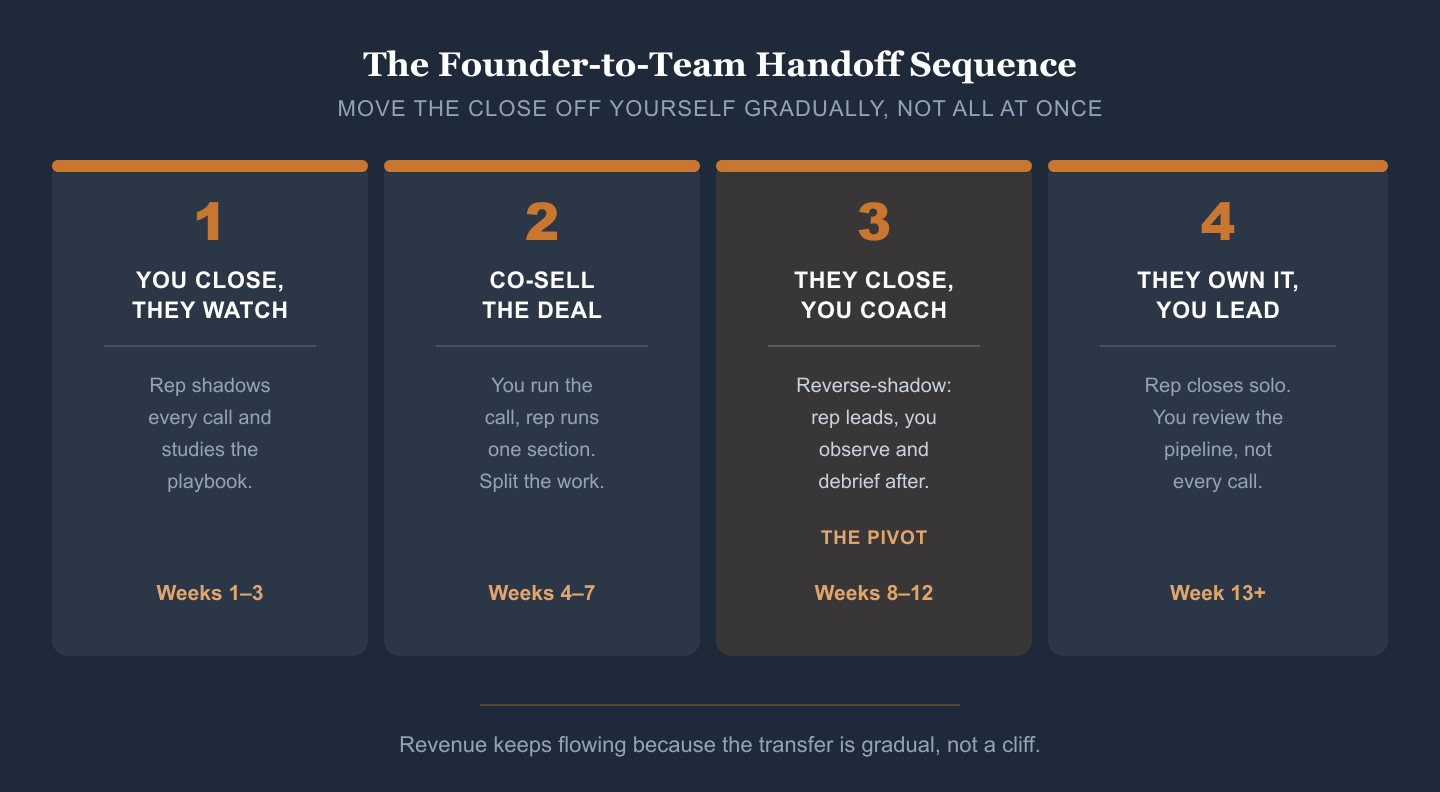
Stage 1: You close, they watch
For the first few weeks, nothing about your selling changes. The rep shadows every important call, reads the playbook, and after each call you debrief: here's why I asked that, here's what I heard, here's why I waited. You're making the invisible process visible. The revenue is safe because you're still the one closing.
Stage 2: Co-sell the deal
Now the rep runs a piece of the call. Maybe they open and handle discovery while you take the tough middle. You split the work and hand more of it over each week. If they wobble, you're right there to catch it, so no deal is ever at real risk. This is where confidence gets built, on both sides.
Stage 3: They close, you coach
This is the pivot. The rep runs the whole call and you go quiet. You're in the room, but you're observing, not rescuing. Then you debrief hard afterward. It takes discipline to sit on your hands while someone closes a deal more slowly than you would. Do it anyway. If you jump in every time it gets bumpy, they never learn to land the plane, and you never get out of the seat.
Stage 4: They own it, you lead
The rep closes solo. You've moved from being in every deal to reviewing the pipeline once a week. You're not gone. You're leading. And because you built the system and transferred it in stages, the revenue didn't drop when you stepped out. It kept compounding, this time without you as the ceiling.
When you successfully transfer your experience, you don't just get a salesperson. You get someone who can tell your story with the same conviction you do. That's how you stop being the bottleneck and start being the leader of a company that can grow beyond you.
The Best Practices Most Founders Skip
These are the details that separate a handoff that holds from one that snaps back. None of them are complicated. All of them get skipped.
- Teach the pain, not the pitch. Spend most of onboarding on the customer's world. A rep who understands the problem outsells a rep who memorized the features, every time.
- Give warm deals, not scraps. Founders often hand rookies the worst leads and keep the good ones for themselves. Then they wonder why the rep can't close. Let them win early on real deals.
- Coach off recordings. Record calls and review them together. Reps improve faster watching their own tape than hearing your opinion of a call you weren't on.
- Protect the founder relationships on purpose. For your biggest accounts, introduce the rep as a partner, not a replacement. A planned transition keeps the relationship. A silent one loses it.
- Inspect what you expect. A process nobody checks is a suggestion. The weekly pipeline review is what keeps the system alive after the excitement wears off.
You don't fix founder-led sales with more hustle. You fix it with a system your team can run without you in the room.
Frequently Asked Questions
Q: How do I stop being the person who closes every deal without losing revenue?
Build the system before you step back, then transfer the close in stages. Document how you sell, define your process and your qualifying standard, write an Accountability Document, hire two reps, ramp them, and run a weekly pipeline review. Then move through the handoff sequence: you close while they watch, you co-sell, they close while you coach, and finally they own it. Because the transfer is gradual and built on a real system, the revenue keeps flowing instead of dropping off a cliff.
Q: Why does revenue drop when a founder hands off sales?
Because most founders hand off the deals but not the system that wins them. The qualifying instincts, the objection handling, the sense of timing all live in the founder's head. The rep inherits the pipeline without the process, does their best, and stalls. Fix the root cause by documenting the sale and transferring it in stages, and the drop disappears.
Q: Should I hire one salesperson or two?
Two. With a single hire you have no benchmark, so you can't tell whether a slow start is the person, the territory, the product, or your onboarding. Two reps give you a real comparison almost immediately, and they protect your revenue because you're not betting the whole handoff on one person who might not work out.
Q: How long before a new rep closes like I do?
Plan on months, not weeks. Average B2B ramp runs several months, and SaaS ramp times have climbed to about 5.7 months in 2025 as products get more complex. The right response isn't to give up and take the deals back. It's to build a real ninety-day ramp with a playbook, live practice, and clear milestones. Structure is what shortens the ramp, not pressure.
Q: Do I really need a documented sales process, or can we just wing it?
You need it. Companies with a formal sales process grow revenue 18% faster than those without one (HBR, Jordan & Kelly), and half of high-performing teams have a clearly defined process versus roughly a quarter of underperformers. Winging it works when you're the only seller, because the process is in your head. The second you add reps, undocumented equals untransferable.
Q: Can a Fractional Sales Leader do this without a full-time VP of Sales hire?
Yes, and for a $1M–$10M company that's usually the smarter first move. A Fractional Sales Leader builds the playbook, the process, the Accountabilities Document, and the cadence, then runs the handoff sequence with your reps, for a fraction of the cost and risk of a full-time VP of Sales. You get the system and the transition without committing a quarter-million-dollar salary to find out if the hire was right.
Still the real sales department in your own company?
The Founder's Corner is a 12-week engagement to build a sales system your team can run, one hour a week with a 50-year sales leader. We document how you sell, install the process, and transfer the close so revenue grows without you in every deal. See exactly how it works and whether it fits your company.
See How The Founder's Corner Works →One honest note: if you're pre-revenue with no customers yet, this isn't for you. You still need to do founder-led selling first to prove the model. This is for founders who've proven it and are ready to hand it off. Prefer to just talk it through? Book a free 30-minute call.
About the Author
Louie Bernstein
Fractional Sales Leader with 50 years of sales experience helping $1M–$10M ARR companies build scalable, repeatable sales systems. Founder of MindIQ (INC 500). LinkedIn Top Voice in Sales Management, Sales Operations, and Sales Coaching.