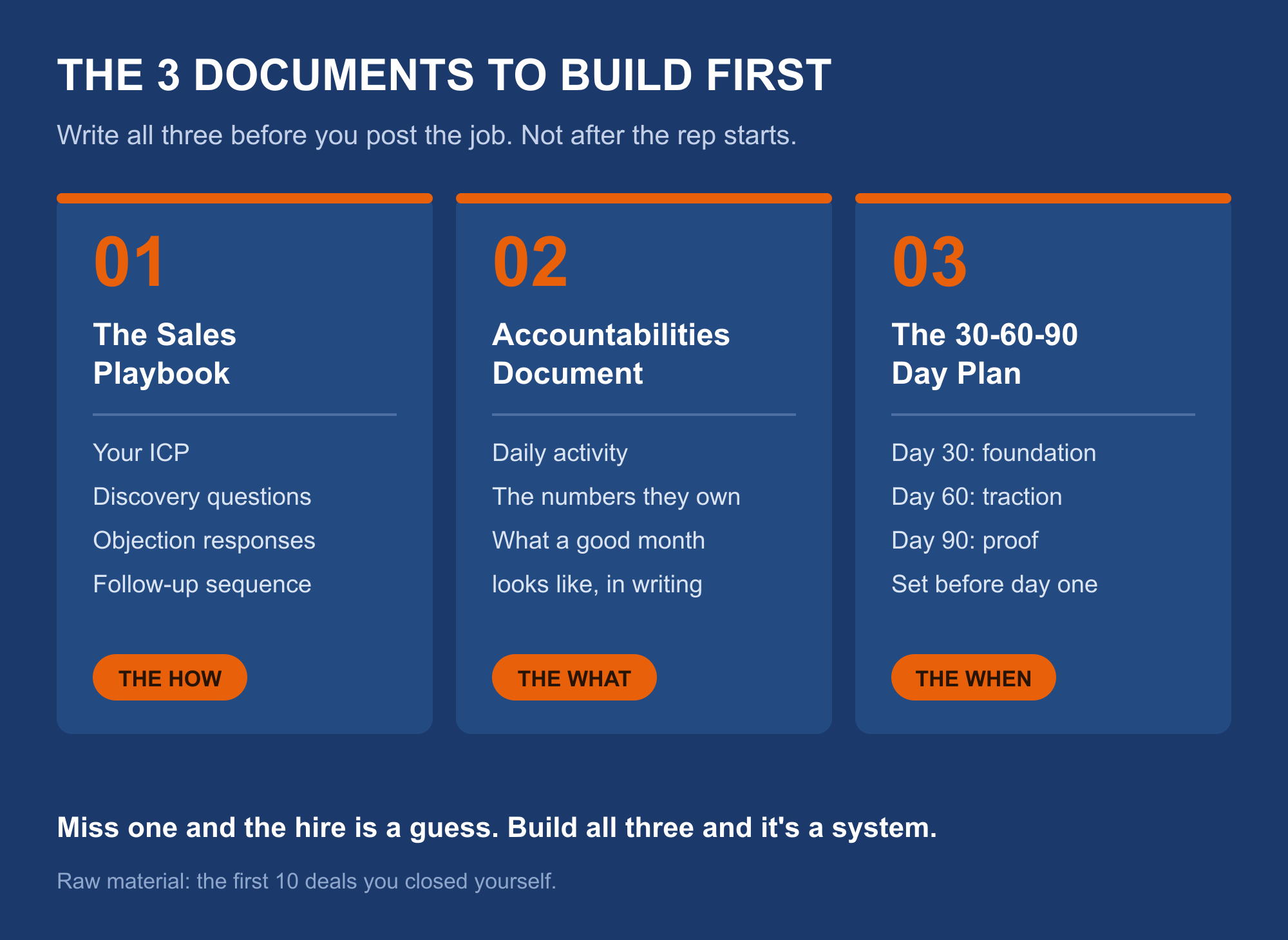
Before your first sales hire, create three documents: a Sales Playbook (how you sell), an Accountabilities Document (what the job is and what a good month looks like), and a 30-60-90 Day Plan (when each milestone should happen). Build them from at least ten deals you closed yourself. Then post the job.
Key Takeaways:
- You can't hand off what you haven't written down. Most first hires fail because the job only existed in the founder's head.
- The Sales Playbook is the how: your ICP, discovery questions, objection responses, and follow-up sequence.
- The Accountabilities Document is the what: daily activity, the numbers the rep owns, and what a good month looks like.
- The 30-60-90 Day Plan is the when: written milestones, set before day one, so a slow ramp shows up on day 31, not day 120.
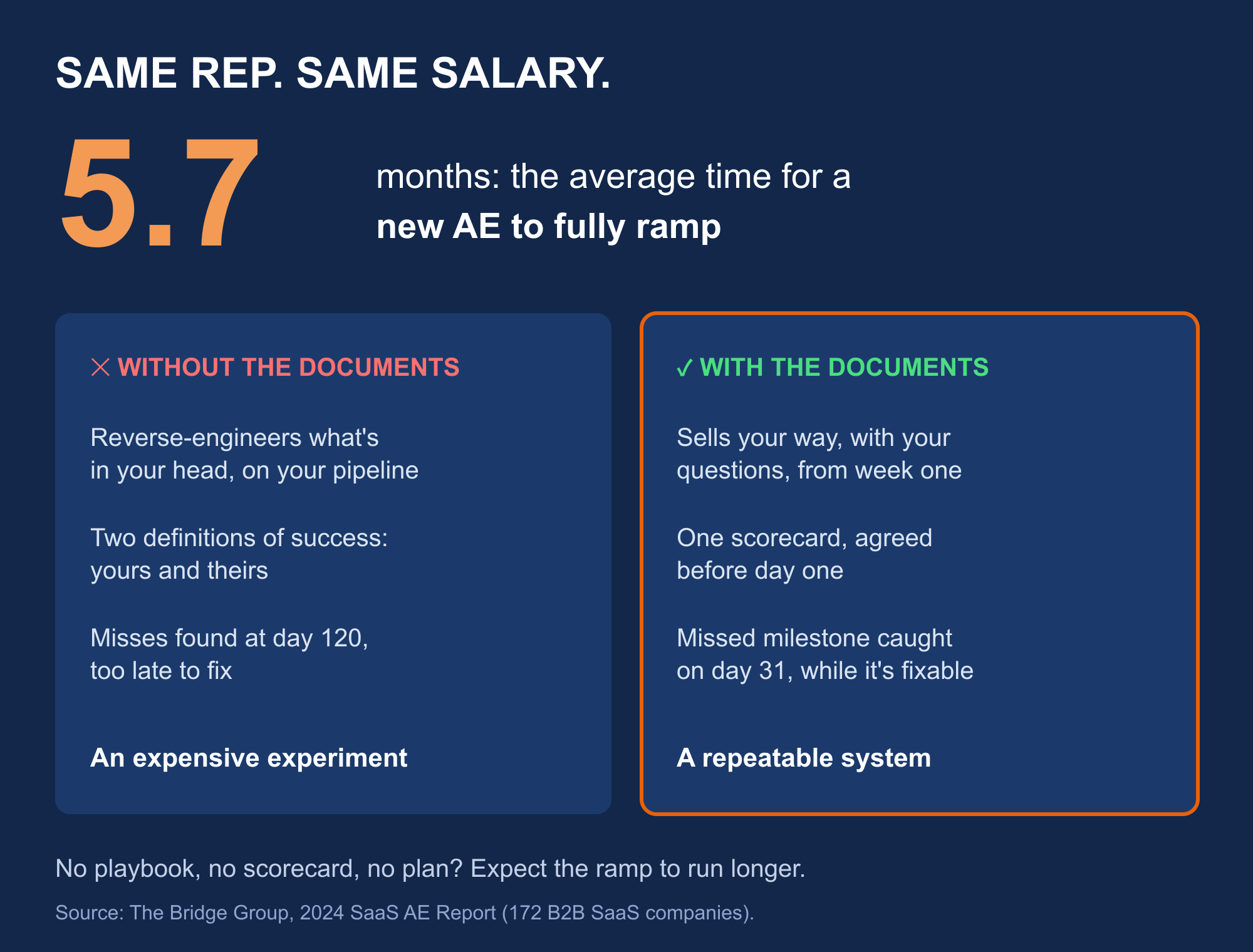
- Ramp is already long. The average new AE takes 5.7 months to fully ramp (The Bridge Group, 2024). No documents means longer.
- Close at least ten deals yourself first. That's where the real content for all three documents comes from.
A founder called me last year. He had just hired his first salesperson. A strong one. Twelve years of experience, great references, big numbers at the last company. Ninety days later the rep was gone and the founder was back to selling everything himself.
He wanted to know what went wrong with the hire. Nothing did. The rep was good. The founder handed him a job that existed nowhere except inside his own head.
There was no written description of who they sold to. No list of the questions that move a deal. No definition of a good month. He'd been selling on instinct for three years, and instinct doesn't transfer. You can't hand someone a feeling.
The hire isn't the first step. It's the fourth or fifth step.
Why can't a new rep just learn by watching you?
Because what you know is invisible to them. After two or three years of closing every deal, you have a sales process. You just never wrote it down. A new rep with no documentation spends the first ninety days reverse-engineering it, on your pipeline, with your prospects, at full salary.
You know which prospects are a waste of time within five minutes. You know the question that surfaces the real budget. You know the one objection that kills deals and exactly how to answer it. It works beautifully, because you're the one running it.
Then you hire someone and assume they'll pick it up. They guess at your buyer. They ask the wrong questions. They fumble the objection you've answered a thousand times. You're paying a fast learner to discover what you already know.
The fix isn't a better hire. It's documentation. Three documents, specifically, that turn what's in your head into something a new person can run.
What goes in the Sales Playbook?
The Sales Playbook is the how. It's the written version of the process you've been running in your head. Version one needs four sections: your Ideal Customer Profile, your discovery questions, your objection responses, and your follow-up sequence. It takes the longest to build and it matters the most.
You don't need a fifty-page binder. You already have the raw material from every deal you've closed.
Your Ideal Customer Profile
Not "B2B companies." The actual profile: company size, the buyer's role, the trigger that makes them start looking, and the pain that makes them say yes. Your best deals share a pattern. Write it down so your rep chases the right prospects instead of every prospect.
Your discovery questions
The exact questions you ask to qualify a prospect and surface the real problem: budget, timeline, decision process, and the cost of doing nothing. You ask these on instinct. A new rep has no instinct yet, so give them the questions. Then they run a real discovery call on day one instead of month three.
Your objection responses
Five to ten objections show up in almost every deal. "You're too expensive." "We already use someone." "Let me think about it." Write down each one and your proven response. Without it, your rep freezes the first time a prospect pushes back, and the deal dies in the silence.
Your follow-up sequence
What happens after the first call, after the demo, after the proposal. Deals rarely die from a bad pitch. They die when nobody touches the prospect for two weeks and the urgency goes cold. Map the sequence so the next step is never a guess.
A competent rep can learn four sections in a day and apply them in a week. Without them, they wing it. And winging it is the most expensive thing a salesperson can do on your pipeline.
What is an Accountabilities Document, and why isn't a job description enough?
An Accountabilities Document is a one-page list of the behaviors and outcomes the rep owns, written before they're hired. A job description gets someone in the door. This document defines the job once they're through it: daily activity, the numbers they own, and what a good month looks like.
It prevents the most painful conversation in early-stage sales. You think the rep is failing. The rep thinks they're doing fine. Neither of you is wrong, because you never agreed on the target.
The daily activity
How many outbound touches, how many discovery calls, how much pipeline to build and keep. Activity is the part of selling a rep fully controls. If you define it, you can coach it. If you don't, you're judging on results alone, and by the time results are bad it's too late.
The numbers they own
Quota, pipeline coverage, and the conversion rate you expect at each stage. Base them on your own real numbers, not a figure you wish were true. A rep can't hit a target nobody defined, and they won't trust one you pulled out of thin air.
What good actually looks like
Write down a strong month, an average month, and what's not acceptable. Tie it to the comp plan so the rep sees exactly how effort turns into income. With a written standard, performance has a scoreboard. Without one, every review becomes an argument about what the job was supposed to be.
Ambiguity is where underperformance hides. Write the role down before someone starts and there's nowhere left for it to hide.
What should a 30-60-90 Day Plan include?
The 30-60-90 Day Plan is the when. It breaks the first ninety days into written milestones, set before day one: foundation by day 30, traction by day 60, proof by day 90. It's the document founders skip most, and it's why so many ramps fall apart quietly until the rep is gone.
Ramp is long even when everything goes right. The average new account executive takes 5.7 months to fully ramp, across 172 B2B SaaS companies (The Bridge Group, 2024). You can't afford to lose the first three of those months to guessing.
By day 30: foundation
Product knowledge complete. CRM set up and in daily use. The Sales Playbook learned. First outbound touches made, often fifty or more. Day 30 isn't about closing. It's about proving they've absorbed the system and they're active.
By day 60: traction
First discovery calls booked and run. First qualified opportunities in the pipeline. They're using your questions and handling the common objections without freezing. Day 60 tells you whether day-30 activity is turning into real pipeline.
By day 90: proof
First late-stage deals with a realistic path to close in month four. A rep who can run your process end to end, mostly alone. Day 90 isn't the finish line, but it tells you clearly whether you have a producer or a problem.
When the milestones are written down, you both know on day 31 if day 30 was missed, and you can fix it while there's time. Without the plan, you find out at day 120, when fixing it is no longer an option.
When are you ready to write these documents?
After you've personally closed at least ten deals and paid attention to each one. You can't write these documents from theory. The real content comes from selling: which buyer closes fastest, which objection shows up every time, and where deals stall. Close the deals, write the documents, then hire.
Ten deals show you which buyer closes fastest and at the highest value. They show you the objection that appears in every conversation and what actually resolves it. They show you a typical sales cycle and where it stalls. You can't invent that. You discover it by doing it.
So the order is fixed. A founder who hires before closing those deals is asking a stranger to invent a sales process from scratch on the company's most valuable pipeline. That's not a hire. That's a gamble with a salary attached.
The documents aren't paperwork. They're proof you have a sales process worth handing off. If you can't write them, you're not ready to hire.
Where does a Fractional Sales Leader fit?
A Fractional Sales Leader builds the three documents with you, then helps you hire against them and coaches the new rep through the first ninety days. It's the fix for founders at $1M to $10M ARR who know they need the documents but are too buried in the business to write them.
Selling is one of ten hats you wear, so the documents never get done. I sit down with you, pull the process out of your head, and turn it into a real Sales Playbook, Accountabilities Document, and ramp plan. You get an experienced sales executive building the foundation without the cost of a full-time VP of Sales you're not ready for.
I've spent 50 years in sales, including 22 years building MindIQ into an INC 500 company. The founders who hire well aren't better at interviewing. They're better prepared before the first interview starts.
Frequently Asked Questions
Q: How long does it take to create these three documents?
If you've closed your first ten deals and paid attention, version one of all three is about a week of focused work, not a quarter. The Sales Playbook takes longest because it has four sections. The other two are an afternoon each once you're honest about your real numbers. Aim for a usable version one, then improve it with the rep's feedback.
Q: Isn't a job description enough?
No. A job description is a recruiting tool. It tells a candidate the title and the broad responsibilities. An Accountabilities Document is a management tool. It defines daily activity, the numbers the rep owns, and what a good month looks like, agreed before they start. You need both. They do different jobs.
Q: What if I haven't closed ten deals yet but I'm drowning?
Then you need leverage on the selling you're already doing, not a salesperson. Hiring a rep before you have a documented process just moves the bottleneck and adds a salary. Get disciplined about closing and documenting those first deals, or bring in a Fractional Sales Leader to build the system with you.
Q: My process changes deal to deal. How do I document it?
It feels fluid because you adapt without noticing. Look across your last ten deals and you'll find a pattern: the same buyer type, the same few objections, the same questions that move things forward. Document the repeatable 80 percent. Coach the judgment calls over time. If there's truly no pattern, you don't have a process to hand off yet.
Q: Do these documents replace the time I spend with the new rep?
No. They make that time count. The documents cover the basics so your time goes to coaching, not explaining the same thing for the fifth time. In the first ninety days, the rep should watch you close, sit in on your calls, and debrief with you when something goes wrong. Handing off sales is a transition, not an event.
Q: If I can only build one document right now, which one?
The Sales Playbook. It's the one nobody else can write without you, because it lives in your head. A rep with a playbook but no Accountabilities Document will struggle with accountability, but they'll know how to sell. A rep with targets and no playbook knows the goal and has no idea how to hit it. Add the other two before you hire.
Q: How long should a first sales hire take to ramp?
Longer than most founders expect. The average new AE takes 5.7 months to fully ramp across 172 B2B SaaS companies (The Bridge Group, 2024). Use your 30-60-90 Day Plan to judge progress on activity and pipeline early, then judge revenue over your full sales cycle.
About to make your first sales hire?
Before you post the job, let's make sure the foundation is there. In 30 minutes we'll look at what you've documented, where the gaps are, and what to build before you bring anyone on.
Schedule a 30-Minute CallAbout the Author
Louie Bernstein
Fractional Sales Leader with 50 years of sales experience helping $1M–$10M ARR companies build scalable, repeatable sales systems. Founder of MindIQ (INC 500). LinkedIn Top Voice in Sales Management, Sales Operations, and Sales Coaching.