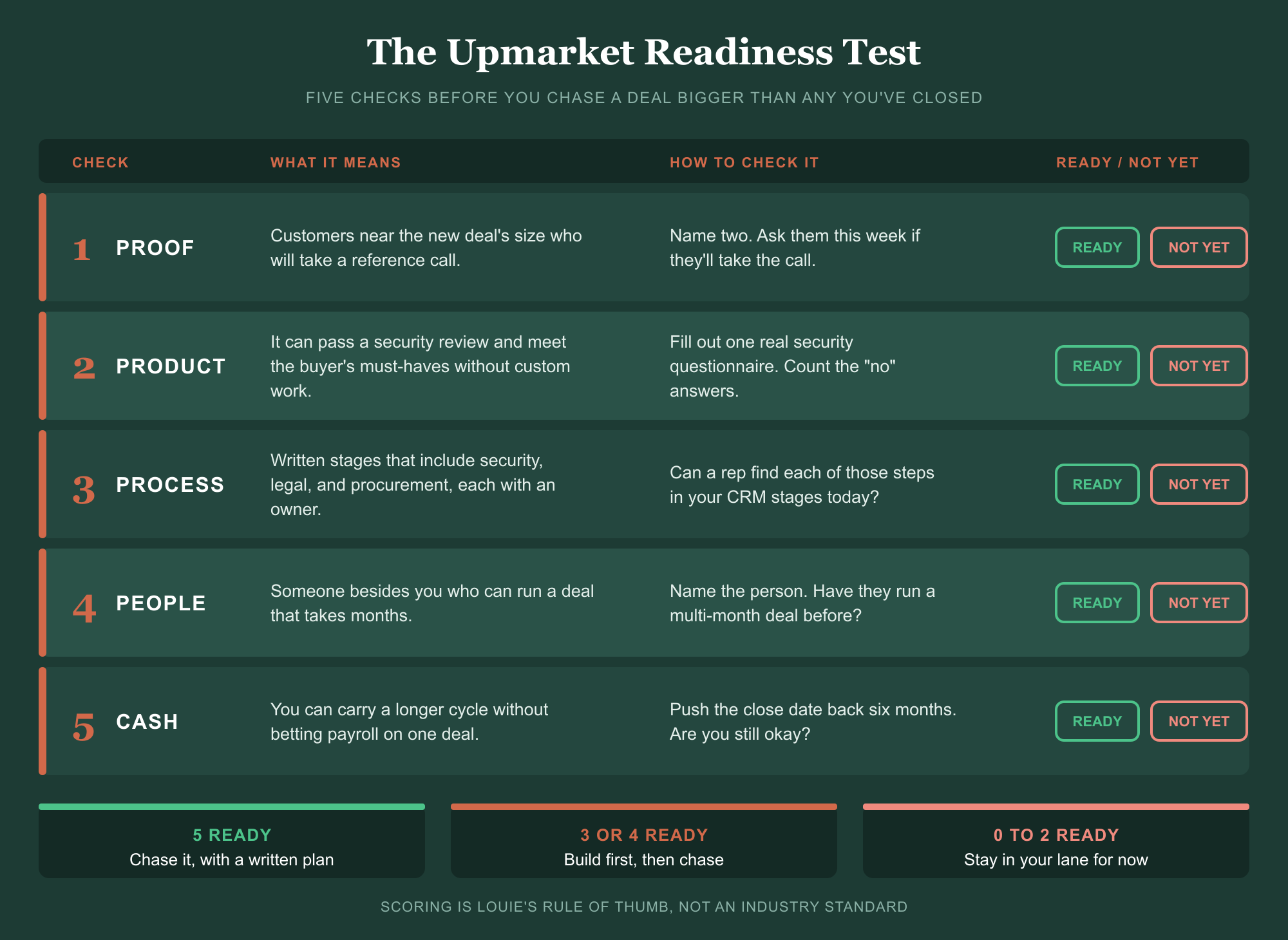
Chase bigger deals only when you can pass five checks: Proof, Product, Process, People, and Cash. Pass all five and you go after them with a written plan. Pass three or four and you build first. Pass two or fewer and you stay in your lane for now. A bigger deal isn't a bigger version of the deal you already close. It's a different sale, and if nobody but you can run it, it pulls you right back into the closer seat.
Key Takeaways:
- "Bigger" is relative. Define it against your own average deal, not someone else's idea of enterprise.
- A bigger deal brings more people, more steps after the yes, and a longer wait. The average B2B buying decision already involves 13 people (Forrester, 2024).
- Run five checks before you chase: Proof, Product, Process, People, and Cash.
- Chasing too early costs more than the deal. It ties up your best rep, bends your roadmap, puts you back on every call, and warps your forecast.
- There are three right answers: chase now, build first, or stay in your lane. Pick one on purpose.
- Bigger deals need a written process with owners. Without one, the work lands on the founder.
Here's the moment this series is about. You've spent a year getting out of sales. You hired reps. You wrote a playbook. Deals are closing without you on every call.
Then a big logo shows up in the pipeline. The deal is three or four times anything you've closed. Your team has never sold one this size. So you get on the first call "just to help." Then the second. Then the security review. Six weeks later, you're back in the closer seat, and you didn't decide to be.
I've watched this happen to a lot of founders. The big deal isn't the problem. The problem is chasing it before the company is built to sell it.
So let's answer the question straight. Some founders should chase bigger deals now. Some should build first. Some should stay in their lane for a while. Here's how to tell which one you are.
A big logo in your pipeline isn't a strategy. It's a test of whether you have one.
What counts as a "bigger deal" for your company?
Don't borrow someone else's definition. "Enterprise" means one thing to a $2M company and something else to a $9M one. There's no dollar line that turns a deal into an upmarket deal.
Start with your own numbers. Pull your closed-won deals from the last 12 months and find your average deal size. Then look at the deal you're tempted to chase.
My rule of thumb: if a deal is about three times your average or more, treat it as a different sale. The same is true if one deal would be a big share of your quarter, or if it brings in a department you've never sold to, like IT security or procurement. Any of those means the rules change, even if the logo isn't famous.
Size isn't the only signal
Sometimes the dollar amount is normal but the buyer isn't. A company ten times bigger than your usual customer can buy a small contract and still send a 200-line security questionnaire. Watch for the process, not just the price.
What changes when the deal gets bigger?
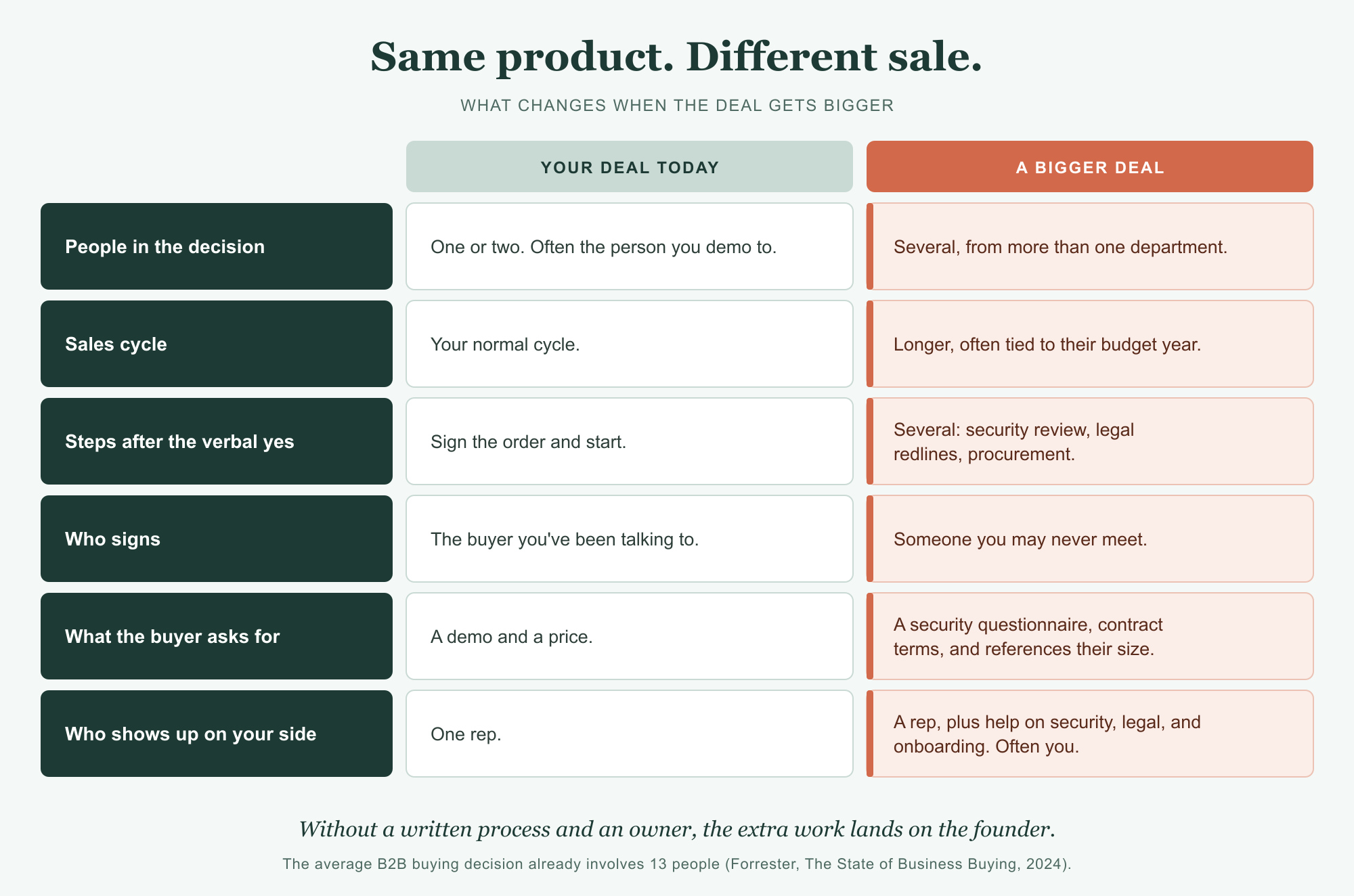
Same product. Different sale. Your current deals probably have one or two people deciding. Often the person you demo to is the person who signs. Bigger deals don't work that way.
More people get a vote
Forrester's 2024 State of Business Buying found that 13 people inside a company are involved in the average B2B buying decision, and 89% of purchases involve two or more departments (Forrester, 2024). Bigger deals tend to pull in more of them, not fewer. Mapping those people is its own skill. I cover it in the multi-threading playbook.
The yes isn't the end
In your current deals, a verbal yes means you send the order form. In a bigger deal, a verbal yes means the next three steps start: a security review, legal redlines on the contract, and procurement. Each one has its own people, its own forms, and its own timeline. None of them care how good your demo was.
The wait gets longer
You'll see a lot of "average enterprise sales cycle" numbers online. Most of the ones I checked don't trace back to real data, so I won't quote them. Measure your own instead. Look at how long your biggest deals took versus your average ones. That gap is your real number, and it's usually bigger than you remember.
More of your people have to show up
A small deal needs one rep. A bigger deal needs the rep, plus someone to answer the security questions, someone to handle the contract, and someone to plan onboarding. If you haven't named those people, there's one person who can do all of it. You.
The Upmarket Readiness Test: five checks
Score yourself honestly. Each check is Ready or Not yet. There's no partial credit, because a bigger buyer won't give you any.
1. Proof: who will vouch for you?
Bigger buyers ask for references from companies like them. Not your happiest small customer. Someone close to their size, with a similar problem. Can you name two who will take a reference call this month? If you have to think hard, mark it Not yet.
2. Product: can it pass their review?
Get a real security questionnaire, from this prospect or a past one, and fill it out. Count the "no" answers. Then look at the buyer's must-haves: single sign-on, user permissions, data rules, the integrations they need. If closing the deal means building features you weren't planning to build, that's Not yet.
3. Process: is it written down?
Your pipeline stages were built for the deals you close today. Do they include security, legal, and procurement as real steps, with exit criteria and an owner for each? If those steps live in your head, a rep can't run them. Stages should move on buyer action, not hope. I lay out how in why your pipeline stages need exit criteria.
4. People: who runs it if you don't?
Name the person, besides you, who will own this deal from first call to signature. Have they run a deal that took months, with a committee on the other side? If the honest answer is "I'll run it and they'll shadow me," you don't have a deal owner. You have an assistant, and you're back in sales.
5. Cash: can you carry the wait?
Take the expected close date and push it back six months. Is the business still fine? If you've already started spending the money in your head, or a hire depends on this deal closing, mark it Not yet. A company that needs one deal to close can't walk away from bad terms, and the buyer can tell.
How to read your score
My rule of thumb: all five Ready, chase it with a written plan. Three or four, build the missing pieces first, then chase. Two or fewer, stay in your lane for now and get better at the deals you already win. None of those is a failing grade. They're three different plans.
If the only person who can run the deal is you, you're not moving upmarket. You're moving back into sales.
What does chasing too early really cost?
The obvious cost is losing the deal. The hidden costs are worse, because you pay them even if you win.
Your best rep's quarter
Big deals go to your best rep. That rep then spends months on one deal instead of closing five normal ones. If it slips or dies, you lost the big deal and the five you didn't work. Your best rep also misses their number, and salespeople don't quit companies, they quit chaos.
Your product roadmap
"We can add that by Q2" is the most expensive sentence in a big deal. One buyer's wish list becomes your engineering plan. Your other customers wait. And if the deal falls through, you built features for a customer you don't have.
Your own time
This is the one founders don't see coming. The bigger buyer wants to meet the CEO. The security team has questions only you can answer. Legal sends redlines and nobody else knows what you'll accept. Every one of those pulls you back in. If you've been working on stepping out, it's the same trap I describe in the hand-off ramp, just running backward.
Your forecast
One giant deal in the pipeline makes the whole quarter look great. Coverage looks healthy. Then it slips a month, and then another. Now your forecast is really a bet on one deal. I'd rather see that deal tracked on its own line, at a low probability, until the buyer does something to earn a higher one. Your pipeline math should hold up without it.
Your price
Procurement's job is to get a better price. If you're desperate for the logo, you'll give it to them, and that number becomes the anchor for every big deal after. I cover how to hold the line in the discount trap.
Chase now, build first, or stay in your lane?
Here's what each answer looks like in practice.
Chase now
You passed all five. Pick a small number of bigger accounts on purpose, not just the ones that wandered in. Name a deal owner for each. Write the extra stages into your CRM before the first call. Set your role in writing too. When do you get on the call, and when don't you? Then track these deals apart from your core pipeline so you can see if the motion is working.
Build first
You passed three or four. Work the gaps one at a time. Ask your largest customers for references. Fill out a security questionnaire before anyone asks for one. Add security, legal, and procurement to your stages. Coach a rep on a longer deal while the stakes are still small. My rule of thumb is to give it a quarter, then run the test again.
Stay in your lane
You passed two or fewer. That's not a weakness. It's information. Most $1M to $10M companies have plenty of room to grow by winning more of the deals they already know how to win. Raise your win rate. Shorten your cycle. Get your reps closing without you. Bigger deals will still be there when you're built for them.
Staying in your lane isn't thinking small. It's refusing to bet the company on one deal you can't run yet.
What if the big deal is already in your pipeline?
Sometimes you don't get to choose. A big company finds you. Don't ignore it, and don't drop everything for it either. Run the test anyway, today, and be honest about what's Not yet.
Then do four things. Name a deal owner who isn't you. Write down your role and stick to it. Add the security, legal, and procurement steps to the deal so nothing surprises you after the yes. And set a walk-away point: the terms you won't accept and the date you'll stop investing if the buyer stops moving. If it isn't in the CRM, it never happened, and that goes for the walk-away point too.
The next article in this series goes deeper on what happens after the verbal yes: how to run security, legal, and procurement as real deal stages so they don't stall the deal or drag you back in.
Where a Fractional Sales Leader fits
This is where a Fractional Sales Leader earns their keep. I run the readiness test with you, using your real deals and your real numbers. Then I build what's missing: the extra stages, the deal owner's role, the references, and the rules for when you get on the call. If the answer is "stay in your lane," I help you get more out of the deals you already win.
I've spent 50 years in sales, including 22 years building MindIQ into an INC 500 company. The founders who moved upmarket well didn't chase the biggest logo they could find. They built a sale their team could run, then went after the deals that fit it.
Frequently Asked Questions
Q: How do I know if my company is ready to sell bigger deals?
Run five checks: Proof (references near the buyer's size), Product (it passes a security review without custom work), Process (written stages for security, legal, and procurement), People (someone besides you can run a multi-month deal), and Cash (you can carry a longer cycle). My rule of thumb is to chase only when all five are ready.
Q: What deal size counts as "moving upmarket"?
There's no industry line. Define it against your own average deal from the last 12 months. My rule of thumb is that a deal about three times your average, or one that brings in departments you've never sold to, is a different sale and needs its own process.
Q: What are the risks of chasing enterprise deals too early?
You tie up your best rep on one long deal, bend your roadmap to one buyer's wish list, get pulled back into sales yourself, and warp your forecast with a deal that keeps slipping. You can pay every one of those costs and still lose the deal.
Q: How many people are involved in a bigger B2B purchase?
More than you're used to. Forrester's 2024 State of Business Buying found the average B2B buying decision involves 13 people, and 89% of purchases involve two or more departments. Bigger deals usually add security, legal, finance, and procurement to the people you already talk to.
Q: Should the founder run the first big deal?
The founder can play a role, but shouldn't own the deal. Name a deal owner, write down when you'll get on the call, and stick to it. If you run the whole thing yourself, you'll win one deal and teach your team that big deals need you.
Q: Can a Fractional Sales Leader help us move upmarket?
Yes. A Fractional Sales Leader runs the readiness test with your real numbers, builds the missing stages and deal roles, coaches a rep through a longer deal, and keeps the founder out of the closer seat. If you're not ready yet, they help you grow the deals you already win.
Is that big deal ready for you?
In 30 minutes we'll run your company through the five checks and tell you whether to chase, build first, or stay in your lane.
Schedule a 30-Minute CallAbout the Author
Louie Bernstein
Fractional Sales Leader with 50 years of sales experience helping $1M–$10M ARR companies build scalable, repeatable sales systems. Founder of MindIQ (INC 500). LinkedIn Top Voice in Sales Management, Sales Operations, and Sales Coaching.