Key Takeaways:
- Founders don't discount because the price is wrong. They discount because they're emotionally invested in the deal and never qualified hard enough to walk away.
- A 1% improvement in price lifts operating profit by 11.1% (Harvard Business Review, Marn & Rosiello). A discount pulls that same lever in reverse.
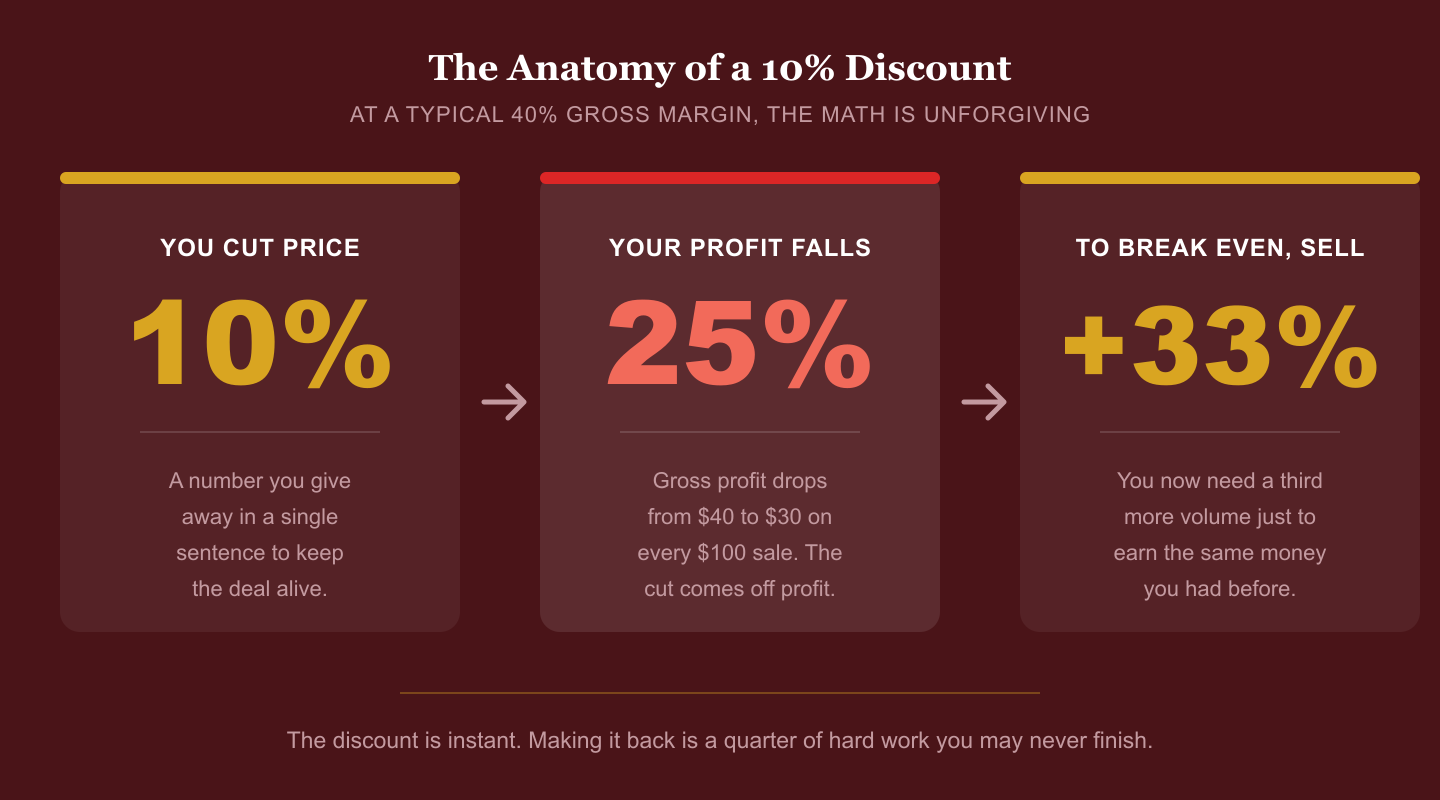
- At a typical 40% gross margin, a 10% discount cuts your profit on that sale by 25%, and you'd have to sell 33% more just to break even.
- Discounting doesn't even close the deals you think it does. Most stalled deals are lost to indecision, not price, and cutting price rarely un-sticks them.
- Over-promising on the roadmap and saying yes to bad-fit customers are discounts too. You're just paying in delivery, churn, and support instead of dollars.
- A clear ICP plus a written playbook removes the need to buy deals. When you know exactly who you help and why you're worth it, you stop negotiating against yourself.
You didn't set out to be a discounter. Nobody does.
It happened one deal at a time. A prospect you'd spent three weeks with went quiet. You could feel the momentum slipping, and you'd already told yourself this one was going to close. So you sent the email. "Look, if we can get this signed by the end of the month, I can do 15% off." They signed. You felt relief for about a day. Then the quiet regret set in, because you knew you'd left money on the table that was never really theirs to take.
I've watched hundreds of founders do this over fifty years in sales. Smart, technical, operationally sharp people who built something real, and who then quietly hand away 10, 15, 20 points of margin because the alternative, losing the deal, feels worse in the moment.
Here's the hard truth: the discount is almost never the problem. It's the symptom. The real problem is that you're selling without a system, so every deal feels like the only deal, and you'll do whatever it takes to keep it alive.
Let's talk about what that costs you, why it usually doesn't even work, and how to stop.
Why Founders Reach for the Discount
If you want to stop discounting, you have to understand why you're doing it. And it's rarely about the number. It's about two things almost every founder-led sale has in common: too much emotion and too little qualification.
You're emotionally invested in the deal
When you're the founder, the deal isn't just a deal. It's validation. It's proof the thing you built matters. It's this month's cash flow and next month's payroll. So when a prospect hesitates, you don't feel it the way a rep with forty other deals feels it. You feel it personally. And a person who's emotionally attached to an outcome will always negotiate badly, because the other side can feel how much you need it.
Fear does something dangerous to founders. It makes you scatter. You start chasing deals that aren't in your ICP. You say yes to prospects that should be a no. You convince yourself that any revenue is good revenue right now. I've lived this. I ran a bootstrapped company for 22 years and made payroll for 24 people through four or five recessions. I know the sleepless nights. And I know that the moment you let that fear drive the deal, you've already lost the negotiation.
You never qualified hard enough to walk away
Discounting is what happens when you get to the end of a deal and realize you have no leverage. And you have no leverage because you never properly qualified. You don't actually know if this prospect has budget, whether they can decide, or how badly they need what you sell. So when they push on price, you have nothing to push back with except a lower number.
A well-qualified deal is a deal you're willing to lose. That sounds backwards, but it's the whole game. If you know the prospect is a genuine fit, has the budget, and has a real cost of inaction, you can hold your price calmly, because you know the value is there and you're not afraid to walk. The founder who can't walk away always pays for it in margin.
A discount is what you give a prospect when you've run out of reasons for them to pay full price. The fix isn't a better discount. It's better reasons.
The three ways founders quietly buy deals
Cutting price is only the most obvious way. There are three, and they all come from the same place:
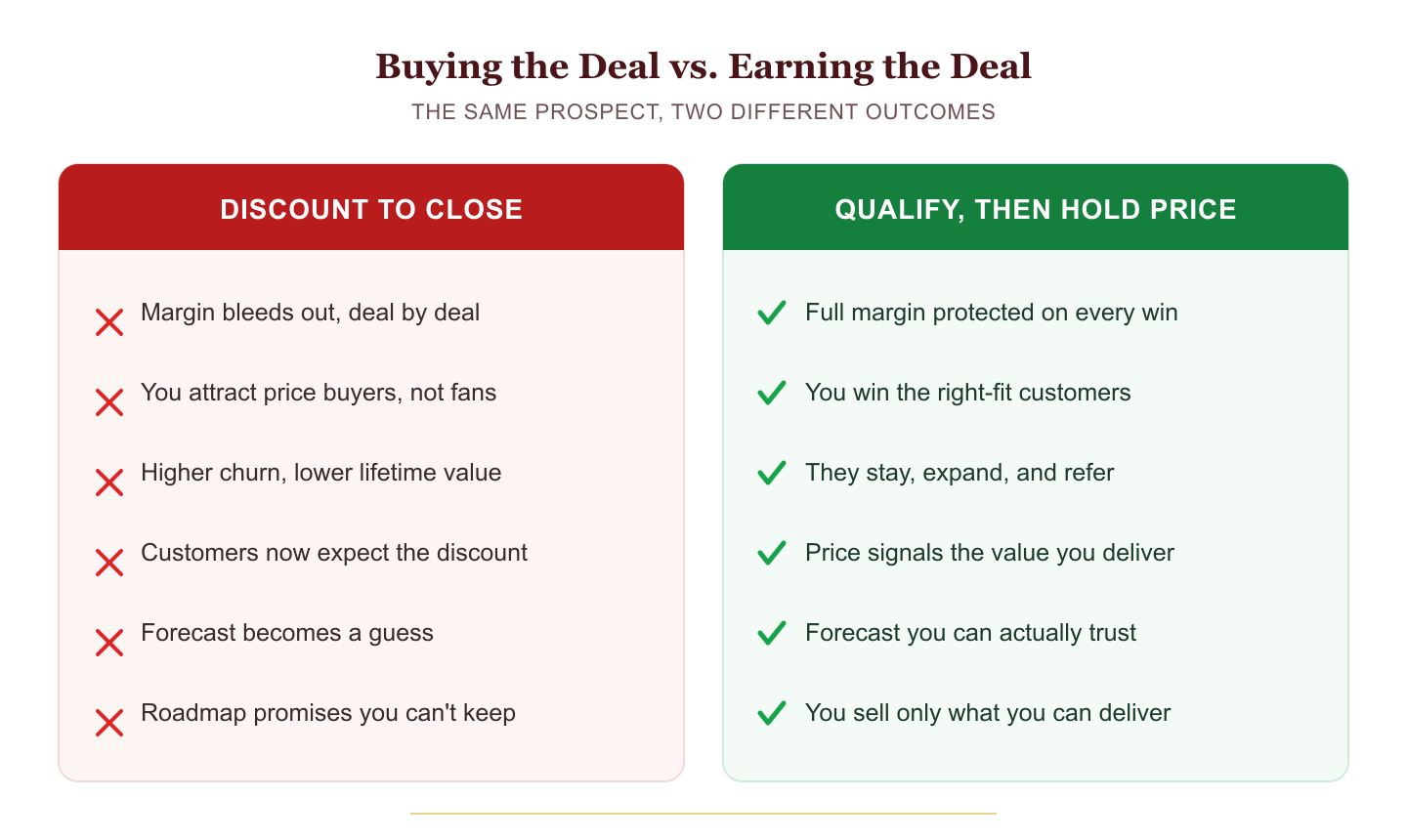
- You discount the price. The straightforward margin giveaway. It shows up immediately on every invoice, forever.
- You over-promise on the roadmap. "Yes, we can build that." Now you've sold a feature that doesn't exist to keep a deal alive, and your engineering team pays the bill in whiplash and missed deadlines.
- You accept the bad-fit customer. They were never right for you, but the logo and the cash looked good. They'll churn, they'll flood support, and they'll leave a bad review on their way out.
Roadmap promises and bad-fit customers are discounts too. You're just paying in delivery, churn, and reputation instead of dollars. And those bills often come due long after the founder has forgotten which deal caused them.
The Real Cost Isn't the Discount. It's Everything After.
When you drop your price 10%, it feels like you gave up 10%. You didn't. You gave up far more, because that discount comes straight off your profit, not your revenue.
The math is brutal, and it doesn't care about your feelings
Price is the single most powerful lever you have on profit. In their classic Harvard Business Review study, McKinsey's Michael Marn and Robert Rosiello found that a 1% improvement in price produces an 11.1% increase in operating profit, more than you'd get from cutting fixed costs or growing volume by the same amount (Harvard Business Review). A discount runs that same lever in reverse, and just as hard.
Run the numbers on a typical deal. Say you sell at a 40% gross margin. You discount 10%. Your gross profit on that sale doesn't drop 10%, it drops 25%, from $40 to $30 on every $100 of revenue. To earn back the profit you just gave away, you now have to sell 33% more. You handed that away in one sentence over email. Making it back is a full quarter of grinding you may never finish.
You can't discount your way to a higher win rate
Founders assume the discount buys enough extra wins to be worth it. The data says otherwise. Winning by Design's research on discount versus win rate found that to offset a 20% discount, your win rate would have to climb from 20% to 25%, an unrealistic jump for most teams. Pair a 20% discount with even a 10% drop in win rate and you can lose 28% of your revenue (Winning by Design). You're not buying growth. You're buying a smaller business that works harder for less.
The customer quality tax
Here's the part founders miss entirely. The customer you win on price is a fundamentally different customer than the one you win on value. Price buyers churn faster, negotiate harder at renewal, and leave the moment a cheaper option appears, because price was the only thing that got them in. You didn't win a customer. You rented one, at a discount.
And it compounds. Every discounted deal trains the market to expect a discount. Procurement teams talk. Your next prospect walks in already knowing you'll cave, because the last three did. You've taught your entire pipeline that your list price is fiction. That's a very hard reputation to un-earn.
Discount once and you close a deal. Discount as a habit and you re-price your whole company, then wonder why your margins won't hold.
There's one more cost, and it's the biggest. If you ever want to sell this company, an acquirer runs one test above all others: what happens to revenue and margin if the founder leaves? A business built on founder-negotiated discounts and hand-shake roadmap promises looks fragile in diligence, and acquirers routinely apply a 20% to 40% valuation discount to revenue that can't be shown to repeat without you in the room. The margin you gave away to close a deal at $2M ARR gets multiplied against you at exit.
The Discount Usually Doesn't Even Work
Now the twist that should change how you sell. Most of the deals you discount to save were never going to be lost on price in the first place.
In The JOLT Effect, Matthew Dixon and Ted McKenna analyzed 2.5 million recorded sales conversations. They found that of the deals lost to "no decision," 56% were lost not to a competitor and not to price, but to the prospect's own indecision, the fear of making the wrong choice (The JOLT Effect). These buyers wanted to move. They just froze.
Here's why that matters for your margin: when a nervous, indecisive buyer stalls and you respond by slashing the price, you often make it worse. A sudden discount reads as pressure, and pressure deepens the fear. Worse, it plants a new doubt: "Why is it suddenly cheaper? What did I almost overpay for? What don't I know?" You didn't remove the risk they were worried about. You added a fresh one.
The prospect who's stalled on price is rare. The prospect who's stalled on risk, on trust, on whether this will actually work for them, is everywhere. A discount answers a question they weren't asking. What they needed was a clearer path, a smaller first step, and the confidence that you'd stand behind it. None of that costs you a point of margin.
The Root Cause: You're Selling Without a System
Every discount problem I've ever diagnosed traces back to the same root. There's no system. It's all in the founder's head, which means it lives and dies with the founder's nerve on any given afternoon.
When "the founder is magic" is your entire sales strategy, three things break. You have no consistent qualification, so you don't know which deals to hold firm on. You have no value narrative written down, so under pressure you default to the one lever anyone can pull: price. And if you've hired a rep or two, you've got a Wild West sales floor, one rep discounting to close, another promising features that don't exist, a third ghosting good leads. You can't fix what you can't see, and you can't see chaos.
The founders who hold their margin aren't tougher negotiators. They're more prepared ones. They walk into every deal with a system that answers the price question long before it's asked. That's the shift from "any revenue is good revenue" to "we only win the right deals, at the right price, for the right reasons."
How to Stop Buying Deals
You don't fix discounting with willpower. You fix it with a system that makes the discount unnecessary. Here's the sequence I put in place with founders, in order.
1. Get obsessive about your ICP
Not directionally clear. Obsessive. Every person who touches a deal should be able to recite exactly who you help, what problem you solve, and, just as important, who is a disqualifying fit. When your ICP is sharp, bad-fit deals get filtered out before they ever reach the price conversation. Half your discounting problem disappears the day you stop selling to people you were always going to struggle to serve.
2. Qualify hard enough to disqualify
Qualification isn't a box you tick. It's earning the right to hold your price. Before you ever talk numbers, you need to know the real problem, what it's costing them to leave it unsolved, who signs, and how the money flows. Disqualifying a bad prospect early is as valuable as qualifying a great one, because both give you back the one thing you can't discount: your time.
3. Build the business case before you name a price
Something I learned decades ago and still use: when you walk a prospect through the numbers, the cost of their problem, the value of solving it, they're far less inclined to ask for a discount. You've done the homework. And if they do push, you don't drop the price. You go back to the business case and show them why lowering it would be a bad decision for both of you. Value quoted before price makes price feel small.
4. Set discount guardrails, and never give margin for free
Sometimes a concession is the right call. The rule is simple: never give a discount without getting something in return. A multi-year commitment. An annual prepay. A case study. A reference. Three referrals. If you must move on price, move slowly and make them earn it, so you don't leave money on the table you never needed to. A discount handed over for nothing teaches the buyer that your first price was never real.
5. Write it down so it survives without you
The last step is what turns a good instinct into a repeatable company. Get the qualification criteria, the value narrative, the objection responses, and the discount guardrails out of your head and into a playbook. That's the difference between "the founder is magic" and "the process is reliable." It's also what lets you eventually hand the sales motion to someone else without your margin walking out the door with you.
When the market gets shaky, you don't get sloppy about who you serve and what you charge. You get sharper. Your process exists precisely for the uncomfortable moments. Trust it.
None of this requires a full-time VP of Sales you're not ready to hire. It requires a system, and someone who's built one before to install it. That's exactly the work a Fractional Sales Leader does: pull the selling out of your head, turn it into a repeatable process, and hand you back your margin.
Frequently Asked Questions
Q: Is discounting ever the right move?
Yes, but only as a deliberate trade, never as a reflex. A discount in exchange for a multi-year contract, an annual prepay, a public case study, or a batch of referrals can be a smart deal. The problem isn't the concession. It's giving margin away for nothing, out of fear, to a prospect you haven't qualified. If you're getting real value back and you decided on it before the call, that's strategy. If you're doing it in a panic over email at month-end, that's the trap.
Q: How do I hold my price when a prospect pushes back hard?
You hold price by going back to the value, not by defending the number. When a prospect says it's too expensive, don't flinch and don't immediately negotiate. Ask what they're comparing it to and walk them back through the cost of their problem and the value of solving it. Often "it's too expensive" really means "I'm not yet sure it's worth it," which is a value conversation, not a price one. And if you genuinely can't reach the value, that may be a prospect you should let go, not a price you should cut.
Q: My competitors are cheaper. Don't I have to discount to compete?
Competing on price is a race to the bottom, and there's always someone willing to go lower and lose money faster. If the only reason a prospect would choose you is price, you have a differentiation problem, not a pricing problem. The fix is to be clear on what you do that the cheaper option doesn't, and to sell to the buyers who value that difference. When you compete on value, the cheaper competitor stops being your competitor. They're serving a different customer than the one you want.
Q: How is over-promising on the roadmap a form of discounting?
Because you're paying to close the deal, just not in cash. When you promise a feature that doesn't exist to get a signature, you've committed engineering time, opportunity cost, and your credibility to that one deal. If it doesn't ship on the timeline you implied, you get a churned customer, a bad reference, and a support burden. That's often more expensive than the discount you were trying to avoid, and it hides in your delivery costs instead of showing up cleanly on the invoice, so it's easy to miss.
Q: I'm at $2M ARR and closing most deals myself. How do I stop this without hiring a VP of Sales?
You don't need a $250K VP of Sales to stop discounting. You need a system, an obsessive ICP, a real qualification process, a value narrative, and discount guardrails, all written down so they hold up under pressure. That's what a Fractional Sales Leader installs, part-time, in a fraction of the time and cost of a full-time hire. The goal is to make your sales motion repeatable and margin-protected before you scale it, so you're not scaling a discounting habit.
Q: Will raising my discipline cost me deals in the short term?
You'll lose some deals you were only ever going to win on price, and those were the wrong deals. What you gain is a higher-margin, better-fit customer base that stays longer, refers more, and forecasts predictably. The founders who tighten up their qualification and hold their price almost always end up with a smaller number of far more valuable customers, and a business that's worth more when they decide to sell it. Fewer, better deals beats more, cheaper ones every time.
You're giving away margin you don't have to.
If you're a founder between $1M and $10M ARR still closing most deals yourself and discounting to keep them alive, that's exactly the situation I was built to help. Let's spend 30 minutes finding the leaks in how you qualify and price, and what it would take to stop buying deals. If a real sales system won't help your business, I'll tell you that too.
Schedule a 30-Minute CallAbout the Author
Louie Bernstein
Fractional Sales Leader with 50 years of sales experience helping $1M–$10M ARR companies build scalable, repeatable sales systems. Founder of MindIQ (INC 500). LinkedIn Top Voice in Sales Management, Sales Operations, and Sales Coaching.