Key Takeaways:
- Only 45% of sales leaders have high confidence in their own forecast (Gartner). The reason is almost always the same: pipeline stages that measure rep activity instead of buyer commitment.
- Stages like "Demo Given" and "Proposal Sent" are fiction. A rep can advance every one of them without the buyer agreeing to a single thing. That's why your pipeline looks full and your forecast is wrong.
- Real stages are named after what the buyer did, not what the seller did. Each stage needs an exit criterion, a specific buyer action you can point to, before a deal is allowed to move forward.
- Vague stages are how the "messy middle" fills up with zombie deals. When advancing costs a rep nothing, everything piles into the middle and stalls there.
- Rebuild four or five stages around buyer-verified exit criteria, hold the line on them, and your pipeline shrinks, gets honest, and finally forecasts. A clean pipeline of real deals beats a bloated one of hopefuls every time.
Open your CRM right now and look at your pipeline stages. I'll bet money they're named after things your reps do: Contacted. Demo Given. Proposal Sent. Negotiating. Verbal Yes.
Here's the problem with every one of those. A rep can move a deal into each of those stages without the buyer committing to anything at all. "Demo Given" just means a rep gave a demo. It says nothing about whether the buyer wants it, can pay for it, or plans to decide this decade.
That's why only 45% of sales leaders have high confidence in their forecast (Gartner). Your stages are measuring effort, not progress. And a pipeline built on effort is fiction, a story your reps tell themselves and you at the end of the quarter.
Let's fix that. This is how you give every stage a real exit criterion the buyer has to satisfy, so your pipeline stops lying to you.
Why Stages Named After Rep Activity Lie to You
Think about what a stage is supposed to tell you. It should answer one question: how close is this deal to becoming revenue? A stage earns its place only if moving into it means the deal genuinely got closer.
Activity stages fail that test. "Proposal Sent" tells you a document left your outbox. It doesn't tell you the buyer asked for it, agreed on the scope, or has budget approved. I've watched founders stare at a pipeline stuffed with "proposals sent" and wonder why nothing closes. It's because sending a proposal is something the seller controls. Whether anyone acts on it is entirely up to the buyer, and the stage name hides that completely.
If a rep can advance a deal without the buyer doing anything, the stage isn't a stage. It's a wish with a label on it.
This isn't a discipline problem. Reps aren't lying to you on purpose. They're using the map you gave them, and the map is drawn wrong. When "progress" is defined as things the rep does, reps do things and call it progress. Change the definition and the behavior follows.
Buyer-Committed vs. Seller-Did: The Distinction That Matters
The single shift that fixes your pipeline is this: name every stage after something the buyer committed to, never after something the seller did. Seller-did stages measure activity. Buyer-committed stages measure reality.
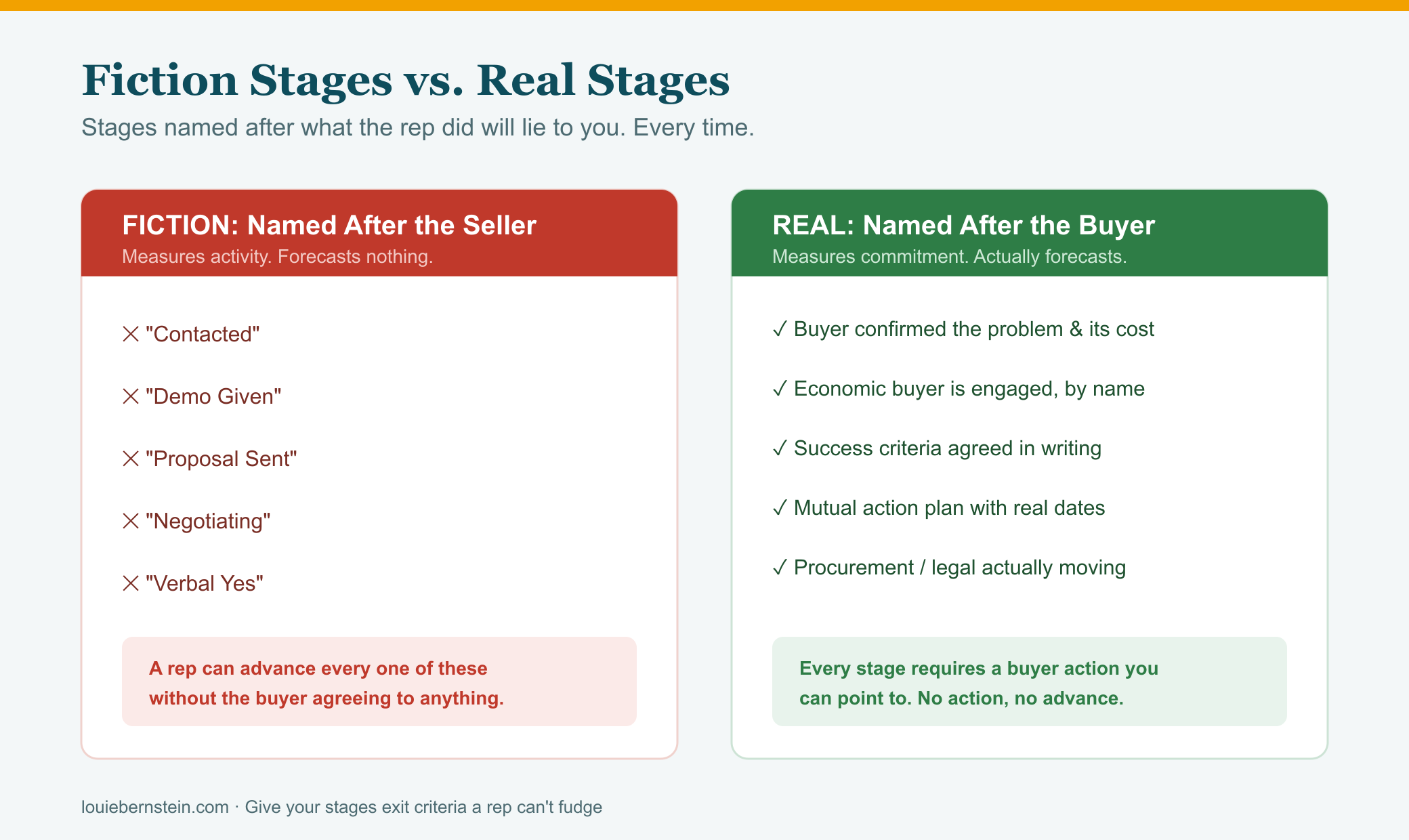
Look at the difference. On the left, every stage is something a rep can check off alone. On the right, every stage requires the buyer to take an action you can actually verify: they confirmed the problem, they put a number on it, the economic buyer got involved, they agreed to success criteria in writing. You can't fake those. Either the buyer did them or they didn't.
This is also why buyer-committed stages catch stalls early. A single-threaded deal can't clear "economic buyer engaged," so it never sneaks into your late-stage forecast pretending to be real. The stage itself does the qualifying for you.
Writing Exit Criteria a Rep Can't Fudge
An exit criterion is the one thing that must be verifiably true before a deal is allowed to leave a stage. Good exit criteria share three traits: they're about the buyer, they're binary (it happened or it didn't), and they leave evidence you can see in the CRM.
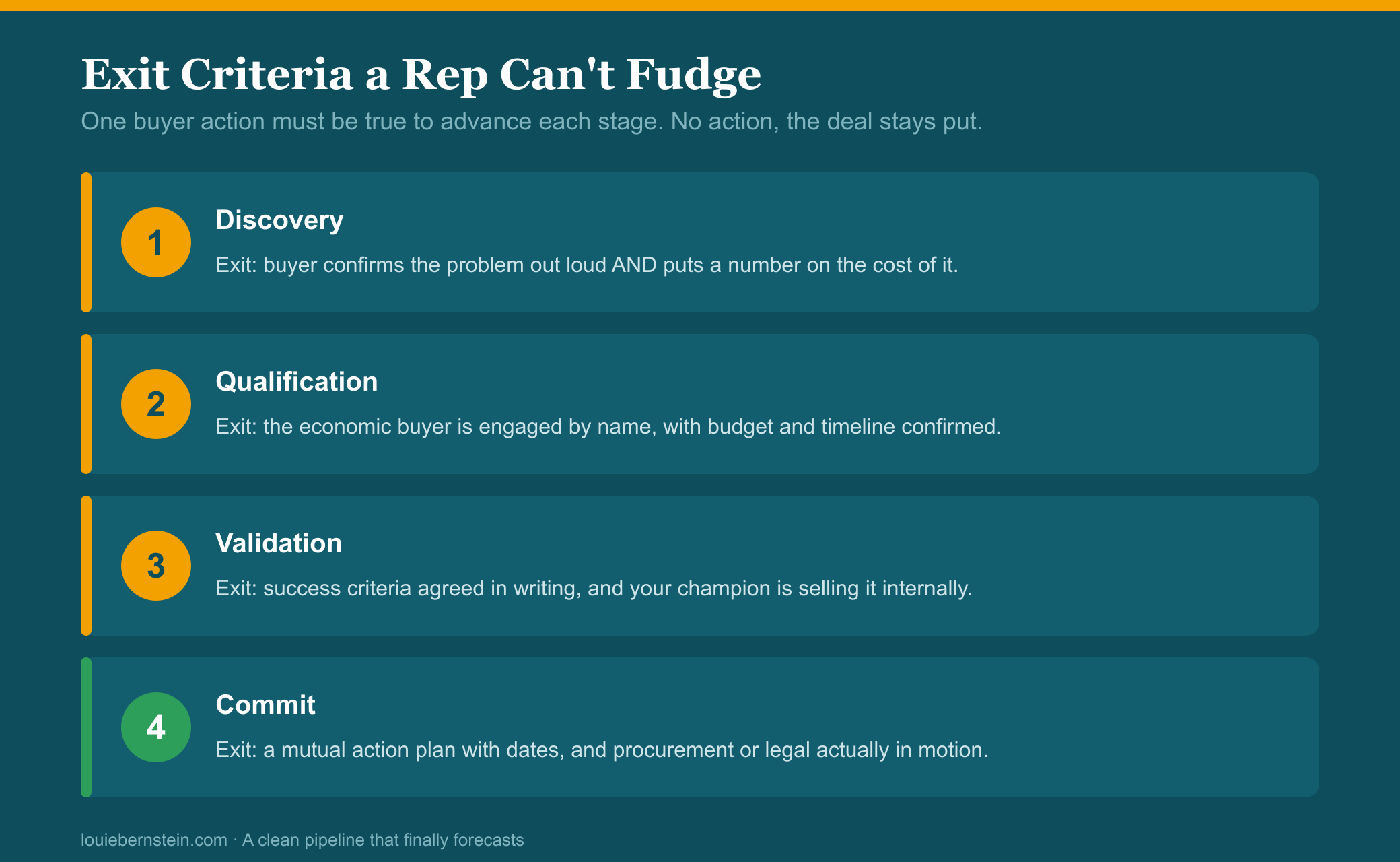
Notice the test each one passes. "Buyer confirmed the problem and put a number on the cost" is binary and leaves evidence, the number is in your notes. "Success criteria agreed in writing" leaves an actual document. Compare that to "Negotiating," which could mean anything from a serious redline to a rep who's afraid to ask where things stand. Keep it to four or five stages. More than that and nobody uses them consistently, which is worse than having too few.
The test for a real exit criterion: could two different people look at this deal and disagree about whether it's met? If yes, it's too vague. Rewrite it until the answer is no.
How Vague Stages Become Stalled Middles
There's a direct line between fuzzy stages and the stalled pipeline I wrote about in why 86% of your deals stall. When advancing a deal costs a rep nothing, everything advances. Weak deals, single-threaded deals, deals with no budget, they all pile into the middle stages because there's no gate stopping them.
Then they sit. The middle of your pipeline swells with deals that were never qualified to be there, and because they're all sitting in the same "Negotiating" or "Proposal Sent" bucket, you can't tell the two live ones from the twenty dead ones. That's the messy middle, and vague stages built it.
Exit criteria are the gate. A deal can't clear "Qualification" until the economic buyer is engaged, so under-qualified deals physically cannot clog your late stages. The pipeline stays honest because the stages won't let it lie.
Rebuilding Your Stages Around What the Buyer Agreed To
Here's the practical build. You can do this in an afternoon with your team:
- List what a buyer actually does on the way to yes. Not what you do. What they do: admit the problem, quantify it, loop in the boss, agree on what success looks like, get procurement involved, sign.
- Collapse that into four or five stages. Discovery, Qualification, Validation, Commit is a clean default. Name them however you like, but each one must map to a buyer milestone.
- Write one exit criterion per stage. Binary, buyer-owned, evidence in the CRM. If you can't verify it from the record, it's not done.
- Add a "next step required" rule. No deal sits in any stage without a specific, calendared next step with the buyer. No next step means the deal isn't in the stage, it's stalled.
- Hold the line in your pipeline review. When a rep says a deal is in Validation, ask to see the written success criteria. The first time you enforce it, your pipeline will shrink. That's the system working, not failing.
Founders resist step five the most, because a shrinking pipeline feels like going backward. It isn't. You didn't lose those deals. You just stopped pretending the dead ones were alive. The number was always fiction. Now it's the truth, and you can plan on the truth.
The Clean Pipeline That Finally Forecasts
Once your stages mean something, a strange and wonderful thing happens: you can forecast. Because each stage now represents a real buyer commitment, your historical win rate by stage becomes trustworthy. A deal in Validation has cleared a real bar, so your Validation-to-close rate is a number you can actually multiply against.
This is the difference between a pipeline and a forecast. A pile of "proposals sent" tells you nothing about next quarter. A set of deals that have each cleared verifiable buyer milestones tells you, with real confidence, how much revenue is genuinely on the way. That's how you climb out of the 45% who don't trust their own numbers and into the group that plans hiring, cash, and growth on a forecast that holds.
If you're a founder who's never built stages like this, no exit criteria, no buyer milestones, just a CRM full of activity labels, this is exactly the kind of system a Fractional Sales Leader installs for $1M to $10M ARR companies. You get a pipeline you can trust without hiring a $250k-plus VP of Sales to build it. And if you have no CRM discipline at all yet, be honest about that first. Exit criteria only work if someone's actually keeping the record straight.
Frequently Asked Questions
Q: What are exit criteria in a sales pipeline?
Exit criteria are the specific, verifiable conditions that must be true before a deal can move from one stage to the next. Good ones are about the buyer (not the rep), binary (it happened or it didn't), and leave evidence in the CRM. For example, a Qualification stage might require "the economic buyer is engaged by name, with budget and timeline confirmed." No confirmation, no advance. They turn your stages from labels into gates.
Q: Why is my sales forecast always wrong?
Usually because your stages measure activity, not buyer commitment. Only 45% of sales leaders have high confidence in their forecast (Gartner), and the most common cause is stages named after what the rep did. If "Proposal Sent" just means a document was emailed, your late pipeline is full of deals that haven't actually progressed, so any forecast built on it is guesswork. Fix the stages and the forecast follows.
Q: How many pipeline stages should I have?
Four or five for most $1M–$10M ARR companies. Discovery, Qualification, Validation, and Commit covers the buyer's journey without overcomplicating it. More stages feel more precise but get used inconsistently, which destroys the very forecasting you were trying to improve. Consistency beats granularity. A simple pipeline everyone uses the same way will out-forecast a detailed one nobody trusts.
Q: What's wrong with stages like "Demo Given" or "Proposal Sent"?
A rep can advance every one of them without the buyer agreeing to a single thing. They measure seller effort, not buyer progress. A demo can be given to someone who'll never buy; a proposal can be sent to someone who never asked for it. Rename them around what the buyer committed to, "buyer agreed on scope and success criteria," and the same deal suddenly tells you the truth about where it stands.
Q: My pipeline will shrink if I do this. Isn't that bad?
No, it's the point. A pipeline that shrinks when you add exit criteria was inflated with deals that were never real. You didn't lose them; you stopped counting the dead ones. A smaller pipeline of genuinely qualified, multi-threaded deals closes at a much higher rate and, crucially, forecasts. Founders who push through the discomfort of that first shrink end up with numbers they can finally plan on.
Q: I'm still doing all the selling myself. Do I even need stages?
Yes, arguably more than anyone. Right now the entire pipeline lives in your head, which means it can't be forecast, delegated, or scaled, and it walks out the door the day you want to step back. Writing down four buyer-committed stages with exit criteria is the first step to turning founder-led selling into a system a team can run. It's also the foundation you'll need before you ever hire a rep.
Want stages that actually forecast?
Give me 30 minutes and I'll rebuild your pipeline stages around buyer-committed exit criteria, live, using your real deals. You'll leave with a four-stage pipeline you can trust. See how a Fractional Sales Leader can help at louiebernstein.com.
Schedule a 30-Minute CallAbout the Author
Louie Bernstein
Fractional Sales Leader with 50 years of sales experience helping $1M–$10M ARR companies build scalable, repeatable sales systems. Founder of MindIQ (INC 500). LinkedIn Top Voice in Sales Management, Sales Operations, and Sales Coaching.