Key Takeaways:
- 86% of B2B purchases stall somewhere in the buying process (Forrester, 2024). That's not a closing problem. It's a system problem, and it starts long before the close.
- A pipeline breaks in three places: the entry (no real qualification), the middle (one contact, no next step), and the decision (no cost of doing nothing). Most stalls live in the messy middle.
- Pushing harder to close a stalled deal makes it worse. You discount, you chase one silent contact, you invent a deadline, and the deal still doesn't move, because the problem was upstream.
- Single-threaded deals die. Multi-threading lifts win rates 130% on deals over $50K (Gong), and deals that close carry twice the buyer contacts of deals that don't.
- The fix isn't a better closer. It's a system: hard qualification at the entry, a real next step on every deal, a buying committee mapped early, and a cost of inaction the buyer feels. Fix the middle and the close takes care of itself.
Here's a number that should stop you cold: 86% of B2B purchases stall at some point in the buying process (Forrester, State of Business Buying, 2024). Not the deals you lost to a competitor. Not the ones that said no. The ones that just... stopped.
Every founder I work with between $1M and $10M ARR describes the same thing in different words. "It was going great, then they went quiet." "We had three good calls and now I can't get them back on the phone." "The champion loves us, but it's stuck in legal, or procurement, or somewhere I can't see."
And almost every one of them reaches for the same fix: close harder. Follow up more. Send another proposal. Offer a discount. It rarely works, and I'll tell you why. The stall didn't happen at the close. It happened three stages earlier, and you're treating the symptom instead of the disease.
This is the article I wish somebody had handed me the first time I watched a "sure thing" rot in the pipeline for six months. Let's fix the actual problem.
The Stall Is a System Problem, Not a Willpower Problem
When 86% of purchases stall, that's not 86% of buyers who lost their nerve. It's a market telling you the buying process is broken, and buyers feel it as much as you do. Forrester found 81% of buyers are dissatisfied with the provider they eventually chose. The whole experience is painful on both sides.
So when a deal stalls, the instinct to blame willpower, yours or the rep's, is almost always wrong. A stalled deal is a deal where the system didn't do its job. Nobody qualified hard enough at the front. Nobody built a reason to move at the back. The deal was allowed to drift because nothing in your process forced it to either advance or die.
A stall is not a rep who forgot to follow up. It's a pipeline that never gave the deal a reason to move.
That distinction matters because it changes what you do next. If it's willpower, you nag people. If it's a system, you build one. Founders who treat every stall as a motivation problem end up with a team that's exhausted and a forecast that's still fiction. Founders who treat it as a system problem fix it once and stop re-fighting it every quarter.
The Three Places a Pipeline Actually Breaks
A pipeline doesn't break everywhere at once. It breaks in three specific places, and once you can name them, you can see exactly where your deals are dying.
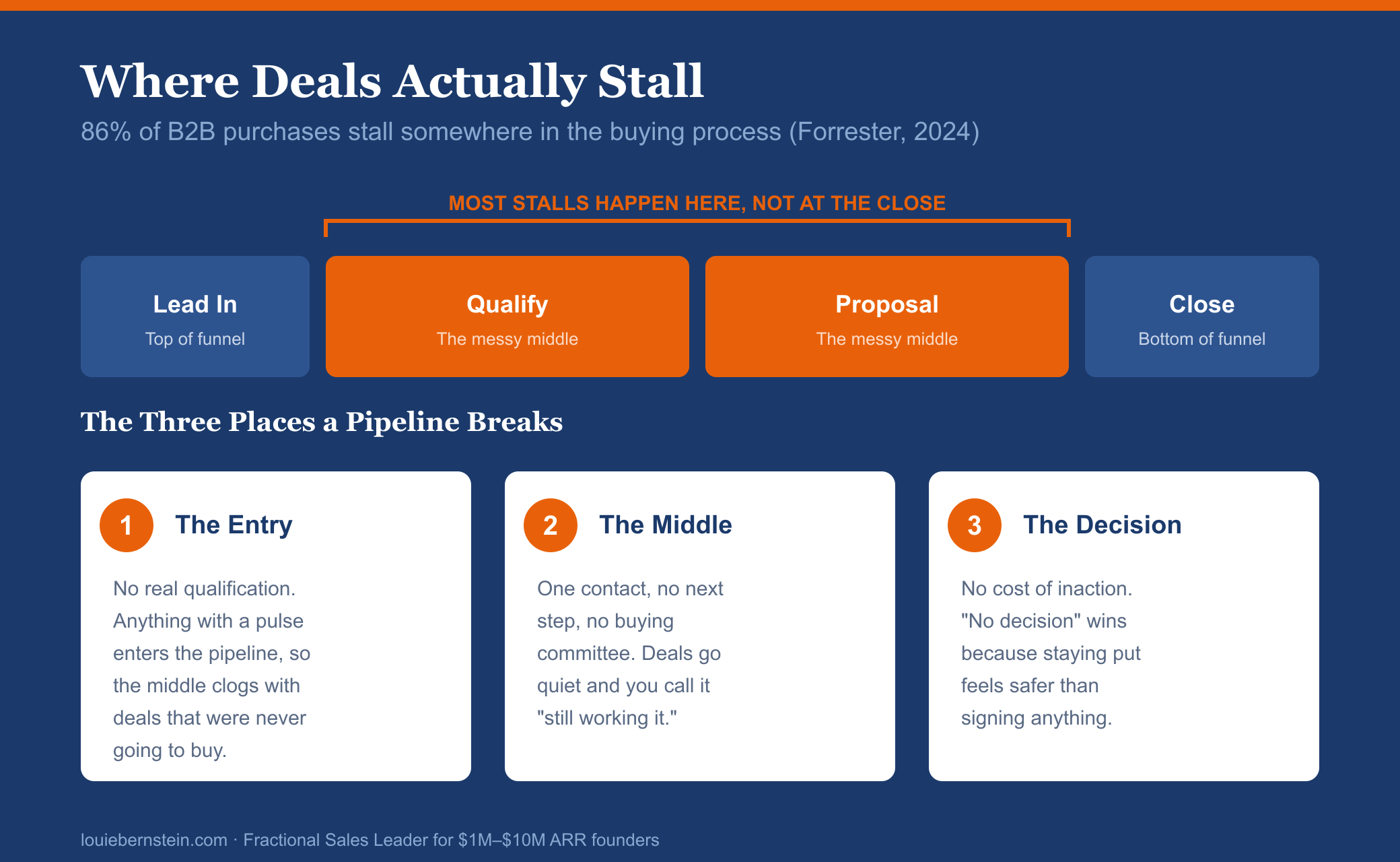
1. The Entry: You Never Qualified
When anything with a pulse gets into your pipeline, the middle clogs with deals that were never going to buy. A "stall" here isn't really a stall. It's a deal that shouldn't have been in there in the first place. If you can't answer who the economic buyer is, what problem they're solving, and why now, you don't have a qualified opportunity. You have a conversation you're calling a deal.
2. The Middle: One Contact, No Next Step
This is where most of the 86% live. You've got one friendly contact, no agreed next step, and no view of the other people who have to say yes. The deal goes quiet, and you tell yourself you're "still working it." You're not. You're waiting, and waiting isn't a stage.
3. The Decision: No Cost of Doing Nothing
At the end, your real competitor isn't the other vendor. It's the buyer deciding to do nothing. If staying put costs them nothing, "let me think about it" wins every time, because inaction feels safer than signing. We'll get to how you fix that below.
Why "Push Harder to Close" Makes It Worse
When a deal stalls, the founder reflex is to apply pressure at the close. More follow-ups. A discount to force a yes. A deadline you both know is invented. Here's the problem: every one of those moves treats a middle-of-the-funnel disease with a bottom-of-the-funnel bandage.
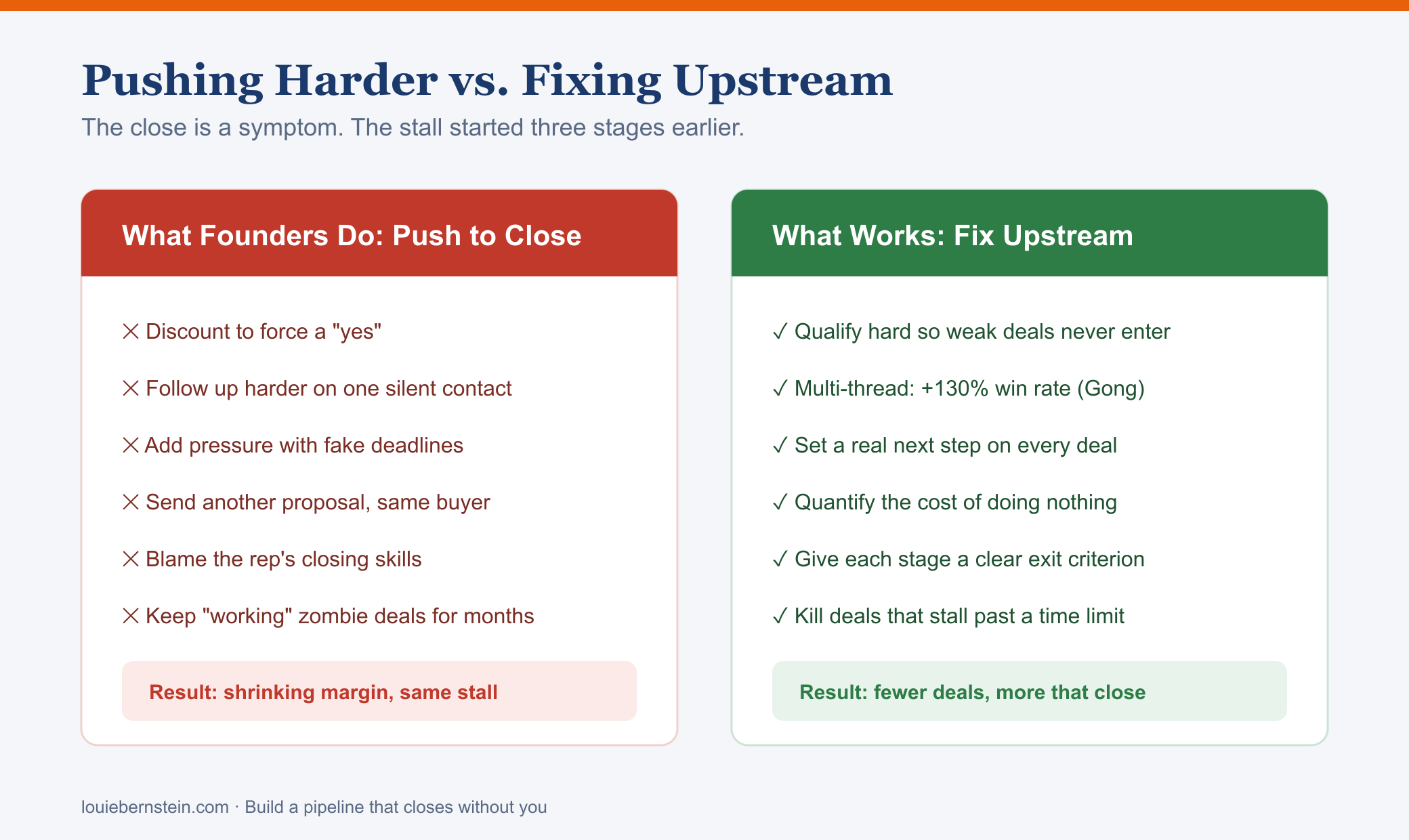
Discounting to force a yes trains buyers to stall on purpose, because they've learned that waiting gets them a better price. Chasing one silent contact harder just annoys the one person who was on your side. Inventing a deadline the buyer doesn't believe torches your credibility right when you need it most.
You can't close your way out of a deal that was never qualified or never multi-threaded. Pushing harder on a broken deal just breaks it louder.
The uncomfortable truth is that fixing the middle means you'll have fewer deals in your pipeline, not more. Qualify hard and a lot of "opportunities" fall out. That feels like losing. It isn't. A smaller pipeline of real deals closes at a far higher rate than a bloated pipeline of hopefuls, and it forecasts, which the bloated one never will.
Diagnosing Your Own Stall Before You Treat It
Before you can fix a stall, you have to find where it lives. Pull up your three biggest "stuck" deals right now and run each one through these questions:
- Who is the economic buyer, by name? If you can't name the person who can actually spend the money, you have an entry problem.
- How many people at the account have you talked to? If the answer is one, you have a middle problem, and a fragile deal.
- What is the specific, agreed next step, on the calendar? If there isn't one, the deal isn't advancing. It's drifting.
- What does it cost the buyer to do nothing for another year? If you don't know, and they don't either, you have a decision problem.
- How long has it sat in its current stage? Anything past your normal cycle time for that stage is a zombie until proven otherwise.
Do this across your whole pipeline and a pattern jumps out fast. Most founders discover their stalls cluster in one place. When they all sit in "one contact, no next step," you've found the single fix that unclogs the most revenue.
What Founder-Led Deals Stall On Specifically
Founder-led sales stalls have their own signature, and it's worth naming because it's probably yours. You are a phenomenal single-threader. You build one deep relationship, usually with someone who loves you, and you sell on trust and vision. That works beautifully until the deal reaches the people who don't know you.
Modern B2B deals now involve around 13 people on the buying side, and 89% of purchases pull in two or more departments (Forrester, 2024). Your one champion can't carry all of them. So the deal that felt "basically closed" hits the CFO, or IT, or a skeptical VP who was never in the room, and it dies quietly, because nobody armed your champion to sell it internally when you weren't there.
The founder's superpower, one deep relationship, is also the founder's biggest stall. A committee of 13 doesn't buy on your charisma. It buys on a business case your champion can defend without you in the room.
The second founder-specific stall is the "no cost of inaction" trap. You're so close to the value of your product that you forget to make the buyer do the math on staying put. One question fixes more stalled founder deals than anything else I teach: "What happens if you do nothing about this for the next twelve months?" Most buyers have never said that answer out loud. When they do, the urgency they've been faking turns real, or you find out fast that it was never there.
The Fix Lives Upstream of the Close
Here's the whole playbook, and notice that none of it happens at the close:
- Qualify hard at the entry. No opportunity enters the pipeline without a named economic buyer, a defined problem, and a reason to solve it now. Fewer deals in, more deals out.
- Multi-thread on purpose. Get to a second and third contact on every real deal. It's the highest-leverage move you can make: 130% higher win rates on deals over $50K (Gong). Single-threaded deals stay off the forecast until they're not.
- Set a real next step every time. Never leave a call without a specific, calendared next action that the buyer agreed to. "I'll follow up next week" is not a next step. "We meet Thursday at 2 with your CFO" is.
- Quantify the cost of inaction. Make the buyer put a number on doing nothing. Their number, in their words, is the only urgency that survives contact with a committee.
- Put a time limit on each stage. When a deal sits too long in one stage, it either advances with a real reason or it's closed-lost. Zombie deals rot forecasts and waste the one resource founders can't buy back: time.
Do these five things and the close stops being a battle. Deals that reach the end are already qualified, already multi-threaded, and already convinced that doing nothing is the expensive option. That's what a working sales system feels like: boring, predictable, and closing without heroics.
If you're a founder with no real process in place yet, no qualification bar, no stages you trust, one contact per deal, this is exactly the gap a Fractional Sales Leader fills for companies between $1M and $10M ARR. You get someone who's built these systems dozens of times, without paying $250k-plus for a full-time VP of Sales you're not ready for. And if you have no system at all yet, that's the honest starting point. You can't optimize a pipeline that was never built. You have to build it first.
Frequently Asked Questions
Q: What does it mean when a deal "stalls"?
A stalled deal is one that hasn't advanced to its next stage and hasn't died. It's just sitting there. Forrester found 86% of B2B purchases stall at some point in the buying process. The key insight is that a stall is a system failure, not a buyer who lost interest. Usually the deal was under-qualified, single-threaded, or missing a real reason to move, and none of that gets fixed by following up harder.
Q: Why do most deals stall in the middle of the pipeline?
The middle is where a deal needs a buying committee, a business case, and an agreed next step, and it's exactly where founder-led deals are thinnest. You've got one champion and no view of the other decision-makers. With around 13 people now involved in a B2B purchase (Forrester), one contact simply can't carry the deal through the people who've never met you. The deal goes quiet, and quiet gets mislabeled as "still working it."
Q: Should I discount to get a stalled deal moving again?
Almost never. Discounting a stalled deal teaches the buyer that waiting pays, so it makes your next deals stall too. Worse, it treats the wrong problem. If the deal stalled because it was single-threaded or had no cost of inaction, a lower price doesn't fix either one. Reserve concessions for a real, mutual next step, not as a bribe to un-stick a deal that's broken upstream.
Q: How do I know if a stalled deal is dead or still alive?
Ask for a real next step and watch what happens. A live deal will agree to a specific action on a specific date with a specific person, ideally someone new on the buying side. A dead deal will give you "let me check internally and circle back," which is a polite no. Put a time limit on each stage: if a deal sits past your normal cycle time with no agreed next step, treat it as closed-lost until the buyer proves otherwise.
Q: What's the single fastest way to reduce stalls?
Multi-thread every real deal. Getting to a second and third contact is the highest-leverage move available: Gong found multi-threading lifts win rates 130% on deals over $50K, and deals that close carry twice the buyer contacts of deals that don't. If you only change one thing this quarter, stop running deals through a single point of failure.
Q: I'm a founder with no real sales process yet. Where do I start?
Start at the entry, not the close. Write down what a qualified opportunity actually is: named economic buyer, defined problem, reason to act now. Then add a rule that no deal advances without an agreed next step. Those two habits alone will cut your stalls dramatically. If you want it built properly and fast, that's the core of what a Fractional Sales Leader installs for a $1M–$10M ARR company without a full-time VP of Sales hire.
Deals stalling in the middle? Let's find where yours die.
In 30 minutes I'll walk your three biggest stuck deals with you, show you exactly where your pipeline breaks, and give you the first upstream fix to install. No pitch, just a clear next step. See how a Fractional Sales Leader can help at louiebernstein.com.
Schedule a 30-Minute CallAbout the Author
Louie Bernstein
Fractional Sales Leader with 50 years of sales experience helping $1M–$10M ARR companies build scalable, repeatable sales systems. Founder of MindIQ (INC 500). LinkedIn Top Voice in Sales Management, Sales Operations, and Sales Coaching.