Key Takeaways:
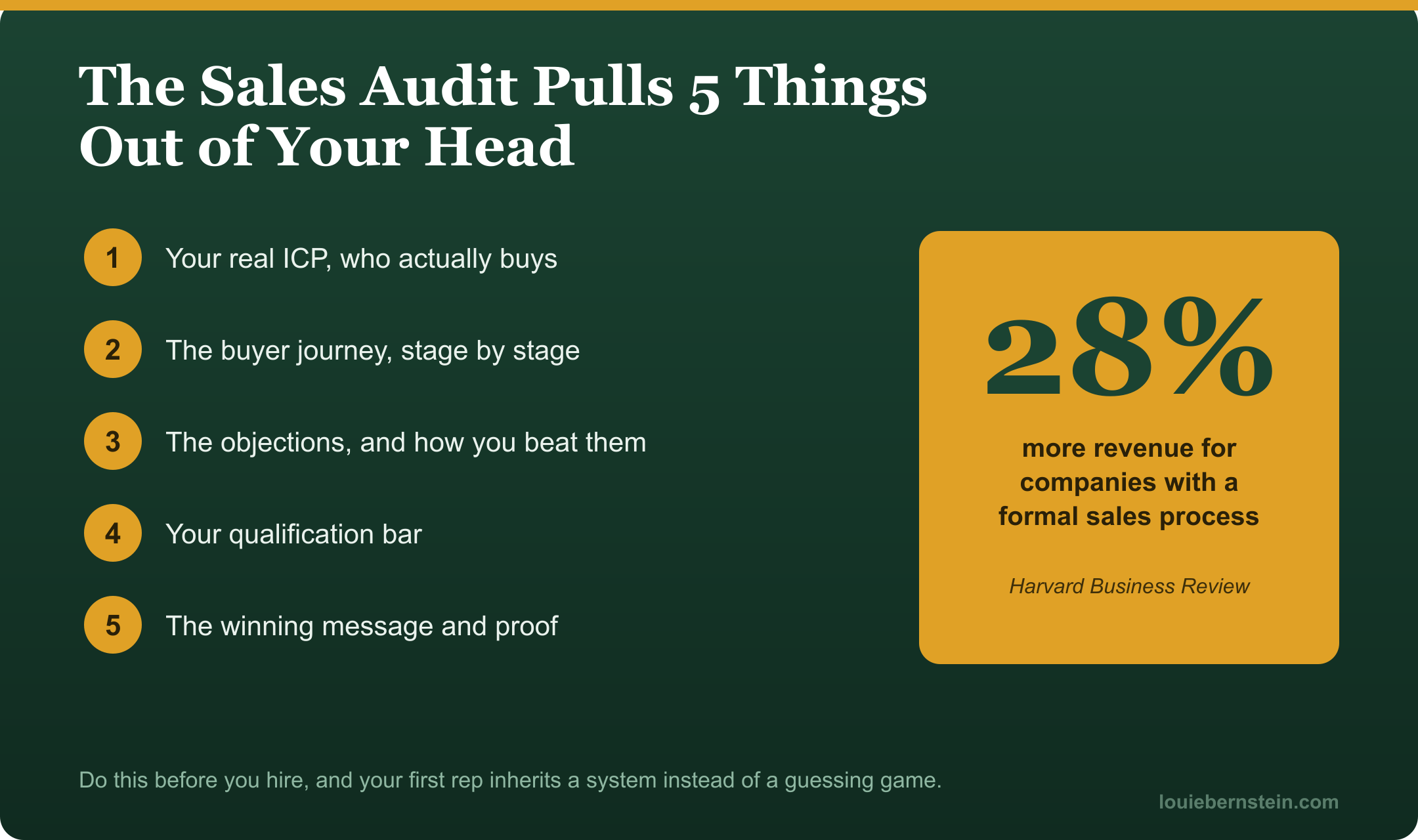
- The step founders skip before their first hire is the sales audit: documenting how you actually sell. Companies with a formal sales process generate up to 28% more revenue (HBR).
- The audit starts with data you already have. Your last ~20 closed deals, won and lost, hold the pattern you've never written down.
- You sell on instinct, so you've never articulated it. The audit forces you to name your ICP, your process, your objections, and your winning message.
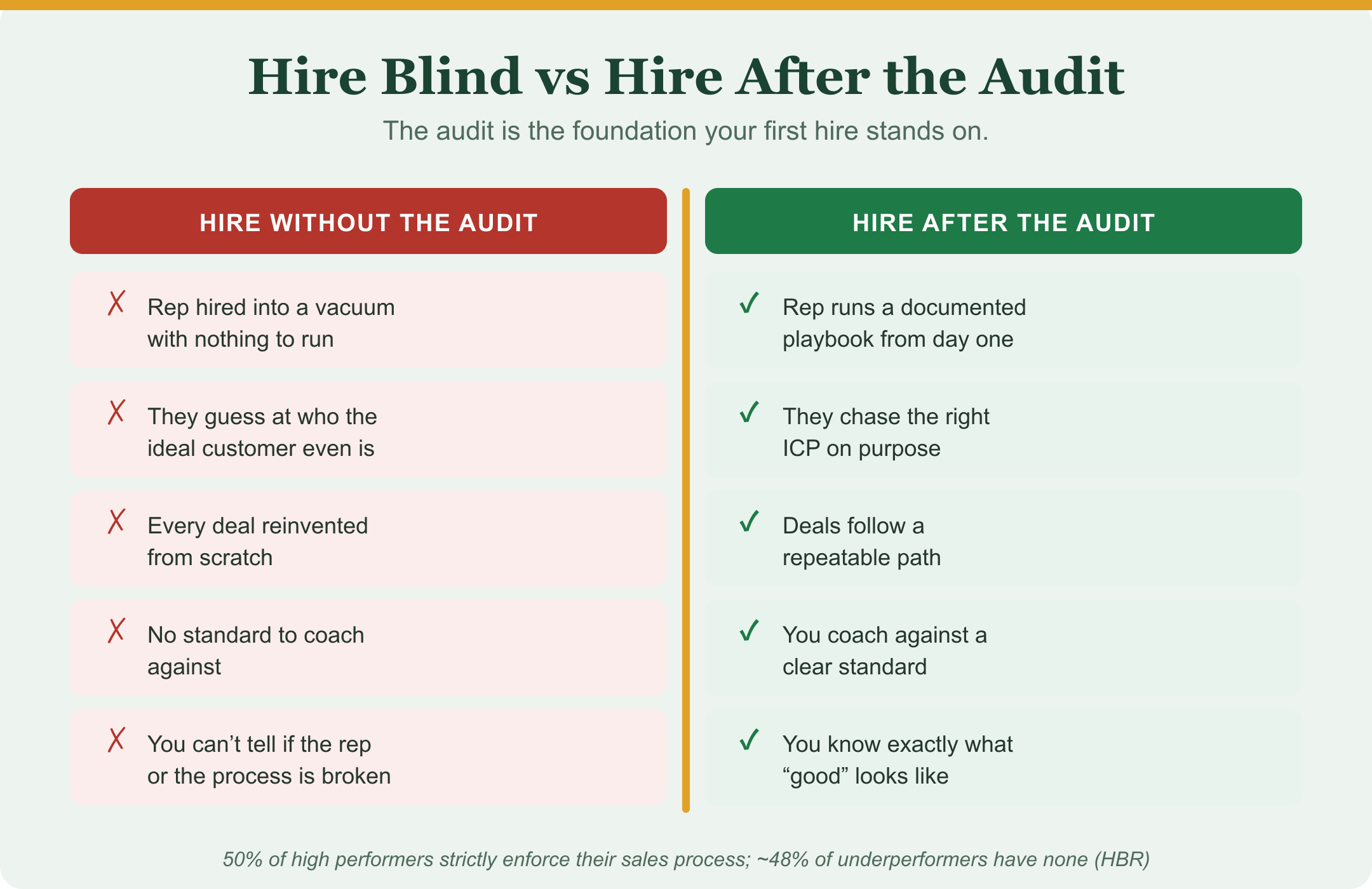
- 50% of high-performing sales orgs strictly enforce a defined process; ~48% of underperformers have none (HBR). The audit is how you cross from one group to the other.
- The audit is the foundation your hire stands on. A great rep on a documented playbook thrives; a great rep in a vacuum fails, and you wrongly blame the rep.
There's a step almost every founder skips on the way to their first sales hire, and it's the one that quietly decides whether the hire works. It's not writing the job description. It's not the interview loop. It's the sales audit: sitting down and actually documenting how you sell, before you ask anyone else to do it for you.
Skipping it is expensive. Companies with a formal, documented sales process generate up to 28% more revenue than those without (Harvard Business Review). And 50% of high-performing sales organizations strictly enforce a defined process, versus roughly 48% of underperformers who have none at all (HBR). The audit is how you move from the second group to the first. Most founders never run it.
The reason is simple. The audit feels like homework exactly when you're most desperate for help. So founders jump straight to hiring, hand the new rep a CRM login and a quota, and hope. Then they pay for the skipped step twelve months later, when the hire washes out. Let me show you what the audit actually is, and how to run it on yourself before you spend a dollar on a rep.
Why Founders Jump Straight to Hiring
The pain that drives the rush is real. Too many deals, not enough hours, and the creeping burnout of being the only person who can close. Hiring feels like the relief valve, so founders post the job and start interviewing. The problem is that hiring to escape the work, before you've documented the work, just relocates the chaos to someone who has even less context than you do.
The audit feels slow when every instinct is screaming for speed. But it's the thing that actually makes the hire fast. A documented motion turns a three-month ramp into a three-week one, because the rep isn't reverse-engineering your genius from scratch. Skipping the audit doesn't save time. It just moves the cost downstream and multiplies it, which is exactly the trap I described in no sales process or playbook, everything is ad-hoc.
The Pattern Hiding in Your Last 20 Deals
The audit starts with data you already have. Pull your last 20 or so closed deals, the wins and the losses both, and go through them like a detective. This isn't guesswork, it's forensics, and the pattern is already sitting in your history waiting to be named.
Ask the questions that reveal the shape of your business: What did the winners have in common, the industry, the company size, the trigger event, the internal champion? Why did the losses actually die, no budget, the wrong buyer, no real urgency? How long did the wins take compared to the losses, and what happened in the deals that stalled? By the time you've worked through twenty deals, you'll see a pattern you've been running on instinct for years but never once put into words.
Documenting What You Do on Instinct
Here's the hardest part, and the most valuable. You sell on instinct, which means you've never actually articulated what you do. The audit forces you to. Walk through your own process stage by stage and, for each one, answer three plain questions: What do I actually do here? What do I ask or send? And what has to be true before this deal moves forward?
The trick is to document what you really do, not what you think you do. Record yourself on a few live calls and watch them back. You'll catch the offhand question that reframes the whole conversation, the specific proof point you reach for, the moment you sense a deal is real. That gap between your theory and your actual behavior is where the gold is. It's the stuff a rep would take years to stumble onto alone, handed to them in an afternoon.
Mapping the Buyer Journey You've Never Written Down
Now flip the view. Map the buyer's journey, not just your sales stages. Where does the buyer actually start? What do they need at each step to move forward? Who else gets pulled into the decision, and when? What almost kills the deal every time? Your sales stages are what you do; the buyer journey is what they experience, and a rep needs both to navigate a real deal.
This matters because the modern purchase is hard. 77% of B2B buyers say their most recent purchase was complex or difficult (Gartner). Your map is how a new rep guides a buyer through that complexity without you in the room. Without it, they improvise, and improvisation is precisely the thing that doesn't scale. If you're not sure whether your current process even holds together, that's worth diagnosing first, which I cover in how to know if your sales process is broken.
Turning Your Own Selling Into a Repeatable Playbook
Everything you've extracted now becomes a single artifact: the playbook. A clear ICP definition, your stage-by-stage process, the qualification criteria that separate real deals from time-wasters, the objection-handling that works, your genuine winning message, and the proof points that move buyers. That's the whole output of the audit, and it's the difference between a rep who runs a documented motion on day one and a rep who spends six months guessing.
Think about which of those two reps you'd rather onboard. One inherits your hard-won pattern and starts contributing fast. The other inherits a login and your good wishes. The playbook is a week or two of work that pays off on every hire, every deal, and every forecast after it. That's why the audit is worth doing before, not after, you bring someone on.
The Audit Is the Foundation the Hire Stands On
Don't think of the audit as busywork you do before the "real" work of hiring. It is the foundation the hire stands on. Put a great rep on a documented playbook and they thrive. Put that same great rep into a vacuum and they fail, and you'll wrongly conclude that the person was the problem when the truth is you never gave them anything to stand on.
You can and should try running the audit yourself. But most founders are too close to their own selling to see it clearly, the instincts are invisible precisely because they're automatic. That's where a Fractional Sales Leader earns their fee: I run the audit with you, pull out the motion you can't see because you're inside it, and turn it into the playbook your hire actually needs. One honest caveat: if you haven't closed roughly 20 deals yet, there isn't enough pattern to audit. Keep selling first. But the moment you have the deals, audit before you hire. Every single time.
Related Reading
Frequently Asked Questions
Q: What is a sales audit for a founder?
It's the process of documenting how you actually sell before you hand it to anyone else. You review your last ~20 closed deals, extract your real ICP, map the buyer journey, and write down your process, objections, qualification criteria, and winning message. The result is a playbook. It matters because companies with a formal sales process generate up to 28% more revenue than those without (HBR), and because a documented motion is the only thing a new rep can actually run on day one.
Q: Why does the audit matter before hiring a salesperson?
Because a hire is only as good as the system you drop them into. 50% of high-performing sales organizations strictly enforce a defined process, while ~48% of underperformers have none at all (HBR). Hire before you've documented your motion and even a great rep is guessing at your ICP, reinventing every deal, and impossible to coach because there's no standard to coach against. The audit turns the hire from a gamble into a plan. Skip it and you'll likely blame the person for a failure the missing system caused.
Q: How do I run a sales audit on myself?
Start with your last 20 closed deals, wins and losses. Find what the winners share and why the losses died. Then document your process stage by stage: what you do, what you ask or send, and what has to be true to advance. Record a few live calls and watch what you actually do, not what you think you do. Map the buyer's journey alongside your stages. Finally, package it all into a playbook: ICP, process, qualification, objections, and winning message. It's roughly a week of focused work.
Q: How many deals do I need before I can audit?
Roughly 20 closed deals is enough to see a real pattern rather than noise. B2B sales are complex, 77% of buyers call their last purchase complex or difficult (Gartner), so a handful of deals won't reveal what's repeatable. If you're not there yet, keep selling; the pattern will come. But the moment you've closed around twenty, run the audit before you hire, while the details are fresh and before you compound a shaky motion by handing it to someone else.
Q: Isn't documenting my process a waste of time when I'm slammed?
It feels that way, which is exactly why underperformers skip it, ~48% have no defined process at all (HBR). But the audit is what makes everything after it faster. It cuts a new rep's ramp from months to weeks, makes coaching possible, and improves your forecast because deals follow a known path. A week spent auditing saves you a failed twelve-month hire. When you're slammed is precisely when a documented, delegable motion is most valuable, because it's the only way to get the work off your own plate safely.
Q: Can someone help me run the audit?
Yes, and it often works better with help, because you're too close to your own selling to see it. A Fractional Sales Leader runs the audit with you, interviews you about your deals, watches your calls, and extracts the instincts you can't articulate because they're automatic. Then they turn it into a documented playbook your first hire can run. You get the benefit of the system without the cost of a full-time VP of Sales, and you get it before you hire, when it does the most good.
Run the audit before you run the hire.
If you're a founder between $1M and $10M in ARR, I'll run the sales audit with you, pull the motion out of your head, and turn it into the playbook your first hire needs. See how it works at louiebernstein.com.
Schedule a 30-Minute CallAbout the Author
Louie Bernstein
Fractional Sales Leader with 50 years of sales experience helping $1M–$10M ARR companies build scalable, repeatable sales systems. Founder of MindIQ (INC 500). LinkedIn Top Voice in Sales Management, Sales Operations, and Sales Coaching.