Key Takeaways:
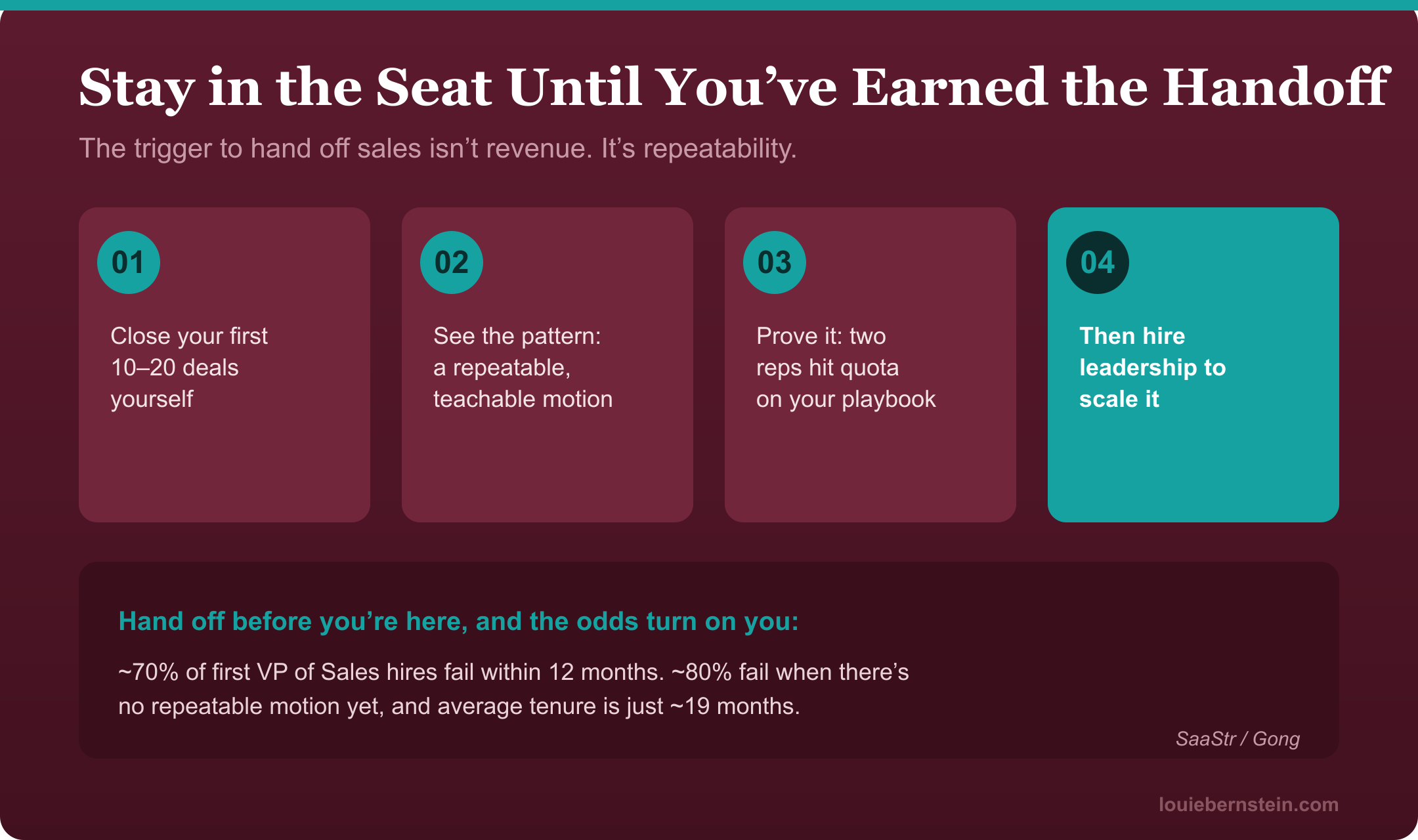
- The common advice, "get out of sales fast", backfires. ~70% of first VP of Sales hires fail within 12 months (SaaStr), and ~80% fail when there's no repeatable motion yet.
- The trigger to hand off sales isn't a revenue number. It's repeatability: can the motion be described, taught, and run by someone who isn't you?
- 20–50 closed deals teach you your real ICP, the real objections, and your actual winning message. You can't systematize a complex sale you've only done a handful of times.
- Founders close on charm, product depth, and credibility. Your first hire has none of those. If your "process" is really just your charisma, there's nothing to transfer.
- Staying in longer, with intent, means closing until you see the pattern, documenting as you go, and only hiring leadership once two reps hit quota on your playbook. That's what a Fractional Sales Leader helps you build.
Every piece of advice you've read tells founders to get out of sales as fast as humanly possible. Hire a VP, delegate, go work "on the business." I'm going to tell you the opposite, and I've watched it play out hundreds of times: you should stay in founder-led sales longer than feels comfortable. Usually a lot longer.
Here's why it matters. Roughly 70% of first VP of Sales hires don't survive 12 months (SaaStr), and the failure rate climbs to about 80% when the role gets created before there's a repeatable sales motion. The average tenure of a VP of Sales is just 19 months (Gong). That's not a hiring-quality problem. It's a timing problem. Founders hand off a sale they never actually figured out, and the hire inherits a job that can't be done.
The urge to escape sales is understandable. It's hard, it's relentless, and you didn't start a company to be a rep forever. But leaving too early doesn't get you out of sales. It drags you right back in, twelve expensive months later, to clean up a failed hire. Let me show you when you're actually ready to hand off, and why staying in longer is the highest-leverage move you can make.
The Instinct to Hand Off Sales Too Early
The instinct comes from a few places. Some founders genuinely dislike selling. Some feel it's beneath the CEO title. Most have simply read a hundred times that great founders build teams and delegate, so they rush to prove they're a "real" CEO by handing off the thing that feels least strategic. The tell is always the same: they're hiring a VP of Sales to escape sales, not to scale a motion that already works.
Here's the problem with that. You can't outsource something you haven't figured out yet. Handing off an ad-hoc, in-your-head selling motion isn't delegation, it's abandonment. You're asking someone to run a play that was never written down. If your sales still live entirely in your instincts and relationships, that's a sign you're not ready to hand off, no matter what the revenue says. I wrote about the danger of that gap in no sales process or playbook, everything is ad-hoc.
Repeatability, Not Revenue, Is the Real Trigger
Most founders use a revenue number as their trigger. "We hit $2M, time to hire a VP of Sales." It feels logical, and it's wrong. Revenue tells you that you can sell. It says nothing about whether the motion works without you. Plenty of companies hit $2M entirely on founder heroics, a network, and a handful of whale deals that no rep could ever reproduce. Hire against that number and you're handing off magic, not a machine.
The real trigger is repeatability. Can the motion be described, taught, and run by someone who isn't you? Jason Lemkin's version of this is blunt and correct: don't hire a VP of Sales until you have two reps who can consistently hit quota running your process (SaaStr). That's the proof. And don't even hire your first rep until you've closed your first ten or so customers yourself and you're spending more than 20% of your time on sales. Those milestones aren't arbitrary. They're the evidence that there's a real, repeatable thing to hand off.
What 20–50 Closed Deals Actually Teach You
There's knowledge that only shows up after you've personally closed enough deals, and it's the exact knowledge a first hire needs handed to them. Somewhere between 20 and 50 deals, the fog clears and you can finally see:
- Who actually buys, your real ideal customer, not the one on your pitch deck.
- The real objections, the four or five that come up every time, and how to handle each.
- The triggers that create genuine urgency instead of a polite "maybe later."
- Your actual winning message, which is almost never the one you started with.
- The three or four signals that reliably predict a deal will close.
This matters because the sale is hard. 77% of B2B buyers say their most recent purchase was complex or difficult (Gartner). You cannot systematize a complex sale you've only run a handful of times, because you haven't seen enough of it to know the pattern from the noise. Twenty to fifty deals is roughly where the pattern becomes undeniable, and a pattern is the raw material of a playbook.
"You can't write a playbook for a game you've only played ten times. Stay at the table until you can see the patterns with your eyes closed."
Why Charm Doesn't Transfer to Your First Hire
Here's the quiet reason so many first sales hires fail. Founders close on things that don't transfer: raw passion for the product, deep technical knowledge, and the credibility of being the person who built the thing. Your first hire has none of that. They can't say "I built this." They don't have ten years in the problem. If your sales process is really just your charisma with a logo on it, there's simply nothing to hand over.
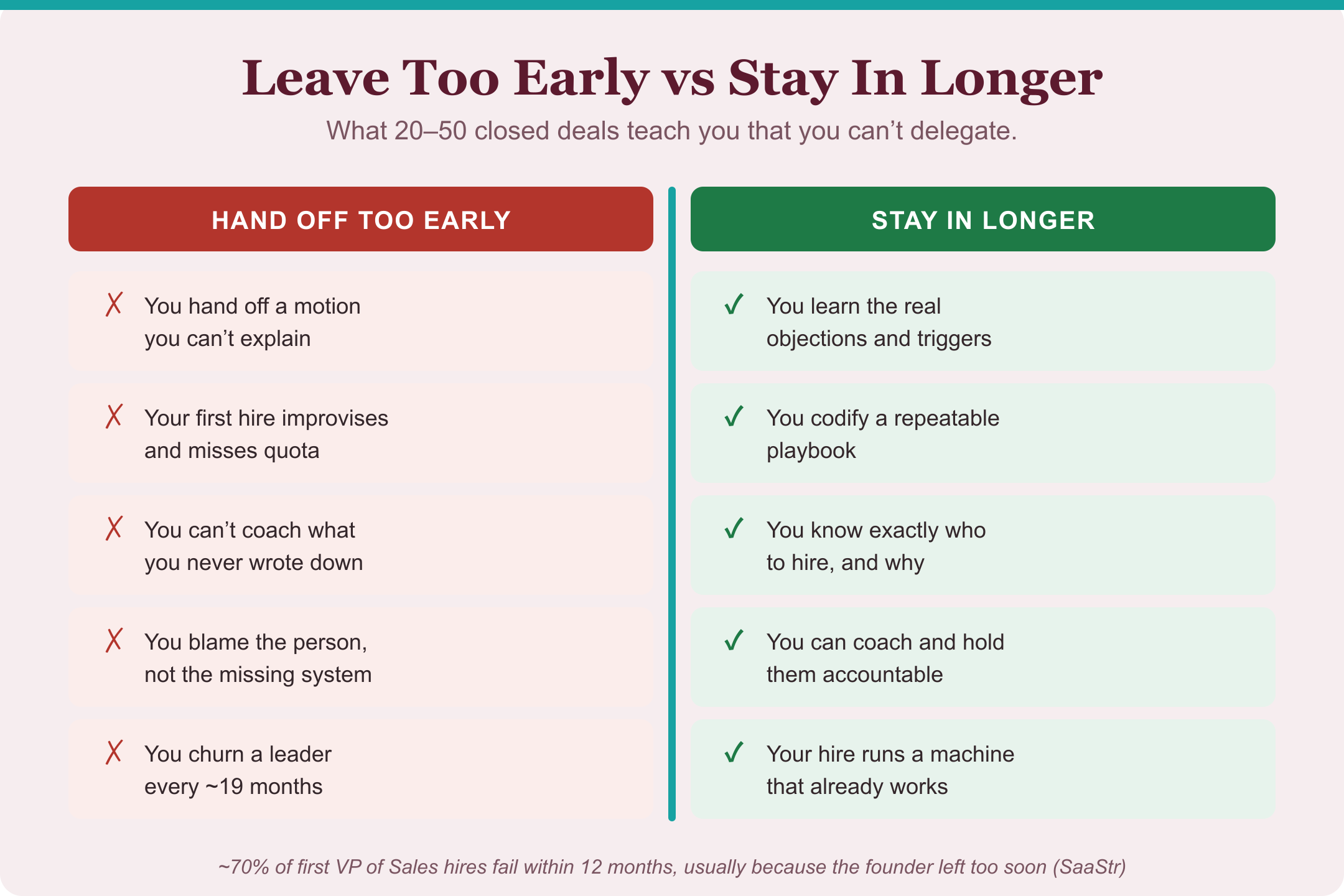
So the hire flails, misses quota, and you conclude that "sales hires just don't work here." But the hire didn't fail. The handoff did. There was no system underneath the charm. The fix isn't a more charismatic rep, it's converting your instinct into a documented, teachable motion, an accountabilities document, a playbook, and a clear qualification bar, before anyone else is asked to run it.
The Cost of Cutting Founder-Led Sales Short
Leaving too early isn't a small mistake. A failed first sales-leadership hire costs you twelve months of runway, the salary and ramp you burned, the pipeline they mismanaged on the way out, and a real hit to team morale. Then you get pulled back into selling anyway, now a year behind where you'd have been, and forced to run the search all over again. That's the expensive irony at the heart of this: the rush to escape sales is the very thing that keeps you trapped in it the longest.
Worse, you lose the compounding. A year spent staying in with intent, closing deals and turning each one into playbook material, builds an asset that pays off every quarter after. A year spent onboarding and then unwinding a doomed hire builds nothing. Same twelve months, wildly different outcomes, and the only variable was whether you handed off a system or a vacuum.
What "Staying In Longer" Looks Like in Practice
Staying in longer doesn't mean selling forever. It means staying in with intent, and there's a clear sequence:
- Keep closing until you've done 20–50 deals and can genuinely predict which ones will land.
- Document as you go. Turn every deal into playbook material: objections, ICP, winning message, qualification criteria.
- Hire a rep, not a VP. Have them run your documented motion and watch closely where it breaks.
- Only then hire leadership. When two reps hit quota on your playbook, bring in someone to scale what's proven.
And you don't have to do the extraction alone, which is where a Fractional Sales Leader earns their keep. I help founders pull the motion out of their head, document it into a real playbook, and install the system, so when you do hand off, your hire steps into a machine that works instead of a vacuum. One honest caveat: if you're pre-product-market fit or you haven't closed enough to see a pattern yet, "staying in longer" is just survival, not strategy. That's fine, keep selling. But the moment the pattern appears, capture it. That single discipline is the difference between founders who scale and founders who churn a VP every 19 months.
Related Reading
Frequently Asked Questions
Q: When should a founder stop doing sales themselves?
Not at a revenue number, but when the motion is repeatable. The clearest test is Jason Lemkin's: don't hire a VP of Sales until you have two reps who can consistently hit quota running your process (SaaStr). Before that, hire your first rep only once you've closed your first ten or so customers yourself and you're spending more than 20% of your time on sales. Those milestones prove there's a real, teachable motion to hand off, rather than founder magic that no one else can reproduce.
Q: Isn't hiring a VP of Sales how you scale?
Eventually, yes, but timing is everything. About 70% of first VP of Sales hires fail within 12 months (SaaStr), and roughly 80% fail when the role is created before a repeatable motion exists. The average VP of Sales tenure is just 19 months (Gong). A VP scales a working system, they don't invent one from scratch. Hire one before you have a proven, documented motion and you're not scaling, you're gambling, and the odds are against you.
Q: How many deals should I close before handing off sales?
Enough to see the pattern clearly, which is usually somewhere between 20 and 50 closed deals. By then you know your real ideal customer, the recurring objections, the genuine urgency triggers, and your actual winning message, which is rarely the one you started with. Given that 77% of buyers call their last purchase complex or difficult (Gartner), you need real reps to separate the pattern from the noise. Fewer than that and you're documenting guesses, not a proven motion.
Q: Why do my sales hires keep failing?
Usually because you handed off charm instead of a system. Founders close on passion, product depth, and the credibility of having built the thing, and none of that transfers to a new rep. If your process lives only in your instincts, there's nothing concrete for the hire to run, so they improvise and miss. The hire didn't fail, the handoff did. Fix it by documenting your motion, an accountabilities document, a playbook, and a qualification bar, before anyone else is asked to sell for you.
Q: What's the difference between founder-led sales and just being the bottleneck?
Intent and documentation. Staying in the seat to learn the pattern and codify it into a system is founder-led sales done right. Staying in because you can't let go, without ever writing anything down, is being the bottleneck. The first builds an asset that outlasts you; the second builds a dependency that traps you. The goal isn't to sell forever, it's to sell long enough to turn your instinct into something a team can run without you.
Q: How do I know my sales motion is actually repeatable?
The only real proof is that someone who isn't you can run it and hit quota. If you can hand a documented playbook to a rep, and they consistently close deals with it, the motion is repeatable. If deals only close when you personally step in, it isn't, no matter how good your revenue looks. Get two reps hitting quota on your playbook before you bring in leadership. That's the green light that you've built a system worth scaling, not just a run of personal wins.
Ready to turn your instinct into a system?
If you're a founder between $1M and $10M in ARR, I'll help you pull the motion out of your head, document it, and install the system, so your next hire steps into a machine that works. See how it works at louiebernstein.com.
Schedule a 30-Minute CallAbout the Author
Louie Bernstein
Fractional Sales Leader with 50 years of sales experience helping $1M–$10M ARR companies build scalable, repeatable sales systems. Founder of MindIQ (INC 500). LinkedIn Top Voice in Sales Management, Sales Operations, and Sales Coaching.