Key Takeaways:
- Ad-hoc selling isn't a personality. It's an undocumented process. And what's undocumented can't be trained, measured, or improved.
- A sales playbook isn't a binder nobody reads. It's your winning motion written down: ICP, messaging, discovery questions, objection handling, mutual action plans, and a defined close.
- Companies with a formal sales process generate 18% more revenue growth than those without one (HBR / Vantage Point).
- You don't invent the playbook. You extract it. The winning pattern already lives in your last 20 closed deals and in the founder's head.
- A document nobody follows is worthless. The playbook only works when it's trained, coached, and enforced in the CRM.
- If you haven't personally closed enough deals to see a repeating pattern, it's too early to write a playbook. Go win more first.
Here's the sentence I hear from founders more than any other: "We don't really have a sales process. Everything's kind of ad-hoc."
And you know what? Ad-hoc got you here. You sold the first million yourself on instinct, hustle, and a deep understanding of your customer that no CRM field could hold. That instinct is real. It's an asset.
But now discovery is inconsistent, demos wander, proposals look different depending on who wrote them, and win rates swing for reasons nobody can explain. You've hired a rep or two, and they can't do what you do. The knowledge that closes deals lives in exactly one place: your head. That's not a system. That's a bottleneck with a pulse.
The fix isn't more willpower or a better CRM. It's turning what you already do well into something other people can run. Let me show you how I do that.
What "Ad-Hoc" Is Actually Costing You
Founders tend to treat "we're ad-hoc" as a mild confession, like admitting the office is a little messy. It isn't mild. An undocumented sales motion is a tax you pay on every single deal, and you can't see the receipt.
Start with the hard numbers. In a study of 786 sales leaders published in Harvard Business Review, companies with a formal, structured sales process saw 18% more revenue growth than those without one (HBR / Vantage Point Performance). Separate research from sales scientist Steve W. Martin found that 48% of underperforming sales organizations had informal or nonexistent processes, while half of high performers ran closely monitored, enforced ones (HBR / Steve W. Martin). The gap between "we wing it" and "we run a system" isn't a rounding error. It's the difference between a company that scales and one that stalls at the founder's capacity.
Inconsistency is invisible until you measure it
When every rep runs their own version of discovery, you don't have one sales process. You have as many processes as you have people, and no way to know which one works. You can't coach what you can't compare. A missed number becomes a mystery instead of a diagnosis, because there's no standard to measure the deal against.
The real killer isn't the competitor. It's indecision.
Matt Dixon and Ted McKenna analyzed more than 2.5 million recorded sales conversations for The JOLT Effect and found that 40% to 60% of qualified deals are lost not to a competitor but to "no decision," the prospect's own indecision and fear of getting it wrong (Dixon & McKenna). An ad-hoc motion feeds that indecision. There's no mutual action plan, no clear next step, no structure that helps a nervous buyer move forward. A documented process is how you take risk off the table for the buyer, which is exactly what the research says closes those stuck deals.
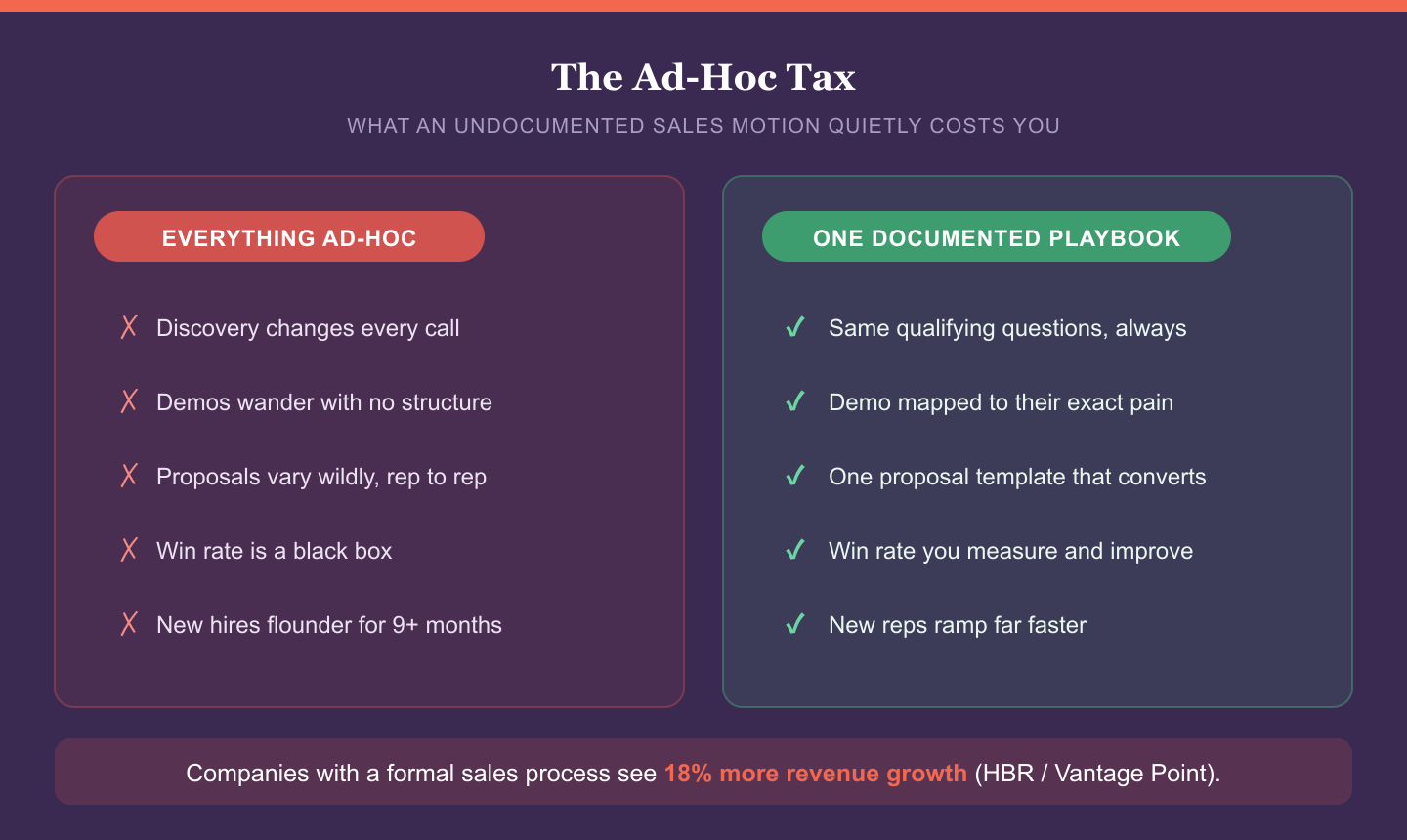
"Ad-hoc isn't a style of selling. It's the absence of a system you haven't written down yet."
A Playbook Isn't a Binder. It's Your Winning Motion, Written Down.
When founders hear "sales playbook," a lot of them picture a fat three-ring binder that gets printed once and never opened again. Forget that image. That's not what we're building.
First, get the two words straight, because people use them interchangeably and they aren't the same thing. Your sales process is the stages a deal moves through, from first touch to closed-won, with clear entry and exit criteria at each step. Your sales playbook is the how: the exact questions, messaging, materials, and moves your team uses to advance a deal through each stage. The process is the map. The playbook is how you drive the road.
A real playbook is a living, working document. It's what a new hire reads in week one and what your best rep still references in year three. It's specific enough that two different people running it produce a similar-quality conversation. And it's built from what already works in your business, not from a generic template you downloaded. If you want the deeper cut on the foundational documents every founder needs before their first sales hire, I wrote about that in what a founder needs to create before making their first sales hire.
The 7 Components of a Playbook That Actually Gets Used
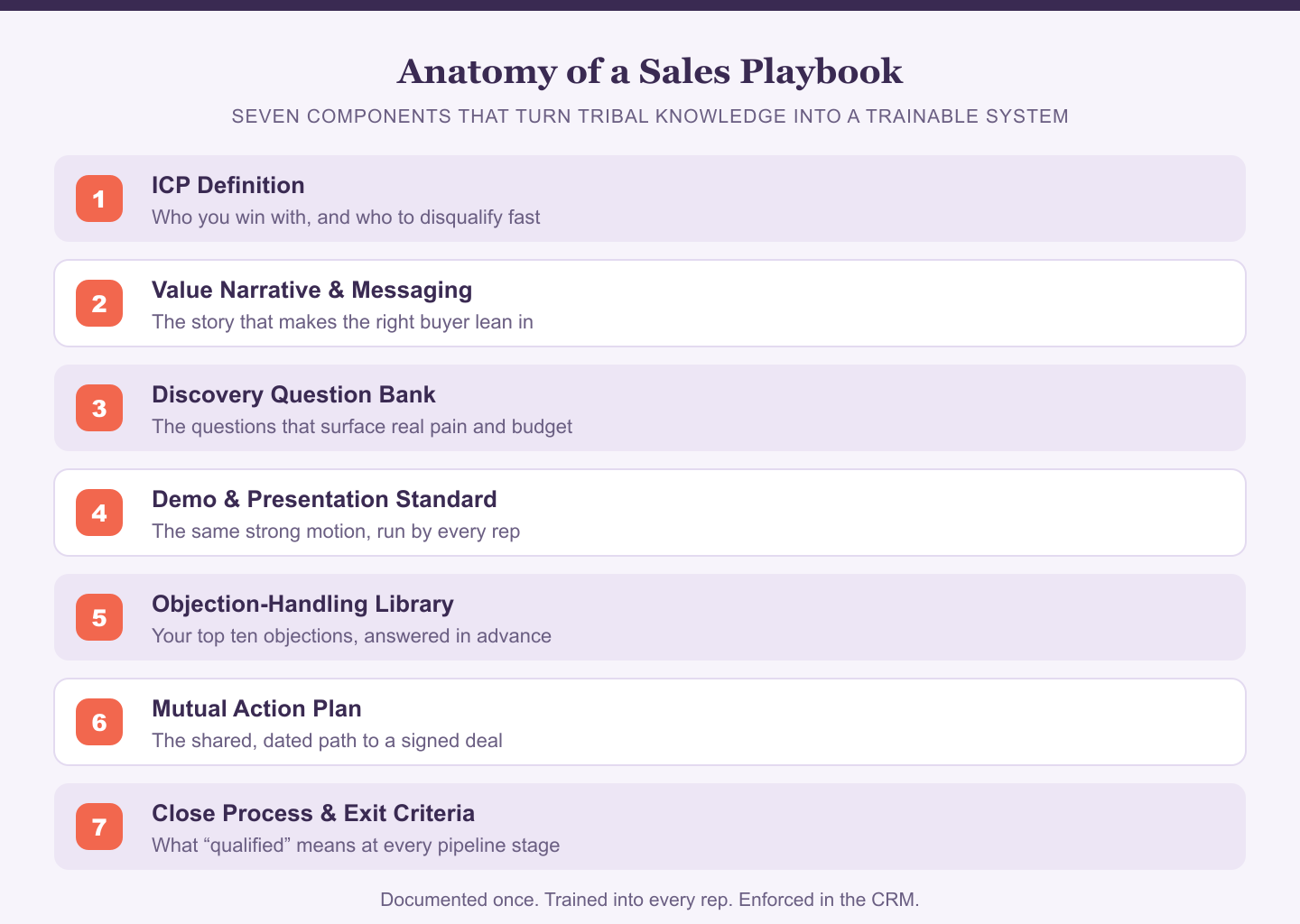
Every playbook I build with a founder has these seven parts. Skip one and you leave a gap a rep will fall through. Here's what each one does and why it earns its place.
- ICP definition. Who you win with, and just as important, who to disqualify fast. The single cheapest way to raise a win rate is to stop spending time on deals that were never going to close. Your ICP is a filter, not a wish list.
- Value narrative and messaging. The story that makes the right buyer lean in, in their language, tied to their pain. CSO Insights found that sales teams with a defined content and messaging strategy post 27% higher win rates (CSO Insights). Consistent words drive consistent outcomes.
- Discovery question bank. The questions that surface the real problem, the cost of that problem, and who signs. This is where deals are actually won. A rep with a great question bank outperforms a rep with a great pitch every time.
- Demo and presentation standard. The same strong motion, run by every rep, mapped to the pain you uncovered in discovery. Not a feature tour. A tailored show of exactly why this solves their problem.
- Objection-handling library. Your top ten objections, answered in advance. Price, timing, "we'll build it ourselves," "let me think about it." When the answers are written and rehearsed, reps stop freezing and deals stop stalling.
- Mutual action plan. A shared, dated path to a signed deal that you and the buyer build together. This is the single best antidote to the "no decision" losses the research warns about. It gives an anxious buyer a rail to hold.
- Close process and exit criteria. A crisp definition of what "qualified" means at every stage, so a deal only advances when it has actually earned the move. This is what makes your forecast believable.
"The playbook you need already exists. It's just trapped in your last 20 deals and the founder's instinct. My job is to get it out."
How to Extract What's in the Founder's Head
This is the part most "sales process" advice skips, and it's the hardest and most valuable part of the whole job. You can't write a playbook from a template. You have to reverse-engineer it from what's actually winning. Here's the step-by-step I run.
Step 1: Mine the last 20 closed deals
We pull your last 20 or so wins and losses and look for the pattern. What did the buyers who said yes have in common? What triggered them to look? What objection came up right before they signed? The winning motion isn't a theory. It's already sitting in your history. We just have to name it.
Step 2: Listen to the founder actually sell
I get on your calls, or we review recordings. The magic you do without thinking, the way you reframe a problem, the question you ask that makes a prospect go quiet, that's the gold. You've done it so many times it feels like nothing. To a new rep it's invisible. My job is to catch it, write it down, and make it repeatable.
Step 3: Run a structured win-loss review
Founders remember their wins fondly and their losses vaguely. A real win-loss process, sometimes talking to the buyers themselves, tells you why deals actually close and why they actually die. That's the raw material for your discovery questions and your objection library. Guesswork produces a guesswork playbook.
Step 4: Draft, test, and tighten
We write the first version, then we run real deals through it and cut what doesn't work. A playbook is never finished on the first pass. It gets sharper every time a rep uses it and reports back. Version one exists to be improved, not framed.
Your instinct closed the first million. Documenting that instinct is how you close the next nine without being in every room.
Make It Stick: From Document to Enforced Motion
Here's the trap. Founders spend real money getting a playbook written, then it sits in a shared drive and nothing changes. A playbook nobody follows is just an expensive PDF. The difference between a document and a system is enforcement.
Three things turn the document into a working motion:
- Train it, then coach it. Onboarding a rep against a real playbook is night and day. New sellers typically take three to nine months to reach full productivity (industry benchmarks), and a documented motion is the biggest lever you have to shorten that. But training is a day. Coaching is forever. You review calls against the playbook every week and correct drift before it hardens.
- Wire it into the CRM. Your pipeline stages and the playbook's exit criteria have to be the same thing. A deal can't move to "proposal" until it clears the discovery bar you defined. That's how the playbook stops being optional and starts being how deals actually flow.
- Measure with a one-page scorecard. Win rate by stage, conversion between stages, and forecast accuracy. When you can see where deals leak, you know exactly which page of the playbook to fix next.
Do this and something quiet and important happens: the company stops depending on you to close. That's the whole point. Not to remove your instinct, but to clone it into a team and a system that runs when you're not in the room.
When a Playbook Won't Fix It (Yet)
I'll be straight with you, because the wrong timing wastes your money. A playbook documents a repeatable, winning motion. So if you don't have one yet, there's nothing to document.
If you're pre-product-market fit, if your last ten deals closed for ten different reasons, or if you personally haven't sold enough to feel a pattern in your bones, then building a formal playbook now is premature. You'd be systematizing noise. In that case, the honest advice is to go win more deals yourself first, stay scrappy, and pay close attention to what's working. Come back to the playbook when you can say "buyers like this, with this pain, tend to buy for this reason." That's the signal you're ready.
But if you're a B2B founder between $1M and $10M in ARR, you've almost certainly crossed that line. You have the pattern. You've just never had the time to write it down, and you're not ready to hand $250K to a full-time VP of Sales to do it. That's the exact gap a Fractional Sales Leader fills.
Frequently Asked Questions
Q: What's the difference between a sales process and a sales playbook?
The sales process is the sequence of stages a deal moves through, with defined entry and exit criteria at each step. The playbook is the "how": the questions, messaging, materials, and moves your team uses to advance a deal through each stage. Think of the process as the map and the playbook as the driving. You need both. The process tells you where a deal is, and the playbook tells your rep what to do next.
Q: How long does it take to build a sales playbook?
A usable first version comes together in a few weeks, not months, because we're extracting what already works rather than inventing from scratch. The mining of past deals and shadowing of live calls happens up front, then we draft, test on real opportunities, and tighten. The playbook keeps improving after that. It's a living document, not a one-time deliverable. The goal is something your team can use in month one, not a perfect artifact you unveil in month six.
Q: We're a small company. Do we really need a formal sales methodology?
You don't need a heavy, named methodology with certification and jargon. You need a documented, consistent motion that fits your business. The data is clear that structure pays off: companies with a formal sales process see 18% more revenue growth (HBR / Vantage Point). For a company under $10M in ARR, "formal" just means written down, trained, and enforced. It should feel like your best selling day, captured so anyone on the team can repeat it.
Q: Won't documenting my process kill the "founder magic" that closes deals?
It's the opposite. The founder magic isn't magic. It's a set of moves you make so often they've become unconscious. Documenting them doesn't remove them, it multiplies them, so your team can run the same plays you do. You'll still be the best seller in the building. The difference is you'll no longer be the only one who can win a deal, and that's what lets the company grow past your personal calendar.
Q: Can't I just buy a sales playbook template online?
A template gives you the skeleton, which is fine as a starting outline. But the value is in the specifics: your ICP, your buyers' exact objections, the discovery questions that unlock your market, the reasons your deals actually close. None of that is in a generic template. A downloaded playbook systematizes someone else's business. The one that moves your win rate is extracted from yours.
Q: How is a Fractional Sales Leader different from a sales consultant here?
A consultant tends to hand you a deck of recommendations and leave. A Fractional Sales Leader builds the playbook with you and then stays to run it: training the team, coaching against it weekly, wiring it into the CRM, and holding the motion accountable. You get the senior sales leadership that installs and enforces the system, at a fraction of the cost and commitment of a full-time VP of Sales.
Your winning motion is trapped in your head. Let's get it out.
If you're a founder between $1M and $10M in ARR and everything still runs on instinct and memory, I'll help you turn that instinct into a documented, trainable playbook your whole team can run. See how it works at louiebernstein.com.
Schedule a 30-Minute CallDownload my Sales Playbook Template here.
About the Author
Louie Bernstein
Fractional Sales Leader with 50 years of sales experience helping $1M–$10M ARR companies build scalable, repeatable sales systems. Founder of MindIQ (INC 500). LinkedIn Top Voice in Sales Management, Sales Operations, and Sales Coaching.