Key Takeaways:
- A broken sales process almost never looks broken while you're still closing. It looks like a busy founder. The tell isn't slow months, it's that everything still runs through you.
- The data is blunt: two-thirds of companies with a set sales process win more than half their deals, and a formal process is tied to a 28% revenue lift (Process Street). Winging it caps you at a 21% average B2B win rate (HubSpot).
- 63% of losses happen before anyone even assesses the need (Process Street). That's a qualifying problem, and qualifying is the first thing that dies when the process lives in your head.
- Hiring your way out usually backfires. A VP of Sales runs $250,000–$400,000 and stays about 17–19 months, and the average rep now takes 5.7 months just to ramp (Alba Talent). You can't hand a new hire a process that doesn't exist.
- No process at all is fixable. That's the normal starting point. The only real disqualifiers are no product-market fit yet, or no willingness to build the system.
Here's the trap. A broken sales process doesn't feel broken while the founder is still the one closing.
It feels like a good quarter, then a slow one, then a scramble. It feels like you're busy. It feels like you just need one more good rep, or one more good month. So you keep selling, because you're good at it, and the whole thing keeps limping forward on your energy.
Then you try to step back. You hand a deal to a rep and it stalls. You look at the forecast and you don't believe it. A new hire flounders for months. That's the moment the truth shows up: you never had a sales process. You had you.
I've watched this happen to dozens of founders between $1M and $10M ARR. Below are the exact signs, what the research says about each one, and how to tell whether you need to fix the system yourself or bring in fractional help to build it with you.
What "Broken" Actually Means
Let's define the word, because most founders use it wrong. A broken sales process isn't one that produces no revenue. If that were true, you'd have shut the doors already. A broken process is one that produces revenue only when you produce it.
That's the distinction that matters. A working sales process is a set of steps a deal moves through that doesn't depend on any single person. A broken one is a set of steps that lives in one head, gets applied by feel, and can't be taught, inspected, or repeated. From the outside they can post the same number for a while. The difference is what happens the day you try to take your hands off the wheel.
The research is not subtle about which one wins. Two-thirds of companies with a defined sales process close more than half their deals, and a formal process correlates with a 28% jump in revenue (Process Street). Compare that to the 21% average win rate across B2B when there's no structure holding it up (HubSpot). Same market. Same product. The gap is the process.
A broken sales process doesn't fail loudly. It just quietly makes you the single point of failure, and calls it a strong founder.
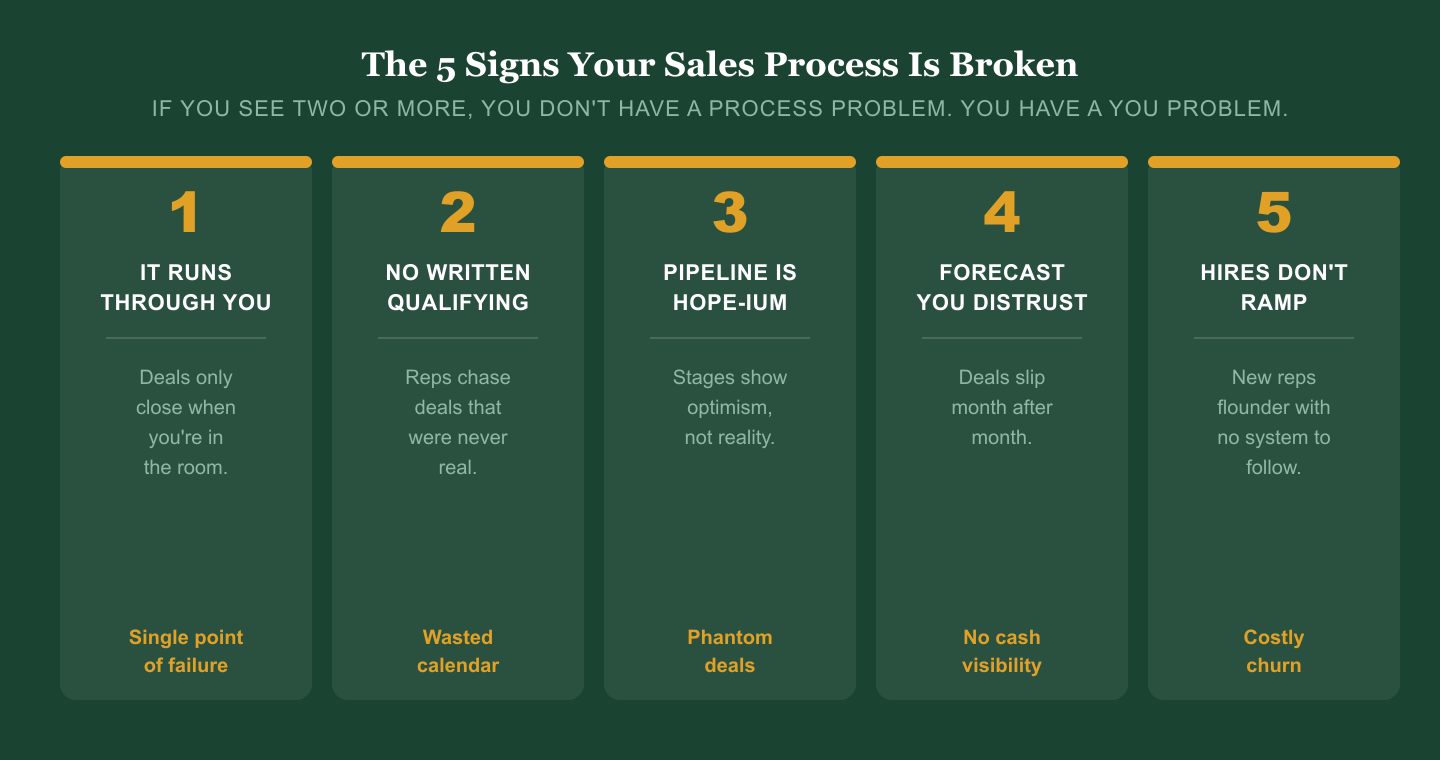
So how do you know if you're there? You don't have to guess. There are five signs, and if two or more of them describe your business, you don't have a process problem. You have a you problem. And that's fixable.
The 5 Signs, Read One by One
1. Every deal runs through you
Deals close when you're in the room and stall when you're not. Your reps loop you in for the "important" call, which is every call. If you took a two-week vacation with your phone off, revenue would go with you. That's not a strong founder. That's a business with a single point of failure, and the failure point is you.
2. Your qualifying isn't written down anywhere
Ask yourself a plain question: could a new rep read one page and know exactly what makes a deal worth pursuing? If the answer is no, your qualifying lives in your gut. You feel a bad-fit deal in the first five minutes. Your reps can't, because you never wrote it down. So they chase deals that were never real, and your calendar fills with prospects who were never going to buy. This is where 63% of losses come from, before anyone even assesses the need (Process Street). Qualifying is the highest-leverage fix in all of sales, and it's the first thing that disappears when the process lives in one person's head.
3. Your pipeline is hope-ium
Open your CRM. Are the deals in those stages because they earned their way in, or because someone felt good after a call? A broken pipeline is a wish list with dollar signs. The numbers back the fear: 30–40% of pipeline deals are phantom or already dead (Coffee.ai), and 79% of opportunity data never makes it into the CRM at all (ForecastIO). If your stages measure optimism instead of reality, every decision you make on top of them is built on sand.
4. You don't trust your own forecast
You say $200,000 will close this month, and quietly you brace for $120,000. Deals slip a month, then another. You can't plan hiring, inventory, or cash because the number is a guess. You're not alone in this. Only 7% of sales organizations hit 90% forecast accuracy or better (ForecastIO). But that stat is cold comfort. If you can't forecast, you can't run the company. You can only react to it.
5. Your hires don't ramp, they drown
You hired a rep to take work off your plate. Six months later they're still shadowing you, still missing quota, still asking what to do next. That's not always a bad hire. Usually it's a no-system hire. The average rep already takes 5.7 months to ramp, up 32% since 2020 (Alba Talent), and you're asking them to ramp on a process that only exists in your memory. Nobody can learn a system that isn't written down.
One of these signs is a busy week. Two or more, and you've hit the ceiling of your own calendar. No amount of hustle raises that ceiling. Only a system does.
Three More Warning Signs (and the Quick Test for Each)
The five signs above are about you. These three show up in the numbers, often months before revenue drops.
- Deals slip and nobody knows why. If every lost deal is “they went quiet” or “they needed more time,” your stages are tracking activity, not progress. Test: map your last ten lost deals. If you can’t find a single pattern, rebuild the stages around buyer milestones.
- Your best rep leaving would break the number. If one resignation would cost you more than 20% of the target, you have a person, not a process. Test: write down what your top performer does differently, and put it in the playbook and your coaching.
- You’re discounting to close deals that should win on value. Habitual discounting means the ICP is off, discovery isn’t tying price to ROI, or reps lack the tools to hold firm. Test: track discount rate by rep, segment, and stage. High in early-stage deals points to the process; concentrated in one rep points to coaching.
Why Hiring Your Way Out Usually Backfires
Here's the move most founders make when they recognize these signs. They decide to hire a VP of Sales, hand them the mess, and let the "expert" fix it. It feels responsible. It's usually the most expensive mistake in the sequence.
Run the math. A full-time VP of Sales costs $250,000 to $400,000 all in, and average tenure has fallen to roughly 17 to 19 months, often shorter than the sales cycle they were hired to fix. Now stack the rest on top: the average rep takes 5.7 months to ramp (Alba Talent), sales turnover runs about 35% a year, and each departure costs $115,000 to $150,000 to replace (industry benchmarks). You're pouring six figures into people, and handing every one of them the same broken, undocumented process to fail against.
A senior hire doesn't come with your process. They come with a process, usually the one that worked at their last company, which may have nothing to do with how your buyers buy. Meanwhile the knowledge that matters, your qualifying instinct and the reason your customers say yes, is still trapped in your head. You didn't fix the single point of failure. You paid $250,000 to move it to someone else's desk, and they'll take it with them when they leave in 18 months.
You can't delegate a process that doesn't exist. You can only build it first, then delegate it. Do it in that order, or you'll keep buying expensive people to run into the same wall.
The fix isn't more headcount. It's the documented system that makes headcount work. Build that first, and your next hire ramps against something real instead of drowning in your memory.
Broken vs. A Documented System
Same founder. Same product. Same market. The only thing that changes between a business that scales past you and one that stays chained to you is whether the sales process lives on paper or in your head. Here's what the two look like side by side.
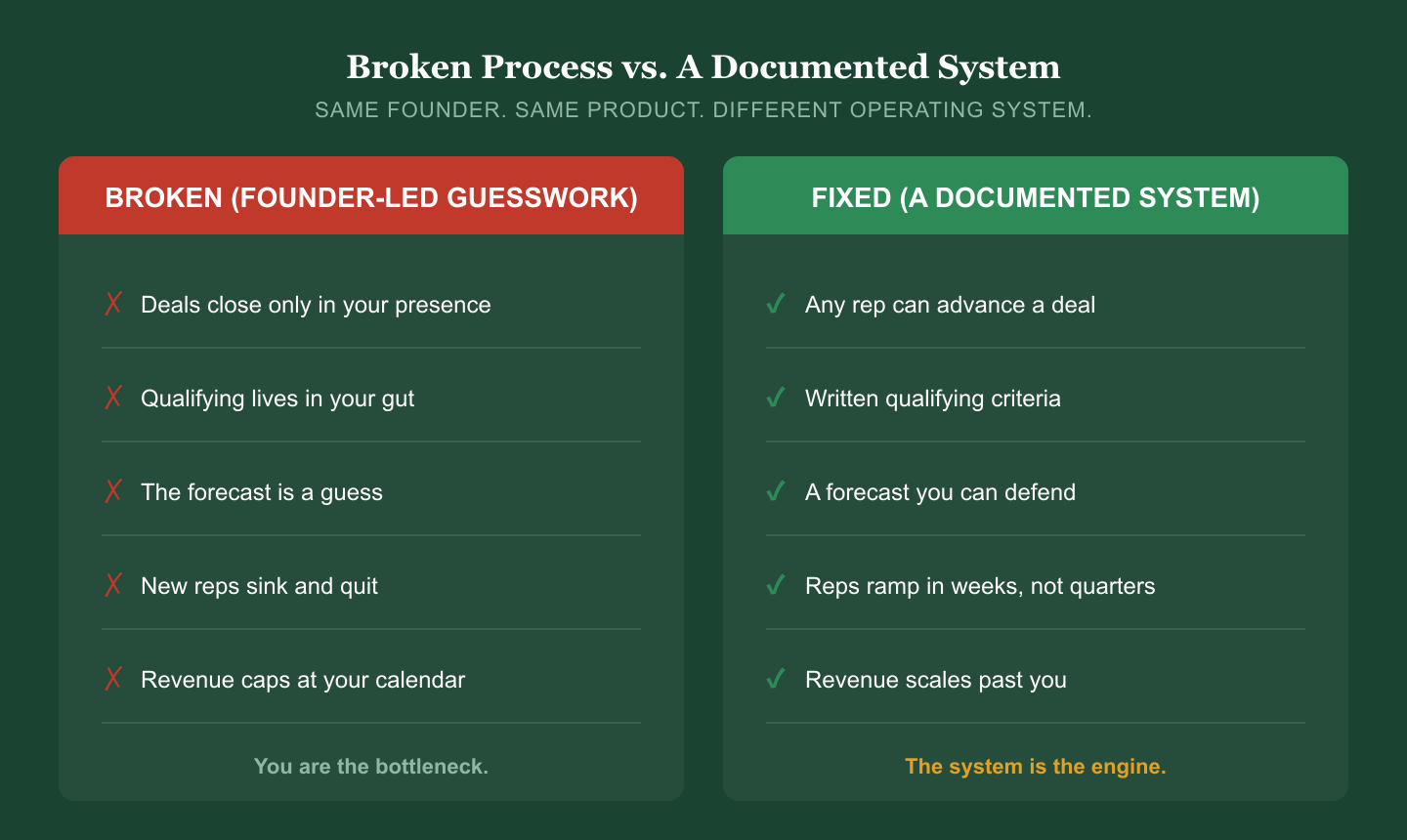
Look at the left column honestly. If most of it is your business today, that's not a verdict on you. You built real revenue on instinct, and that's harder than running someone else's playbook. But instinct doesn't transfer, and it doesn't scale. The right column is what a system gives you: the same selling that made you successful, written down so other people can run it and you can finally step out of the deals.
What a Fractional Sales Leader Fixes First (and Who It Won't Help)
This is the gap a Fractional Sales Leader fills. Not another body to manage, and not a six-figure bet on someone who leaves in a year and a half. Someone who's built these systems many times, works with you a few hours a week, and pulls the process out of your head and onto paper your team can actually run. When I work with a founder inside The Founder's Corner, we build it in a deliberate order, worst leak first:
- Qualifying, written down. The one-page standard for what makes a deal real, so your team stops chasing ghosts and you stop being the only filter. This is the 63%-of-losses fix, and it's first for a reason.
- Pipeline stages a prospect has to earn. Real entry and exit criteria for every stage, so the pipeline reflects reality instead of hope-ium, and the forecast starts meaning something.
- An Accountability Document for every role. A clear standard each person owns, so there are no surprises about who does what, and a hire has something concrete to ramp against.
- A weekly sales rhythm that inspects the work. The cadence that runs the team without you and flushes out hope-ium before it poisons the forecast.
- Your exit from the closing seat. A forecast you can defend, hires who ramp, and revenue that keeps coming when you step back. That's the whole point.
Now the honest part, because I'd rather tell you not to hire me than take your money for something that won't work. A lot of founders assume that having no process at all means they're too early for this. The opposite is true. No system is the normal starting point. Most founders I work with have their entire sales process living in their own head with nothing written down. That's exactly the condition this is built to fix. We start from zero on purpose.
So what doesn't it help? Two situations. First, if you haven't found product-market fit yet. If the product hasn't proven it has a buyer, there's nothing to systematize, and no sales structure fixes a product gap. Fix the product first. Second, if you're in full crisis and need someone hands-on in the business every day, running the floor, that's a different engagement than building a system a few hours a week. And if you want someone to just close your deals for you, that's not fractional leadership. That's relocating the founder trap onto another desk. Be honest with yourself about which situation you're in before you reach out.
Frequently Asked Questions
Q: How do I know if my sales process is broken or if I just had a slow month?
A slow month is a number. A broken process is a dependency. The test isn't your revenue, it's what happens when you step away from it. If deals stall the moment you're not in the room, if your qualifying and pipeline live only in your head, and if new hires can't ramp because there's nothing written to ramp against, the process is broken no matter how good this month looked. Two or more of the five signs in this article is the real signal, not a single slow month.
Q: Isn't founder-led sales a good thing at my stage?
It's a great thing, right up until it's the only thing. Founder-led sales is how nearly every company gets its first millions, and nobody sells your vision better than you. It becomes a problem when it's the sole engine at $1M to $10M ARR, because it caps growth at the size of your calendar. The goal isn't to stop founder-led selling. It's to document what you do so well that other people can do it too, and you're not the ceiling anymore.
Q: Why not just hire a VP of Sales to fix it?
Because you can't delegate a process that doesn't exist yet. A VP costs $250,000 to $400,000, stays about 17 to 19 months on average, and arrives with their last company's playbook, not yours. Hand them your undocumented mess and they'll spend six months guessing at what you already know, then leave and take it with them. Build the documented system first. Then a VP, or your existing reps, has something real to run. That's the order that works.
Q: I don't have any sales process at all. Am I too early for fractional help?
No, and this is the most common misread. Having no system isn't a disqualifier, it's the normal starting point. Most founders I work with walk in with their entire process living in their head and nothing written down. We build it from scratch, in order, worst leak first. The only genuine too-early signal is not having product-market fit yet. If the product hasn't proven it has a buyer, fix that before you build sales structure, because structure can't fix a product gap.
Q: What's the first thing a Fractional Sales Leader fixes?
Qualifying, almost always. It's the highest-leverage fix in sales, because 63% of losses happen before anyone assesses the real need (Process Street). We write down the one-page standard for what makes a deal worth pursuing, so your team stops chasing deals that were never real and you stop being the only filter. From there we build pipeline stages a prospect has to earn, Accountabilities Document for each role, and a weekly rhythm that inspects the work. Qualifying first, because everything downstream is cleaner once the junk is out.
Q: How long does it take to fix a broken sales process?
Some of it moves fast. Tighter qualifying and a cleaner pipeline can land in the first few weeks, because they mostly stop wasted effort. The bigger outcomes, a forecast you trust, hires who ramp, revenue that holds when you step back, build over about 12 weeks and keep compounding after. One founder I worked with grew sales 61% and turned their first profit in years within a year of building the system. That's not a first-session miracle. It's the payoff of documenting what you already do well.
Q: Can I fix a broken sales process while still trying to hit this quarter's number?
Yes, but run it in parallel. You can't stop selling to fix the process. Make two or three surgical changes that improve the most deals right now — tighter qualification, buyer-based stages, a weekly pipeline review — and build the rest of the system alongside them.
If two or more of those signs are your business, you don't need to hustle harder. You need a system.
The Founder's Corner is a 12-week program that pulls your sales process out of your head and turns it into something your team can run without you. No system yet is fine. That's exactly what we build. See how it works and whether it fits your situation.
See The Founder's Corner →Or book a 30-minute call and I'll tell you honestly whether your process is broken and whether I can help.
About the Author
Louie Bernstein
Fractional Sales Leader with 50 years of sales experience helping $1M–$10M ARR companies build scalable, repeatable sales systems. Founder of MindIQ (INC 500). LinkedIn Top Voice in Sales Management, Sales Operations, and Sales Coaching.