Key Takeaways:
- Multi-threading lifts win rates 130% on deals over $50K, and deals that close carry twice the buyer contacts of deals that don't (Gong, from 1.8 million opportunities). Single-threading is a self-inflicted wound.
- A B2B purchase now involves around 13 people across two or more departments (Forrester). Your one champion can't carry all of them, no matter how much they love you.
- The founder's superpower, one deep relationship, is also the founder's biggest deal-killer. When the deal reaches the CFO or IT who never met you, it dies quietly.
- You surface the committee with one question to your champion: "Who else has to be OK with this before it moves?" Then you map six roles: champion, economic buyer, decision maker, user buyer, blocker, and coach.
- Multi-threading isn't a personality trait, it's a process. Build it into your stages and your cadence so it happens on every deal, not just the ones where a rep happens to be well-connected.
Let me describe a deal you've had. You've got one great contact. They love the product, they love you, they say all the right things. You're sure it's going to close. Then it goes to "the team," or "leadership," or "procurement," and it evaporates. No, just... gone.
That deal didn't die because your product was wrong or your price was high. It died because it was single-threaded. You had one relationship in an organization that needed a dozen people to agree, and the moment your one person couldn't carry it any further, there was nobody else in the building on your side.
Here's the number that should change how you sell tomorrow: multi-threading lifts win rates 130% on deals over $50K (Gong). That's not a rounding error. That's the difference between a business that scales and one that lurches from lucky deal to lucky deal. This is the playbook.
Why One Contact Is a Conversation, Not a Deal
A deal with one contact isn't a deal. It's a conversation you're allowed to have. It feels like progress because someone's engaged and enthusiastic, but you're one job change, one reorg, or one skeptical boss away from zero.
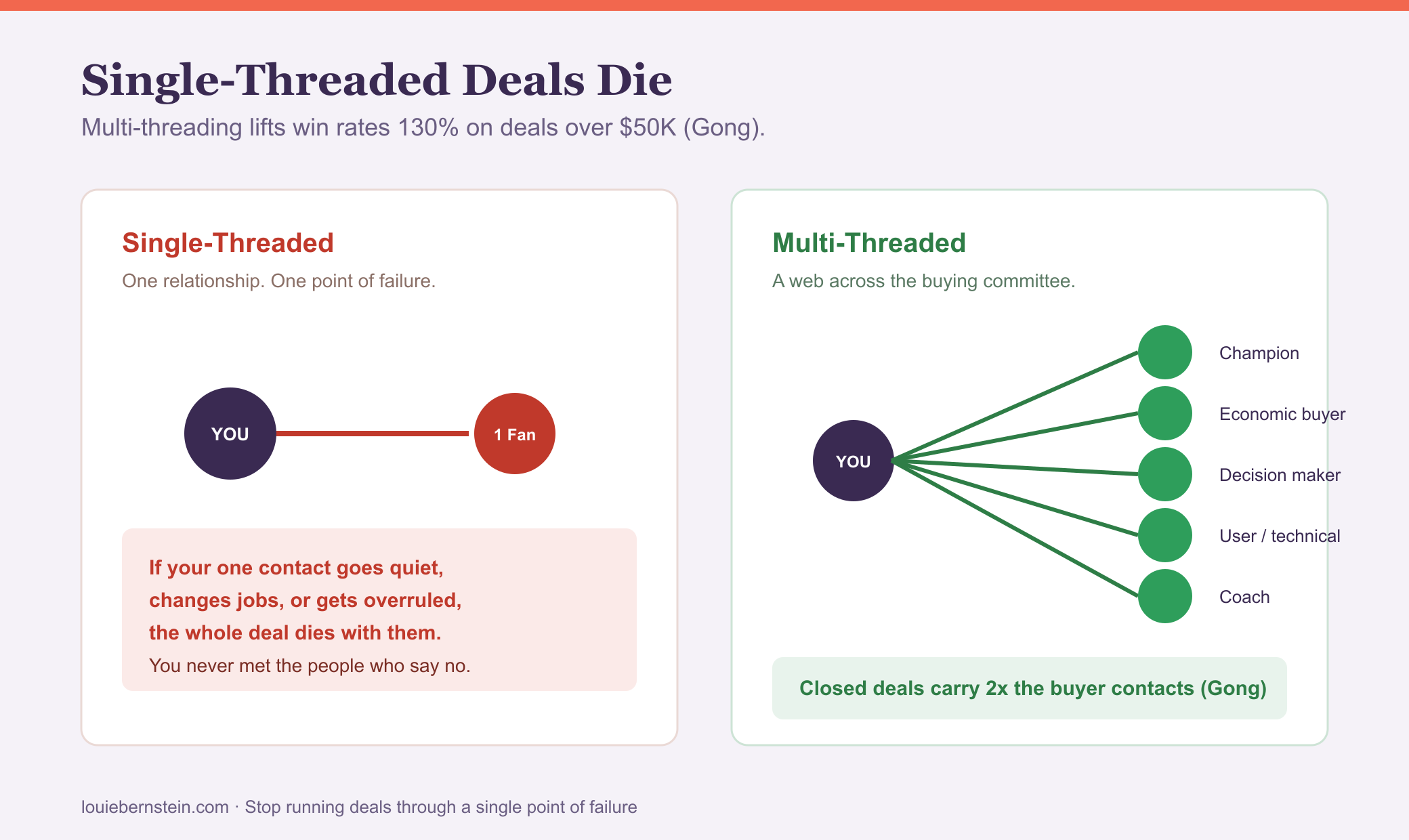
Think about how fragile that left side is. Your one contact goes quiet, or gets pulled onto another project, or leaves the company, and the whole deal walks out the door with them. You never met the people who actually control the money or could veto the purchase. You were running the entire deal through a single point of failure and calling it a pipeline.
One enthusiastic contact tells you the deal is possible. It never tells you the deal is safe. Safe comes from the second, third, and fourth relationship.
The 130% Win-Rate Gap Nobody Is Pulling
Gong analyzed 1.8 million opportunities and found two things worth tattooing on your forecast. First, multi-threading boosts win rates by 130% on deals over $50K. Second, the deals that close carry twice as many engaged buyer contacts as the deals that don't. Multi-threading isn't a nice-to-have. It's one of the largest, most reliable win-rate levers in all of B2B sales.
So why doesn't everyone do it? Because it's uncomfortable. Asking your happy champion to introduce you to their boss feels like you might rock the boat. Founders especially hate this, because the single relationship feels warm and safe. But the comfort is exactly the trap. You're trading a small moment of awkwardness now for a deal that quietly dies later.
If a deal is single-threaded, don't put it on your forecast. Not because it can't close, but because you have no way of knowing if it will.
The Champion Question That Surfaces the Buying Committee
You don't multi-thread by cold-emailing random people at the account. You do it through your champion, with one question that reframes the whole conversation: "Who else has to be OK with this before it moves forward?"
Notice what that question does. It's not "can I talk to your boss," which puts your champion on the defensive. It's a collaborative question that treats getting internal buy-in as a shared problem you'll solve together. A good champion will name three or four people immediately, and now you have a map. Follow it with: "What's the best way to get them the information they'll need?" Now your champion is helping you multi-thread instead of guarding the gate.
If your champion won't name anyone or won't make introductions, that's not a small thing. It's a signal the deal is weaker than it looks, or that your "champion" isn't one. Better to learn that in week two than in the lost-deal review.
Mapping 13 Stakeholders Without Losing the Deal
Thirteen people sounds overwhelming, and you don't need a personal relationship with all of them. You need to know who they are and cover the six roles that actually decide the outcome. Map these:
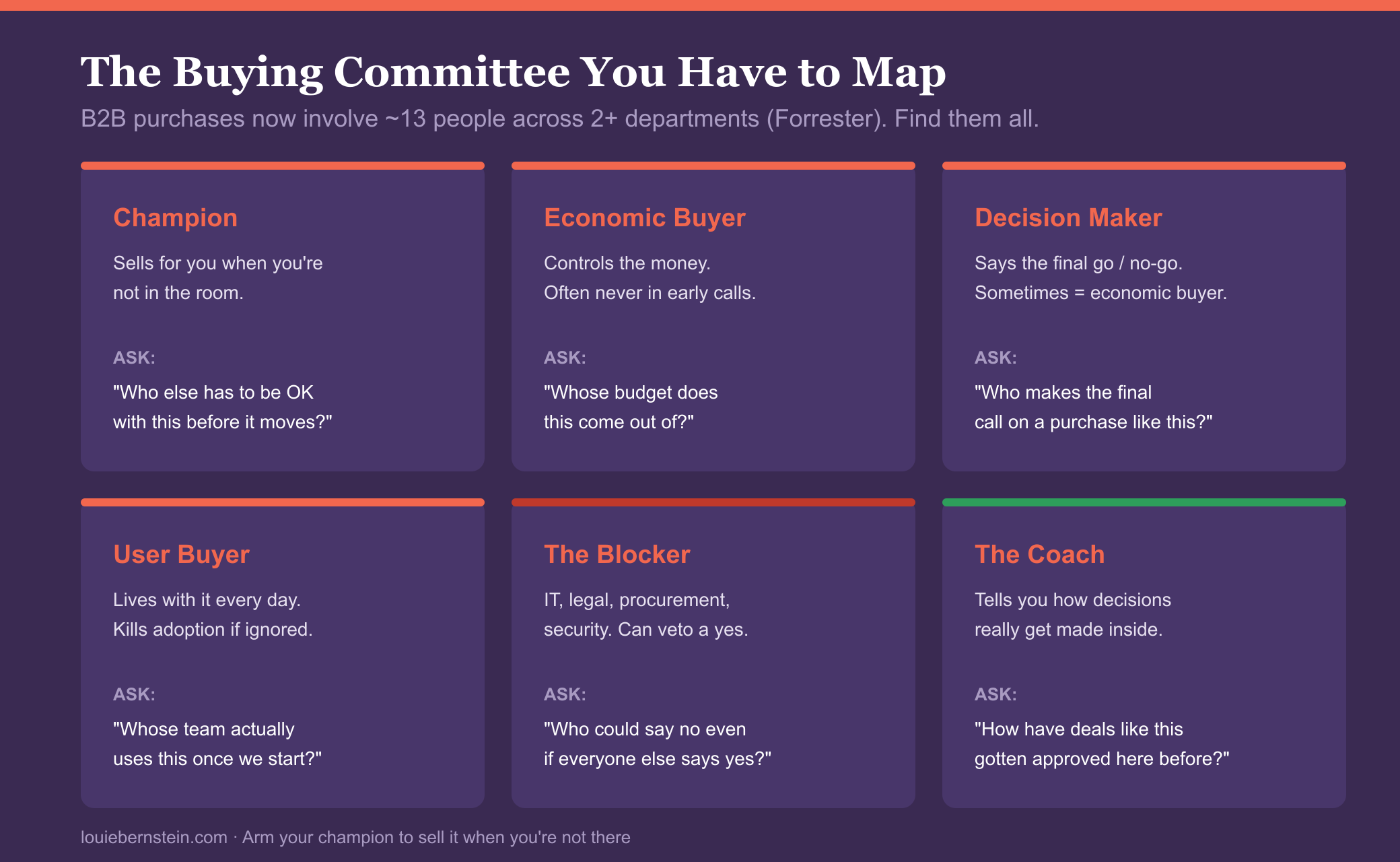
The two roles founders miss most are the blocker and the coach. The blocker is the person who can veto a yes, IT, legal, security, procurement, and who was never in your sales calls because your champion didn't think to include them. The coach is someone who'll quietly tell you how decisions actually get made inside the company. Find those two early and you'll stop losing "won" deals in the last mile. And remember: the economic buyer, the person whose budget this comes out of, often never appears in early conversations. If you haven't engaged them by the time you're talking price, the deal is single-threaded no matter how many demos you've given.
Arming Your Champion to Sell Internally
Here's the part most people skip. Most of your deal happens in rooms you're not in. Your champion is pitching your solution in a hallway, on a Slack thread, in a budget meeting, and if you haven't given them the words and the numbers, they'll do it badly. Not because they don't care, but because selling isn't their job.
So arm them. Give your champion a short, forwardable business case: the problem in their words, the cost of not solving it, what success looks like, and the three objections their colleagues will raise with your answers already attached. Make it so easy that your champion can copy, paste, and look smart. When you arm the champion, you're multi-threading even in the rooms you can't enter.
A champion who loves you but can't defend the business case will lose the deal for you internally. Your job is to make them dangerous in a meeting you'll never attend.
Building Multi-Threading Into Your Process, Not Your Luck
The reason multi-threading doesn't happen isn't that people don't believe in it. It's that it's left to chance, to whether a given rep happens to be well-connected or bold enough to ask. Take it off luck and put it into your system:
- Make it an exit criterion. No deal advances past qualification until at least a second contact is engaged. This ties directly to giving your stages real exit criteria, the stage itself enforces it.
- Track contacts per deal. Put a "buyer contacts engaged" field on every opportunity. If it says one, the deal is at risk, full stop.
- Ask the champion question every time. "Who else has to be OK with this?" becomes a required part of discovery, not an afterthought.
- Build the champion kit once. Create a reusable internal business-case template so arming the champion takes ten minutes, not an hour.
- Inspect it in pipeline review. When a rep says a deal is strong, ask "how many contacts?" A single-threaded "strong" deal isn't strong. It's lucky, and luck doesn't forecast.
If you're a founder still doing all the selling, this is doubly important, because your single relationships are the most single-threaded of all. You sell on charisma and trust, which works right up until the deal meets someone immune to both. Building multi-threading into a repeatable process is exactly the kind of system a Fractional Sales Leader installs for $1M to $10M ARR companies, without the cost of a full-time VP of Sales. And if you've got no process at all yet, start here: put a second contact on every real deal this week. It's the single highest-return habit you can build.
Frequently Asked Questions
Q: What is multi-threading in sales?
Multi-threading means building relationships with several stakeholders inside a buying organization instead of relying on one contact. It matters because a modern B2B purchase involves around 13 people (Forrester), and multi-threaded deals win at much higher rates, 130% higher on deals over $50K, according to Gong. A single-threaded deal runs through one point of failure; multi-threading spreads the risk and gives you allies in rooms you're not in.
Q: How do I multi-thread without going around my champion?
You go through the champion, not around them. Ask, "Who else has to be OK with this before it moves forward?" It frames internal buy-in as a shared problem, not a threat. Then ask how best to get those people the information they need. A real champion will make introductions gladly. If they resist, that's valuable data: the deal is weaker, or the person isn't the champion you thought.
Q: Who are the key roles in a buying committee?
Six roles decide most B2B deals: the champion (sells for you internally), the economic buyer (controls the budget), the decision maker (the final go/no-go), the user buyer (lives with it daily), the blocker (IT, legal, or procurement who can veto), and the coach (tells you how decisions really get made). You don't need a deep relationship with all 13 people, but you do need to cover these six roles.
Q: What does it mean to "arm" a champion?
It means giving your champion everything they need to sell your solution when you're not there: the problem in their words, the cost of inaction, what success looks like, and the top objections their colleagues will raise with answers attached. Most of a deal happens in meetings you'll never attend. If your champion can't defend the business case, they'll lose it for you. Make them easy to say yes to.
Q: Should I put a single-threaded deal on my forecast?
No. Not because it can't close, but because you have no reliable way to predict whether it will. A single contact can go silent, change roles, or get overruled by people you've never met. Keep single-threaded deals off the committed forecast until you've engaged at least a second and ideally a third stakeholder. Making that a rule is one of the fastest ways to make your forecast trustworthy.
Q: I'm the founder and all the relationships are mine. How do I start?
Start with your most important open deal and add one contact this week. Ask your main contact the champion question and get one introduction. Then make it a rule going forward: no deal is "real" until a second person is engaged. Founder relationships are the most single-threaded of all because they run on personal trust. Turning that into a multi-threaded process is a core part of making your sales scalable and, eventually, handoff-ready.
Running deals through one contact? Let's fix that.
In 30 minutes I'll map the buying committee on your biggest open deal, show you who's missing, and hand you the champion script and business-case template to multi-thread it. See how a Fractional Sales Leader can help at louiebernstein.com.
Schedule a 30-Minute CallAbout the Author
Louie Bernstein
Fractional Sales Leader with 50 years of sales experience helping $1M–$10M ARR companies build scalable, repeatable sales systems. Founder of MindIQ (INC 500). LinkedIn Top Voice in Sales Management, Sales Operations, and Sales Coaching.