Key Takeaways
- The founder moves from regular closer to escalation support and executive sponsor.
- Write the triggers before a big deal gets into trouble.
- Set your deal-size line from your own contracts, revenue exposure, and delivery risk.
- A request for approval doesn't always require a founder sales call.
- The rep runs the meeting, sends the follow-up, and stays the deal owner in the CRM.
- Review repeated escalations to find missing rules and coaching needs.
You're drowning in deals, but you're afraid revenue will drop the day you stop owning them. Then a rep brings you a large opportunity with a difficult buyer. Your calendar opens up, and you're back in the closer seat.
That fear deserves a practical answer. A company can't treat every unusual deal as routine. But it also can't teach buyers and reps that the founder takes over whenever the conversation gets hard.
Stepping out of sales doesn't mean disappearing. Write down exactly when you come back in, who can request your help, and what you'll do. Step in by rule, not by anxiety. Your reps keep owning their deals.
Your presence can support the deal without transferring the deal back to you.
1. Define What Actually Requires the Founder
Separate difficult selling from company decisions
An objection isn't automatically an escalation. Neither is a slow reply, a competitor's lower quote, or a rep who hasn't asked the buyer about the decision process. Those are selling and coaching problems.
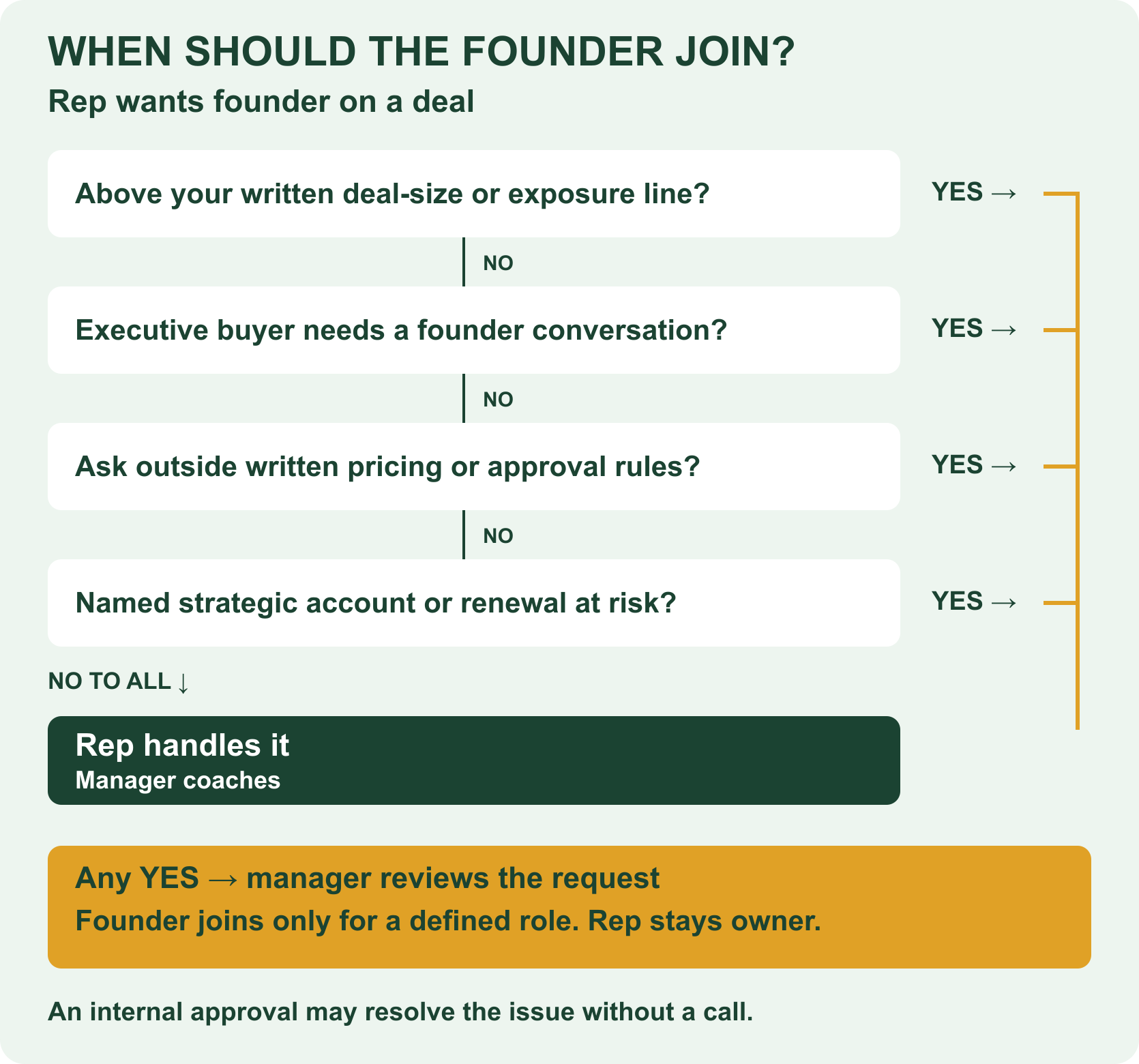
Founder involvement makes sense when the company needs your authority, your relationship, or a commitment only you can make. Start with four possible triggers: unusual revenue exposure, an executive buyer requesting founder access, an exception beyond delegated authority, and a named strategic account or renewal at risk.
Each trigger earns a review. It doesn't automatically earn a meeting. A discount approval might take one internal decision. A buyer's concern about company direction might need a conversation. Don't confuse those two jobs.
Ask one question before accepting the invitation: “What changes for the buyer because I'm there?” If the answer is only “they'll take us more seriously,” ask what the rep has learned about the actual concern.
Set your own deal-size line
There's no universal dollar cutoff for a founder call. Review your recent won contracts, your normal contract range, and the exposure a large agreement creates. Include delivery commitments and customer concentration, not just bookings. The Founder Bottleneck Scorecard helps you measure current dependence before choosing where your involvement belongs.
Decide which opportunities require leadership review because they sit outside that normal range. Write the measurement down. Annual contract value, total contract value, and expected gross profit tell different stories. Choose the measure that fits your business and use it consistently.
Test the proposed line against recent deals. Would it have flagged decisions you needed to make? Would it have sent nearly every opportunity to you? Adjust before adopting it. A line that captures everything gives your reps no room to work.
Define “strategic” before the logo appears
A familiar company name isn't enough. A strategic account might open a market you've already chosen, require an important partnership, or create delivery exposure beyond normal approvals. Write the reason in the CRM.
For a renewal, identify the revenue at risk, the customer's stated concern, the decision date, and who owns recovery. The founder may need to make a company commitment. The account owner still coordinates the work with delivery and customer success.
Don't let “strategic” become a way to skip qualification. A large logo without a funded problem or an approval path still needs discovery.
2. Give Requests One Clear Route
Let reps raise concerns early
The rep should be able to flag a risk without being accused of failing. Waiting until the buyer's deadline leaves everyone with fewer choices. Require evidence, but don't make the request so hard that people hide problems.
Use the sales manager as the first reviewer. If you have a Fractional Sales Leader running the team, that person can review requests and decide what needs your involvement. If you're still the only manager, use the same written checklist yourself.
The reviewer decides among three actions: coach the rep, get an internal approval, or request a founder conversation. Put the approval limits and routing responsibility in the Accountabilities Document.
Require a short brief
Before a founder meeting, the rep records the trigger, the buyer's concern in their own words, what has already been tried, and the exact help requested. Include the next buyer decision and its date.
“Can you help close this?” isn't a brief. “The buyer's CEO wants to understand our implementation commitment before approving the contract; I need you to explain who can authorize resources” gives you a job.
Agree on a response time your team can meet. Name a backup if the reviewer or founder is unavailable. For urgent requests, define the direct contact route and require the rep to record the decision afterward. Urgency can shorten the route without erasing accountability.
Keep approval separate from attendance
If the issue is a price exception, the rep needs a decision and its limits. The buyer doesn't necessarily need to meet you. Tell the rep what is approved, what conditions apply, and when the approval expires.
If the issue is technical feasibility, bring the person who can answer it. Founder attendance doesn't replace an answer from delivery or engineering. Your role may be to approve a company commitment after those people have checked it.
This keeps your calendar focused on work that requires you. It also teaches the rep that asking for help is part of owning the deal.
3. Show Up as an Assist, Then Hand the Conversation Back
Agree on your role before the call
The rep prepares the agenda and names your part: executive reassurance, an approved commercial decision, a company commitment, or a relationship conversation. Decide when you'll speak and what you won't promise without review.
Don't start with a fresh product pitch because you enjoy telling the founding story. The buyer may have already heard it. Ask the rep what the buyer understands and which question remains unanswered.
Rehearse the opening. The rep can say, “I'll run our discussion and next steps. I've asked our founder to join for your questions about our commitment to this rollout.” That gives the buyer access without making the rep disappear.
Let the rep run the meeting
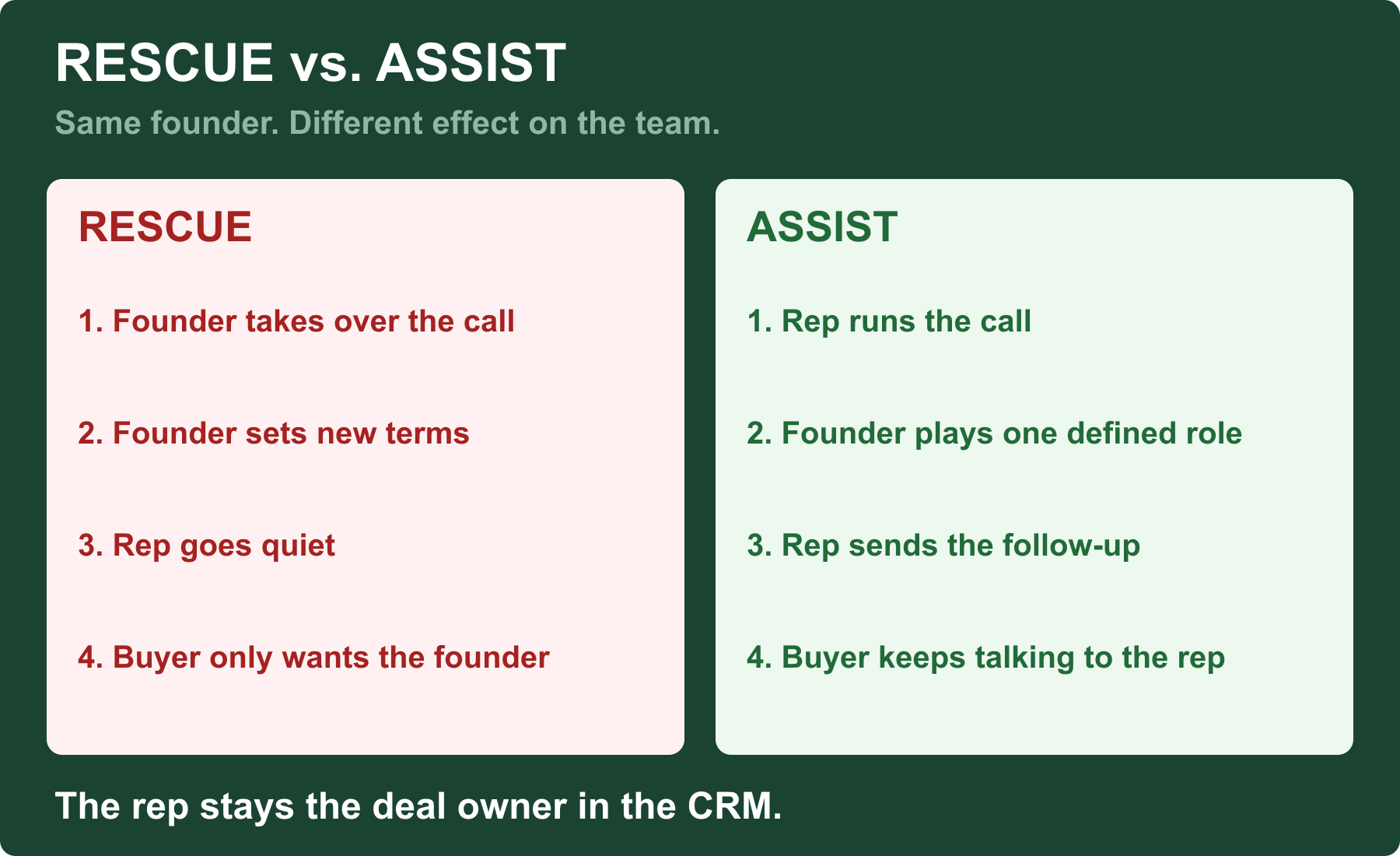
The rep opens, confirms the purpose, brings you into the agreed topic, and returns to the buyer's next step. You answer the question you came to answer. Then you hand the conversation back by name.
If the buyer asks for a new term, avoid making a promise just to keep momentum. Say the team will check it and return with an answer. A founder's casual agreement can create work or risk the rest of the company hasn't accepted.
If you hear a coaching issue, make a note for the debrief. Unless a material error needs correction, don't interrupt every awkward pause. A rep can't learn to lead a meeting while you keep taking the microphone.
Keep the rep visible after the call
The rep sends the recap, records decisions, and owns the next action. Copy you when it serves a purpose. Don't start a separate email thread with the buyer that the rep can't see.
If a buyer contacts you directly, respond with the rep included. “I'll help with that decision. Taylor is coordinating the agreement and will confirm the next step.” Then make sure Taylor has the information needed to act.
The deal owner stays the same in the CRM. Founder participation is recorded as support. Salesforce's opportunity-team guidance includes executive sponsor as a team role. You can use that distinction even if your CRM only has a notes field.
The call isn't finished until the buyer knows who owns the next step.
4. Put a Copyable Escalation Rule in the Sales Playbook
Start with this sample
Adapt the brackets before using this rule. It is a starting policy, not an industry standard.
- Triggers: Request review when a deal exceeds [our defined size or exposure line], an executive buyer requests founder involvement for a stated business concern, an ask exceeds written approval limits, or a documented strategic account or renewal faces a specific risk.
- Request: The rep records the trigger, buyer concern, deadline, attempted actions, and requested founder role in the CRM. The rep recommends a next step.
- Review: [Named manager or Fractional Sales Leader] decides whether coaching, internal approval, or founder attendance is needed. The reviewer responds within [agreed time], with [named backup] covering absences.
- Urgency: If a buyer deadline arrives before normal review, use [direct contact route]. Record the decision and supporting facts in the CRM afterward.
- Call: The rep runs the agenda. The founder handles one agreed topic. New terms stay within written authority or return for review.
- Ownership: The rep remains the CRM deal owner, sends the follow-up, and coordinates the next buyer action. Founder messages include the rep.
- Review afterward: The manager checks the result, the founder's time, and whether the request revealed a missing rule, capability, or qualification step.
Practice the rule before you need it
Role play a request that qualifies and one that doesn't. Have the rep explain the buyer's concern, recommend an action, and introduce you. Then practice a buyer who asks you directly for a discount.
Check the hand-back too. Can the rep close the meeting with a named action, owner, and date? Can they write the recap without asking you to reconstruct the call?
Store the rule beside pricing authority and deal-review guidance in the Sales Playbook. A policy nobody can find won't help when a buyer gives your rep a deadline.
5. Review Escalations Without Reclaiming the Pipeline
Track why you joined and what changed
Use your existing pipeline meeting. Review the trigger, founder time, buyer outcome, and next step. Check whether the rep still owns the communication. A signed deal can hide a broken handoff if the buyer now calls only you.
Look at the share of qualified opportunities that needed founder attendance, alongside the reasons. Compare similar deal types and stages. A week with several unusual contracts doesn't prove your reps have gone backward.
Don't judge success only by win rate. Escalated deals often carry different risks from routine deals. Ask whether your involvement resolved the stated issue and whether the team stayed accountable afterward.
Turn repeated requests into better rules
Repeated discount requests may reveal unclear authority or weak value conversations. Repeated delivery questions may need better discovery and earlier input from delivery. Repeated executive reassurance may mean your team needs approved evidence about company commitments.
Fix the source. Update one rule, teach it, and watch whether the next similar deal moves without you. Keep a legitimate escalation path open while building the team's ability to handle more work. For a wider check of missing responsibilities, review What Breaks First When a Founder Steps Out Too Early.
The founder never fully leaves sales. You move from regular closer to escalation support and executive sponsor. That role has boundaries. You contribute where your authority matters, while the rep keeps doing the job you hired them to do.
Related ReadingHow to Stop Being the Person Who Closes Every Important Deal →
Frequently Asked Questions
When should a founder join a sales call?
Join when a reviewed issue requires your authority, relationship, or company commitment. Set written triggers and define your part before the meeting. A difficult objection alone is a reason for coaching, not automatic founder attendance.
What deal size should trigger escalation?
Use your own contract history, normal deal range, revenue concentration, and delivery exposure. Choose a consistent measure and test the proposed line against recent deals. There is no dollar threshold that fits every B2B company.
What if the buyer insists on meeting the founder?
Ask what they need to discuss. A concern about company direction or a major commitment may justify a meeting. Explain that the rep continues to coordinate the deal, and bring the conversation back to that person after your part.
Who owns the opportunity after the founder joins?
The rep remains the deal owner in the CRM and manages follow-up. Record the founder's supporting role and any approvals. If ownership truly needs to change for another reason, make that a separate, explicit management decision.
Should the founder approve every discount?
No. Write approval limits that fit your margins and commercial policy. Route requests outside those limits to the designated approver. Approval can happen internally without putting the founder on a buyer call.
How can a Fractional Sales Leader help?
A Fractional Sales Leader can write the escalation rule, clarify authority, review requests, and coach reps before and after calls. The aim is to protect important decisions while helping the team manage its own deals.
Give your team a clear rule for bringing you in.
If every difficult deal still lands on your calendar, Fractional Sales Leadership can help you define authority, coach your reps, and keep ownership clear. Learn more at LouieBernstein.com.
Schedule a 30-Minute CallAbout the Author
Louie Bernstein
Louie Bernstein is a Fractional Sales Leader and the founder of MindIQ. He helps B2B founders build repeatable sales systems through Sales Playbooks, clear sales processes, pipeline management, and coaching.