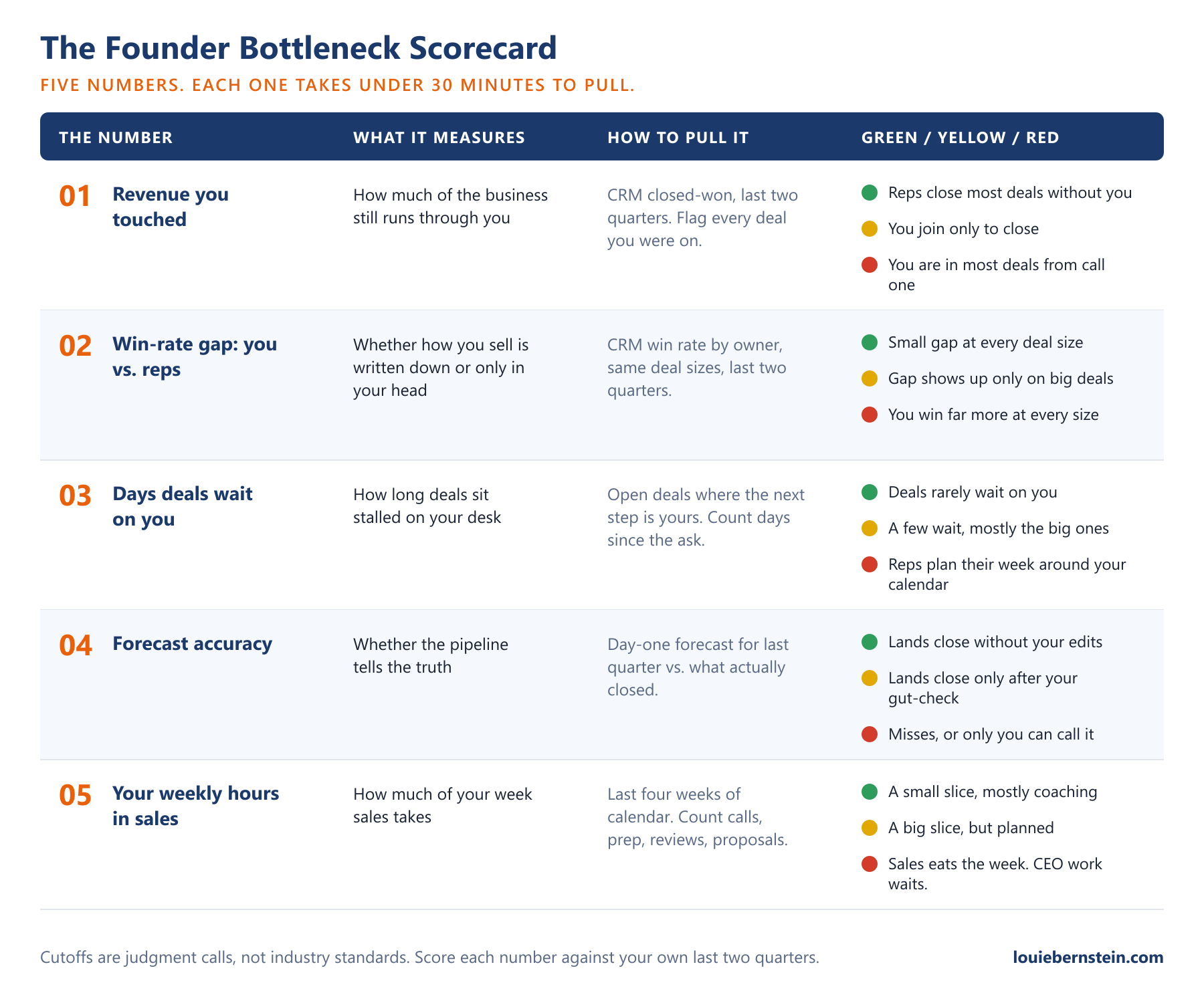
You know it's time to stop closing when five numbers say so, not when you feel buried. Pull the share of closed revenue you touched, the gap between your win rate and your reps', the days deals sit waiting on you, last quarter's forecast against what closed, and your weekly hours in sales. The first, third, and fifth show how much the business depends on you. The second and fourth show whether the system can run without you.
Key Takeaways:
- Feeling overwhelmed tells you that you're busy. It doesn't tell you whether it's safe to step out.
- Five numbers do: revenue you touched, your win-rate gap, days deals wait on you, forecast accuracy, and your weekly hours in sales.
- Each one comes out of your CRM or your calendar in under 30 minutes. If it isn't in the CRM, it never happened, so a missing number is a finding too.
- Three numbers measure how much the business depends on you. Two measure whether the system is ready to run without you.
- High dependence plus a weak system is the danger zone. Step out there and revenue drops. Build first, then step out.
- Only 45% of sales leaders and sellers have high confidence in their forecast (Gartner, 2020). If yours only works after your gut-check, the system isn't ready yet.
Here's the tension I hear from founders every week. "I'm drowning in deals. But I'm terrified revenue drops the day I stop owning them."
Both halves of that sentence are true. You are drowning. And revenue might drop. The problem is that most founders try to settle it with a feeling. One bad week and they want out. One lost deal after a hand-off and they take everything back.
Feelings swing. Numbers don't. When you're tired, you'll step out too early. When you're scared, you'll stay too long. Both cost you money.
So let's replace the feeling with a scorecard. Five numbers. You can pull all of them this week from your CRM and your calendar. When you're done, you'll know which of two things to do: step out now, or build the system first and step out later.
This is the first article in a four-part series on stepping out of the closer seat. It's the diagnosis. The rest of the series covers what breaks, how to hand off, and when you should still step in.
“Feeling buried tells you you're busy. It doesn't tell you it's safe to leave.”
How do you score yourself before you stop closing?
Score yourself by pulling five numbers from the last two quarters and rating each one green, yellow, or red. Use real records, not memory. Give each number 30 minutes or less. If you can't pull a number at all, score it red. A number you can't find means the system doesn't exist yet.
One warning before you start. I'm not going to give you industry cutoffs for these, because there aren't good ones for a company your size. Where I give a line, it's my rule of thumb from 50 years in sales. Your own trend over two quarters matters more than any line I draw.
Number 1: How much of your closed revenue did you personally touch?
This is the share of closed-won revenue where you took part in the sale, not just the share you closed alone. It matters because it shows how much of the business runs through you. If most revenue needed you somewhere in the deal, then stepping out takes that revenue with you.
How to pull it
Export closed-won deals from the last two quarters. Add one column: "Founder involved?" Mark yes if you ran a call, wrote the proposal, set the price, or made the closing call. Then add up the dollars marked yes and divide by total closed revenue. Your calendar will fill in the gaps your CRM missed.
What it tells you
Count "touched," not "owned." Plenty of founders let reps own the deal in the CRM while they quietly run every big call. That's the shadow pipeline, and it hides dependence. My rule of thumb: if you touched more than half the revenue, the business depends on you, no matter whose name is on the deals.
Number 2: How big is the gap between your win rate and your reps'?
This is your win rate on qualified deals compared with your reps' win rate on deals of the same size. It matters because it shows whether the way you sell is written down or still lives in your head. A big gap means the method is yours. A small gap means the method is the company's.
How to pull it
In your CRM, filter closed deals from the last two quarters by owner. For each person, divide deals won by deals won plus deals lost. Then split by deal size, because you probably take the biggest ones. Comparing your $80K deals to a rep's $15K deals tells you nothing.
What it tells you
A gap only on big deals is normal and fixable. A gap at every deal size means your reps don't have what you have: the questions, the qualifying rules, the way you handle price. That's a playbook problem, not a people problem. My rule of thumb: if you win about twice as often as your reps on the same size deal, don't step out yet. Write down what you do first.
Number 3: How many days do deals sit waiting on you?
This is the number of days an open deal waits for your action: a price approval, a call, a contract review, a reply. It matters because waiting deals slip, and slipped deals lose. Ebsta and Pavilion found 44% of deals were pushed back, and win rates fell 67% when deals slipped (Ebsta/Pavilion, 2024).
How to pull it
List every open deal where the next step belongs to you. If your CRM has a next-step owner field, filter on it. If not, ask each rep one question: "Which of your deals are waiting on me, and since when?" Count the days from the ask to today. Then do the same for deals that closed last quarter by looking at your email and Slack.
What it tells you
This number shows the cost of you, not the value of you. Every day a deal waits, the buyer cools off and the rep loses face. Salespeople don't quit companies. They quit chaos. A rep who waits a week for your answer on every discount will find a company where they don't have to. My rule of thumb: a deal that waits on you more than two business days is a red flag. Several at once means you are the sales process.
“Your win rate shows what you add. Days-waiting shows what you cost. You need both numbers.”
Number 4: How close was last quarter's forecast to what actually closed?
This is the revenue you forecast at the start of last quarter compared with what actually closed. It matters because a forecast only works if the pipeline tells the truth without you. You're not alone if yours doesn't. Only 45% of sales leaders and sellers have high confidence in their forecast accuracy (Gartner, 2020).
How to pull it
Find the number you told your board, your partner, or yourself on day one of last quarter. Put it next to closed-won for that quarter. Then ask a second question: did that forecast come from the pipeline, or from you going deal by deal and adjusting the odds in your head?
What it tells you
Landing close isn't enough. If the forecast only lands after your gut-check, the system can't forecast. You can. Most forecasts fail because stages are opinions, not proof. Action-based stages fix that. A deal moves forward when the buyer does something, like booking a demo with the decision maker, not when the rep feels good. My rule of thumb: if you miss by more than about 15% either way, or nobody but you can call the number, score it red. I wrote more on this in why founders can't forecast.
Number 5: How many hours a week do you spend in sales?
This is the time you spend each week on sales work: calls, prep, proposals, pricing, deal reviews, and follow-up. It matters because every hour you sell is an hour you aren't doing the CEO work only you can do. It's also the number founders guess wrong most often, usually low.
How to pull it
Open your calendar for the last four weeks. Tag every block that was sales: prospect calls, internal deal reviews, proposal writing, pricing approvals. Add 30 minutes of prep and follow-up for each prospect call, because that time never makes it onto the calendar. Divide by four for your weekly average.
What it tells you
Look at what kind of hours they are, not just how many. Coaching a rep before a call builds the system. Running the call yourself replaces it. My rule of thumb: if sales takes more than half your week, you're not the CEO who sells. You're the sales department, and the CEO job is waiting. I covered what that costs in dollars in the true cost of staying the chief closer.
How do you read your five scores together?
Read your scores as two questions. Numbers 1, 3, and 5 answer "How much does the business depend on me?" Numbers 2 and 4 answer "Is the system ready to run without me?" Put those two answers on a grid and you get one of four places to stand, each with a different next move.
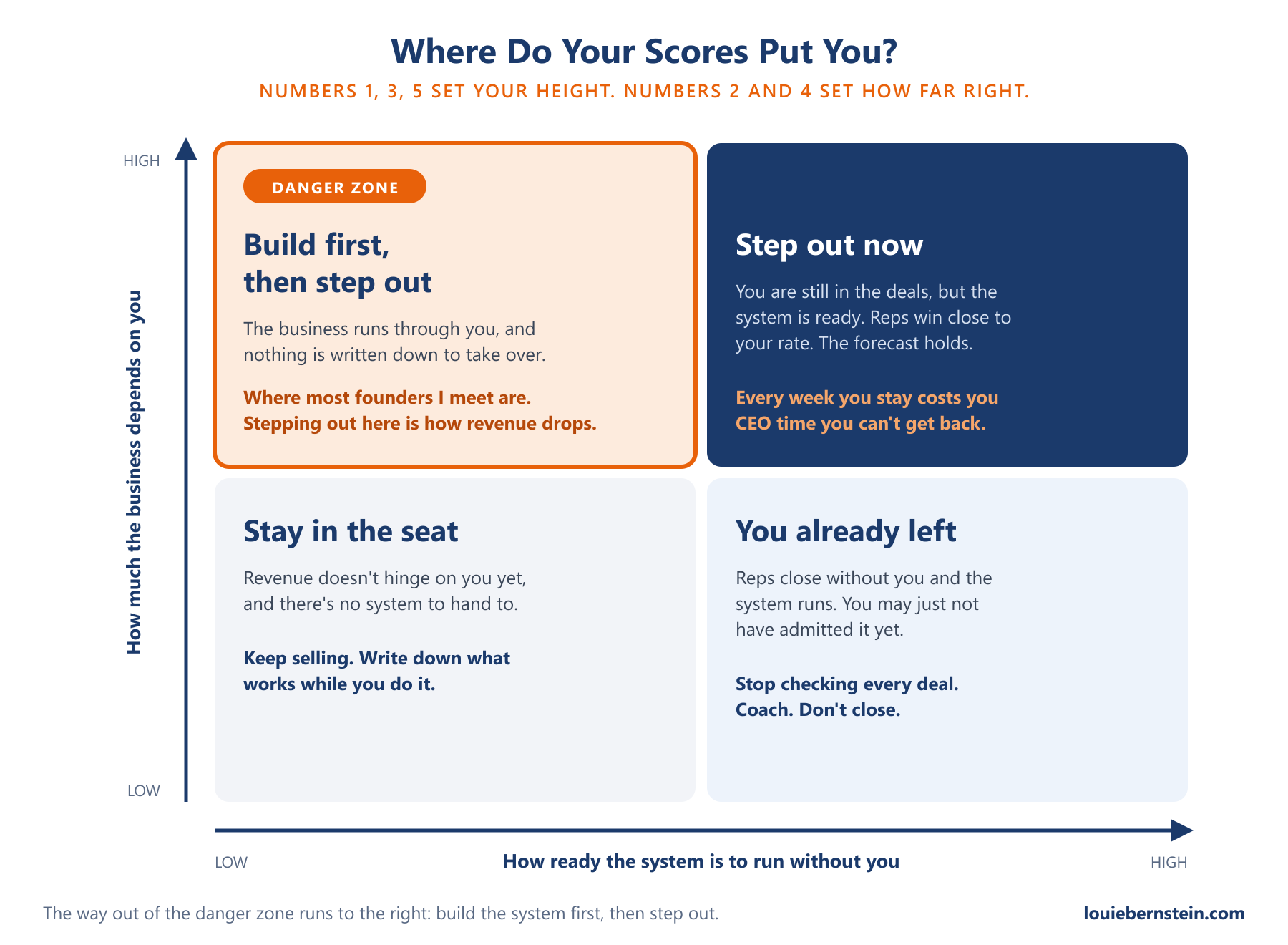
Build first, then step out (the danger zone)
Mostly red on 1, 3, and 5. Mostly red on 2 and 4. This is where most founders I meet are standing. The business runs through you, and nothing is written down for anyone else to run. If you step out from here, revenue drops, and you'll take sales back within a month. Your job is to build first: a written sales process, action-based pipeline stages, and clear rules for pricing and discounts. Then step out.
Step out now
Red on dependence, but green or yellow on 2 and 4. Your reps win close to your rate and the forecast holds without you. You're still in the deals out of habit. Every week you stay costs you CEO time. This is the founder who most needs a plan for the hand-off itself, because the risk now is the first bad week, not a missing system.
Stay in the seat
Low dependence, weak system. This is usually an earlier company where revenue doesn't hinge on you yet, and there's no system to hand to. Keep selling. But write down what works while you do it, so you're not starting from zero later.
You already left
Green on most of it. Reps close without you and the system runs. You may just not have admitted it yet. Stop reviewing every deal. Coach. Don't close.
“The danger isn't staying in the seat. It's leaving it before there's anything to hand off.”
What should you do after you score yourself?
After you score yourself, pick the one red number that's easiest to move and fix it first. Then pull all five numbers again next quarter. You're not trying to turn everything green at once. You're trying to move right on the grid, one number at a time, until stepping out is a decision the numbers have already made.
Here's where I'd start, based on your worst score:
- Red on win-rate gap. Record your next five sales calls. Write down the questions you ask and the moments you push or walk away. That's the start of your playbook.
- Red on days waiting. Write a one-page discount and pricing rule your reps can use without calling you.
- Red on forecast. Rewrite your pipeline stages so each one requires a buyer action to enter.
- Red on hours. Pick one deal type, like your smallest deals, and stop attending those calls this month.
In 22 years building MindIQ into an INC 500 company, the hardest lesson I learned was this. The founder's instinct has to become a document before anyone else can use it. The scorecard tells you how far you are from that.
The next article in this series covers what breaks first when a founder steps out too early, and how to spot each failure before it costs you a quarter.
Frequently Asked Questions
Q: What if my CRM data is too messy to pull these numbers?
Then you've found your first problem. If it isn't in the CRM, it never happened. Pull what you can from your calendar, email, and invoices, and score anything you can't find as red. Messy data almost always means deals live in your head, which is the dependence this scorecard is built to find.
Q: How often should I run the scorecard?
Run it once a quarter. The numbers move slowly, and one bad month can make them look worse than they are. Track your trend across two or three quarters. Moving right on the grid matters more than any single score.
Q: What if I only have one rep, or none?
You can still score numbers 1, 3, 4, and 5. For number 2, compare your win rate this year with last year, or score it red if no one else has sold yet. With no reps, you're almost always in "stay in the seat" or the danger zone, so the work is writing the system down before you hire.
Q: Isn't a big win-rate gap just proof that my reps aren't good enough?
Sometimes. But check deal size first, because founders usually take the best deals. If the gap holds at every size, ask whether your reps have what you have: the questions, the qualifying rules, the pricing calls. Most of the time the gap is a missing playbook, not a missing talent.
Q: Which of the five numbers matters most?
Win-rate gap and forecast accuracy, because they tell you whether the system can run without you. The other three tell you how much you're carrying. A founder with heavy dependence and a ready system can step out fast. A founder with a weak system can't, no matter how buried they feel.
Q: Can a Fractional Sales Leader help me score and fix these?
Yes. A Fractional Sales Leader pulls the five numbers with you, finds where you sit on the grid, and builds what's missing: the Sales Playbook, action-based stages, pricing rules, and a forecast that works without you. Then they run the hand-off so revenue doesn't drop when you step out.
Not sure where you land on the grid?
In 30 minutes we'll walk through your five numbers and decide whether you should step out now or build first.
Schedule a 30-Minute CallAbout the Author
Louie Bernstein
Fractional Sales Leader with 50 years of sales experience helping $1M–$10M ARR companies build scalable, repeatable sales systems. Founder of MindIQ (INC 500). LinkedIn Top Voice in Sales Management, Sales Operations, and Sales Coaching.