Key Takeaways:
- A founder's gut is genuinely a good forecast at first, because you're in every deal. That advantage collapses when there are more deals than one brain can hold, usually somewhere around $3M ARR.
- Only 45% of sales leaders have high confidence in their forecast (Gartner), and only 39% of companies see even half their reps hit quota (RepVue). Forecasting on feel is not a personal flaw. It's a system gap.
- A forecast is a promise you can plan against: hiring, cash, and growth all key off it. A pile of open deals is not a forecast. Your best month tells you almost nothing about next month.
- The fix is a repeatable system: defined stages, a win rate by stage, and deals sorted by real probability into commit, best case, and pipeline, not one number based on how you feel today.
- Predictable revenue starts with one number: your win rate by stage. Once you know it, your pipeline stops being a guess and starts being a forecast you can actually run a company on.
Let me start with something founders don't expect to hear from me: your gut forecast used to be right. When you were doing $800K and juggling a dozen deals, you knew every one of them cold. You could smell which would close. Your "feel" was a legitimately good forecast, because you were personally in every single deal.
Then you grew. More deals. A rep or two. Longer cycles. And one quarter, the number you "just knew" was going to hit came in 30% light, and you had no idea why. That wasn't you losing your touch. That was you hitting the ceiling of what one human brain can track.
You're in good company at the bottom of the confidence scale. Only 45% of sales leaders have high confidence in their own forecast (Gartner). The difference between the founders who break through and the ones who stay stuck isn't better instincts. It's trading gut feel for a system. Here's how to make that trade.
The Point Where "I Just Know" Stops Working
There's a specific moment where founder intuition stops being an asset and starts being a liability. It's when the number of deals in flight exceeds what you can personally hold in your head with any accuracy.
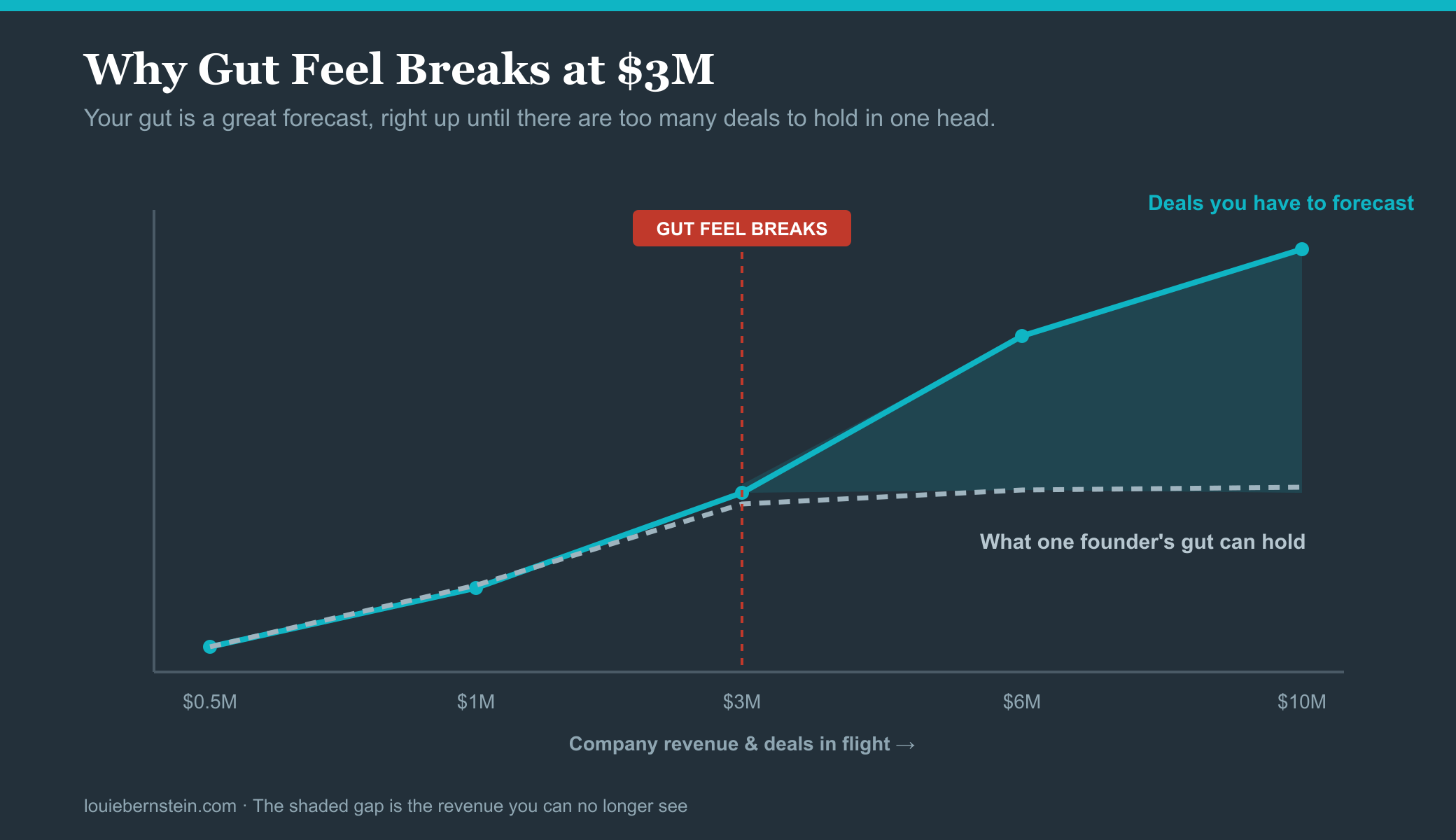
Look at the gap that opens up. Below the line, your gut kept pace with your deals. Above it, the deals kept multiplying and your mental model flatlined. That shaded area is revenue you can no longer see, deals slipping, stalling, or dying without you noticing until the quarter closes. For most founders this happens somewhere between $2M and $4M ARR. I use $3M as the marker, but the real trigger isn't a revenue number. It's deal volume outrunning your memory.
Gut feel isn't wrong. It just doesn't scale. The founder who could forecast a dozen deals cannot forecast fifty, and no amount of trying harder changes that.
What a Forecast Is Actually For
A lot of founders treat the forecast as a report card, a number they report to themselves or a board, and dread. That's not what it's for. A forecast is a planning tool. It's the number every other decision in your company keys off of.
When can you afford to hire that second rep? When do you sign the bigger lease? Can you fund the product roadmap out of revenue, or do you need to raise? Every one of those questions depends on knowing, with reasonable confidence, how much revenue is genuinely coming and when. A forecast you trust turns those from anxious guesses into decisions. A forecast you don't trust means you're flying your whole business on vibes.
That's why "I just know" is so dangerous past a certain size. It's not that your instinct is bad. It's that you're making seven-figure decisions on a number you can't actually defend, and when it's wrong, everything downstream, hiring, cash, growth, is wrong with it.
Why Your Best Month Tells You Nothing About Next Month
Here's a trap I see constantly. A founder has a monster month, three big deals land at once, and they extrapolate: "If we did $300K this month, we're a $3.6M run-rate business." Then next month is $90K and panic sets in.
Neither month means what you think. Without a system, your results are lumpy because your deals close when they happen to close, not on any predictable cadence. A great month often just means a few deals that were always going to close happened to land in the same 30 days. It tells you nothing about the health of what's behind them. Only 39% of companies see even half their reps hit quota (RepVue), and a big reason is exactly this: revenue that arrives in random clumps instead of a steady, forecastable stream.
A great month is a gift, not a forecast. If you can't explain exactly why it happened, you can't repeat it, and you certainly can't plan on it.
The Difference Between a Pipeline and a Forecast
This is the distinction that unlocks everything, and most founders blur the two. A pipeline is a list of every deal you're working. A forecast is what will actually close, by when, with what confidence. They are not the same thing, and confusing them is how you end up telling your board "$840K in the pipeline" and delivering $230K.
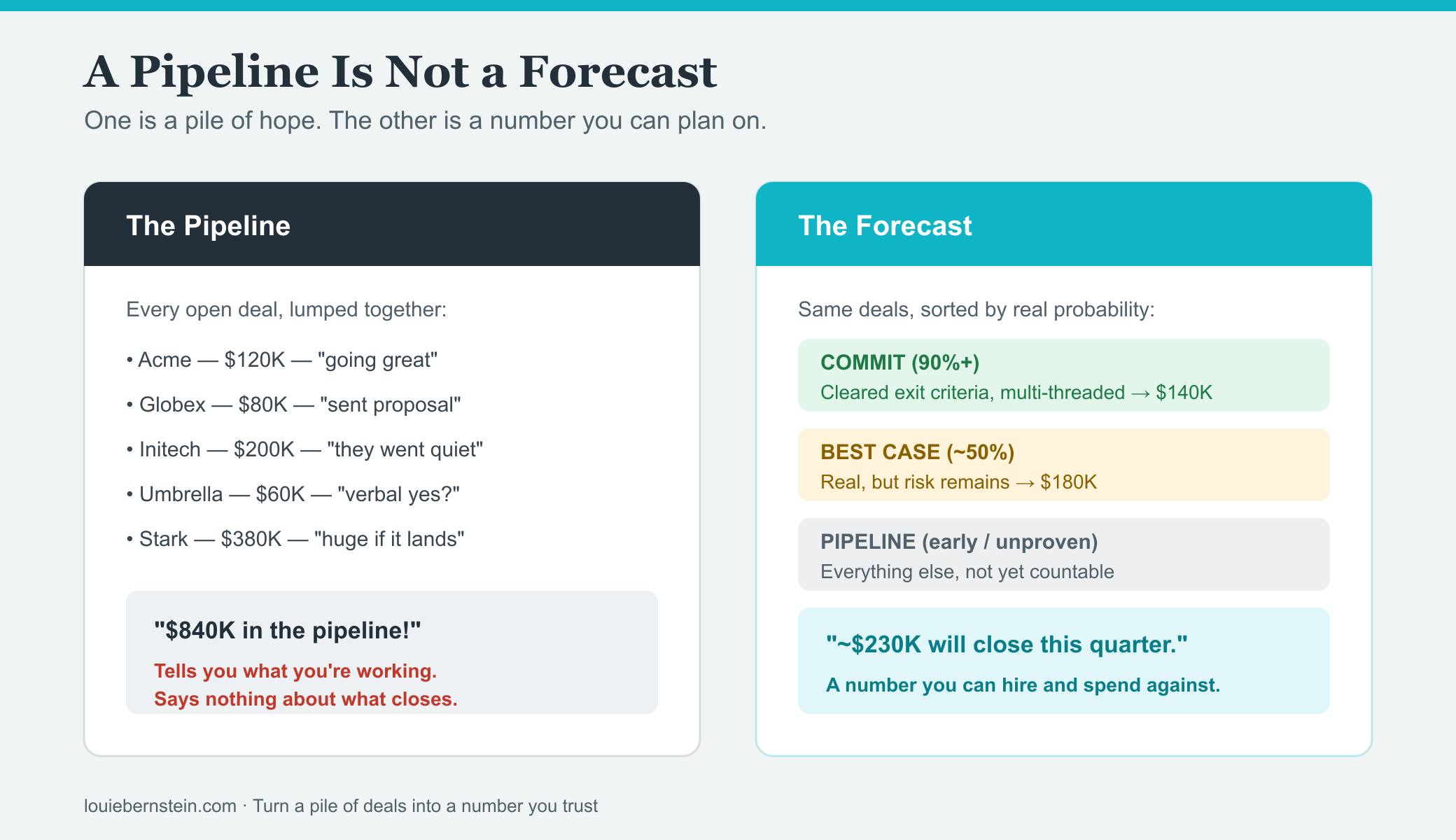
The pipeline on the left is a pile of hope. Every deal counts the same, the "going great" one and the "they went quiet" one, so the total is meaningless. The forecast on the right takes the exact same deals and sorts them by real probability: commit for the ones that have cleared their bar, best case for the ones that are real but still risky, and pipeline for everything too early to count. Now the number means something. This only works when your stages actually mean something, which is why giving your stages real exit criteria is the foundation under any forecast you can trust.
Random Wins vs. Repeatable Revenue
The deepest reason founders can't forecast is that, without a system, their wins are somewhat random. A deal closes because you personally charmed the buyer, or a warm intro happened to land, or timing was lucky. Those wins are real, but they're not repeatable, and you can't forecast what you can't repeat.
Repeatable revenue comes from a repeatable process: consistent qualification, defined stages, multi-threaded deals, and a known conversion rate at each step. When the process is repeatable, the output becomes predictable, and prediction is just forecasting by another name. This is also the same discipline that stops deals from silently dying in the middle, which I covered in why 86% of your deals stall. A stalling pipeline and an untrustworthy forecast are the same disease with two names.
The First Number That Makes Revenue Predictable
If you do only one thing after reading this, do this: figure out your win rate by stage. Of the deals that reach qualification, what percent close? Of the deals that reach a proposal, what percent close? That single set of numbers is the hinge everything else turns on.
Here's why it's so powerful. Once you know that, say, 40% of deals in your Validation stage close, then $500K sitting in Validation isn't $500K, it's $200K of forecastable revenue. Suddenly your pipeline converts into a forecast with actual math behind it. You can work backward from a revenue target to the pipeline you need. You can spot which stage is leaking. You can tell the difference between a slow month and a broken funnel.
Getting to that number, and building the stages and CRM discipline that make it trustworthy, is exactly what a Fractional Sales Leader installs for $1M to $10M ARR companies, without the cost of a full-time VP of Sales. And I'll be straight with you: if you have no CRM, no stages, and no clean deal history, you can't calculate a real win rate yet. That's not a reason to skip it. It's the reason to build the foundation first, before you try to forecast anything at all.
Frequently Asked Questions
Q: Why can't I forecast my sales accurately?
Usually because you're forecasting on gut feel, which works when you're in every deal but breaks once there are more deals than you can hold in your head, often around $3M ARR. Only 45% of sales leaders trust their own forecast (Gartner). The fix is a system: defined stages with real exit criteria, a known win rate by stage, and deals sorted by probability rather than one number based on how confident you feel today.
Q: What's the difference between a pipeline and a forecast?
A pipeline is the list of every deal you're working. A forecast is what will actually close, by when, and with what confidence. A pipeline lumps a "going great" deal and a "went quiet" deal together, so the total is meaningless. A forecast sorts the same deals by real probability into commit, best case, and pipeline categories. One is a pile of hope; the other is a number you can hire and spend against.
Q: At what revenue does gut-feel forecasting stop working?
There's no exact number, but for most founders it's somewhere between $2M and $4M ARR. I use $3M as the marker. The real trigger isn't revenue, it's deal volume: the moment you have more deals in flight than you can accurately track in your head, your gut forecast starts missing. Adding reps accelerates it, because now you're also forecasting deals you were never personally in.
Q: What's the single most important number for forecasting?
Your win rate by stage, the percentage of deals at each stage that go on to close. Once you know it, your pipeline converts into a forecast with real math. If 40% of Validation-stage deals close, then $500K in Validation is $200K of forecastable revenue. It also lets you work backward from a revenue target to the pipeline you need and spot exactly which stage is leaking.
Q: I had a huge month. Doesn't that prove things are working?
Not on its own. A great month often just means a few deals that were always going to close happened to land in the same 30 days. Without a system, results are lumpy and one month tells you little about the next. The test is whether you can explain exactly why the month was good. If you can't reproduce it on purpose, it's a gift, not a forecast, and you can't plan a business on gifts.
Q: I don't have a CRM or clean data. Where do I even start?
Start by defining four simple stages with buyer-committed exit criteria and logging every open deal against them, even in a spreadsheet to begin with. You can't calculate a win rate without a record of deals and outcomes, so building that record is step one. Once you have a few months of clean data, the win rate, and a real forecast, follows. This foundation is the first thing a Fractional Sales Leader puts in place for a founder still selling on instinct.
Forecasting on feel? Let's build you a real one.
In 30 minutes I'll show you how to turn your pile of deals into a commit / best-case / pipeline forecast, and find your win rate by stage. You'll leave with a number you can actually plan on. See how a Fractional Sales Leader can help at louiebernstein.com.
Schedule a 30-Minute CallAbout the Author
Louie Bernstein
Fractional Sales Leader with 50 years of sales experience helping $1M–$10M ARR companies build scalable, repeatable sales systems. Founder of MindIQ (INC 500). LinkedIn Top Voice in Sales Management, Sales Operations, and Sales Coaching.