Key Takeaways:
- Being the hero closer is the right move early. It's why you have revenue. It quietly becomes the ceiling, because the company can only grow as fast as your calendar.
- Two founders step out of the closer seat and do the exact same thing. One sinks, one thrives. The outcome is decided before you step back, not after.
- Sinking looks like this: you hand off the deals but keep the system in your head, so revenue drops and you get pulled back in. Thriving means you build the machine first, then transfer the close.
- Companies with a formal, documented sales process grow revenue 18% faster than those without one (HBR, Jordan & Kelly). The system scales. Your personality doesn't.
- A company that can't run without you carries a key-person discount of 10 to 25% when someone goes to buy it (Pratt, valuation literature). The hero closer is an asset on the P&L and a liability on the balance sheet.
- You don't become worth less when you stop closing. You become worth more, because you're now the person who built an engine that prints revenue without you standing over it.
Here's a question that keeps founders up at night, even the successful ones: what actually happens the day you're no longer the one closing every deal?
You've been the hero closer since day one. You know the product cold, you believe in it more than anyone, and when a deal's on the ropes, you're the one who saves it. That's not ego. That's how you got from zero to a few million in revenue. Nobody sells your company like you do.
But you already know it can't last. You can't scale a company one calendar slot at a time. So the question isn't whether you step back. It's what happens when you do. And the honest answer is: it depends entirely on you, because I've watched two founders do the exact same thing and get opposite results.
One steps back and the whole thing sinks. Deals stall, the number gets missed, and inside a quarter they're back in every deal, more trapped than before. The other steps back and the company thrives, growing faster than it ever did when they were doing all the selling. Same move. Two outcomes. Let me show you what separates them, because it's not talent and it's not luck.
The Hero Closer Is the Best Thing About Your Company, Until It Isn't
Let's be clear about something before we bury the hero closer. Founder-led selling works. It's supposed to. In the early days you are, without question, the best salesperson your company will ever have, and it's not close.
Why Founders Out-Close Everyone
You carry three things no hire can fake. You have total product conviction, because you built the thing to solve a problem you lived. You have unmatched context, so you can pivot a pitch on the fly when a buyer's real objection surfaces. And you have authority in the room. When the founder says "I'll make sure that gets handled," the buyer believes it, because you're the one who can. That combination is why founders routinely close at rates a green rep can't touch. It's a genuine edge, and you should use it hard while you have it.
The Day the Asset Becomes the Anchor
The problem is that the very thing making you great at closing is the thing that can't be copied. Somewhere between $1M and $10M in revenue, the edge flips into a cap. Every deal routes through you, so growth is throttled by how many hours you have. You stop building the product, hiring the team, and setting strategy, because you're on back-to-back calls. Worst of all, the company now has a single point of failure with your name on it. If you're out for a month, revenue is out for a month. What got you here is now the exact thing keeping you from getting there.
Being the best closer in the building was your superpower at $1M. At $5M it's the reason you're stuck. The goal was never to close forever. It was to become unnecessary to the close.
Sink or Thrive Is Decided Before You Step Back, Not After
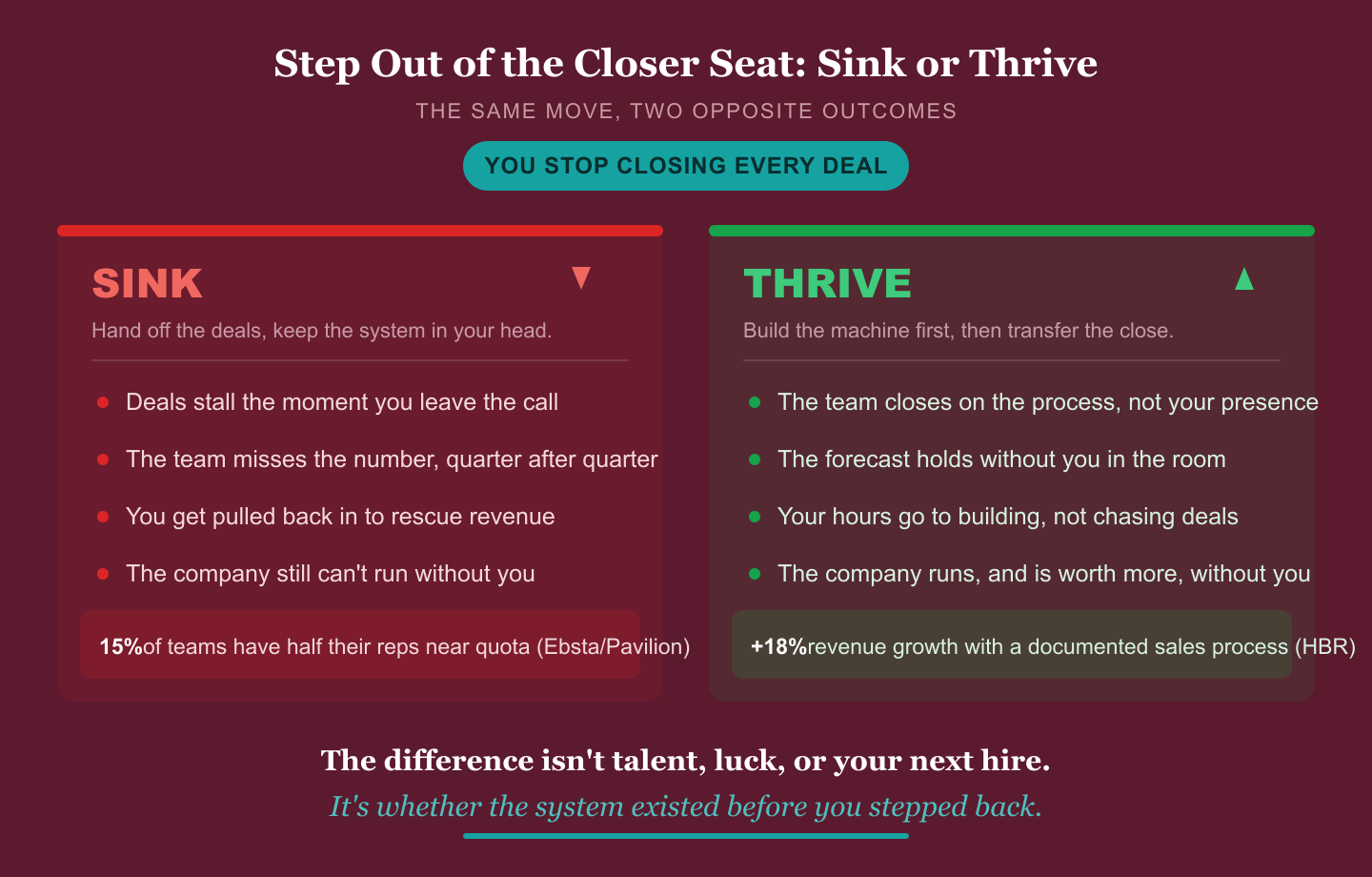
Here's the part most founders get backwards. They think the sink-or-thrive outcome gets decided after they hand off, based on whether the new people are any good. It doesn't. It's decided before you step back, by what you built while you were still the one closing. The handoff just reveals which one you did.
The Sink Path: You Hand Off the Deals, Keep the System in Your Head
This is the default, and it's what happens to most founders who try to step back on willpower alone. You hire a rep, hand them a list, and tell them to go sell. But everything that makes the sale work still lives in your head: which objections matter, what a real buying signal looks like, when to walk, how you frame the price. None of it's written down, so the rep can't run it. Deals stall, the number gets missed, and you do the only thing you can. You jump back in to save the quarter. Now you've paid for a rep and you're still the bottleneck. The reality that most reps are already swimming upstream doesn't help. Only about 15% of sales teams have even half their people near quota (Ebsta/Pavilion), and that's with a system. Drop someone into no system and the math gets ugly fast.
The Thrive Path: You Build the Machine First, Then Transfer the Close
The founders who thrive do it in the opposite order. Before they hand off a single deal, they extract what's in their head and turn it into a system a normal, well-trained person can run. The sale gets documented. The process gets real stages with exit criteria. The forecast gets built on pipeline math instead of gut feel. Then, and only then, they transfer the close. When they step back, the team keeps closing because they're not relying on the founder's presence. They're running the founder's playbook. That's the difference between a company that grows 18% faster on the strength of a formal process (HBR, Jordan & Kelly) and one that quietly slides back to founder-led everything.
Revenue doesn't collapse because you left. It collapses because you took the system with you when you left, and nobody knew it was in your head until it walked out the door.
What Has to Exist Before You Hand Off the Close
If the whole game is what you build before you step back, then the practical question is: build what, exactly? Here's the short list. These are the pieces that turn "the way I sell" into "the way we sell," so the close survives without you.
- 1. A documented sale. Write down how you actually win. The questions you ask, the objections that matter, the moment a deal is really qualified. If it only lives in your head, it can't be handed to anyone.
- 2. A real process with exit criteria. Stages that mean something, where a deal can't move forward until specific things are true. This is what makes a pipeline forecastable instead of a list of hopes. See why your stages need exit criteria.
- 3. An Accountabilities Document. Who owns what, and what "good" looks like for each seat. Nobody can hit a number they were never clearly handed.
- 4. Two hires, not one. A single rep gives you a sample size of one and no way to tell a people problem from a process problem. Two lets you compare, coach, and see what's actually working.
- 5. A genuine ramp. A new AE takes roughly 5 months, and often up to 7, to reach full productivity (Bridge Group). Plan for it. Firing a rep at month three for "not producing" usually means you fired the ramp, not the rep.
- 6. A weekly cadence. A standing pipeline review where deals get inspected and coached. This is the flywheel that keeps the system a habit instead of a document nobody opens.
Transfer the Close in Stages, Not in One Cutover
Even with all six in place, don't hand off the close in a single day. A hard cutover is how you drop revenue. Do it in four moves instead. First, you close and they watch. Then you co-sell, and they run pieces of the call. Then they close and you coach from the passenger seat. Finally, they own it and you're out of the deal entirely. Each step transfers a little more of the "why" and protects the revenue a clean break would put at risk. Done this way, the handoff is boring, and boring is exactly what you want.
The Founder-Dependency Discount: What the Hero Closer Really Costs
There's a cost to being the hero closer that never shows up on the income statement, and it's the one that should scare you most. It shows up the day you try to raise money, bring on a partner, or sell.
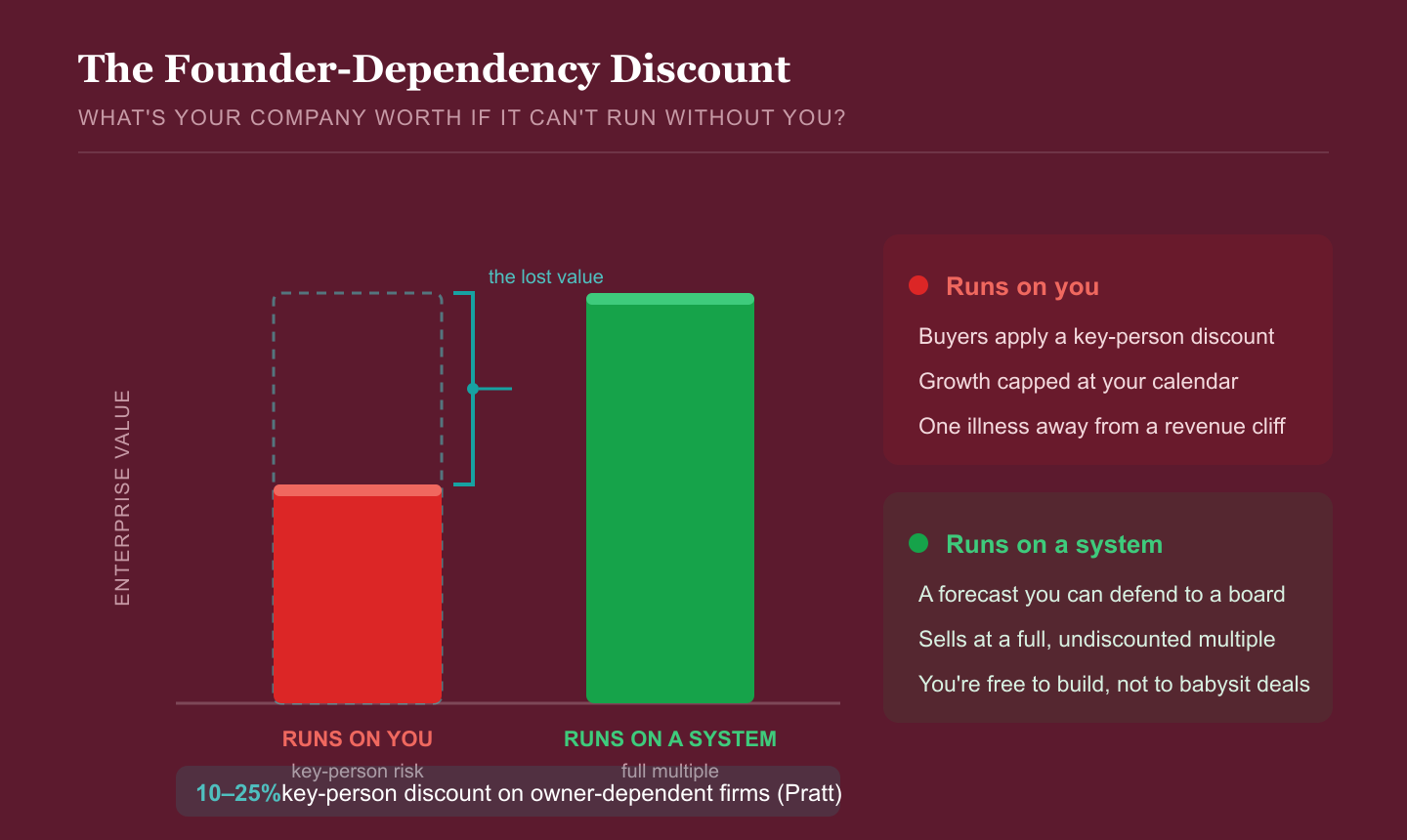
Valuation professionals have a name for it: the key-person discount. When a business depends too heavily on one individual, appraisers knock 10 to 25% off the value to price the risk that the person leaves (Pratt, the standard reference in private-company valuation). If you're the only one who can close, you are that key person, and you've built a company that's worth measurably less precisely because it needs you. A revenue engine that runs on a documented system doesn't carry that discount. It sells at a full multiple, because the buyer isn't buying you. They're buying the machine.
Compare that to the "permanent" alternative founders reach for instead, a full-time VP of Sales. That's a $300K-plus all-in commitment (Glassdoor) for someone who lasts about 17 months on average at a venture-backed company (Pavilion), plus a long search and a leadership ramp stacked on top of your reps' ramp. Spending that to install a documented system, coach a team into it, and then hand it off is a far better use of the money than renting a title. That's the model a Fractional Sales Leader runs, and it's exactly how you retire the discount.
If I'm not the one closing, what am I even worth? You're worth more, not less. A closer is worth their pipeline. A founder who built a system that closes without them is worth the whole company.
When Stepping Back Is the Wrong Call, and When It's Exactly Right
I'd rather tell you the truth than sell you a system you're not ready for. There's one situation where trying to hand off the close is a mistake, and it's this: you're still pre-product-market fit. If you don't yet know exactly who buys, why they buy, and how to repeat the win, there is no system to document. You'd be systematizing a motion that doesn't exist. When you're still figuring out the sale, you should be the one selling, learning from every call. Build the repeatable win first. Then build the machine around it.
But notice what's not a disqualifier: having no sales process or systems in place at all. Founders assume that means they're too early. It's the opposite. If you're a B2B founder in the $1M to $10M range with a product that clearly works and nothing but you behind the selling, you're not too early. You're right on time, and you're actually the easiest case, because we get to build it right the first time instead of unwinding bad habits. The blank page is a gift. That's the whole reason louiebernstein.com exists: to help founders build the system that lets them stop being the hero closer, and thrive on the other side of it instead of sinking.
Frequently Asked Questions
Q: Will my revenue drop when I stop closing every deal?
It drops if you hand off the deals but keep the system in your head, because the team has no way to run the sale the way you do. It holds, and usually grows, if you document the sale, build a real process, and transfer the close in stages before you fully step back. The revenue doesn't follow you out the door when the system stays behind. Companies with a formal, documented process grow 18% faster than those without one (HBR).
Q: How do I know if I'm the hero closer or just a hands-on founder?
Simple test: could your company survive 30 days without you selling? If every important deal still routes through you, if the forecast is really just your gut, and if a month off would mean a month of missed revenue, you're the hero closer. Being involved is fine. Being the single point of failure is the problem, and it caps how big the company can get.
Q: I have no sales process at all. Does that mean I'm not ready to step back?
Not at all, as long as you have product-market fit. Having no system is a reason to start, not to wait. Building from a blank page is the cleanest engagement there is, because we're installing good habits instead of unwinding bad ones. The only time "no process" is a real problem is if you're still pre-product-market fit and don't yet know who buys and why. Then you should keep selling until the repeatable win exists.
Q: If I'm not closing, what's my value to the company?
It goes up, not down. A closer is worth their pipeline. A founder who's built a sales system that closes without them is worth the entire company, and a more valuable one, because it no longer carries the 10 to 25% key-person discount buyers apply to owner-dependent businesses (Pratt). Your job shifts from working in the sales to working on the company, which is the job only you can do.
Q: Should I just hire a VP of Sales to take over the closing?
Be careful. A VP of Sales is a $300K-plus all-in bet (Glassdoor) on someone who averages about 17 months at a venture-backed company (Pavilion), and if there's no system for them to run, they'll struggle the same way a rep would. Most founders in the $1M to $10M range are better served building the system first with senior part-time leadership, then hiring a full-timer to run a machine that already works, instead of paying a premium for someone to build it from scratch.
Q: How long does it take to get out of the closer seat safely?
Plan on a few months minimum, driven mostly by ramp. A new AE needs roughly 5 to 7 months to reach full productivity (Bridge Group), and the staged handoff, you close and they watch, then co-sell, then they close and you coach, then they own it, takes a full selling cycle or two to complete. Rushing it is how you drop revenue. Done in order, you're out of the deals for good and the system keeps running.
Want to thrive when you step back, not sink?
Give me 30 minutes and I'll look at how your deals actually close today, tell you honestly which pieces are missing, and show you what it takes to get out of the closer seat without dropping revenue. See how a Fractional Sales Leader can help at louiebernstein.com.
Schedule a 30-Minute CallAbout the Author
Louie Bernstein
Fractional Sales Leader with 50 years of sales experience helping $1M–$10M ARR companies build scalable, repeatable sales systems. Founder of MindIQ (INC 500). LinkedIn Top Voice in Sales Management, Sales Operations, and Sales Coaching.