Key Takeaways
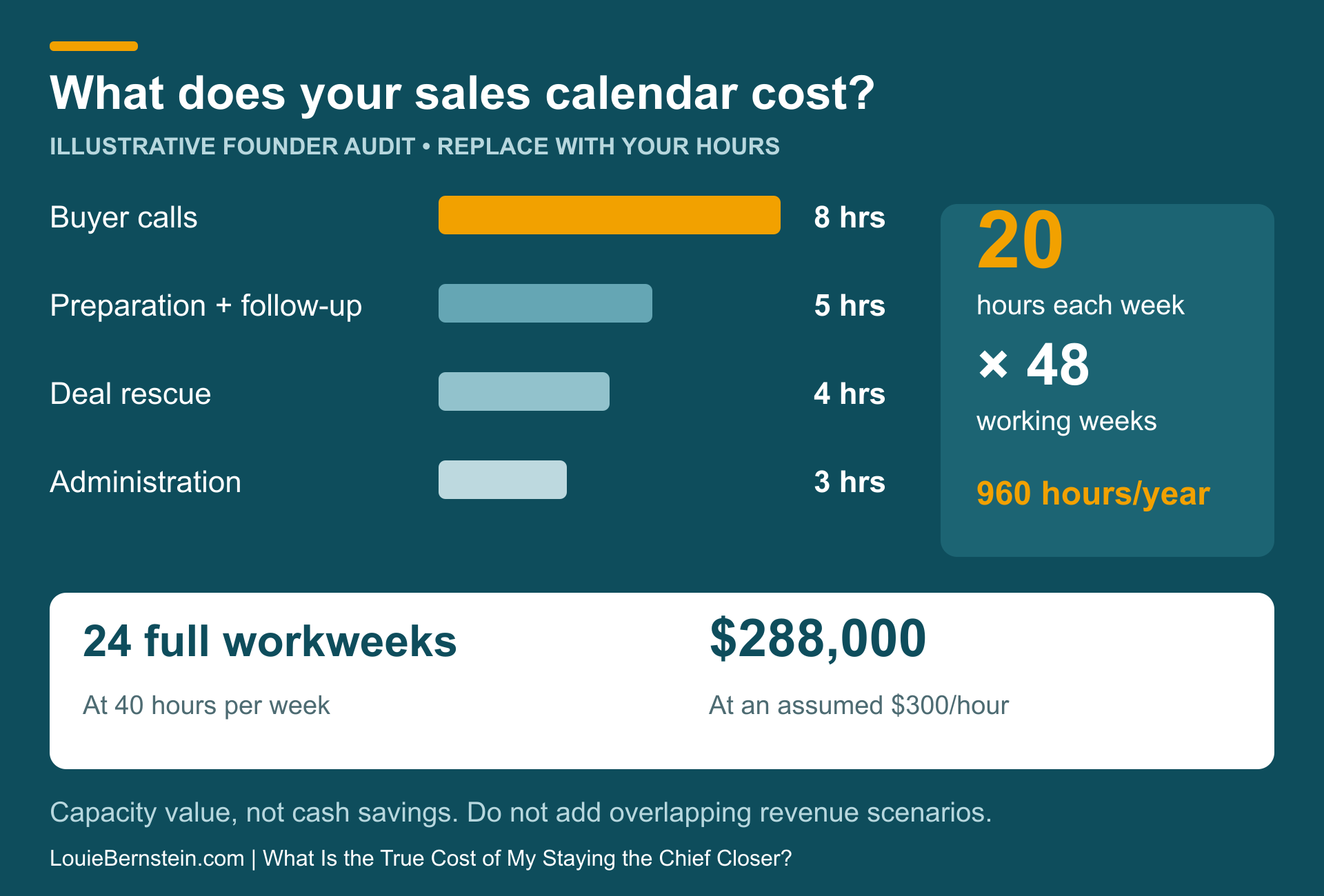
- Twenty sales hours a week over 48 weeks equals 960 hours. At an assumed $300 an hour, that's $288,000 of founder time, not a cash expense.
- Track time, delayed opportunities, and personal bandwidth separately. Adding them together can count the same cost twice.
- A higher founder win rate doesn't settle the question. Compare total team output and the hours required to produce it.
- A documented Sales Playbook plus a Fractional Sales Leader can reduce dependency. Measure the handoff by buyer evidence and fewer founder interventions.
You close another deal at 6:15. The team thanks you. Dinner's cold, the product decision is still waiting, and tomorrow's calendar looks exactly like today's.
If you're running a B2B company at $1M to $10M ARR, that can look like success from the outside. You're bringing in revenue. Inside, it feels like you've built yourself a job you can't leave.
I wouldn't tell you to stop selling because you're tired. I'd ask what staying the chief closer costs, what work only you can do, and what has to be true before someone else takes over. Let's put numbers beside those questions.
As the Founder, I Need Real Numbers Before Switching.
Start with a two-week calendar audit
The true cost of founder-led sales is the time you spend running sales, the valuable work that time displaces, and the opportunities your availability limits. There isn't one honest dollar figure that fits every founder.
For ten working days, record discovery, demos, proposals, follow-up, internal deal questions, CRM cleanup, and coaching. Include the ten-minute interruptions. Mark each activity as founder-only, teachable, or administrative.
Sales work includes more than buyer calls. In Salesforce's 2024 survey of 5,500 sales professionals, reps reported spending 70% of their time on non-selling tasks (Salesforce). That's a rep survey, not a founder benchmark. Use it as a reason to inspect the hidden work, not to assume your calendar matches it.
Price the time without pretending it's cash
Here's an illustrative founder calendar: eight hours of buyer calls, five of preparation and follow-up, four of deal rescue, and three of administration each week. Total: 20 hours.
At 48 working weeks, that's 960 hours a year, or 24 forty-hour weeks. Value those hours at $150, $300, or $500 and the annual time value is $144,000, $288,000, or $480,000. These are assumptions you can change, not measured founder averages.
Your hourly value isn't ARR divided by hours worked. Revenue belongs to the whole business. Use a conservative estimate of the value of your next-best work, then name that work: pricing, a channel partnership, a product decision, or hiring a key operator.
If handing off sales frees ten hours a week, the same $300 assumption values the recovered capacity at $144,000 annually. You haven't saved that much cash. You've created room to do something worth doing.
What Growth Is Waiting for Your Calendar?
Compare capacity, not just closing talent
Suppose you can work ten qualified opportunities a month and win 40%. That's four wins. Two trained reps handling ten comparable opportunities each at a 25% win rate produce five wins between them.
At $30,000 in new ARR per win, that's $120,000 versus $150,000 in monthly new ARR bookings. Those are scenarios, not a hiring forecast. Rep pay, ramp time, qualified demand, retention, and delivery capacity still matter. Two reps don't create twice the qualified pipeline by showing up.
The point is simple. You can be the best closer and still limit total sales. Measure how many suitable opportunities the business can handle without everything waiting for you.
Be careful with the “faster growth” statistic
A 2013 survey of 62 B2B companies reported an 18% relative difference in its revenue-growth measure between formal and informal sales processes (Vantage Point/SMA, slides 7–8 and 19).
That older study used a seven-point, self-reported growth scale and included many large companies. It doesn't establish an 18% ARR lift for a $2M founder-led business, or prove the process caused the difference. It supports taking process seriously. It doesn't belong in your budget as promised revenue.
Use your own growth scenarios instead. Starting at $2M ARR, three years of 15% annual growth reaches about $3.04M. At 25%, it reaches about $3.91M. The difference is roughly $875,000 in ending ARR. Neither rate is a prediction about hiring a Fractional Sales Leader. The comparison shows why even a modest growth gap deserves attention.
Keep an opportunity delay log
Record the buyer, value, next step, days waiting, and reason for delay. Separate “waiting for founder approval” from “buyer hasn't approved a budget.” Only one is your bottleneck.
If a $60,000 annual subscription starts a month late, $5,000 of subscription revenue shifts later under a simple monthly model. The whole $60,000 hasn't vanished. If the buyer leaves for a competitor, that's a different outcome. Don't put both in the same loss column.
Your Exhaustion Belongs on the Scorecard
Count the interruptions you stopped noticing
Twenty hours spread over two days is different from twenty hours scattered across every day and evening. The second calendar can leave you without a useful block for founder work.
Track evenings interrupted, protected work blocks lost, and decisions postponed. Don't invent a dollar price for missing dinner. Record the pattern and decide what you're willing to keep accepting.
Also measure founder dependency: opportunities needing your intervention divided by opportunities actively worked during the period. If 18 of 24 need you, that's 75%. Define intervention as a required call, approval, or rescue, and use the same definition every week.
A rep asking you the same question for the fifth time isn't evidence that you're irreplaceable. It's a reason to improve the instructions and the coaching.
Don't add every cost into one scary total
Keep three columns: actual cash spending, founder capacity value, and revenue scenarios. A delayed partnership may already be the reason you valued an hour at $300. Adding its full potential revenue to your time calculation would exaggerate the cost.
For your next decision, use one conservative cash case and one capacity case. Then consider the personal limits you won't cross. That's more useful than a seven-figure headline built by counting the same problem three times.
Build a Handoff You Can Actually Measure
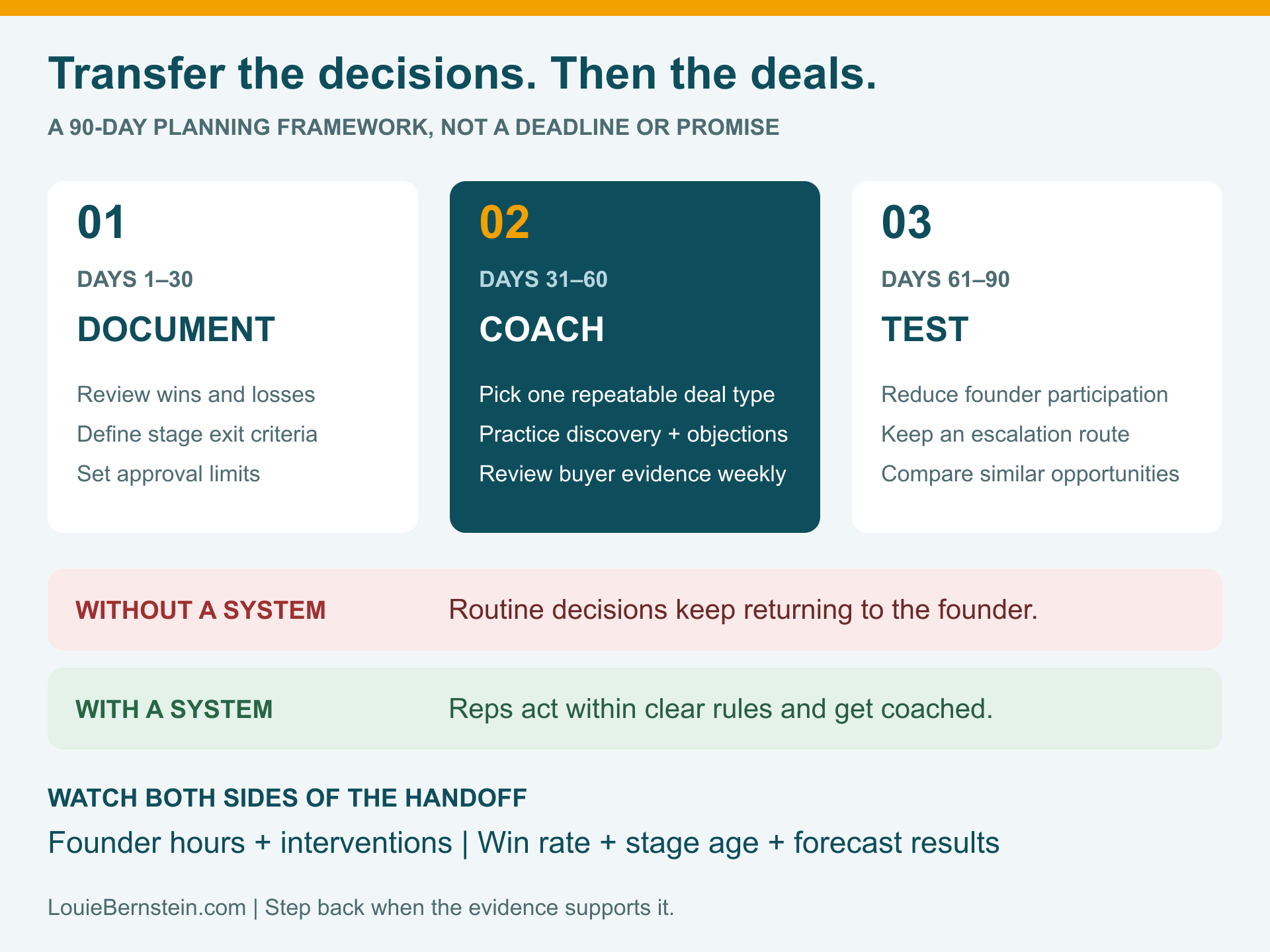
Days 1–30: extract the decisions behind your wins
Start with five won deals, five lost deals, and five that went nowhere, if you have enough history. Review calls with appropriate consent and inspect CRM notes. Find what buyers needed to believe, who approved the purchase, and where your team got stuck.
Turn that evidence into a short Sales Playbook. Include your ideal customer, disqualification rules, discovery questions, common objections, pricing boundaries, and sales stages with exit criteria. “Demo completed” describes seller activity. “Buyer confirmed the problem, impact, and next decision step” describes progress.
Add an Accountabilities Document naming who owns each decision. Set approval limits for discounts and unusual commitments. Otherwise, you'll document the process and still receive every approval request.
Days 31–60: teach, observe, and correct
Choose one repeatable deal type for the handoff. Role play discovery and objections. Let the rep lead real calls, then review one specific improvement afterward. A Fractional Sales Leader should coach the rep to make the next move, not become the new person closing everything.
Run a weekly pipeline review around evidence: what changed, what's missing, who owns the next action, and when the buyer agreed to it. Save the forecast at a consistent point each week and compare it with results. Keep missed dates visible.
If you need to hire, use the same discovery role play in interviews and score candidates against the job. Build onboarding around demonstrated skills. A completed training checklist doesn't prove someone can qualify a buyer.
Days 61–90: test independence on routine deals
Reduce your participation in the selected deal type. Keep a clear escalation route for material risks. Review these five measures together:
- Founder sales hours per week.
- Share of opportunities requiring founder intervention.
- Win rate for comparable, completed opportunities.
- Time in stage and overdue buyer next steps.
- Forecast versus actual bookings, using the same period and definition.
Agree on guardrails before you step back. For example, require complete buyer evidence and no unapproved pricing exceptions. Compare similar deal sizes and sources. A handful of wins is too small a sample to declare the handoff finished, especially with a long sales cycle.
What Should You Pay to Remove the Dependency?
Compare the full scope of the work
A full-time VP budget can reach $250,000 or more. Vendux estimates $250,000–$400,000 annually all-in; that's a provider's market estimate, not a universal salary floor. Its 2025 survey reports average fractional compensation of $11,732 monthly, or $140,784 if annualized (Vendux).
At another scope, Sales Manager Now advertises a starting price of $4,400 a month (Sales Manager Now). These aren't interchangeable offers or my pricing. Team size, hours, hiring work, and hands-on management change the bill.
For illustration, a $7,500 monthly engagement costs $90,000 annually. At an assumed 75% contribution margin before that fee, covering it requires $120,000 of incremental recognized annual revenue. Include commissions and other variable costs in your margin. New ARR booked late in the year won't produce a full year of revenue immediately.
Buy clear accountabilities and an exit plan
Ask for a written scope that includes the time audit, approval rules, call coaching, forecast review, and handoff scorecard. Add a monthly review of why you were pulled back into deals. Use those reasons to update the playbook.
Require the company to own the documents, CRM configuration, and training materials. Agree on who will run the meetings when the engagement ends. Independence should survive the leader's departure.
No sales system is a valid reason to consider my help. No repeatable evidence that customers want the product is a different problem. If you're still finding a buyer and offer that work, founder discovery stays essential. Fractional Sales Leadership can't manufacture demand or remove the need for people to do the selling.
Frequently Asked Questions
When does founder-led sales become too expensive?
When routine selling displaces higher-value founder work and deals repeatedly wait for you. Around $1M–$3M ARR is a useful time to audit, not a universal cutoff. Your calendar and buyer delays tell you more than the revenue milestone.
How do I calculate my founder hourly value?
Estimate what the next-best use of your time could reasonably produce. Test a low, middle, and high assumption. Don't divide company ARR by your hours or treat recovered time as guaranteed savings.
Should I stop joining sales calls entirely?
No. Keep a defined role in strategic relationships and unusual decisions. Transfer routine calls first. Your involvement should have a specific purpose rather than being a requirement for every deal.
Can a Fractional Sales Leader help without a playbook?
Yes, when you have repeatable wins to learn from and people who can execute. Building and coaching the process can be the assignment. Confirm that implementation is included before signing.
Will the handoff take exactly 90 days?
No. Ninety days is a planning framework. Longer sales cycles, hiring needs, and thin pipeline can extend the work. Reduce your role when the team demonstrates competence, not because a date arrived.
What if my reps still close fewer deals than I do?
Compare similar opportunities, total team output, margin, and founder hours. A lower individual win rate can still support greater capacity. If results deteriorate, inspect qualification and coaching before taking every deal back.
Let's Put Your Sales Dependency on Paper
If you're a B2B founder at $1M–$10M ARR, I'll help you examine what's keeping you in every deal and whether a documented system with part-time leadership fits. Visit LouieBernstein.com to see how I work. Bring your calendar and three deals that couldn't move without you.
Schedule a 30-Minute CallAbout the Author
Louie Bernstein is a Fractional Sales Leader who helps B2B founders at $1M–$10M ARR build repeatable sales systems, coach their teams, and reduce founder dependency.