Key Takeaways:
- Every sales hand-off has a first bad week. It's not a sign you made a mistake. It's the toll on the road out.
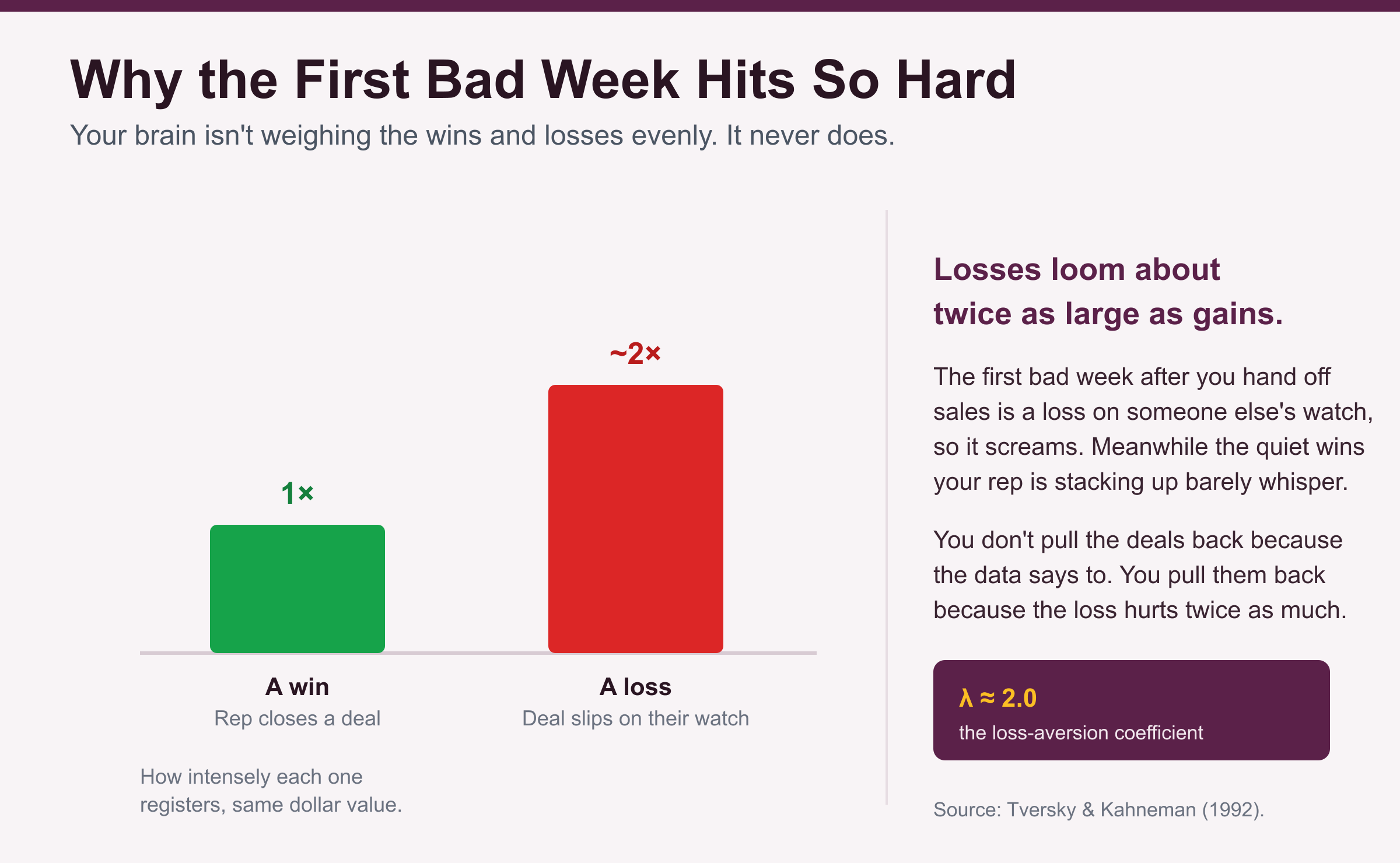
- Losses register about twice as intensely as equivalent gains (Tversky & Kahneman). A deal that slips on your rep's watch hurts ~2x more than the quiet wins they're stacking up feel good.
- That asymmetry, not the data, is why founders panic and yank the deals back. The math isn't telling you to. Your loss aversion is.
- The average new rep takes about 5 months to fully ramp (Bridge Group). Judging week one is judging at 5% of the race.
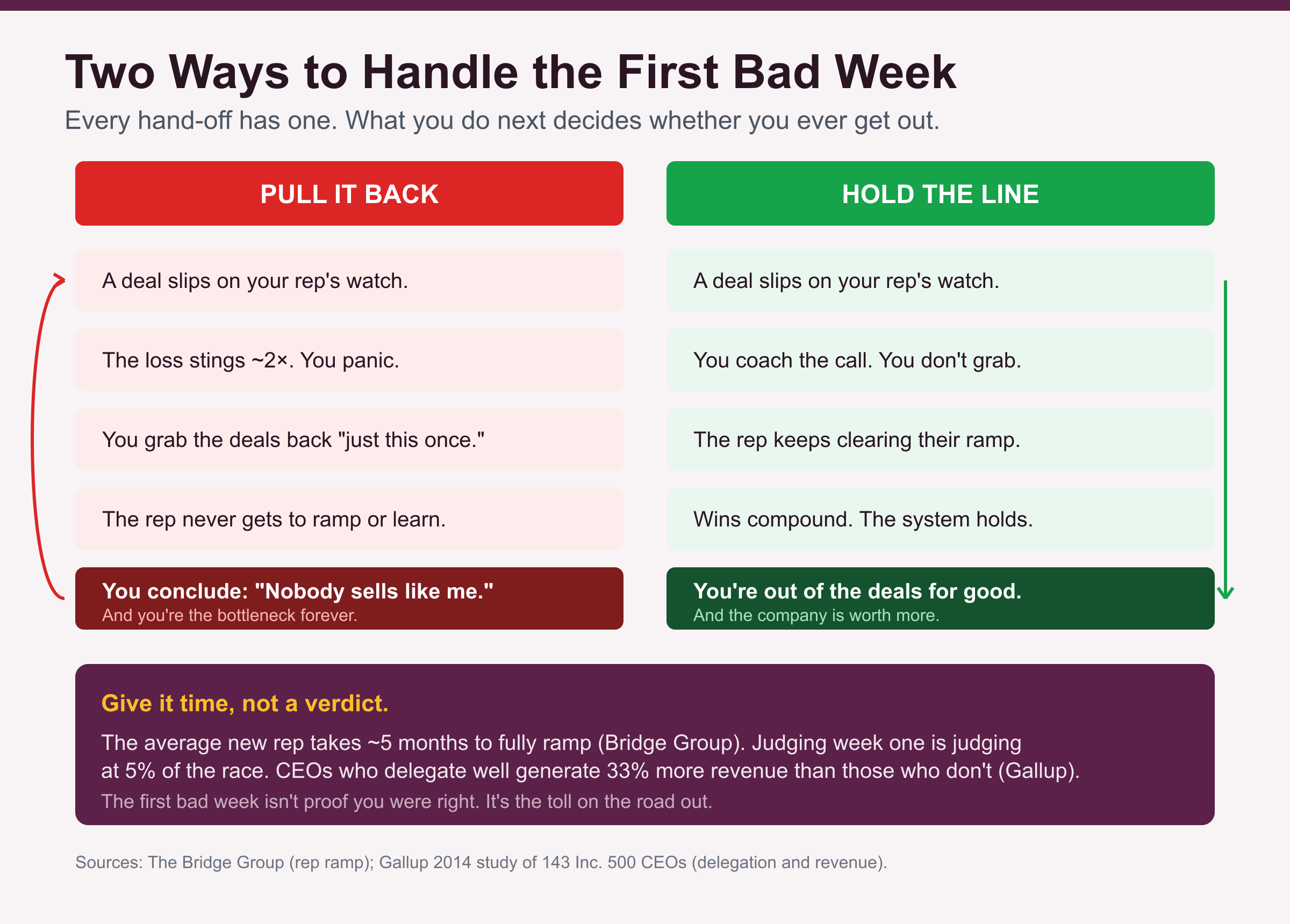
- Pulling the deals back doesn't just cost this one hand-off. It teaches you the wrong lesson, "nobody sells like me," and locks you in as the bottleneck for good.
- Hold the line. Coach the call, don't grab the deal. CEOs who delegate well generate 33% more revenue than those who don't (Gallup).
Here's a number that explains more founder behavior than any sales stat: a loss feels about twice as intense as an equivalent gain (Tversky & Kahneman). That single fact is why so many founders finally hand off sales, hit one rough week, and grab it all back, undoing months of progress in an afternoon.
You know the moment. You've done the hard thing. You handed real deals to your new rep. And then, day four, a deal you would have closed in your sleep goes sideways. Your chest tightens. A voice says: see, nobody can sell this but me. Your hand moves toward the phone to take it back.
Don't. That voice isn't wisdom, it's a well-documented bug in human decision-making, and it's about to cost you the whole hand-off. I've watched founders do this for fifty years, and I did it myself. Let me show you what's actually happening, and how to hold the line.
The Panic Is Real, and It's Lying to You
The reason the first bad week feels like a verdict is that your brain is not a neutral scorekeeper. In their Nobel-winning work on prospect theory, Daniel Kahneman and Amos Tversky showed that losses loom roughly twice as large as gains, the loss-aversion coefficient sits around 2. Losing $100 hurts about as much as winning $200 feels good.
Now apply that to your hand-off. When your rep closes a deal, you feel a small, quiet win. When a deal slips on their watch, you feel a loud loss, roughly twice as loud. So even if your rep is quietly winning more than they're losing, your emotional ledger reads deep in the red. The scoreboard says you're fine. Your gut says abort. The gut is wrong, and it's wrong in a predictable, measurable way.
What Taking It Back Actually Costs You
Grabbing the deals back feels like damage control. It's actually the most expensive move you can make, because it doesn't just lose you one deal, it teaches you the wrong lesson and traps you.
You're judging the race at the starting line
The average new sales rep takes about five months to fully ramp (Bridge Group). Five months. When you pull the plug in week one, you're not evaluating your rep, you're evaluating someone at roughly 5% of their ramp, still learning your product, your market, and your buyers. Of course they lost a deal you'd have won. You have a twenty-year head start. Judging them against your peak, on day four, isn't rigor. It's a rigged test.
You confirm a lie and lock yourself in
This is the real trap. When you take the deals back and the numbers recover, you "prove" that nobody can sell like you. But you didn't prove that. You proved that a beginner performs worse than an expert, which was never in question. You've now got false evidence for a belief that will keep you personally closing every deal until you burn out or cap the company. The first bad week didn't reveal that you're irreplaceable. Your reaction to it manufactured that conclusion.
How to Hold the Line
Holding the line doesn't mean ignoring problems or abandoning your rep. It means responding to the first bad week with coaching instead of a takeover. Here's how.
1. Decide the rules before the bad week comes
Loss aversion hijacks you in the moment, so make the decision in advance, when you're calm. Agree with yourself, in writing, on a real evaluation window, one full ramp, not one week, and on the leading indicators you'll actually watch. When the panic hits, you follow the plan you made rationally instead of the impulse you're feeling emotionally.
2. Watch leading indicators, not just wins and losses
One lost deal is noise. The signal is the trend: are the rep's discovery calls getting sharper? Are they qualifying with your criteria? Is pipeline being created? Are the recordings getting closer to how you'd run them? Those tell you whether the hand-off is working long before the win rate does, and they're far less vulnerable to a single dramatic loss.
3. Coach the call, don't grab the deal
When a deal wobbles, resist taking it over. Get on the recording with your rep, find the two things they'd do differently, and let them run the next one. Every deal you rescue is a deal they didn't learn from, and a signal to the whole team that you don't really trust them. Coaching builds a seller. Rescuing builds a dependent.
The first bad week isn't proof you were right to worry. It's the price of admission to a company that runs without you. Pay it once and you're free. Refuse to pay it and you pay forever.
This isn't just soft encouragement, it's how growth actually happens. A Gallup study of 143 Inc. 500 CEOs found that those with high delegator talent generated 33% more revenue than those with low or limited delegation, and posted dramatically higher three-year growth. Letting go, and staying let go through the rough patch, is not a threat to the business. It's one of the clearest predictors of how fast it grows.
If you know the first bad week is coming and you don't trust yourself to hold the line alone, that's exactly where a Fractional Sales Leader earns their keep. They run the hand-off, coach the rep through the rough patch, and keep you from pulling the baby back at the first cry. If you want the deeper reason that grab reflex is so strong, I wrote about the five fears behind it.
Frequently Asked Questions
Q: Why do I feel such a strong urge to take deals back after I've handed them off?
Because of loss aversion. Kahneman and Tversky's research shows losses register about twice as intensely as equivalent gains. A deal that slips on your rep's watch feels like a loss on your watch, so it hits about twice as hard as the quiet wins they're accumulating feel good. Your emotional ledger reads far worse than the actual scoreboard. The urge to grab the deal back isn't a rational read of the situation, it's a predictable bias, which is exactly why you can plan around it instead of obeying it.
Q: How do I know if a bad week is normal or a real sign my rep can't sell?
Look at the trend, not the single result. One lost deal in week one is noise, especially since the average rep takes about five months to fully ramp (Bridge Group). What matters is direction: are their discovery calls improving, are they qualifying to your criteria, is pipeline growing, are their recordings getting closer to how you'd run them? If the leading indicators are trending up, a lost deal is just ramp. If they're flat or declining over a full evaluation window, that's real signal. Judge the slope, not one data point.
Q: But what if it really was a deal only I could have closed?
Sometimes that's true, and those deals belong on your short list of genuine, keep-them-yourself relationships. But be honest about how short that list really is. Most deals that feel like "only I could close this" are actually "only I know how I close this," a documentation gap wearing a disguise. The test is whether the reason is a real relationship or authority only you hold, versus a technique you've simply never written down. The first you keep. The second you teach, and then it's no longer only yours.
Q: How long should I give a new rep before I judge the hand-off?
Plan on a full ramp, around five months for the average rep to reach full productivity (Bridge Group), before you judge outcomes like win rate. That doesn't mean flying blind for five months. Watch leading indicators weekly and coach continuously. But don't let a bad week, or even a bad month, trigger a takeover. Decide your evaluation window in advance, in writing, so that when loss aversion strikes you're following a plan you set rationally instead of an impulse you're feeling in the moment.
Q: Isn't staying hands-on the responsible thing to do with revenue on the line?
Staying involved as a coach is responsible. Taking every deal back is not, it just feels responsible because it soothes your loss aversion in the moment. The longer-term data cuts the other way: Gallup found CEOs with high delegator talent generated 33% more revenue and far higher three-year growth than those who held on. The responsible move is to protect the business's ability to sell without you, which means coaching through the rough patch, not rescuing every wobble and rebuilding the bottleneck you were trying to escape.
Q: I've pulled deals back before and never managed to let go. How do I break the pattern?
Take the decision out of your own hands in the heat of the moment. Set your evaluation window and leading indicators in writing beforehand, and give someone else the authority to hold you to them. That's a big part of what a Fractional Sales Leader does: they run the hand-off, coach the rep through the inevitable rough patch, and act as the steady hand that keeps you from grabbing the deals back at the first bad week. Having a partner who's done it before is often the difference between a hand-off that sticks and the fifth one that doesn't.
Don't let one bad week undo the whole hand-off.
If you're a founder between $1M and $10M ARR who's tried to hand off sales before and pulled it back, let's make this one stick. Thirty minutes to build the evaluation plan, the leading indicators, and the coaching rhythm that carries you through the first bad week, so you get out of the deals for good. If a real sales system won't help your business, I'll tell you that too.
Schedule a 30-Minute CallAbout the Author
Louie Bernstein
Fractional Sales Leader with 50 years of sales experience helping $1M–$10M ARR companies build scalable, repeatable sales systems. Founder of MindIQ (INC 500). LinkedIn Top Voice in Sales Management, Sales Operations, and Sales Coaching.