Key Takeaways:
- "Busy" is not "ready." Being overwhelmed means demand exceeds your capacity. Being ready means the motion works without you. They're not the same thing.
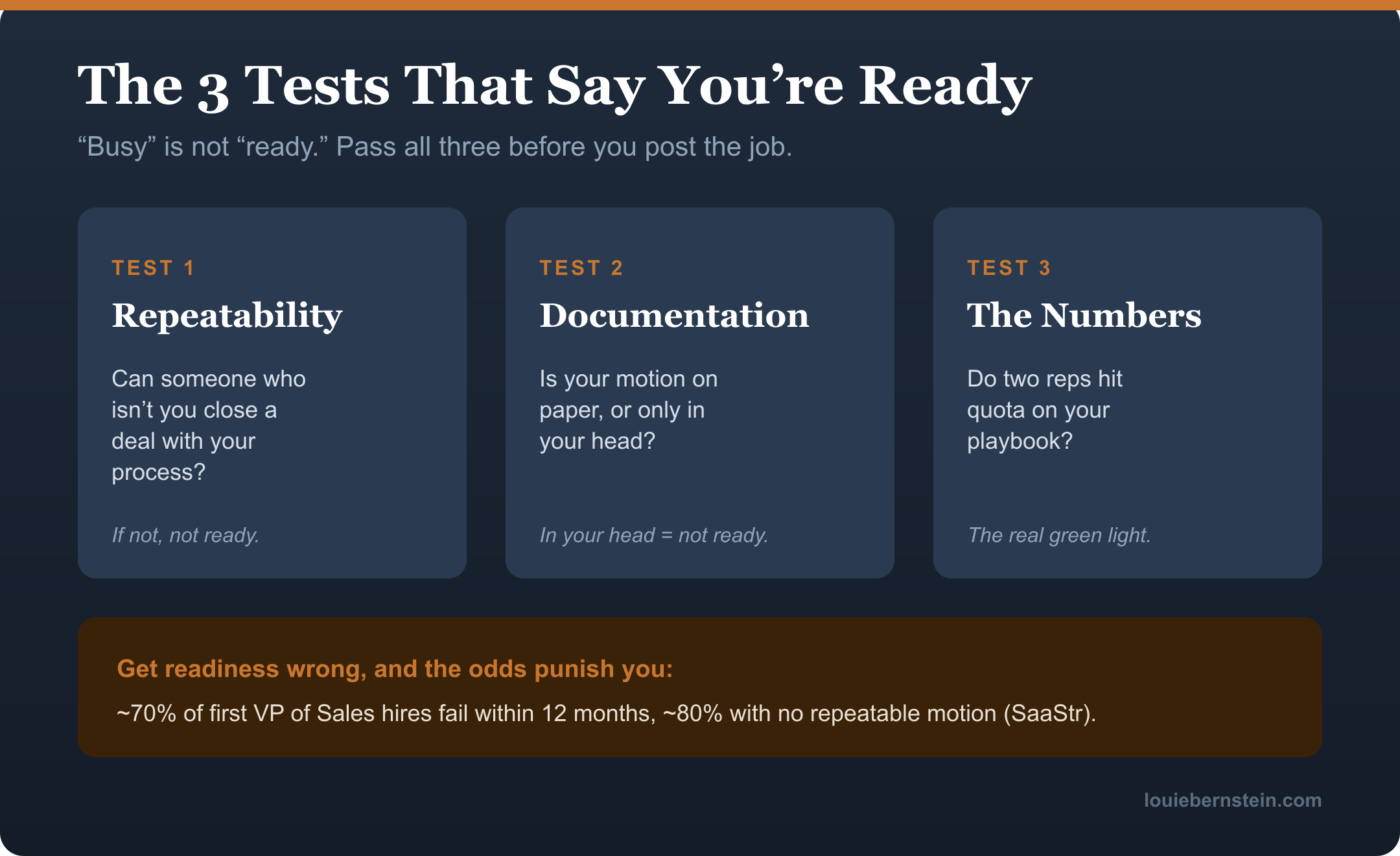
- Readiness isn't a feeling, it's three tests: Repeatability (can someone else close it?), Documentation (is it on paper?), and the Numbers (do two reps hit quota on your playbook?).
- The single clearest signal you're ready, per Jason Lemkin: two reps consistently hitting quota running your process (SaaStr). That's the green light.
- Hiring to escape a broken situation and hiring to scale a proven one look identical on the job posting and end completely differently. ~70% of first VP hires fail within 12 months (SaaStr).
- Run the five-point readiness checklist before you post the job. If you can't check all five, you're not ready, and hiring anyway is how you join the failure statistic.
You're slammed. You're taking every sales call, writing every proposal, and closing deals at midnight. So it feels obvious that you're ready to hand off sales. But being busy and being ready to step back are two completely different things, and confusing them is one of the most expensive mistakes a founder can make.
Here's the evidence. Roughly 70% of first VP of Sales hires fail within 12 months (SaaStr), and the number climbs to about 80% when the role is created before a repeatable motion exists. The average tenure of a VP of Sales is just 19 months (Gong). A big share of those failures trace back to one thing: a founder who was exhausted, mistook that exhaustion for readiness, and handed off a sale that wasn't ready to be handed off.
The good news is that readiness isn't a feeling you have to guess at. It's a set of tests you can actually pass or fail. Let me give you the three that tell you whether you're truly ready to step back, and the checklist to run before you ever post the job.
"Busy" Is Not the Same as "Ready"
Busy means demand has outrun your personal capacity. Ready means the motion works without you in the room. Those are not the same state, and it's entirely possible to be drowning in a sales motion that only works because you're the one running it. Hiring your way out of that state doesn't fix anything, it just hands an impossible job to someone with less context than you have.
So ask yourself the honest question: are you trying to hand off because the system is proven and simply needs more hands, or because you personally can't take it anymore? The first is scaling. The second is escaping. If every deal still runs through you, you're not ready to step back, you're the bottleneck, which is a very different problem that I dig into in I'm the bottleneck, every deal still needs me.
The Repeatability Test: Can Someone Else Close It?
Test one. Can someone who isn't you close a deal using your process? This is the test that matters most, because it separates a real motion from a founder's personal magic. If deals only close when you bring your product depth, your relationships, or the credibility of being the person who built the thing, then what you have isn't a repeatable process. It's you, and you can't hire you.
The cleanest way to run this test is to actually try it. Have a rep, or even a contractor, run a few deals on your documented process and watch closely. If they can move deals forward and close without you stepping in to save them, you're building genuine repeatability. If every deal stalls the moment you're not personally involved, that's your answer: not ready yet, and no VP hire will change that.
The Documentation Test: Is It in Your Head or on Paper?
Test two. Is your motion written down, or does it live entirely in your instincts? You cannot hand off what only exists in your head. If a new rep would have to shadow you for three months to absorb your approach by osmosis, you don't have a process, you have a person, and that person is you.
This is why documentation is a readiness test, not a nice-to-have. Companies with a formal, documented sales process generate up to 28% more revenue than those without (HBR), precisely because writing the motion down is what makes it transferable and coachable. If you haven't done that work yet, that's your next step before any hire, and it's exactly the exercise I lay out in the sales audit every founder skips before hiring.
The Numbers That Say Your Motion Will Hold
Test three. The numbers. The single clearest signal, and the one Jason Lemkin points to, is two reps consistently hitting quota running your playbook (SaaStr). That's not a vanity metric, it's proof that the motion produces results in hands other than yours. If you have it, you've earned the right to hire leadership to scale. If you don't, you're guessing.
Beyond that headline signal, look at consistency. Is your win rate stable across deals you didn't personally run? Is your sales cycle predictable enough to forecast within a reasonable range? Or is your revenue lumpy, propped up by a few whale deals you personally landed through sheer force? A steady, rep-driven number will hold when you step back. A lumpy, founder-dependent one will collapse the moment you do, and take your new hire down with it.
"Readiness isn't how tired you are. It's whether the machine keeps running when you walk out of the room."
The Trap of Hiring to Escape Instead of to Scale
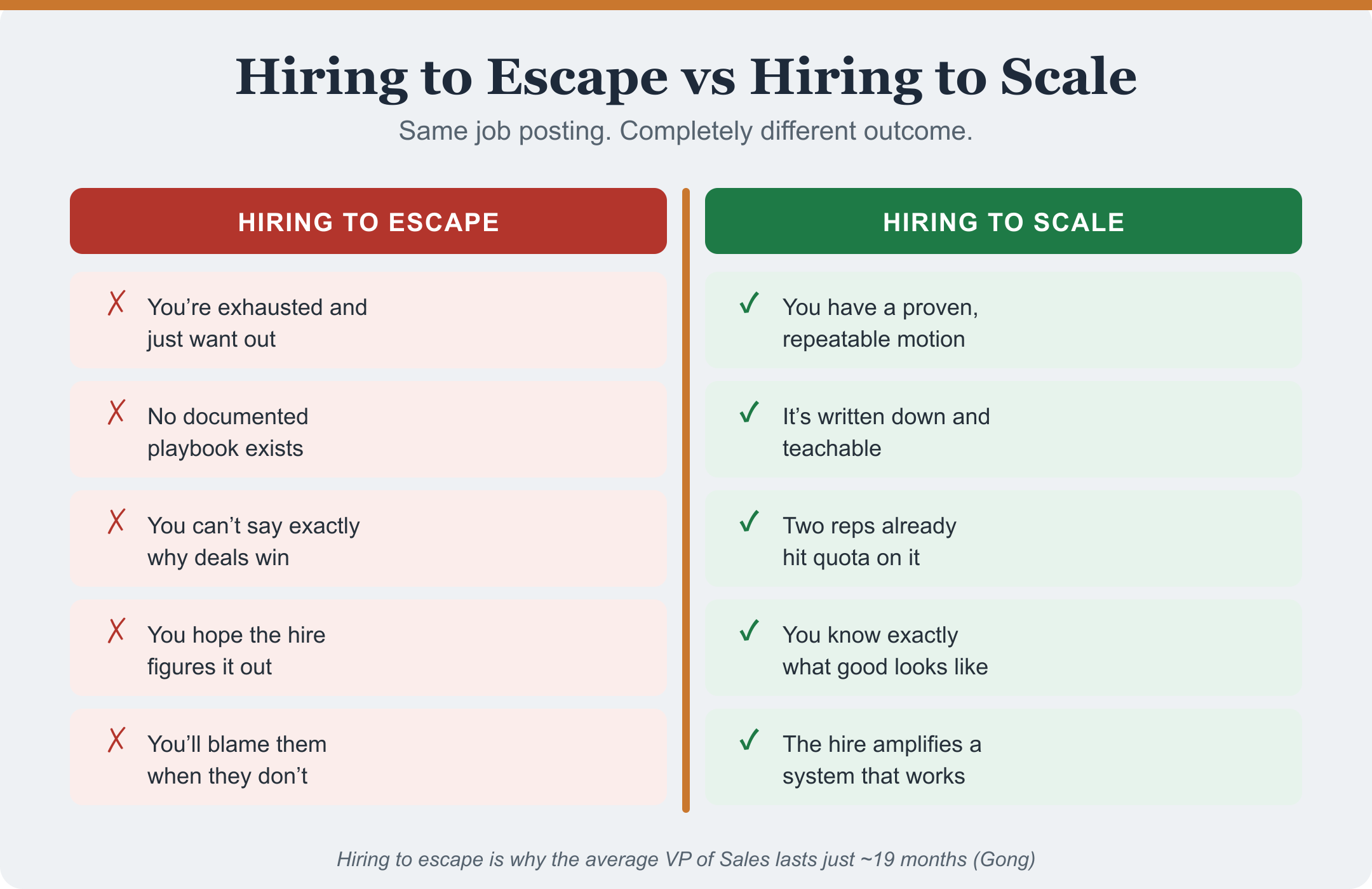
The most dangerous state to hire from is exhaustion. You're burned out, you want out, so you go find the most impressive VP of Sales you can and hope they'll fix everything. They won't, because a VP scales a system that exists, they don't invent one from nothing. Hire to escape and you hand them a vacuum, watch them fail, and land right back where you started, now a year and a couple hundred thousand dollars behind.
Hiring to scale is the opposite. The system is proven and documented, the numbers hold in other people's hands, and the new leader amplifies something that already works. Same job posting, same title, completely opposite outcome. The only variable that changed was whether you were ready, or just tired.
The Readiness Checklist Before You Post the Job
Here's the whole thing distilled into five checks. Run it honestly before you post the job:
- Someone who isn't you has closed deals running your process.
- Your motion is documented: ICP, stages, qualification, objections, and message.
- Two reps hit quota on your playbook.
- Your win rate and cycle are consistent, not dependent on whale deals you landed.
- You're hiring to scale a working system, not to escape a broken one.
Can't check all five? You're not ready, and hiring anyway is how founders join the 70% failure statistic. But here's the encouraging part: the gap between "busy" and "ready" is closeable, and usually faster than founders expect. That's the exact work I do with founders as a Fractional Sales Leader: run the readiness tests honestly, close the gaps, and get you to a real, documented, proven motion, so that when you step back, it holds. One honest caveat: if you're pre-product-market fit or haven't closed enough to even run these tests, the answer is simply "not yet," and that's fine. Keep selling. Readiness will come. Force it early and you'll pay the failed-hire tax instead.
Related Reading
Frequently Asked Questions
Q: How do I know if I'm ready to step back from sales?
Readiness isn't a feeling, it's three tests. Repeatability: can someone who isn't you close a deal with your process? Documentation: is your motion written down or only in your head? The Numbers: do two reps hit quota on your playbook, and is your win rate consistent? Pass all three and you're ready to hire leadership to scale. Fail any one and you're not, no matter how busy or burned out you feel. Being overwhelmed is a capacity problem; readiness is a systems problem.
Q: Isn't being overwhelmed a sign I should hire someone?
It's a sign you need help, but not necessarily a sign you're ready to hand off. Being busy means demand outran your capacity; being ready means the motion works without you. If every deal still runs through you personally, hiring just moves an impossible job to someone with less context, and it usually ends badly, ~70% of first VP of Sales hires fail within 12 months (SaaStr). Fix the readiness gap first: document the motion, prove someone else can run it, then hire.
Q: What's the single clearest signal I'm ready?
Two reps consistently hitting quota running your playbook (SaaStr). It's the cleanest proof that your motion produces results in hands other than yours, which is the whole point. Anyone can generate revenue on founder heroics; the question is whether the system works when you're not the one selling. If two reps can hit quota on your documented process, you've earned the right to hire leadership to scale it. If they can't, you have a founder-dependent motion, not a repeatable one.
Q: Why do so many first sales-leadership hires fail?
Because founders hire before the motion is ready. About 70% of first VP of Sales hires fail within 12 months, and roughly 80% fail when the role is created before a repeatable motion exists (SaaStr). The average tenure is just 19 months (Gong). It's rarely a talent problem. It's a readiness problem: the founder handed off a sale that only worked because they were running it. A great leader can scale a proven system, but no one can rescue a motion that was never really there.
Q: What's the difference between hiring to escape and hiring to scale?
Hiring to escape means you're burned out, there's no documented system, and you're hoping the new hire fixes everything, they can't, and they usually don't last. Hiring to scale means the motion is proven and documented, two reps already hit quota on it, and the new leader amplifies something that works. The job posting looks identical either way; the outcome is opposite. The variable isn't the quality of the hire, it's whether you were ready or just exhausted when you made it.
Q: I'm not ready yet. What should I do?
Keep selling, and use the time to close the gap deliberately. Document your motion as you go, get a rep or contractor running deals on your process, and push toward two reps hitting quota on your playbook. That's the work that turns "busy" into "ready." If you want to move faster, a Fractional Sales Leader can run the readiness tests with you, close the gaps, and build the documented, proven motion, so that when you do hire and step back, it actually holds instead of collapsing.
Not sure if you're ready? Let's run the tests.
If you're a founder between $1M and $10M in ARR, I'll run the readiness tests with you, close the gaps, and build the documented, proven motion, so when you step back, it holds. See how it works at louiebernstein.com.
Schedule a 30-Minute CallAbout the Author
Louie Bernstein
Fractional Sales Leader with 50 years of sales experience helping $1M–$10M ARR companies build scalable, repeatable sales systems. Founder of MindIQ (INC 500). LinkedIn Top Voice in Sales Management, Sales Operations, and Sales Coaching.