Key Takeaways:
- Revenue can look healthy while the work that supports it loses its owner.
- Watch five weak spots: discounts, qualification, late-stage progress, forecasting, and account relationships.
- This is a diagnostic order to check, not a proven timetable that every company follows.
- Look for buyer actions and written evidence in the CRM, not just rep activity.
- Replace each invisible founder task with a rule, a named owner, and a review.
- Coach the missing skill before deciding to take the whole sales job back.
Revenue does not have to fall off a cliff the day you stop closing. Check the work underneath it before a missed quarter tells you something broke.
You are drowning in deals. You want your week back. But you are terrified that revenue drops the day you stop owning every close. So you hand the calls to a rep and keep watching the revenue number.
That number can reassure you for the wrong reason. Deals you already built may still close. Meanwhile, the next set of deals starts losing the small decisions you used to make without thinking.
At a B2B company doing $1M to $10M in ARR, the founder may be the pricing policy, the qualification filter, and the person who gets a buyer to return a call. Taking your name off the calendar does not assign those jobs to somebody else.
The Founder Bottleneck Scorecard measures how much sales depends on you. This article looks underneath those numbers. Here is the order I would use to inspect the damage: discounting, the shadow pipeline, late-stage stalls, forecast slips, and account relationships. It is a practical checklist, not a research-backed sequence. Problems can overlap or show up in another order.
Stepping out too early is not proof that your people cannot sell. It can mean your invisible work suddenly has no owner.
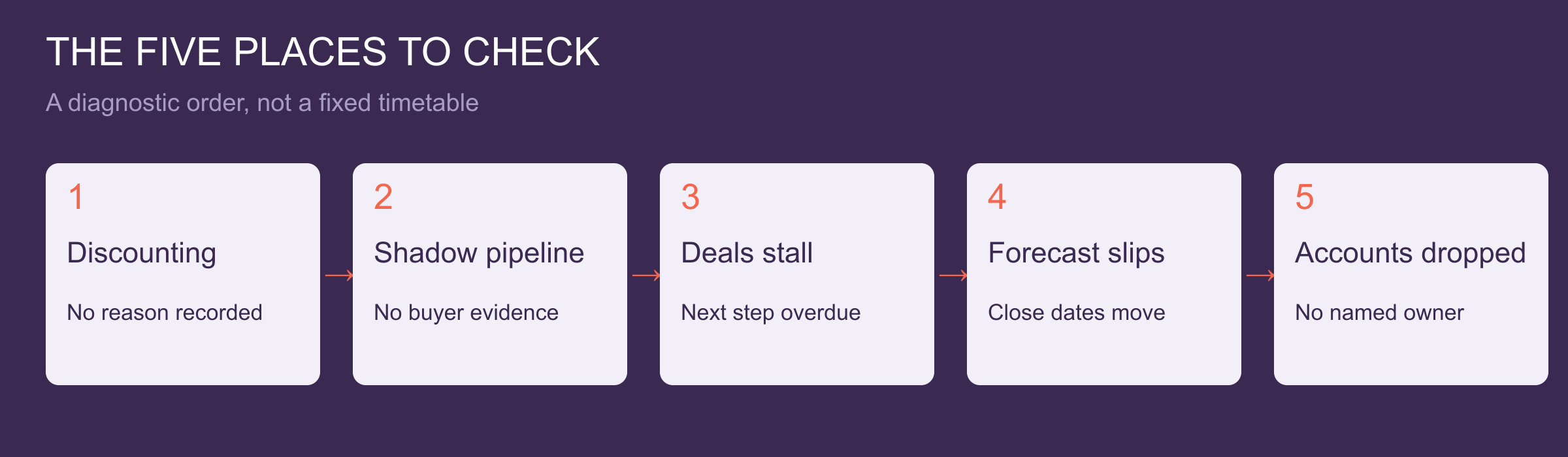
1. Discounting starts doing the job you used to do
Price is a useful first check because a concession can appear in a proposal before it appears in revenue. Your rep may close the deal and still give away value you would have defended. A closed-won report alone will not show you the gap.
When a buyer pushed back, you knew whether to hold price, change scope, or walk away. Your rep sees the same objection but may not know where the boundary sits. Without written rules, lowering the price can feel like the safest way to keep the deal moving.
Early warning: the exception has no explanation
Review proposals alongside closed deals. Compare list price with agreed price for similar offers, deal sizes, and contract terms. Look for concessions with no recorded buyer objection, approval, or exchange. More requests to "just approve this one" deserve a closer look.
A discount is not automatically a mistake. A smaller scope or a longer commitment may support a different price. The problem is a concession that buys nothing and teaches the buyer that waiting gets rewarded.
Use a simple hypothetical example. A $30,000 annual contract discounted by 10% brings in $27,000. That is $3,000 less annual contract value, even though the CRM still shows a win. This is arithmetic, not a claim about what your team will lose.
Replace judgment with boundaries and practice
Write down who can approve which concessions, what the buyer must give in return, and where the reason gets recorded. Include changes to payment terms and free services, not just percentage discounts. Put the rules in the Sales Playbook.
Then role play the price conversation. Ask the rep to explain value, explore the objection, and offer a scope change when appropriate. Your job is to teach the decision. If every objection still requires your personal call, the pricing work has not been handed off.
2. The shadow pipeline loses its filter
You probably had opinions about deals that never made it into the CRM. You knew one prospect had no money. Another had a real deadline. A third liked talking but would never buy. Your forecast quietly reflected that knowledge, even when the records did not.
When you step out, those records may look stronger than they are. The rep inherits a stage and a close date, but not the reason you trusted or distrusted the opportunity. The shadow pipeline gets exposed when someone tries to run it using the visible information.
Early warning: a strong stage with weak evidence
Open the deals in your later stages. Can the owner point to a buyer-confirmed problem, a reason to act, a decision process, and a next step? Or do the notes say "great call," "interested," and "proposal sent"? Enthusiasm is not qualification.
Compare deals you touched with deals the rep ran. Keep the buyer type and deal size similar. If your deals have context that the others lack, do not jump straight to a talent verdict. Check whether anyone taught the rep to gather and record that context.
Make qualification visible
Write qualification criteria for your actual customers. Explain what counts as evidence and what remains unknown. Budget not confirmed is different from budget unavailable. A supportive contact is different from the person who can approve the purchase.
Ask the rep to show the evidence in the CRM. If it is missing, agree on the next question for the buyer. Move the opportunity back when its current stage cannot be supported. A smaller honest pipeline gives you more control than a large one full of guesses.
A stage is a claim. The buyer evidence in the CRM has to support it.
3. Late-stage deals stop moving
Some deals were moving because you kept creating the next step. You called the executive, clarified a concern, or got both sides to agree on a decision meeting. The rep saw the deal advance but may never have seen the work that caused it.
Now the proposal is out and the rep is waiting. Follow-up emails keep going, so the activity report looks busy. But the buyer has not done anything new. The difference between activity and progress becomes expensive near the end of the sale.
Early warning: the next step belongs only to the seller
Look at late-stage opportunities with overdue tasks. "Send another email" is something the rep can do alone. "Buyer reviews the implementation plan with operations on Thursday" is a buyer action. You need to know which kind of step is on the record.
Compare time in stage with your own past deals of similar size and complexity. Do not use a universal day count. A security review may take longer than a straightforward renewal. What matters is whether the delay has an explanation and an owner.
Use exit criteria instead of hope
Define what must happen before a deal advances. A proposal stage might require the buyer to confirm scope, identify who approves it, and agree to a review meeting. Sending a document does not prove any of those things happened.
Coach the rep to ask for the next commitment during the current conversation. If the buyer will not agree, find out why. The right response may be more discovery, a revised scope, or removing the deal from the current forecast.
You can review the call and help plan the next one without taking ownership of it. Give the rep a question to ask and a clear outcome to seek. If you do join, name your purpose beforehand and let the rep run the meeting and record the next step.
4. The forecast slips, then accounts feel dropped
A forecast miss is often the delayed report of problems already present in pricing, qualification, or progress. You used to adjust for those problems in your head. Without that adjustment, the team may treat every close date in the CRM as equally believable.
Early warning: close dates change without buyer evidence
Save a forecast snapshot at the start of the period. In the weekly pipeline review, track what moved out, what moved in, and why. Ask what changed on the buyer side. A rep moving a date to the last day of next month is not a buyer decision.
Separate a target from a forecast. The target says what you need. The forecast says what current evidence supports. If you need $100,000 but can support $60,000, keep both numbers visible. Hiding the gap makes it harder to decide what to do.
Review the same fields each week: owner, amount, stage evidence, buyer action, date, and risk. The consistency matters. You are building a record somebody else can use, rather than holding a meeting where everyone tries to guess your opinion.
Early warning: an account still treats you as its owner
Relationship gaps may surface later because a buyer does not need help every day. Then a renewal approaches, an issue appears, or a new executive arrives. The customer contacts you because nobody made clear who owns the relationship now.
Check the accounts tied to deals you handed off. Does each have a named owner, a promised next contact, and a record of open commitments? Has the customer met that owner? An internal reassignment is not a customer hand-off.
Introduce the new owner with a reason the customer can understand. Explain who handles decisions and follow-through. Have the new owner lead the next conversation while you provide context. Keep any executive role you still hold explicit, so the customer knows when to involve you.
Do not tell the new owner to "stay close" and assume the job is defined. Record the next contact, the purpose, and the commitments. Your personal trust can help the introduction. The account plan has to carry the ongoing work.
5. Install an owner for every piece of invisible work
Before you reduce your role further, make a list of the decisions you made on recent deals. Include the small ones: refusing free work, questioning a deadline, calling a missing stakeholder, and remembering a promise to a customer. Those are accountabilities, not personality traits.
For each one, name the rule or process, the person responsible, and the review that tells you whether it happened. Put the accountabilities in an Accountabilities Document. Put the selling instructions and examples in the Sales Playbook.
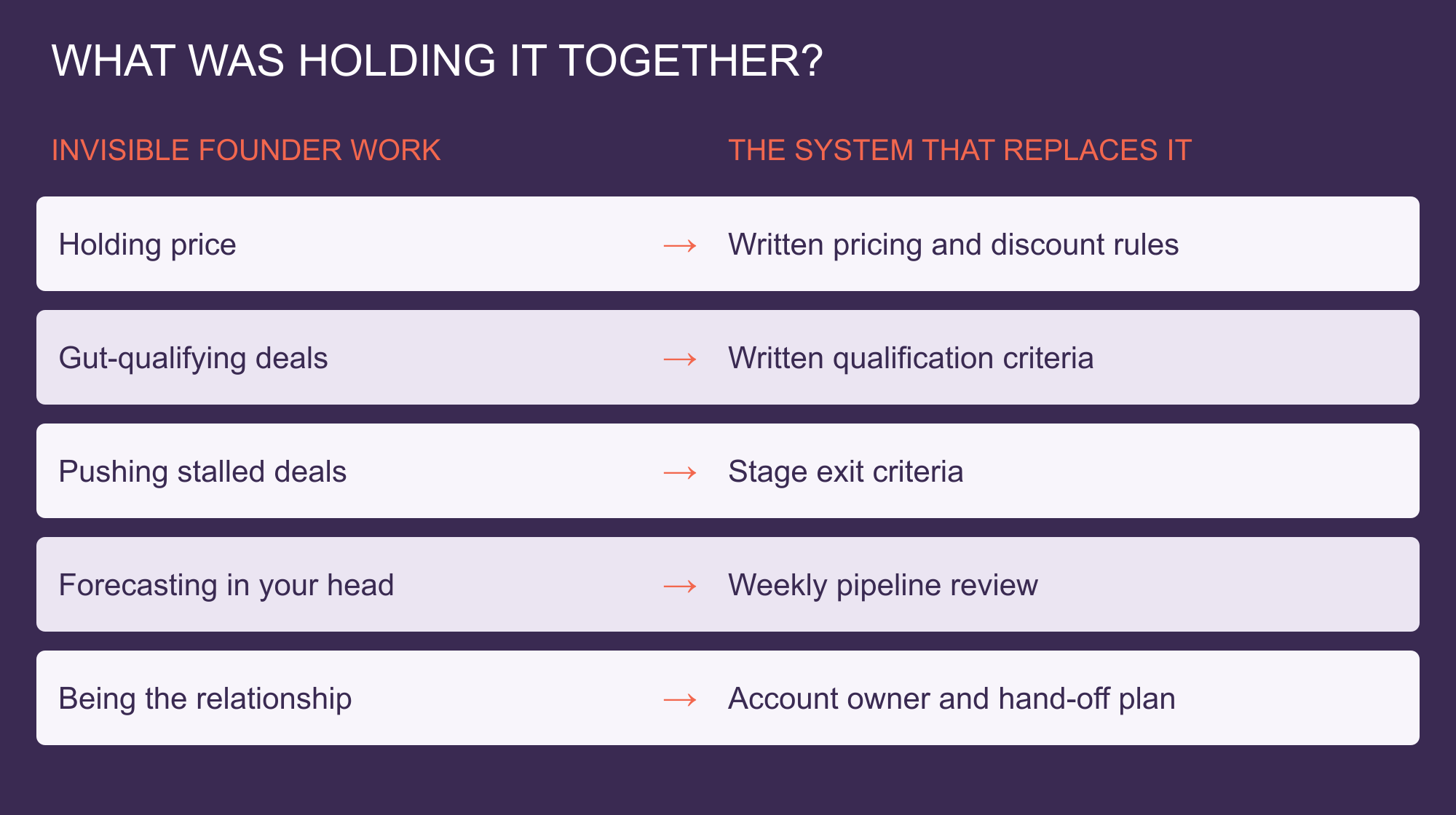
Test the replacement on real deals
Choose comparable opportunities and let the rep run them using the written process. Review proposals, call recordings, and CRM evidence. Ask the rep to explain the decision before you give your answer. That shows you whether the process is usable or just documented.
My rule of thumb is to reduce founder involvement only after the new owner can explain and perform the work without waiting for me. That is an operating preference, not an industry cutoff. One win alone does not prove that every part of the hand-off works.
If discounting rises, fix pricing rules and coach the conversation. If deals stall, fix the missing buyer commitment. If account ownership is unclear, make the introduction. Match the repair to the break rather than taking every deal back.
Keep watching outcomes as well as compliance. A rep can fill every field and still misunderstand the buyer. Review what the customer said, what the rep concluded, and what happened next. Good records make coaching possible; they do not replace judgment.
Your goal is not to disappear from sales. It is to make the work hold without your constant intervention.
The First Bad Week, for the urge to take sales back when the first rough patch arrives.
Frequently Asked Questions
Q: Does revenue always drop when a founder stops closing?
No. Deals already in motion may still close, and a team with clear accountabilities may keep performing. Watch pricing, buyer commitments, and account ownership alongside revenue. The point is to spot a missing process before it shows up as a missed number.
Q: Do these five problems always happen in this order?
No. This is an order for checking the work, not a proven sequence or timetable. A key account can feel dropped before a discount appears. Inspect all five areas and use your records to identify the first gap in your business.
Q: How can I tell whether a rep needs coaching or the system is missing?
Ask the rep to show the rule, the evidence, and the next action. If no one defined them, start by fixing the process. If they are clear but the rep cannot apply them, coach with real calls and deals. Review the result before making a hiring judgment.
Q: Should I join every stalled deal to protect revenue?
No. First identify what is missing. The rep may need a better question, access to a stakeholder, or a clear decision meeting. Join when you have a defined role that adds value. Keep the rep responsible for the opportunity and the follow-through.
Q: Which CRM report should I review first?
Start with proposals and concessions, then inspect late-stage deals for qualification evidence, overdue buyer actions, and changed close dates. Include the accounts that used to depend on you. A dashboard shows where to look; the individual records explain the problem.
Q: Can a Fractional Sales Leader help before I hire a full-time VP of Sales?
Yes, when the work is to define accountabilities, build a Sales Playbook, coach the team, and establish pipeline reviews. Agree on what the leader will install and teach. The goal is a team that owns the process, with evidence that it works.
Find the work that still depends on you
Fractional Sales Leadership can help you assign the missing work, teach the decisions, and build a sales process your team can run. Learn more at LouieBernstein.com.
Schedule a 30-Minute CallLouie Bernstein
Louie Bernstein is a Fractional Sales Leader with 50 years of sales experience. He helps B2B founders at $1M to $10M ARR build repeatable sales systems. He founded MindIQ, an INC 500 company.