Step out of sales in four stages: I sell and you watch, we sell together, you sell and I watch, then you sell and I'm escalation only. Run the stages separately for small, mid-size, and strategic deals, starting with the smallest. Move a segment up only when it meets written exit criteria, and move it back when it slips.
Key Takeaways:
- A hand-off isn't a date on the calendar. It's four stages, and each one has a job for you, a job for the rep, and a debrief after every call.
- Move up a stage when written exit criteria are met, not when you're tired or when a set number of weeks has passed.
- Run the ramp by deal segment. Small deals go first, mid-size deals follow, strategic deals move last.
- A segment that keeps slipping moves back one stage. That's the ramp doing its job, not failing.
- Ramp takes time even when it goes well. The average new AE needs 5.7 months to fully ramp (The Bridge Group, 2024).
- Use your scorecard numbers to decide when a stage is done: win-rate gap, days deals wait on you, and forecast accuracy.
Here's the sentence I hear from founders more than any other. "I'm drowning in deals. But I'm terrified revenue drops the day I stop owning them."
So they do one of two things. They keep every deal and burn out. Or they pick a Monday, hand the rep a list of accounts, and step away. The first bad week arrives, a deal slips, and they take it all back.
Both moves treat the hand-off as a switch. On or off. You own the deals or the rep does. That's why both fail.
A safe hand-off is a ramp. You step out in four stages, one deal segment at a time, and you only move up when the numbers say the stage is done. Revenue stays steady because at no point is a deal left with nobody who knows how to close it.
You don't hand off sales in a day. You step out of it, one stage and one deal size at a time.
Why can't you hand off sales in one day?
Because the part of selling that wins deals is invisible. You know which question surfaces the real budget and when to stop talking. A rep can't copy what they've never seen. A one-day hand-off asks them to rebuild your judgment on live deals, and the pipeline pays for every guess.
Ramp is slow even when everything goes right. The average new account executive takes 5.7 months to fully ramp (The Bridge Group, 2024 SaaS AE Report). Drop a rep into your pipeline with no ramp and you're betting the quarter on how fast they figure it out alone.
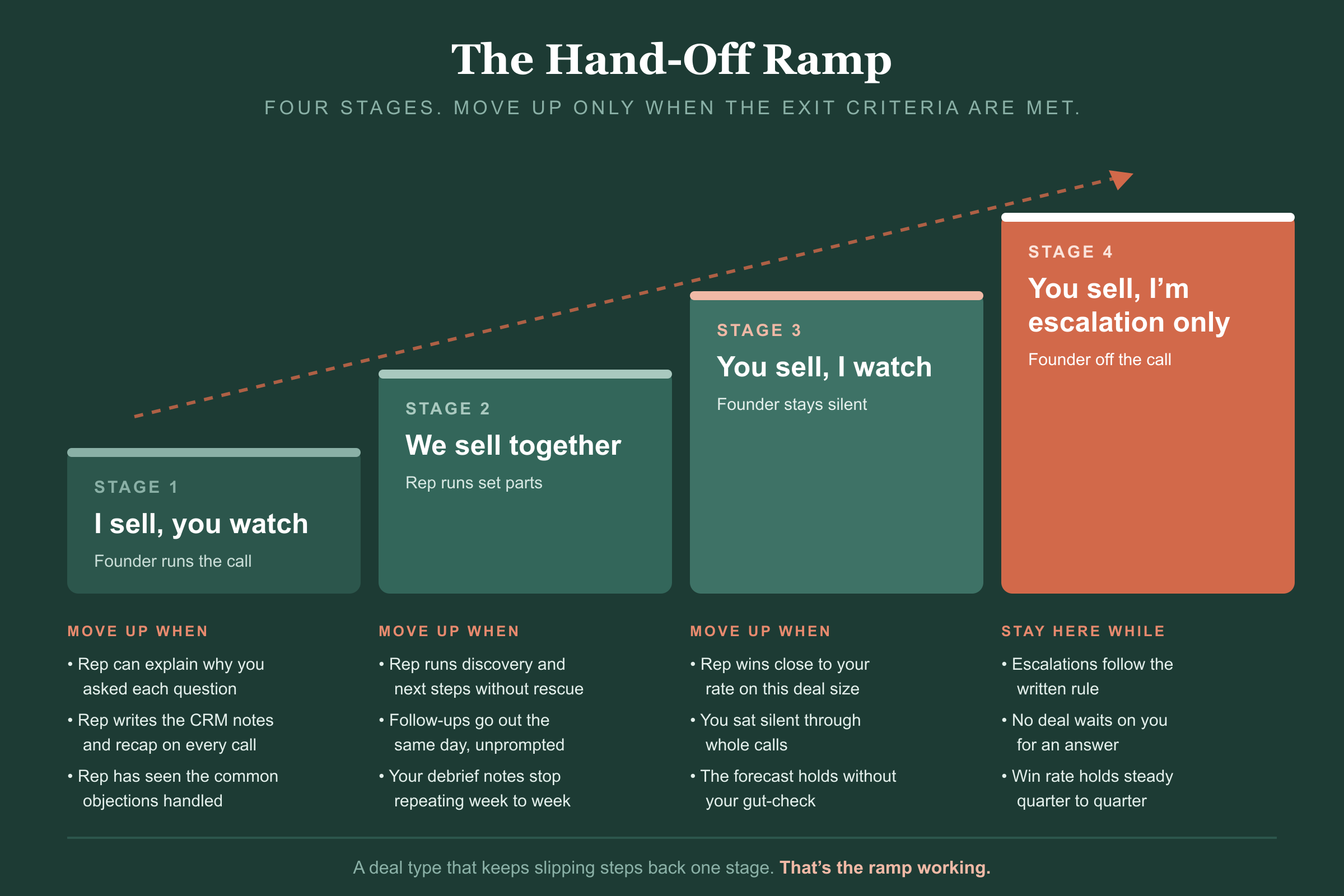
The ramp below fixes that. Each stage has four parts: what you do, what the rep does, what you debrief after every call, and the exit criteria that let the rep move up. Write all four down before you start. If you haven't checked whether you're ready to start at all, run the three readiness tests first.
Stage 1: I sell, you watch
In Stage 1 you keep running every call in the segment, and the rep watches all of them. Nothing changes for the buyer. What changes is that your thinking becomes visible. The goal isn't for the rep to sell yet. It's for them to understand why you sell the way you do.
What you do
Run the call the way you always do. Before each call, tell the rep in two sentences what you want to learn from this buyer. That turns a call they watch into a call they study.
What the rep does
They take notes, write the CRM entry, and send the recap. That last part matters. If it isn't in the CRM, it never happened, and from Stage 1 on the rep owns the record even while you own the conversation.
The debrief
Ten minutes, right after the call. Ask the rep three things. Why do you think I asked that question? What did the buyer say that changed the deal? What would you have said next? Their answers tell you more than any test.
Exit criteria
The rep can explain the reason behind your key questions. Their CRM notes and recaps are complete without edits. They've watched you handle the common objections in this segment. When all three are true, move up.
Stage 2: We sell together
In Stage 2 the rep runs set parts of the call while you run the rest. Agree on the split before the call, not during it. A common starting split: the rep opens and runs discovery, you handle pricing and the close. Each week, the rep's part gets bigger.
What you do
Take only the parts you agreed to. When the rep's section gets bumpy, don't jump in unless the deal is at real risk. Note it for the debrief instead. Buyers notice when you take over.
What the rep does
They prepare the agenda, run their sections, and set the next step at the end of the call. They also own the follow-up.
The debrief
Start with the rep's view. What went well in their part, and where did they get stuck? Then add the one thing you'd change. Just one. Five corrections after every call teaches a rep to wait for you.
Exit criteria
The rep runs discovery and sets next steps without you rescuing the call. Follow-ups go out the same day without reminders. Your debrief notes stop repeating from one week to the next. Repeated notes mean the lesson hasn't landed yet.
Stage 3: You sell, I watch
In Stage 3 the rep runs the whole call and you stay silent. You're there to observe, not to rescue. This is the hardest stage for founders, because you'll watch a deal move slower than you'd move it. Sit on your hands anyway. It's the only way the rep learns to finish.
What you do
Join, introduce yourself as someone who's there to listen, and then stay quiet. If the buyer asks you a question, answer it briefly and hand the call back to the rep by name. Take notes for the debrief.
What the rep does
Everything. They run the agenda, handle the objections, talk price inside the written discount rules, and close for a specific next step. When a deal needs an answer only you can give, they ask for it through the escalation route, not with a look across the table.
The debrief
Ask the rep to grade their own call first. Then compare it with what you saw. A rep who spots their own gaps is ready for more. A rep who defends every choice needs more time here.
Exit criteria
This is where your scorecard numbers come in. The rep's win rate on this deal size is close to yours. You sat silent through whole calls without needing to step in. And the forecast for this segment holds without your gut-check deal by deal. My rule of thumb: if you win about twice as often as the rep on the same deal size, stay in Stage 3.
Stage 3 isn't about whether the rep sells like you. It's about whether the deal closes without you.
Stage 4: You sell, I'm escalation only
In Stage 4 you're off the calls for this segment. The rep owns the deals from first meeting to signature. You come back in only when a written escalation rule says to. Your weekly job becomes a pipeline review, not a seat on the call.
What you do
Review the segment's pipeline once a week. Ask about buyer actions, not feelings. Did the decision maker attend? Is the next meeting booked? Action-based stages make that review fast, because a deal only moves forward when the buyer does something.
What the rep does
They run the deals, keep the CRM current, and raise escalations early with a short written brief. They don't wait until the buyer's deadline to tell you there's a problem.
The debrief
Move from every call to the weekly review, plus a short debrief on any deal you were pulled into. Look at why the escalation happened. Repeated escalations of the same kind point to a missing rule or a coaching need.
Staying in Stage 4
Stage 4 holds while escalations follow the written rule, no deal waits on you for an answer, and the segment's win rate stays steady quarter to quarter. The rule for when you still get on the call is the subject of the escalation rule, the last article in this series.
Which deals should you step out of first?
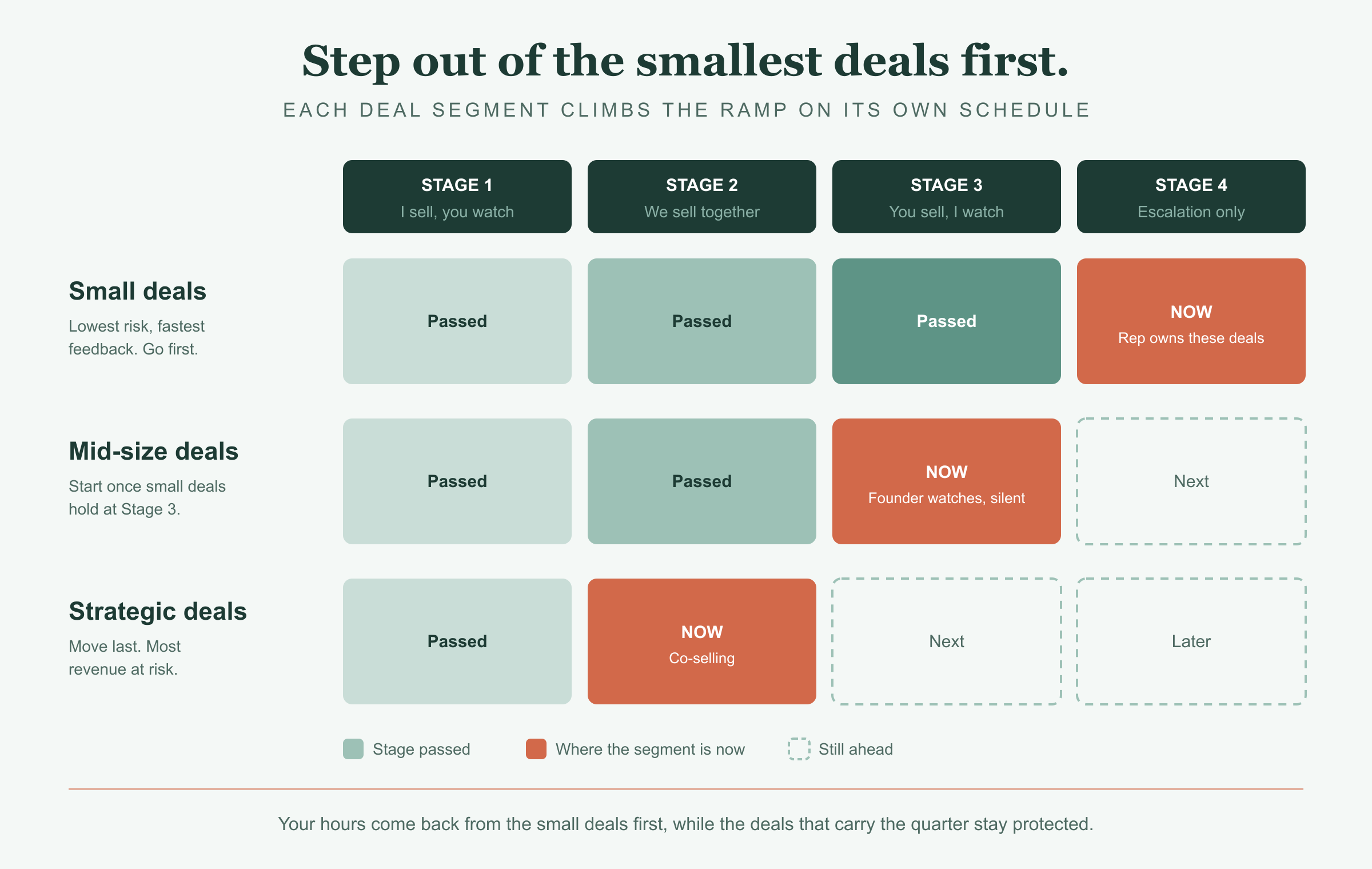
Your smallest deals. They carry the least revenue risk, they close fastest, and there are more of them, so the rep gets more reps. Mid-size deals start once small deals hold at Stage 3. Strategic deals move last, and you may stay their escalation contact for a long time.
Each segment runs its own ramp. That means the same rep can be in Stage 4 on small deals, Stage 3 on mid-size deals, and Stage 2 on strategic deals, all in the same week. That's normal. It's how your hours come back without putting the quarter at risk.
Define the segments with your own numbers. Look at your last two quarters of closed deals and split them by contract value into three groups. Write the cutoffs down so nobody argues later about which ramp a deal belongs to.
What happens when a deal type keeps slipping?
It moves back one stage. If mid-size deals keep stalling after you stepped out, return to Stage 3 for that segment and watch the calls again. That isn't failure. The ramp is catching a gap before it costs you a quarter. Going back one stage is cheaper than taking every deal back.
Slipping deals are expensive. Ebsta and Pavilion found 44% of deals were pushed at least once, and win rates fell 67% when deals slipped (Ebsta/Pavilion, 2024). A segment that keeps slipping is a segment losing revenue, so act on it in weeks, not quarters.
Use a clear trigger. My rule of thumb: if close dates in a segment get pushed two weeks in a row without a buyer reason, step back one stage. Then use the debriefs to find the one missing piece, usually a qualifying question or a pricing rule.
Step back one segment, not all of them. The first bad week covers how to hold the line when that urge hits.
Moving back a stage isn't the hand-off failing. Taking every deal back is.
How long should each stage take?
As long as the exit criteria take, and no shorter. I won't give you a fixed number of weeks, because a 30-day sales cycle and a 6-month cycle can't run on the same clock. Tie each stage to deals seen, not days passed, and let the criteria decide when it's done.
My rule of thumb: a rep should see at least a handful of deals in a segment go all the way through each stage before moving up. With short sales cycles, that can happen in a few weeks. With long ones, it can take a quarter or more for a single segment.
Track the ramp where everyone can see it. One line per segment in your weekly pipeline meeting: current stage, the exit criteria still open, and the next review date. Salespeople don't quit companies. They quit chaos. A rep who knows exactly what earns the next stage will work toward it.
What does a Fractional Sales Leader install?
A Fractional Sales Leader builds the ramp and runs it with you. That means the deal segments, the written exit criteria for each stage, the debrief questions, the discount rules, and the weekly review. It's the fix for founders at $1M to $10M ARR who need to step out but can't risk the revenue.
The hard part isn't the plan. It's following it when a deal looks shaky. A Fractional Sales Leader sits in the debriefs, holds the line on the criteria, and tells you when a segment is ready or needs to step back. For the wider system around the ramp, see how to stop being the person who closes every deal.
I've spent 50 years in sales, including 22 years building MindIQ into an INC 500 company. The founders who step out well don't have braver reps. They have a ramp with written rules, and they follow it.
Frequently Asked Questions
Q: What is a sales hand-off ramp?
It's a staged plan for moving deals from the founder to a rep. There are four stages: I sell and you watch, we sell together, you sell and I watch, and you sell while I'm escalation only. Each stage has written exit criteria, and each deal segment moves through the stages on its own schedule.
Q: What's the difference between shadowing and reverse shadowing?
Shadowing is Stage 1: the rep watches you sell. Reverse shadowing is Stage 3: you watch the rep sell and stay quiet. Most founders do plenty of the first and skip the second. Skipping it means the rep never closes a deal with someone watching and coaching afterward.
Q: What if a buyer only wants to talk to me?
Ask what they need from you specifically. Often it's reassurance about the company, which you can give in a short conversation before handing the deal back to the rep by name. If you keep running the deal, the buyer learns the rep doesn't matter, and every renewal comes back to you.
Q: Do strategic deals ever reach Stage 4?
Often, yes, but last. Some founders stay the escalation contact on a few strategic accounts for good. That's fine as long as the rep owns the deal and you join only when the escalation rule says to.
Q: What if revenue dips while I'm stepping out?
Check which segment it came from. If one segment is slipping, move that segment back one stage and find the gap in the debriefs. Don't take every deal back. Small dips on small deals are the price of a rep learning, and that's why you start there.
Q: Can a Fractional Sales Leader run the ramp for me?
Yes. A Fractional Sales Leader defines the segments, writes the exit criteria, runs the debriefs, and holds the weekly review. You stay involved where your judgment matters, and the ramp keeps moving even in the weeks when you're pulled into everything else.
Ready to step out without losing revenue?
In 30 minutes we'll split your deals into segments, see where each one sits on the ramp, and decide which deals you can stop running first.
Schedule a 30-Minute CallAbout the Author
Louie Bernstein
Fractional Sales Leader with 50 years of sales experience helping $1M–$10M ARR companies build scalable, repeatable sales systems. Founder of MindIQ (INC 500). LinkedIn Top Voice in Sales Management, Sales Operations, and Sales Coaching.