Key Takeaways:
- You're not choosing between founder-led sales and a $400K VP. There's a third door, and it's the one most $1M–$10M founders should walk through first.
- A full-time VP of Sales runs $250K–$450K all-in (2025 SaaS comp guides) and lasts an average of 19 months (Gong), down from 26. Hire the wrong one and the U.S. Department of Labor pegs the cost at 30%+ of first-year salary.
- Leadership isn't selling. It's five jobs: process design, team building, coaching, metrics, and accountability. A Fractional Sales Leader installs all five without the full-time salary.
- Fractional retainers run $6K–$15K a month, roughly 40–70% less than a comparable full-time exec, and you can scale up or down month to month.
- The model bridges the gap until you're ready for a permanent leader, or it proves the system so your eventual full-time hire actually succeeds instead of failing in 19 months.
- If you have no product-market fit and no sales at all yet, this isn't for you. I'll tell you that up front, and I'll tell you why.
Almost every founder I talk to at $1M–$10M ARR is stuck on the same rock.
They know founder-led sales has run its course. They're the bottleneck. Every deal still routes through them. And they know the answer is supposed to be "hire a VP of Sales." But when they price it out, the number is absurd for where they are. A quarter of a million dollars, sometimes closer to half, for a bet that lasts an average of a year and a half.
So they do nothing. They keep selling. They keep being the bottleneck. And the business stays exactly as dependent on them as it was the day they realized it shouldn't be.
Here's the thing nobody tells you: the choice was never binary. You don't need to pick between doing it all yourself and committing to a full-time executive you can't afford and might not need for another two years. There's a middle path, and it's the one I've built my career on.
The False Choice That's Quietly Costing You Growth
Let's put real numbers on the full-time VP option, because most founders never actually run the math.
All-in on-target earnings for a mid-market VP of Sales land between $250K and $450K, and enterprise roles run past $500K (2025 SaaS compensation guides). Add a recruiter or search fee that's typically 20–30% of first-year comp on top of that. Then factor in the ramp: a senior sales executive needs three to six months just to learn your business before they change anything.
Now here's the part that should stop you cold. The average tenure of a new sales leader is 19 months, and it's been falling. It was 26 months a decade ago (Gong). So you're paying a premium, waiting two quarters for impact, and the clock says your hire is likely gone before they've seen three full sales cycles play out.
And if you hire the wrong one? The U.S. Department of Labor puts the minimum cost of a bad hire at 30% of that person's first-year salary. At the executive level it's far worse. CareerBuilder's employer research pegs the average cost of a bad executive hire at $240,000 or more once you count lost momentum, a demoralized team, and the cost of starting the search over.
A full-time VP hire at your stage is a six-figure bet placed before month one, on a role that statistically won't make it to month twenty.
I'm not saying never hire a VP of Sales. I'm saying most founders reach for that hire before they've built the thing that makes the hire succeed. They think the VP will bring the system. Usually the VP shows up expecting to find one, doesn't, spends six months building from scratch, and burns half their tenure before the first quota-carrying rep is even productive.
Leadership Isn't Selling. Here Are the Five Jobs It Actually Covers
This is the misunderstanding at the root of the whole problem. Founders think sales leadership means "someone who closes the big deals." That's not leadership. That's just another rep, a more expensive you.
Real sales leadership is five distinct jobs, and none of them is closing deals for you.
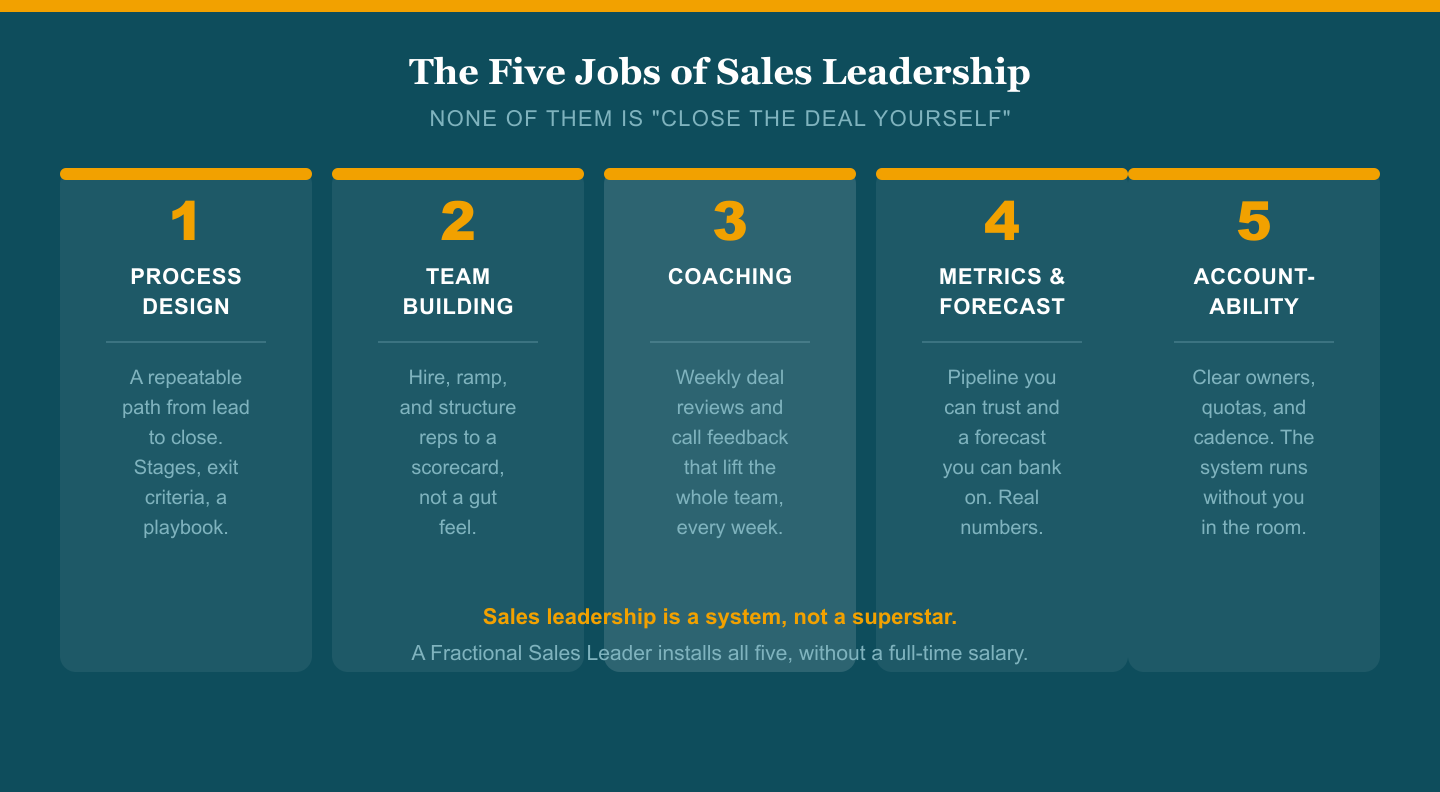
1. Process design. A repeatable path from first touch to closed-won. Defined stages, exit criteria for each stage, and a playbook a new rep can follow without shadowing you for six months. This matters more than founders think. According to CSO Insights, 43% of organizations still don't have a formal sales process. And Harvard Business Review found businesses with a standardized process see up to a 28% increase in revenue over those that don't.
2. Team building. Hiring, ramping, and structuring reps against a scorecard instead of a gut feel. Knowing who to hire, when to hire them, and how to onboard them so they're productive in weeks, not quarters.
3. Coaching. Weekly deal reviews and call feedback that raise the whole team's game. This is the job that compounds. A rep who gets real coaching every week is a different rep in ninety days.
4. Metrics and forecasting. A pipeline you can actually trust and a number you can bank on. Not a CRM full of stale deals and happy-ear guesses, but a forecast built on qualified opportunities with a realistic path to close.
5. Accountability. Clear owners, quotas, and a cadence that holds. Everyone knows their number, everyone knows the rhythm, and the system keeps running whether or not you're in the room. I write this down in what I call an Accountabilities Document, so it survives handoffs, new hires, and your vacation.
Look at that list again. Not one of those five jobs requires the person doing them to be full-time and permanent. They require experience and consistency, which is exactly what a fractional model delivers.
The Real Cost of Waiting
Here's the math founders never run side by side. On the left, the full-time VP. On the right, the fractional model that does the same five jobs.
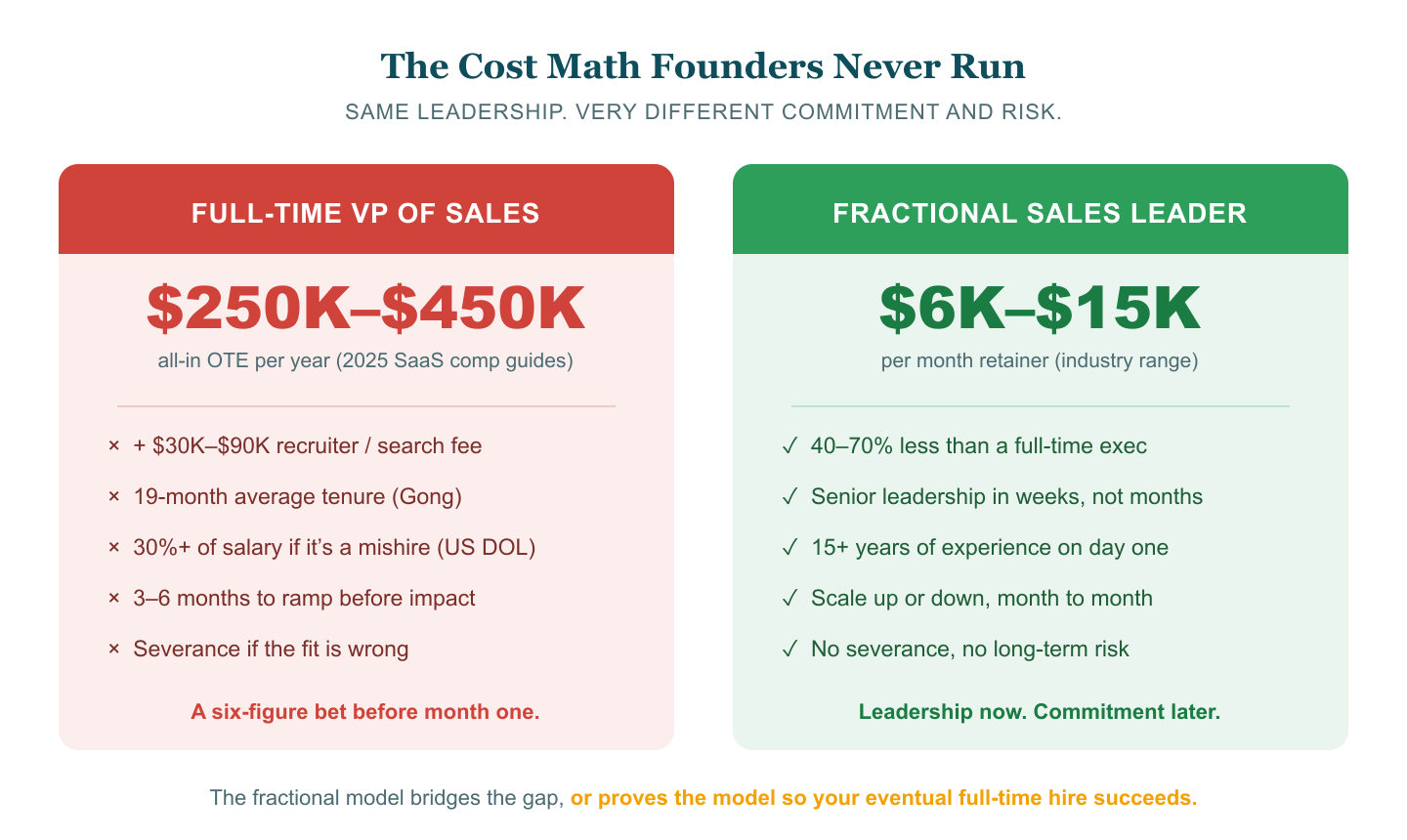
A fractional engagement typically runs $6,000 to $15,000 a month. Across the fractional executive market, companies report roughly 40–70% cost savings versus a full-time hire with comparable skills. And you're not locked in. If you need more of me one month and less the next, the model flexes. There's no severance conversation, no six-month ramp you're paying full freight for, and no recruiter fee.
This isn't a fringe idea anymore. Roughly 25% of U.S. businesses now use some form of fractional hiring, and 72% of CEOs say they plan to increase their use of fractional executives in the next year (industry surveys, 2026). The market has grown up because the math works. You get a senior operator with 15-plus years of experience on day one, at a fraction of the commitment.
Meanwhile, the cost of waiting is real and it's silent. Every month you stay the bottleneck is a month of deals moving at your speed, reps you haven't hired, and a valuation that's capped because the business can't run without you. I wrote more about that in the $250K decision you can't afford to get wrong, and it's worth your ten minutes.
How a Fractional Sales Leader Bridges the Gap
"Fractional" scares some founders because it sounds like part-attention. It isn't. It's full experience on a part-time schedule, focused on the highest-leverage work. Here's how a real engagement runs, step by step.
The First 30 Days: Diagnose Before Prescribing
I don't walk in and start changing things. I listen to calls, review the pipeline, talk to your reps and your customers, and find out what's actually happening versus what the CRM says is happening. Most of the time your CRM is lying to you, and the first job is to find the truth. By day 30 you get a clear read: what's working, what's broken, and what to fix first.
Days 30 to 90: Build the System
This is where the five jobs get installed. We define the stages and exit criteria. We write the playbook. We set the qualification bar so reps stop chasing deals that were never going to close. We put a real forecast cadence in place. And we start weekly coaching, because process without coaching is just a document nobody follows.
The Handoff: Prove the Model, or Set Up the Hire to Win
This is the part that separates a Fractional Sales Leader from a consultant who hands you a slide deck and leaves. I stay until the system runs without me. Then one of two things happens. Either you've grown into a place where a full-time VP genuinely makes sense, and now you're hiring into a functioning machine with a track record, so that hire actually succeeds. Or you've realized you don't need the full-time role at all, because the system does the work.
I've lived both sides of this. I once joined a company as their Fractional Sales Manager, built the process and the team, and a couple of months in they asked me to step up to Fractional Vice President of Sales and join the leadership team. Same person, expanded role, earned by results, not by a job title on day one. That's how this is supposed to work. You prove it, then you scale it.
A full-time VP is a bet on a person. A fractional engagement is an investment in a system. Build the system first, and the person you eventually hire inherits a machine instead of a mess.
When a Fractional Sales Leader Is the Wrong Call
I'd rather lose the engagement than take your money for something that won't work. So let me be straight about who this isn't for.
If you have no product-market fit yet, if you're still figuring out whether anyone will pay for what you've built, you don't need sales leadership. You need to keep selling it yourself. Founder-led sales is the right tool for that stage. You learn the objections, you hear the market, and you can't outsource that discovery. A Fractional Sales Leader can't manufacture demand that isn't there.
If you have zero sales process and zero traction, no reps, no repeatable deals, no signal that the thing sells, then a system has nothing to systematize yet. In that case what you actually need is a few more months of founder-led selling to find the pattern, and then a conversation. The good news is that the honest answer takes one call to figure out, and it costs you nothing to ask.
But if you're between $1M and $10M ARR, you've proven the thing sells, and you're the reason it can't scale? That's the exact spot where a Fractional Sales Leader earns their fee several times over.
Frequently Asked Questions
Q: What's the difference between a Fractional Sales Leader and a sales consultant?
A consultant diagnoses and recommends. They hand you a strategy and a slide deck, then leave you to execute it. A Fractional Sales Leader owns the outcome. I build the system and stay in the seat to run it, coach your reps every week, sit in on deals, and hold the team accountable to the numbers. Consultants advise from the sideline. A Fractional Sales Leader is on the field with your team until it works.
Q: How much does a Fractional Sales Leader cost compared to a full-time VP?
Fractional retainers typically run $6,000 to $15,000 a month depending on scope and time commitment. A full-time VP of Sales runs $250K to $450K all-in once you add base, variable, and equity, plus a 20–30% search fee to hire them. Across the market, companies report 40–70% savings with the fractional model. And you can scale the engagement up or down month to month, which you can't do with a salaried executive.
Q: Will a part-time leader really have enough time for my business?
Fractional doesn't mean distracted. It means focused on the highest-leverage work instead of sitting in every meeting on your calendar. A senior operator can do in half the time what it takes a first-time VP a full week to do, because they've built this system before. You're not buying hours. You're buying judgment and experience applied to the few things that actually move your revenue.
Q: I'm not ready to give up control of my customer relationships. Does this take that away?
No. The goal isn't to pull you out of the relationships that matter. It's to make sure the business doesn't depend on you being in every single one. You stay the founder your best customers want to hear from. We build a team and a system so the other 90% of deals don't need you at all. That's what frees you to work on the business instead of inside every transaction.
Q: How long does a fractional engagement last?
Long enough to build the system and prove it runs without me, and no longer. For most $1M–$10M companies that's somewhere between six and eighteen months. The whole point is to work myself out of the seat. I'm not trying to become a permanent line item. I'm trying to leave you with a functioning sales operation and a decision: hire a full-time leader into a machine that works, or keep the system running as is.
Q: Can a fractional leader help me eventually hire the right full-time VP?
That's one of the most valuable things the model does. By the time you're ready for a full-time VP, you'll have a documented process, a track record, and a clear scorecard for what "good" looks like in your business. That means you hire into a working system instead of asking a new executive to build one from scratch. It's the single biggest reason first VP hires fail, and it's exactly what proving the model first prevents.
You need leadership now. You don't need a $400K bet to get it.
Let's spend 30 minutes on where your sales actually stand, what a system would change, and whether a fractional model is the right call for your stage. If it's not, I'll tell you that too. See how it can help at louiebernstein.com.
Schedule a 30-Minute CallAbout the Author
Louie Bernstein
Fractional Sales Leader with 50 years of sales experience helping $1M–$10M ARR companies build scalable, repeatable sales systems. Founder of MindIQ (INC 500). LinkedIn Top Voice in Sales Management, Sales Operations, and Sales Coaching.