Key Takeaways:
- Founder-led sales past ~$3M ARR costs 3–5x more than it looks once you count opportunity cost and revenue leakage, not just the salary you're "saving."
- Every hour you spend selling is an hour of CEO-level work worth ~$900/hr you're not doing.
- The "Founder Burnout Tax" = lost deals + delayed product and strategy + the literal health cost of burnout on your decisions.
- For most $2M–$5M ARR founders, staying in sales quietly costs $300K–$700K a year in hidden losses.
- A Fractional Sales Leader (~$144K/yr) is the de-risked way to buy that time back, often at a 300%+ ROI once you count what you recover.
You're the founder of a $3 million ARR company. You're closing deals, writing code, managing customer success, and trying to fundraise, all in 70-hour weeks, and you haven't taken a vacation in two years. You tell yourself, "once we hit $5M, I'll hire someone to take over sales." Here's what I know: every month you wait costs you $20,000 to $40,000 in lost opportunity.
This isn't a guilt trip. It's math. When you're stuck in the weeds of sales execution, crafting proposals, running discovery, negotiating contracts, you're not doing the work only you can do as CEO. And that work is worth far more than closing individual deals.
Most founders think about sales cost as a direct expense: "I'm not paying a salary, so founder-led sales is free." That's catastrophically wrong. Founder-led sales carries three categories of hidden cost, and once you add them up, the number is staggering.

Cost #1: Opportunity Cost (The $900/Hour Problem)
If you're a founder of a $3M ARR company, your hourly rate is roughly $900/hour on a 40-hour week, and that's probably low. But your real economic value isn't that average, it's what the company could achieve if you spent that time exclusively on high-leverage CEO work: a strategic partnership that unlocks $500K in new revenue, a product-vision call that prevents a costly pivot, a Series A that extends your runway 18 months, a VP hire who 10x's your technical output, or a 10% price increase that adds $300K to ARR with zero new sales effort. Each of those carries a multiplier, one good decision can generate $100K to $1M in value.
Now track your calendar for a week: prospecting, discovery, demos, proposals, negotiation, follow-ups, internal sales meetings, CRM data entry. Most founders doing sales spend 20–30 hours a week here. Do the math: 25 hours × $900 × 52 weeks is about $1.17M a year in lost CEO productivity. You're not "saving money" by doing sales yourself, you're hemorrhaging it.
Cost #2: Revenue Leakage (The Deals You're Losing)
You close a discovery call with a hot prospect who asks for a proposal by Friday. Then a key customer threatens to churn, your co-founder needs the roadmap, and product has an emergency, so Friday comes and goes. You send it Tuesday; the prospect has gone cold; you've lost a $50,000 deal because you were too busy being CEO to be a good salesperson. That's revenue leakage, and it gets worse as you scale.
Founder-led sales works with 10–15 active opportunities. But at $2M–$5M ARR you need 30–50 to hit growth targets, and that takes daily discipline: moving deals through stages, scheduling follow-ups, nurturing long cycles, re-engaging stalled deals. Run the numbers: a $1.2M pipeline (40 deals at $30K) at a normal 25% close rate should yield $300K. Distracted, your close rate drops to 15%, and you lose $120K a quarter, $480K a year. Add the prospecting blackouts, when you disappear into fundraising and stop outbound entirely, and you create a feast-or-famine cycle that makes it impossible to hire, market, or plan.
Cost #3: The Health Tax (The Cost of Burnout)
You make hundreds of micro-decisions a day doing sales, discount this deal? follow up again? customize the proposal or use the template? Each one depletes your cognitive resources, so by the time you reach the decisions that actually matter, should we pivot the product, should we hire this VP, your judgment has degraded. Decision fatigue pushes you toward risk aversion, impulsive choices, and analysis paralysis, and the cost is poor strategic calls that take months to unwind.
Burnout isn't just emotional, it's physical: weakened immunity, disrupted sleep, strained relationships, and real financial drag from medical costs, coaching, and reduced productivity during recovery. Burned-out founders can need four to six months to return to full cognitive capacity. If you wait until you break, you're looking at half a year of suboptimal performance on top of everything else.
The Founder Burnout Calculator: Your Personal Numbers
Here's how to run it for yourself. Add four numbers. (1) CEO opportunity cost = hours per week on sales × your CEO hourly value ($300–$900) × 52. (2) Revenue leakage = pipeline value × (normal close rate − distracted close rate), times four quarters. (3) New-business drought = (weeks per year with zero prospecting ÷ 4.33) × average monthly new business. (4) Health tax = stress-related medical and coaching costs, plus a 10–20% productivity haircut from decision fatigue. Sum them. For most $2M–$5M ARR founders, the total lands between $300,000 and $700,000 a year. Want it done for you? Run the Founder Burnout Calculator.
A Worked Example: Meet Sarah ($3M ARR SaaS)
Sarah spends 28 hours a week on sales at a $900/hr CEO value. She carries a $1.5M pipeline that closes at 25% normally but 18% when she's distracted, goes dark on prospecting 12 weeks a year for fundraising and launches, books $80K in new business monthly when she's actually prospecting, and spends $5K a year on stress-related health costs. Add it up: $1,310,400 in opportunity cost + $420,000 in leakage + $221,600 in drought + $5,000 in health = $1,957,000 a year. For a $3M ARR company, founder-led sales is quietly costing her nearly two-thirds of revenue.
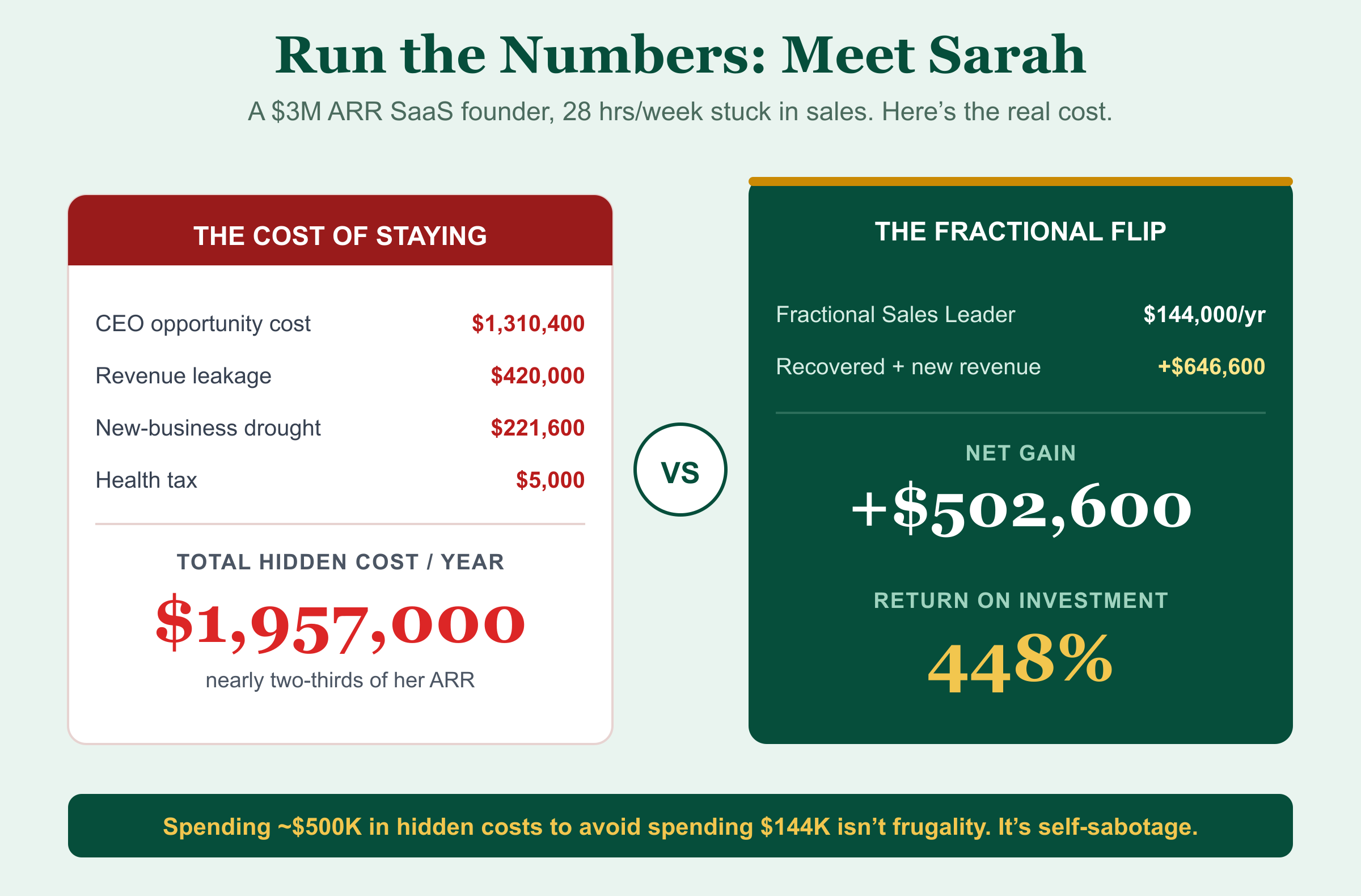
Now run it in reverse. Sarah hires a Fractional Sales Leader at $12,000/month, $144,000 a year. She gets 28 hours a week back for CEO work (a partnership worth +$400K ARR, a Series A, a key VP hire worth +$200K ARR), her close rate returns to 25% (+$420K recovered), the prospecting blackouts end (+$221,600 recovered), and her health and decision-making improve. Conservatively, that's about $646,600 in recovered and new revenue against $144K in cost, a net gain of roughly $502,600 and a 448% ROI. She pays $12K a month and gets back over $1M in recovered and new revenue.
Why Founders Resist the Math
If it's this obvious, why do founders keep doing sales themselves? It comes down to three objections. "I'm the best salesperson we have." True, but that's a symptom of a broken system, not a reason to stay, if you're the only one who can close, you've built a dependency, not a process. A Fractional Leader's job is to extract your sales IP into a transferable system; within 90 days your reps should close at 70–80% of your effectiveness, and match you within six months, which is exactly what a Fractional Sales Leader does.
"I don't trust anyone else with our customers." That's fear dressed up as quality control. Customers don't need you, they need a consistent, professional experience, which a trained rep on a documented playbook delivers better than you do frazzled between board meetings. And "I can't afford to hire someone yet." You can't afford not to: doing sales yourself costs $300K–$700K a year, a Fractional Leader costs $144K. Choosing to spend $500K in hidden costs to avoid a $144K line item isn't frugality, it's financial self-sabotage.
The Transition Plan: How to Get Your Time Back
You can offload sales without wrecking your pipeline, over about six months. Month 1 is audit and build: the Fractional Leader shadows your calls, reviews your CRM, and interviews early customers, then builds the sales playbook, the CRM workflows, and an accountabilities document that defines what success looks like for each role. You're still closing during this phase, just no longer alone.
Months 2–3 are transition and train: hire one or two dedicated salespeople (or train your juniors) and hand off deals in stages, you run discovery while they shadow, then they run it while you shadow, then they run it independently while the Fractional Leader coaches. By the end of month 3 you're only closing the strategic deals reps tee up for you. Months 4–6 are the full handoff: by month 6 you're out of sales execution entirely, attending the weekly pipeline review as an observer, with your calendar finally freed for the CEO work only you can do.
A Real Client: Kevin's Transformation
One client, Kevin, runs a SaaS point-of-sale company and was doing half the sales himself, 65-hour weeks, turning down partnerships for lack of time, missing product-roadmap meetings. We built a complete sales playbook in 30 days, hired and trained two junior salespeople, and took over pipeline management and daily sales operations. Twelve months later his sales time was down 65% (to about 8 hours a week on strategic deals only), the "Kevin is the bottleneck" complaints were gone, and he took his first two-week vacation in four years. In his words: "Thank you Louie for what you have done in the past year. I believe our sales are far better than where they were a year ago, great job!"
"Founders should do sales until they prove the model, then build the system that scales beyond them. If you're at $2M+ ARR and still the primary salesperson, you're not being scrappy, you're being expensive."
Related Reading
Frequently Asked Questions
Q: At what revenue point should I stop doing sales myself?
The inflection point is typically $1M–$2M ARR. Below $1M, founder-led sales is necessary to prove product-market fit. Above $2M, you should be transitioning out, and by $5M, if you're still the primary closer, you're leaving significant money on the table and capping your own scalability. The longer you wait, the higher the hidden cost compounds.
Q: What if I actually enjoy doing sales?
Enjoyment isn't a good reason to stay in execution mode. Plenty of founders enjoy coding, but they don't spend 30 hours a week writing code at $3M ARR. Weigh enjoyment against opportunity cost. Stay involved in the strategic deals you love (the $500K enterprise account), but daily sales execution, discovery, proposals, follow-ups, should be delegated to a system built to run without you.
Q: How do I calculate my CEO hourly value if I'm bootstrapped and barely paying myself?
Your CEO value isn't your salary, it's the economic value of your strategic decisions. Ask: "What could I unlock with 20 more hours a week?" A partnership, a fundraise, a key hire, a pricing change? Estimate the revenue or savings those outcomes create, divide by the hours required, and that's your CEO hourly rate. For most founders it's at least $300–$500 an hour, and often far more.
Q: Can I use this to convince my co-founder or board that we need to hire?
Yes, that's exactly what it's for. Run the numbers, show them the hidden costs, and present the Fractional Sales Leader as a de-risked alternative to a full-time VP hire. The ROI is hard to argue with once you include opportunity cost and revenue leakage, not just the headline retainer. It reframes the conversation from "can we afford to hire?" to "can we afford not to?"
Q: What if a Fractional Sales Leader doesn't perform as well as me at first?
Expect a ramp. Your close rate may dip slightly while the new process is installed and reps are trained. That's temporary. Within 90 days a well-trained team following a documented playbook should match your performance, and within six months exceed it, because they're not splitting attention across product, fundraising, and everything else you carry as CEO. The short-term dip buys you a permanent, scalable system.
Q: Is a Fractional Sales Leader cheaper than hiring a full-time VP?
Considerably, and less risky. A Fractional Leader runs roughly $144K a year with no equity, benefits, severance, or recruiting fees, versus a full-time VP whose all-in cost pushes $400K, where you can spend ~$150K before you even know the hire worked. For a company that needs the system built rather than scaled, the fractional path is the right first move. Here's the full VP vs. Fractional breakdown.
Stop bleeding money. Start building leverage.
Run the numbers on your own business, then decide the thing your future self will thank you for. I built a detailed Founder Burnout / ROI calculator that walks you through this exact analysis. Run it at louiebernstein.com/tools/roi-calculator.
Schedule a 30-Minute CallAbout the Author
Louie Bernstein
Fractional Sales Leader with 50 years of sales experience helping $1M–$10M ARR companies build scalable, repeatable sales systems. Founder of MindIQ (INC 500). LinkedIn Top Voice in Sales Management, Sales Operations, and Sales Coaching.