Key Takeaways:
- A sales consultant advises. A fractional sales manager executes. That single distinction decides which one is worth your money.
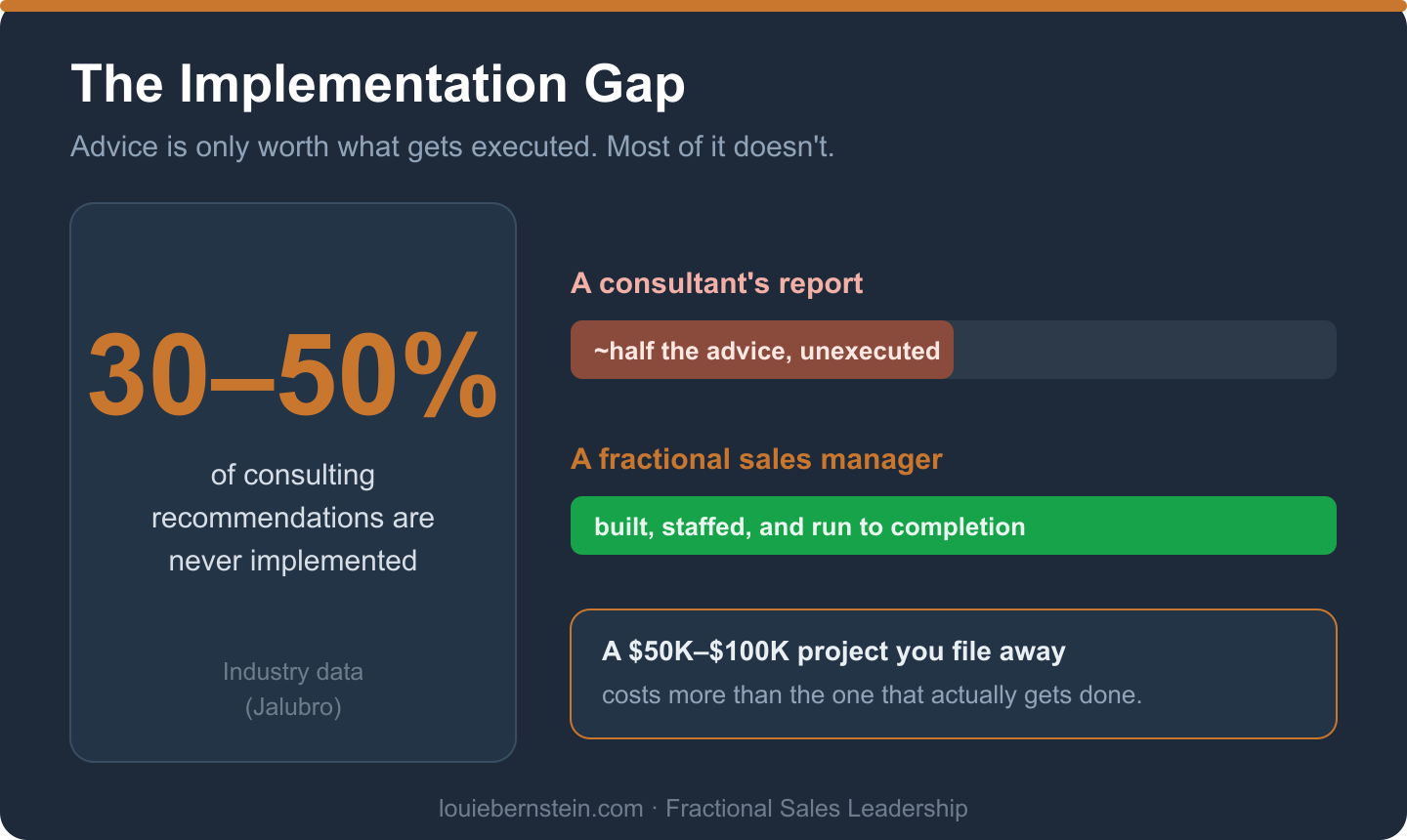
- A consultant hands you a report and recommendations, then leaves. Between 30% and 50% of consulting recommendations are never implemented (industry data, Jalubro), so you're often paying for advice that never gets used.
- A fractional sales manager (I use the title Fractional Sales Leader) builds the system, runs it week to week, and holds your reps accountable to the number.
- If you're a founder at $1M–$10M ARR with no documented sales process, a consultant's report will sit in a drawer. You don't have the execution layer to act on it. You need a doer, not an advisor.
- If you already have a working team and just want an outside audit, a consultant can be the right, cheaper call. I'll tell you when that's you.
A founder emailed me last month with one line. "I've talked to two sales consultants and a fractional sales manager, and I honestly can't tell the difference. They all say they'll fix my sales. Who do I actually hire?"
It's a fair question. The titles get used like they mean the same thing. They don't. And picking the wrong one when you're stuck between $1M and $10M ARR isn't a small mistake. It's months of lost momentum and a five-figure check with nothing to show for it.
So let me draw the line clearly, the way I'd draw it for you on a call.
A consultant gives you a map. A fractional sales manager gets in the car and drives with you until you know the route cold.
Why "Manager" and "Consultant" Get Blurred Together
The fractional market has exploded, and the language hasn't kept up. Fractional sales leaders in the US and Canada grew from about 5,000 in 2020 to 9,000 in 2024, an 80% jump in four years (Vendux). Roughly 25% of US companies now use fractional executives, and that's projected to climb toward 35% (Sci-Tech Today). When a market grows that fast, everyone rushes to describe what they do, and the words get sloppy.
Consultants call themselves fractional. Fractional operators call themselves consultants. Both promise to "fix your sales." The label on the LinkedIn profile tells you almost nothing. What tells you everything is one question: at the end of the engagement, do you have a document, or do you have a running sales team? That's the whole ballgame.
The Sales Consultant: The Advisor
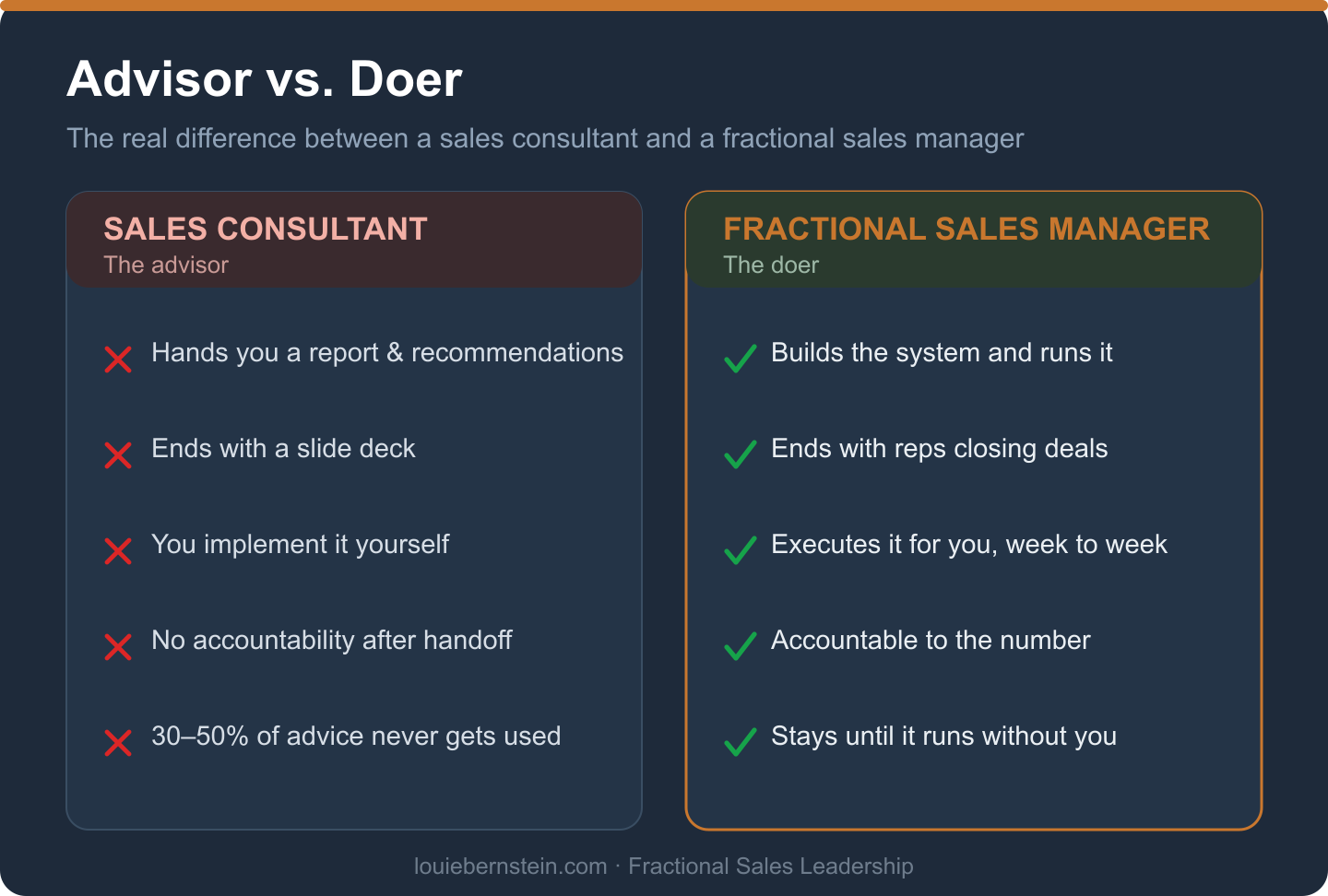
A sales consultant is hired to diagnose and recommend. They study your funnel, interview your team, benchmark you against the market, and hand you a set of recommendations. Good consultants are sharp. The analysis is often genuinely useful. The deliverable is knowledge.
What a sales consultant actually does
- Audits your current sales process and points out where deals leak
- Benchmarks your metrics against companies at your stage
- Recommends a strategy, a tech stack, or a new comp plan
- Delivers a report, a framework, and usually a slide deck
- Hands it to you and moves on to the next client
Who a consultant is right for
A consultant is a strong fit when you already have a functioning sales team and a manager to execute the advice. You have the hands to do the work. What you're missing is an outside diagnosis, a second opinion on strategy, or a specific expertise you don't have in-house. In that situation, an advisor is exactly right, and it's the cheaper option.
What a consultant costs
Sales consulting is priced by the project or the day. Day rates commonly run $1,500–$5,000, and a comprehensive project for a mid-market company typically lands between $50,000 and $100,000+ (industry benchmarks). Here's the catch that nobody prints on the invoice: you're paying for the recommendation, not the result. The execution is still entirely on you.
A consultant's report is only worth what you execute from it. If nobody on your team has the time or the skill to run the plan, the report is an expensive paperweight.
The Fractional Sales Manager: The Doer
A fractional sales manager doesn't just tell you what to do. They do it. I call the role Fractional Sales Leader, because "manager" undersells the job at your stage. You're not paying for a diagnosis. You're paying for someone to build the machine and run it until it runs without them.
What a fractional sales manager actually does
- Extracts what's in the founder's head and writes it into a real Sales Playbook
- Builds the pipeline stages, the CRM setup, and the qualification standard
- Creates the hiring infrastructure: Ideal Candidate Profile, structured interviews, an Accountability Document, and an onboarding plan
- Runs the weekly cadence: pipeline reviews, coaching, one-on-ones
- Holds the reps accountable to documented numbers, week after week
- Stays in the seat until the founder can step out and the system holds
Who a fractional sales manager is right for
This is the role for founders between $1M and $10M ARR who are still closing most of the deals themselves. There's no documented process, no playbook a new rep could pick up, and a CRM that's more fiction than fact. You don't need someone to tell you it's broken. You already know. You need someone to fix it with their own hands.
What a fractional sales manager costs
A fractional engagement is a monthly retainer, often in the $8,000–$15,000 range depending on scope, for part-time leadership that's in your pipeline every week. Compare that to $200,000–$280,000 in total comp for a full-time VP of Sales who will struggle without the infrastructure a fractional leader builds first. You're not buying advice. You're buying execution, at a fraction of the full-time cost.
Side by Side: Where the Money Actually Goes
| Dimension | Sales Consultant | Fractional Sales Manager |
|---|---|---|
| Core job | Diagnose and recommend | Build and run |
| Deliverable | A report and a slide deck | A working sales team and system |
| Who executes | You do | They do, with your team |
| Accountability | Ends at handoff | Weekly, to the number |
| Pricing | Project or day rate | Monthly retainer |
| Best when | You have a team to act on it | You're still doing the selling |
| Biggest risk | Advice never gets implemented | Weaker fit once you're truly scaling a large team |
The Mistake I See Founders Make
A founder at $3M ARR knows sales is a mess, so they hire a consultant. Smart firm, thorough audit. Six weeks later a 40-page report lands in the inbox. New qualification criteria, a redesigned pipeline, a comp plan overhaul, an outbound cadence. All of it correct. All of it useful.
Then nothing happens. The founder is still closing deals all day. The two reps are still winging it. Nobody owns rolling out the new process, training the team, or inspecting whether any of it sticks. The report gets read once and filed. This isn't rare. Somewhere between 30% and 50% of consulting recommendations are never implemented (industry data, Jalubro), and it's usually not because the advice was wrong. It's because there was no one to do the work.
Harvard Business Review made this point decades ago in a piece literally titled "Consulting Is More Than Giving Advice" (HBR, 1982). Advice without execution rarely changes anything. At your stage, execution is the entire problem.
If you were going to implement the plan yourself, you were never short on advice. You were short on time, on process, and on someone to run it. That's a doer's job, not an advisor's.
How to Tell Which One You Need Right Now
Answer these three questions honestly.
1. Do you have a team that can execute a plan?
If you have sales reps and a manager who can take a set of recommendations and run with them, a consultant can add real value. If you're the manager, the closer, and the trainer all at once, a report just adds to your to-do list. You need a doer.
2. Is your gap knowledge, or is it capacity?
A knowledge gap ("I don't know what good looks like") is a consultant problem. A capacity gap ("I know roughly what to do, I just can't be the one to do it") is a fractional sales manager problem. Most founders I talk to have a capacity problem and keep shopping for knowledge.
3. What do you need to exist in 90 days?
If the answer is "a clear strategy and a second opinion," hire the advisor. If the answer is "a written playbook, a rep who's actually producing, and me out of the weeds," hire the doer. Name the outcome first, and the right role picks itself.
Where I Fit In, and Where I Don't
I'm a Fractional Sales Leader. I work with B2B founders between $1M and $10M ARR who are still closing most of their own deals and have no real system underneath them. I come in and build it. The playbook, the pipeline, the CRM, the hiring, the coaching cadence. Then I run it week to week until you can step out and it holds.
Here's the honest part. If you have no sales systems or processes in place, a consultant is the wrong first move for you. You'll get a smart report you don't have the bandwidth to execute, and it'll gather dust. That founder needs a doer who builds the foundation, not an advisor who describes it.
And if you already have a functioning team and a capable manager, and you just want a sharp outside read on strategy, I'll tell you a consultant is the better, cheaper fit, and I'll mean it. I'd rather point you to the right answer than sell you the wrong one.
Related Reading
Fractional Sales Leader vs. Fractional VP of Sales vs. Fractional CRO: Which One Do You Actually Need? — once you've settled advisor vs. doer, this breaks down the three fractional operator roles by stage, scope, and price.
When should I hire a fractional sales manager?
Hire a fractional sales manager when you have reps but nobody managing them, you're personally running sales and it's draining you, or your forecast feels like guesswork — and you can't yet justify a full-time sales leader.
- Trigger signs: reps missing quota repeatedly, no structured coaching cadence, and you're still the de facto sales manager.
- Cost and speed: typically $3,000–$9,000/month and onboarded in weeks — versus months and $250K+ to recruit a full-time VP.
- Duration: most engagements run 3–12 months — long enough to install structure and coaching without a permanent overhead line.
Frequently Asked Questions
Q: What's the real difference between a sales consultant and a fractional sales manager?
A consultant advises and a fractional sales manager executes. The consultant studies your sales, hands you recommendations, and leaves. The fractional manager writes the playbook, trains the reps, runs the pipeline reviews, and stays accountable to the numbers week over week. One gives you a map. The other drives with you.
Q: Is a fractional sales manager the same thing as a Fractional Sales Leader?
In practice, yes. I use the title Fractional Sales Leader because at the $1M–$10M ARR stage the job is bigger than managing a team. You're building the whole system before there's a team to manage. The word "manager" is what most founders search for, but the work is leadership and construction, not just supervision.
Q: A consultant quoted me less than a fractional retainer. Isn't that cheaper?
Only if you execute the advice. A $50,000 project is not cheaper than a retainer if 30–50% of it never gets implemented (industry data, Jalubro). Price the outcome, not the invoice. A smaller check that produces a running sales team beats a larger check that produces a report you can't act on.
Q: Can a sales consultant help a founder who has no sales process at all?
Rarely, and I'll be blunt about it. If there's no team and no process, there's no one to hand the recommendations to. The founder becomes the implementer on top of everything else they're already doing, and the plan stalls. A founder starting from zero needs someone who builds and runs, not someone who advises and exits.
Q: How long does a fractional sales manager engagement last?
Long enough to build the system and prove it runs without them, usually several months to a year or more. The goal is to work themselves out of a job. By the end you should have a documented process, a rep producing consistently, and a CRM you trust. A consultant's engagement ends when the report is delivered. A fractional manager's ends when the machine runs on its own.
Q: When is a consultant genuinely the better choice?
When you already have a working sales team and a manager who can act on the advice, and your gap is knowledge rather than capacity. In that case you don't need someone to run your sales. You need a sharp outside diagnosis, and a consultant delivers that for less. The right hire always matches the actual gap.
Need a doer, not another report?
If you're a founder stuck in your own sales and you want the system built and run, not just diagnosed, see how a Fractional Sales Leader works and whether it fits where you are.
See How It Can Help YouOr grab a 30-minute call and I'll tell you straight which role you need.
About the Author
Louie Bernstein
Fractional Sales Leader with 50 years of sales experience helping $1M–$10M ARR companies build scalable, repeatable sales systems. Founder of MindIQ (INC 500). LinkedIn Top Voice in Sales Management, Sales Operations, and Sales Coaching.