Key Takeaways:
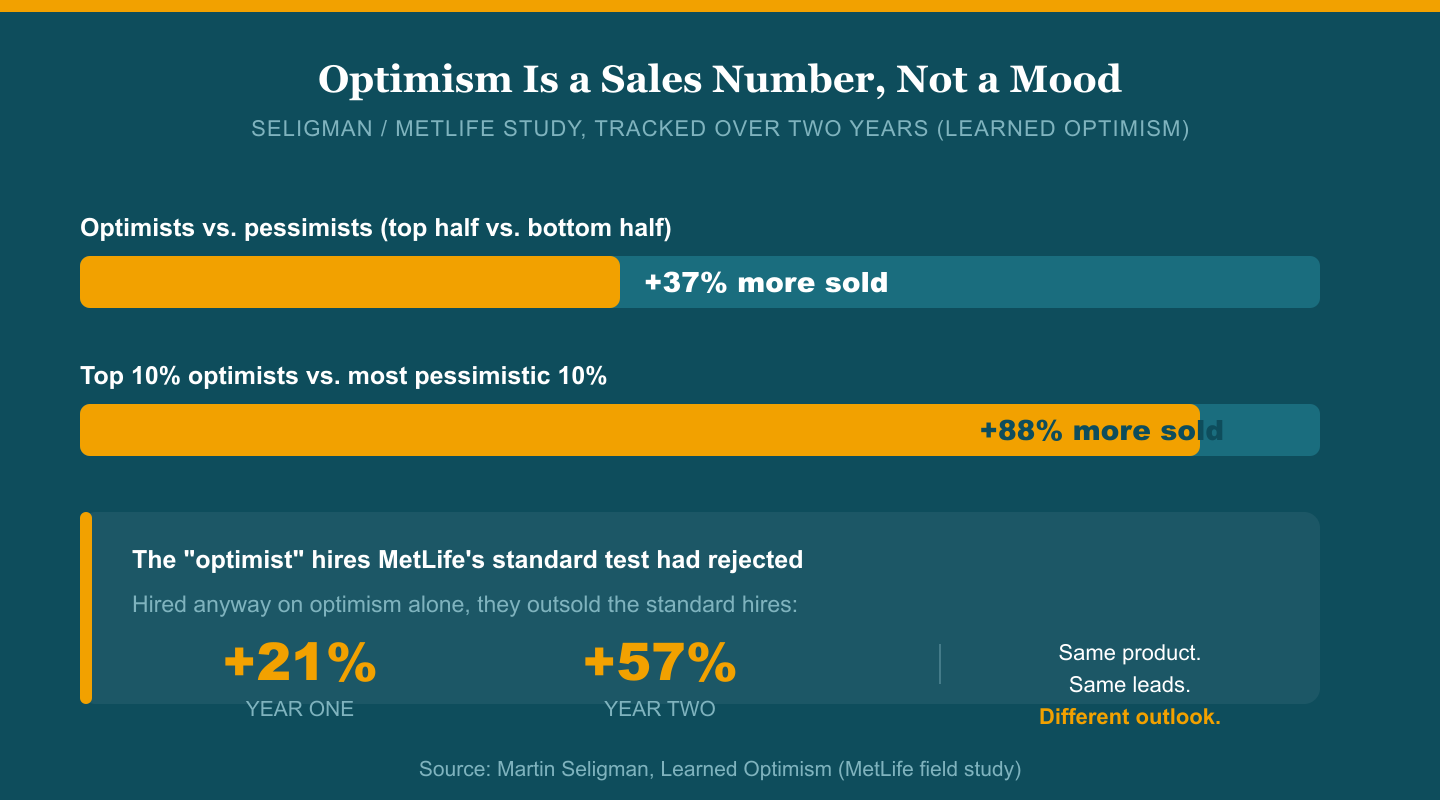
- Attitude isn't a soft, feel-good extra. Optimistic salespeople outsold pessimists by 37% over two years, and the top 10% of optimists outsold the most pessimistic 10% by 88% (Seligman, MetLife).
- A bad attitude is contagious. One negative team member drops the whole group's performance by 30% to 40% (Felps, University of Washington), and your prospects feel it before they ever say no.
- You can't demand a good attitude into existence. You hire for it, you model it, and you build the conditions that make it the easy choice.
- One toxic hire costs a company about $12,489 in turnover alone, nearly double the $5,303 a superstar adds (Housman & Minor, Harvard). Keeping the wrong attitude on the team is the expensive choice, not the kind one.
- Most "attitude problems" are really clarity problems. When people don't know what winning looks like, they check out.
- Hire for attitude, train for skill, coach relentlessly, and remove the wrong one fast. That's how you build a team people actually want to buy from.
Founders ask me this one a lot. "Louie, how do I get my salespeople to have a good attitude?"
Usually there's a story behind it. One rep who's negative in every meeting. A team that used to have fire and somehow lost it. A quota that keeps getting missed while everyone shrugs. The founder is still doing most of the selling themselves, and they can feel the mood in the room dragging the whole business down.
Here's the honest answer. You don't get a good attitude by asking for one. Attitude is an output. It's the result of who you hire, what you tolerate, how clearly you lead, and whether you're willing to remove the person poisoning the room. I don't fully buy the old adage that "attitude is everything." But I'll tell you this after fifty years in sales. When you've got the right attitude on a team, everything else gets easier. And when you've got the wrong one, it will quietly kill your business.
If you're a founder somewhere between $1M and $10M in revenue, still carrying the sales load yourself, this isn't a personality issue to manage around. It's a leadership problem to solve. Let me show you how.
Attitude Is a Sales Multiplier, Not a Personality Trait
Let's kill the idea that attitude is fluffy. It's one of the most measurable predictors of sales performance we have.
Back in the 1980s, psychologist Martin Seligman ran a study with MetLife that every founder should know about. He tested sales agents for optimism and then tracked what they actually sold. The optimistic half outsold the pessimistic half by 37% over two years. The agents in the top 10% for optimism outsold the most pessimistic 10% by 88% (Seligman, Learned Optimism). Same product. Same leads. Same training. The difference was outlook.
Then Seligman did something bolder. He convinced MetLife to hire a group of people who had failed the company's standard screening test but scored as strong optimists. That group outsold the regular hires by 21% in year one and 57% in year two. MetLife had been rejecting some of its best future salespeople because it was measuring the wrong thing.
Why does this happen? Because sales is a job built on rejection. A pessimist hears "no" and concludes the market is bad, the product's overpriced, and they're not cut out for this. An optimist hears the same "no" and concludes that particular prospect wasn't ready, and dials the next one. Over a quarter, that gap compounds into a massive difference in activity, and activity is what fills a pipeline.
"YOU are in control of your attitude, every minute of your waking day. Things happen around you, but you have the power to decide how you'll respond. That's the real meaning of freedom."
I wrote that line in my sales training years ago and I still believe every word of it. A good attitude isn't luck and it isn't personality. It's a choice your people make, or don't. Your job as the leader is to make the right choice the obvious one.
The Wrong Attitude Is Contagious, and Your Customers Can Feel It
Here's the part founders underestimate. A bad attitude doesn't stay contained to one rep. It spreads.
Researcher Will Felps ran a now-famous experiment at the University of Washington. He planted a single actor inside small teams and had him play one of three roles: the jerk, the slacker, or the downer. Teams with that one bad apple performed 30% to 40% worse than teams without one, even when the other members were talented and motivated (Felps, University of Washington). Worse, the healthy members started copying the bad behavior. The negativity became the culture.
Now put a dollar figure on it. A Harvard study of 50,000 workers found that one toxic employee costs a company about $12,489 in turnover alone, nearly double the $5,303 a top performer adds in value (Housman & Minor, Harvard Business School). Read that again. Removing a toxic person is worth more to your business than hiring a superstar. Founders keep the wrong salesperson around because firing feels expensive. Keeping them is what's actually expensive.
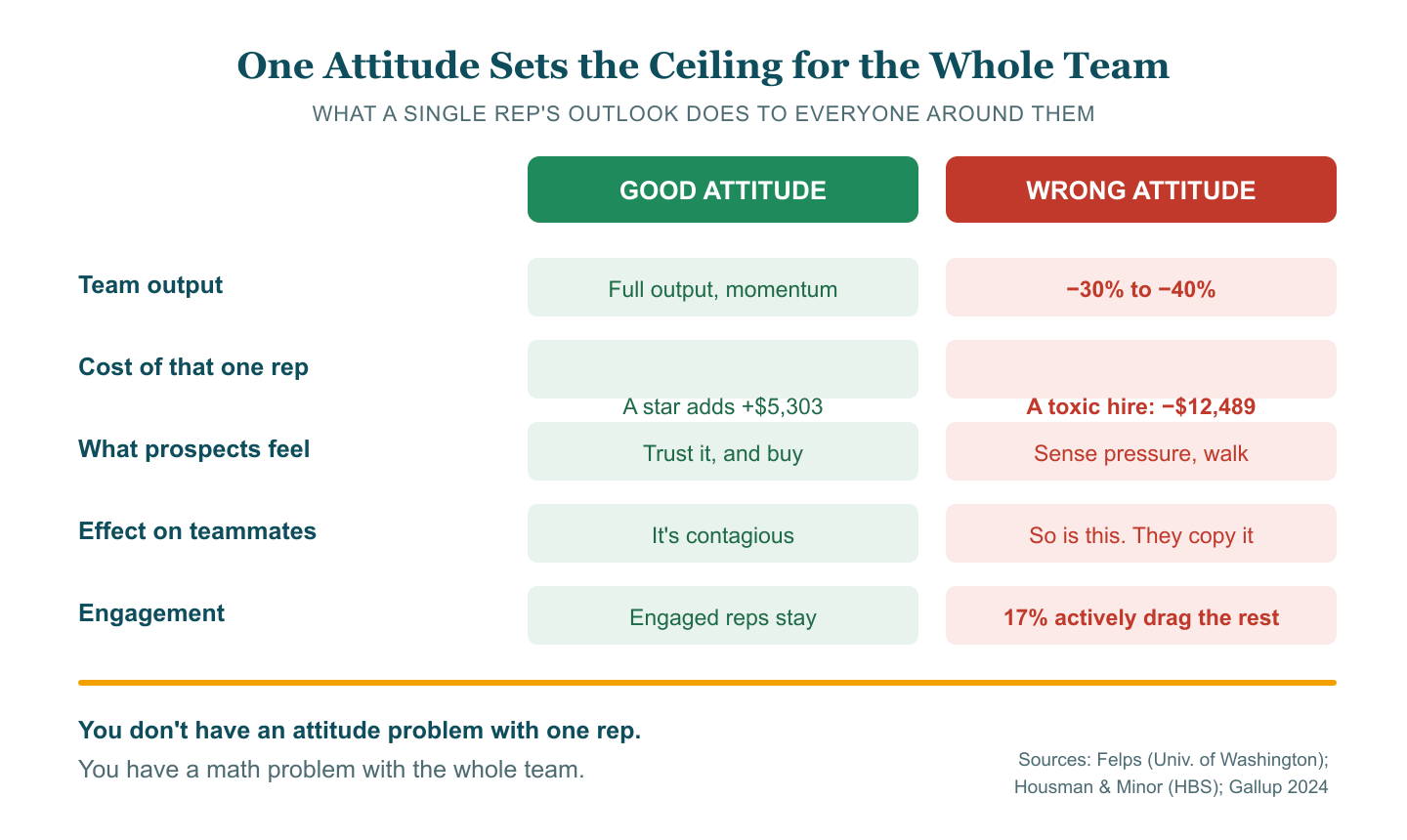
And it doesn't stop at the team. It walks right onto the sales call. I've said for years that just as a good attitude can be felt over the phone, a negative one can be felt too. Your prospect senses the pressure, the resentment, the going-through-the-motions. And people don't buy from someone they don't trust. A rep with a rotten attitude isn't just underperforming, they're actively repelling the customers you spent money and time to attract.
A good attitude is contagious. So is a bad one. The only question is which one you're letting set the temperature in the room.
You Hire for Attitude. You Train for Skill.
Here's the truth most founders learn the hard way. You can teach product knowledge. You can teach a sales process. You can teach objection handling and discovery and closing. What you can't teach, at least not in any reasonable timeframe, is a person's baseline attitude toward work, rejection, and other people.
So stop hiring the slick résumé with the sour disposition and hoping the disposition improves. It won't. Hire the person with the right attitude and coachable energy, and build the skills into them. A hungry, positive rep with average skills will out-earn a skilled cynic every time, because the positive rep keeps showing up, keeps improving, and keeps the room lifted.
What does the right attitude actually look like in an interview? Watch for these signals:
- They take ownership. Ask about a deal they lost. Do they blame the market and the product, or do they tell you what they'd do differently?
- They stay positive when they're down. The real test of attitude isn't how someone acts after a win. It's how they carry themselves through a dry spell.
- They're curious, not defensive. Offer a small piece of coaching in the interview. Do they lean in, or do they explain why they're already right?
- They talk about the customer, not just the commission. The best salespeople genuinely want to help. It shows up in how they describe past clients.
Get this filter right at the front door and you solve half your attitude problems before they ever start. Get it wrong, and you'll spend the next year managing a mood you were never going to fix. If you want a deeper cut on this, read how to recruit and retain top sales talent.
Five Things That Actually Build a Good Attitude on a Sales Team
You've got the right people. Now here's how you build and protect the attitude day to day. This is the work, and it's mostly on you.
1. Model it yourself, every single day
Your team's attitude will never rise above yours. If you walk in stressed, short, and pessimistic about the quarter, that's the temperature you've set. I'm not telling you to fake it. I'm telling you that before you get out of the car or open your laptop, do one thing that puts you in a strong state of mind. The founder sets the weather. Own that.
2. Give people a clear picture of what winning looks like
Most bad attitudes are really just confusion in disguise. When a rep doesn't know exactly what's expected, how they're measured, or what "good" looks like, they disengage to protect themselves. Write it down. Numbers, activities, behaviors. I call it an Accountability Document, and it turns a vague "do better" into a target people can actually hit.
3. Coach in short, consistent doses
Attitude feeds on progress. A rep who's improving is a rep who's engaged. So don't save feedback for the quarterly review. Run a fifteen-minute coaching huddle in the morning. Play a great call the team can learn from. Reinforce what went right out loud. When people can see themselves getting better, the negativity has nowhere to live.
4. Recognize effort and behavior, not just closed deals
If the only thing you ever celebrate is the signed contract, everyone who's in a slump feels invisible, and invisible people get cynical. Catch people doing the right things. The great discovery call. The tough prospect they didn't give up on. Recognition is cheap and it's the single most underused motivation tool a founder has.
5. Deal with the bad apple fast
Every founder knows who it is. The person who rolls their eyes in the meeting, undercuts the new hire, and treats every initiative like a joke. You've been hoping they'd turn around. They won't, and the Felps and Harvard numbers tell you exactly what it's costing you while you wait. Have the direct conversation. Set a clear expectation and a timeline. And if it doesn't change, let them go. Your team is watching what you tolerate, and tolerating it is a decision.
You're not responsible for someone else's attitude. That's on them. But you are one hundred percent responsible for whether you keep paying them to spread it.
When It's Not an Attitude Problem, It's a Leadership Gap
Before you blame your people, look at the system they're working in. Globally, only 21% of employees are engaged at work, and 17% are actively disengaged (Gallup, State of the Global Workplace 2024). Gallup puts the cost of that disengagement at $8.9 trillion, roughly 9% of global GDP. That is not a coincidence of bad personalities. It's a leadership vacuum at scale.
On a small sales team, a founder-sized version of that vacuum shows up as attitude problems. No clear process, so people wing it and lose. No pipeline discipline, so they can't see progress. No coaching, so they never improve. No accountability, so the good ones resent carrying the weak ones. Fix the system and a lot of "bad attitudes" quietly turn back into good ones, because now the job is winnable.
This is exactly the work I do with founders. Not a rah-rah speech that wears off by Thursday, but the actual scaffolding, hiring for attitude, an Accountability Document, a repeatable process, and a coaching rhythm, that makes a good attitude the natural result rather than something you have to beg for. You don't need a full-time VP of Sales to put that in place. A Fractional Sales Leader builds it with you.
One honest caveat. If you've got no sales system in place at all, no process, no metrics, no structure, then attitude coaching by itself won't save you. You can't motivate your way out of chaos. The good news is that building the system and building the attitude are the same project, and that's where the real turnaround starts.
Frequently Asked Questions
Q: Can you actually change a salesperson's attitude, or are they just wired that way?
You can influence it, but you can't install it. Seligman's own work proved optimism can be learned, so a fundamentally decent person in a bad rut can absolutely be coached back. What you can't do is transform a genuinely negative, blame-everything person into a positive one through willpower and pep talks. That's why hiring for attitude matters so much. It's far easier to protect a good attitude than to manufacture one that was never there.
Q: One of my best closers has a terrible attitude. Do I really have to let a top producer go?
This is the hardest call a founder makes, and the Harvard data is blunt about it. A toxic worker costs roughly $12,489 in turnover damage versus the $5,303 a superstar adds, because the toxic person drives your other good people out the door. First, have the direct conversation. Sometimes a top producer genuinely doesn't realize the effect they're having. Set a clear expectation and a timeline. But if nothing changes, understand that the revenue they bring in is very likely less than the revenue and morale they're destroying around them.
Q: Isn't "good attitude" just code for being fake and happy all the time?
No, and if that's what you're rewarding you'll get performers, not producers. A good attitude in sales means ownership, resilience after a "no," coachability, and genuinely wanting to help the customer. It has nothing to do with being cheerful in the hallway. Some of the best attitudes I've worked with belonged to quiet, serious people. What they shared was that they took responsibility, kept improving, and never poisoned the room.
Q: How do I keep morale up when the team is in a slump and deals aren't closing?
Shift what you celebrate. In a slump, closed deals go quiet, so if that's the only thing you recognize, everyone feels like a loser. Start recognizing the leading activities and behaviors instead, the strong discovery calls, the follow-up discipline, the prospects your reps didn't give up on. Progress you can see keeps attitude alive while the results catch up. And keep your own attitude steady, because the team reads yours first.
Q: I'm the founder and I'm burned out. How can I set the tone when I'm running on empty?
Fair question, and an honest one. You can't pour into your team from an empty cup, and they can feel your exhaustion even when you think you're hiding it. Part of the reason founders burn out is they're still carrying the entire sales function personally. Building a real system, and bringing in help to lead it, is what takes the weight off so you can actually lead again. Fixing your own bandwidth is often step one in fixing the team's attitude.
Q: How fast should I expect an attitude to improve once I address it?
If it's a good person in a rough patch, you'll often see a shift within a few weeks of clear expectations, real coaching, and visible progress. If it's a genuine character issue, you'll usually know within 30 to 60 days of a direct conversation whether they're willing to change. Set the timeline out loud when you have the talk. That way it's not a surprise later, and you're making a decision on evidence instead of hope.
A good attitude is built, not demanded.
The right attitude on your sales team comes from the right people, clear expectations, real coaching, and a leader who won't tolerate the wrong one. That's the system I build with founders at $1M to $10M in revenue inside The Founder's Corner. If you're serious about fixing it and not just venting about it, this is where you start.
See How The Founder's Corner Works →Prefer to just talk it through? Book a 30-minute call.
About the Author
Louie Bernstein
Fractional Sales Leader with 50 years of sales experience helping $1M–$10M ARR companies build scalable, repeatable sales systems. He built and led his own team through four recessions over 22 years and made the INC 500 as founder of MindIQ. LinkedIn Top Voice in Sales Management, Sales Operations, and Sales Coaching.