Key Takeaways:
- If you're a founder between $1M and $10M ARR, making a VP of Sales your first real sales hire is the most expensive move on the menu. You're paying a premium to have someone build a system that should already exist before they arrive.
- The math is against you. The average VP of Sales now lasts just 19 months, down from 26 (Gong), and a typical VP runs $250K to $450K OTE (2025 SaaS comp benchmarks). Miss on the hire and the U.S. Department of Labor puts the floor at 30% of first-year pay, before you count the lost pipeline.
- A VP is a driver, not a mechanic. Hand them a documented process and reps to run it, they'll scale it. Hand them a blank page and your calendar, they'll spend a year improvising the thing you needed built.
- The better first move is a Fractional Sales Leader plus two sales reps. You get senior leadership building the process and coaching the reps, for a fraction of a full-time VP's cost, with none of the long lock-in.
- Hire the VP later, on purpose, once there's an engine worth handing off. That's a promotion into a working system, not a rescue mission with a $300K price tag.
Founders ask me how to hire a VP of Sales all the time. They're at $2M, maybe $4M, drowning in the sales work themselves, and they've decided the fix is to go find a heavy hitter who'll take it off their plate and build the machine. It's a reasonable instinct. It's also the wrong first move, and I'll show you both the how and the why.
Here's the trap. When you're stuck in founder-led sales, a VP of Sales looks like the rescue. But you're not hiring leadership yet. You're hiring construction. There's no process to lead, no playbook to enforce, no team to manage. There's you, your instincts, and a pipeline that only moves when you personally push it. Drop a $300K executive into that and you haven't bought a machine. You've bought a very expensive person to invent one, on your dime, on a clock that's shorter than the job.
So let's do this properly. I'll walk you through how you'd actually hire a VP of Sales the right way. Then I'll show you the numbers on why you shouldn't lead with it, and the sequence I put founders on instead.
First, Here's How You'd Actually Hire a VP of Sales
I'm not going to pretend the role never makes sense. It does, eventually. If you're going to hire a VP of Sales for a B2B startup, here's how you do it without lighting money on fire.
Define the job before you ever post it
Most VP searches fail before the first interview because the founder can't say, on one page, what the person is accountable for. Write an Accountability Document first. Not a job description full of adjectives, an actual list of the outcomes this person owns: pipeline coverage, win rate, ramp time for new reps, forecast accuracy, quota attainment across the team. If you can't write those numbers down, you're not ready to hire someone to hit them. You're ready to figure out what they should be, which is a different job.
Hire for the stage you're in, not the stage you dream about
The VP who scaled a team from $50M to $150M is not the person who builds your first repeatable process. Those are opposite skill sets. The scaler optimizes a running machine. You need a builder who's comfortable selling deals themselves, writing the playbook as they go, and hiring the first few reps. Founders routinely overhire here, chasing a logo-heavy résumé for a job that's really about rolling up sleeves. That mismatch is a big reason so many of these hires wash out inside two years.
Interview for builders and know what it costs
In the interview, stop asking about their biggest number and start asking what they built. "Walk me through the last sales process you documented from scratch." "How did you ramp your first two reps, and how long did it take?" "Show me a comp plan you designed." Builders light up at those questions. Scalers get vague. And go in clear-eyed on price. A VP of Sales in US SaaS typically runs $250K to $450K in total OTE (2025 comp benchmarks), usually a 60/40 or 70/30 base-to-variable split, plus equity. That's the number you're committing to before a single new dollar of revenue shows up.
Why You Shouldn't Start Your Sales Team With a VP
Now the part nobody selling you on the hire wants to say out loud. At your stage, leading with a full-time VP of Sales is a bad bet, and the data isn't subtle about it.
You'd be hiring someone to run a system that doesn't exist
A VP of Sales is built to lead a function, hold a team to a process, and forecast a machine that's already turning. That's the job. But in founder-led sales there's no machine yet. The "process" lives in your head. The qualification criteria are your gut. The pitch is you being good in a room. So the VP walks in on day one and, instead of leading, has to build all of that from nothing while also carrying a quota. You've hired a conductor and handed them an empty stage. Most great VPs don't want that job, and the ones who take it often aren't the builders you actually needed.
The clock is shorter than the build
Here's the timing problem. The average VP of Sales tenure has fallen to 19 months, down from 26 a few years ago (Gong). Now stack the build on top of that. It takes 5 to 9 months just to ramp a single new rep to full productivity, and the 2026 average has crept up to 5.7 months, up 32% since 2020. So your VP spends the first quarter learning your business, a couple of quarters building process and hiring, a couple more waiting on reps to ramp, and suddenly they're a year and a half in with the results just starting to show, right as the average tenure runs out. You're paying for the build and rarely stay employed long enough to enjoy the payoff.
The downside is brutal and asymmetric
When this hire misses, and at this stage it misses more often than it lands, the bill is enormous. The U.S. Department of Labor puts the cost of a bad hire at a minimum of 30% of the person's first-year earnings, and that's the floor. On a $300K VP, that alone is six figures before you add the lost pipeline, the deals that didn't get worked while they found their feet, the reps they hired who leave when they do, and the six-to-twelve months of runway you can't get back. You didn't just lose a hire. You lost a year, at the exact stage where a year is the most expensive thing you own.
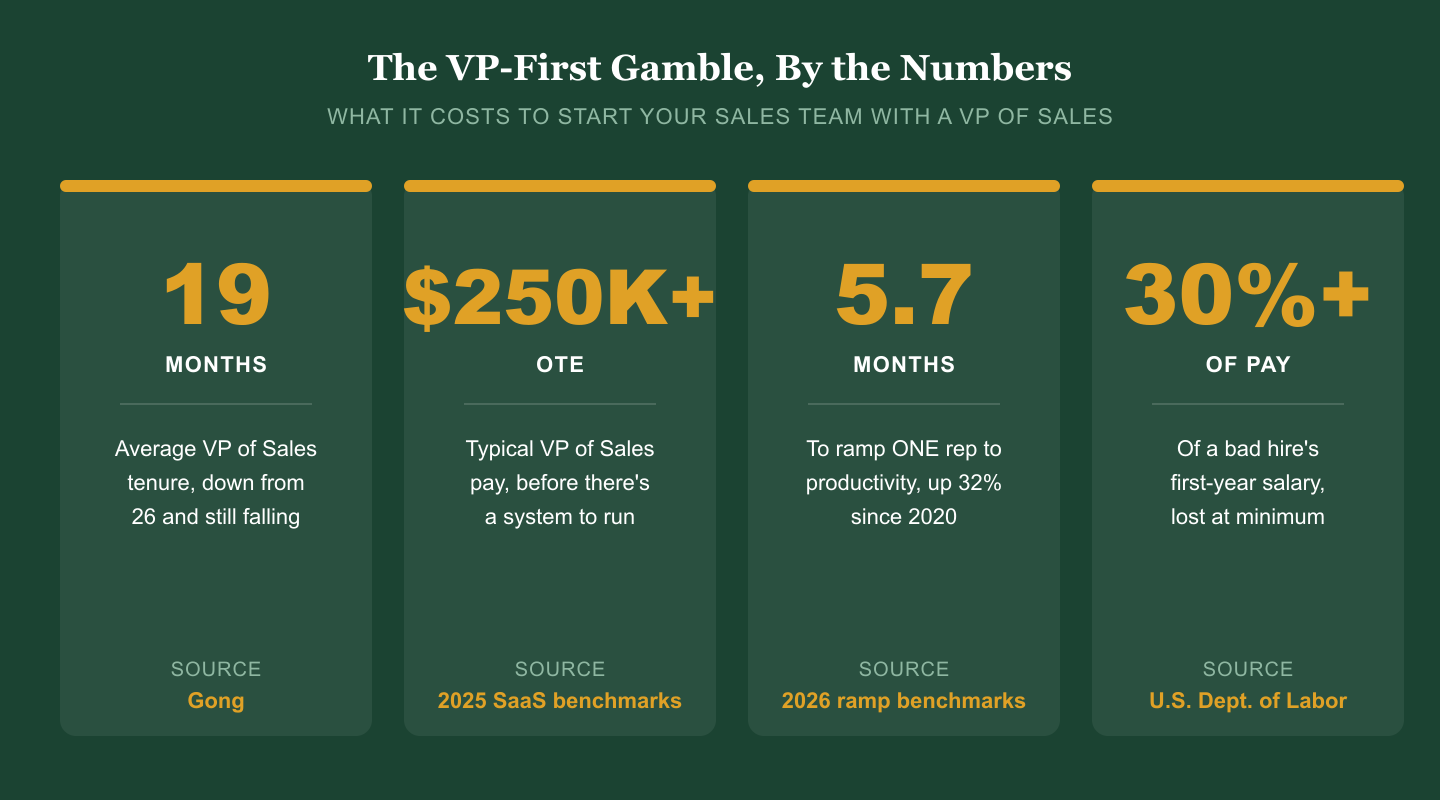
A VP of Sales is a driver. If you don't have a car yet, you don't need a driver. You need someone who can build the car and teach the next people to drive it.
The Better First Move: A Fractional Sales Leader and Two Reps
Same budget as one VP, dramatically different odds. Here's the sequence I put founders on, and why each piece matters.
Why a Fractional Sales Leader instead of a VP
A Fractional Sales Leader is a senior operator who's built and run sales teams, working with you part-time to build the exact thing a VP would need before they could succeed. The documented process. The Accountability Document. The hiring plan, the comp plan, the pipeline discipline. You get that experience for a fraction of a full-time VP's cost, and you're not locked into a $300K salary while the engine is still being built. This isn't a fringe idea anymore. Fractional sales leaders in the US and Canada grew 80% from 2020 to 2024 (Vendux, 2025 State of Fractional Sales Leadership), and companies using fractional sales leadership have reported revenue lifts of up to 24%. Founders are choosing the builder before the driver on purpose.
Why two reps, never one
The reflex is to hedge by hiring a single rep first. Don't. One rep is a single point of failure. When they struggle, you can't tell if it's the rep or the pitch, because you've got a sample size of one. When they quit, and new reps churn, your whole sales effort resets to zero overnight. Two reps give you a control group. You see who's ramping and who isn't, you get healthy competition and mutual accountability, and you're never one resignation away from starting over. I've written a whole piece on why one salesperson is a trap, but the short version is this: two reps cost 30 to 40% more up front and give you ten times the stability. And because they ramp inside a real system, they get there faster. Strong onboarding alone lifts new-hire productivity by about 50%.
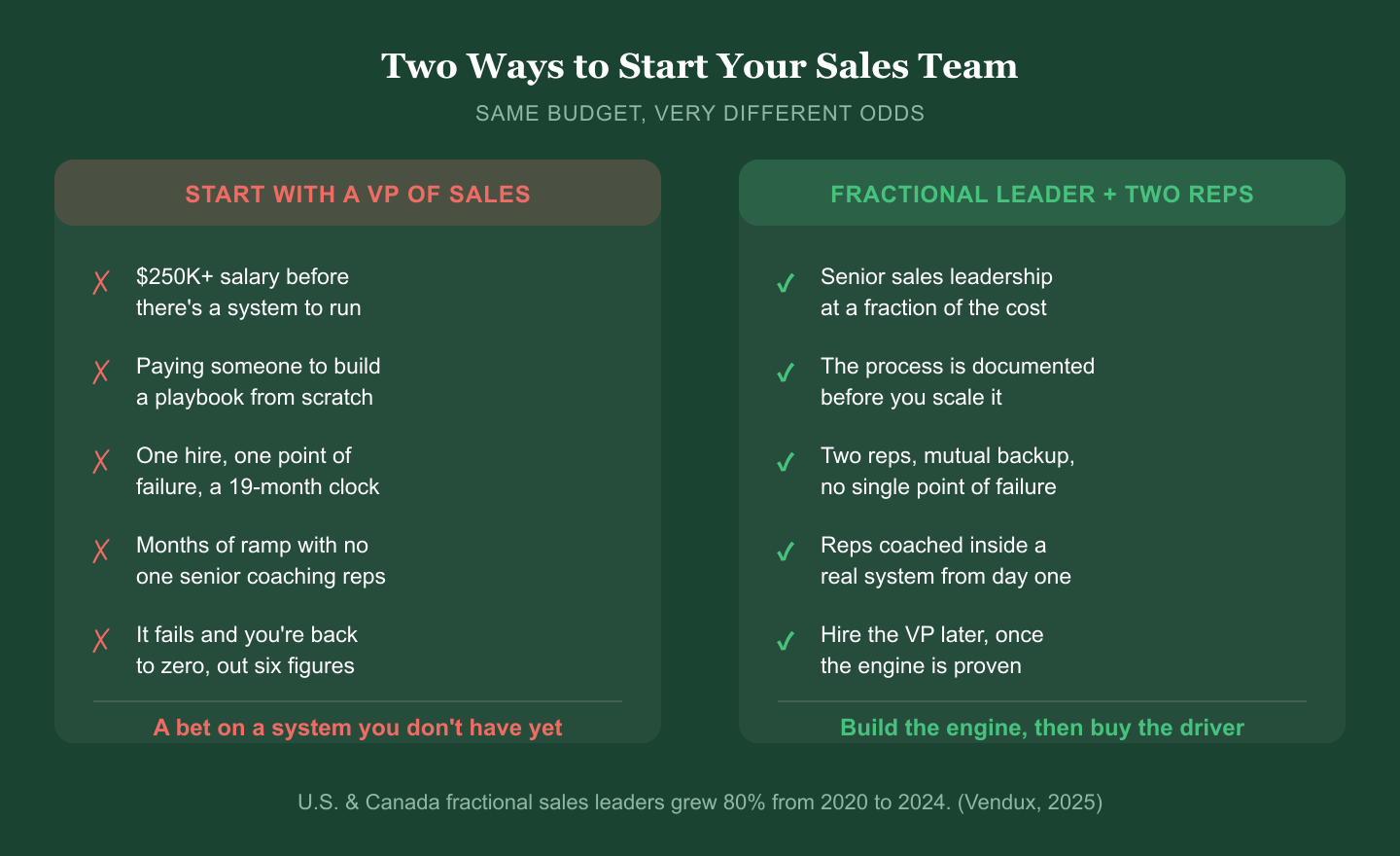
Build the engine, then buy the driver. Do it in that order and the VP hire stops being a gamble and becomes a promotion into something that already works.
So When Do You Actually Hire the VP?
I'm not anti-VP. I'm anti-sequence-error. You hire the VP of Sales when there's a job for them to lead, and you'll know because a few things will be true at once.
The signals that it's time
You have a repeatable process that closes deals without you in every meeting. You have two or more reps hitting quota inside that process, which proves the system works for people who aren't you. You have real metrics, pipeline coverage, win rates, ramp times, so you can hold a VP accountable to numbers instead of vibes. And you have enough volume that managing the team is a full-time job on its own. When those are true, a VP walks into a running machine and does what they're great at: scaling it. That's a VP hire with the odds flipped in your favor, because you're handing them a car, not a pile of parts.
Why This Matters Most Between $1M and $10M ARR
This is the exact band where the VP-first mistake does the most damage. Below $1M, you're still finding product-market fit and you probably should be selling it yourself. Above $10M, you likely have the scale and the systems to absorb a big leadership hire. But between $1M and $10M, you're in the gap. You're too big to keep doing it all yourself, and too small to bet a year of runway on a $300K executive who has to build from scratch. The reflex hire feels like progress. It's usually just an expensive detour that ends with you back where you started, minus a year and minus the cash.
That's the whole reason a Fractional Sales Leader exists. You get the senior experience to build the process, hire the right reps, and coach them into a working system, sized to where your company actually is right now. It's leadership on the stage you're on, not the stage on the org chart you're imagining. Get the engine running first. Then, when you hire the VP, you're not rolling the dice. You're handing someone the keys to something real.
The question isn't how to hire a VP of Sales. It's what has to exist before one can succeed. Build that first, and the hire almost makes itself.
Frequently Asked Questions
Q: When should a B2B startup hire a VP of Sales?
When there's a job for them to lead, not build. That means a repeatable sales process that closes without the founder in every meeting, two or more reps already hitting quota inside it, real metrics to hold a VP accountable to, and enough volume that managing the team is a full-time role. Hit those markers and a VP walks into a running machine and scales it. Miss them and you're paying a $300K executive to invent your sales function from scratch, which is the wrong job for that person and the wrong bet for you.
Q: How much does a VP of Sales cost at a startup?
In US SaaS, a VP of Sales typically runs $250K to $450K in total OTE, usually split 60/40 or 70/30 base to variable, plus equity (2025 comp benchmarks). That's before the miss. The U.S. Department of Labor puts the cost of a bad hire at a minimum of 30% of first-year earnings, and for a senior sales leader the real number climbs fast once you add lost pipeline, reps who leave when they do, and six-to-twelve months of runway. It's one of the most expensive individual bets a $1M to $10M founder can make.
Q: Why do so many VP of Sales hires fail at startups?
Usually a sequence error, not a people error. The founder hires a VP to lead a function that doesn't exist yet, so the VP has to build the process, hire the reps, and carry a quota all at once, on a clock that's shorter than the build. Average VP of Sales tenure is now 19 months (Gong), while ramping even one rep takes over five months. Add a résumé mismatch, hiring a scaler when you needed a builder, and the hire is set up to wash out before the results ever show.
Q: What's the difference between a VP of Sales and a Fractional Sales Leader?
A VP of Sales is a full-time executive who leads an existing sales function. A Fractional Sales Leader is a senior operator who works with you part-time to build that function in the first place: the process, the Accountability Document, the hiring and comp plans, the coaching. You get the same caliber of experience for a fraction of the cost, without committing to a $300K salary before the engine exists. Think of the Fractional Sales Leader as the builder and the VP as the driver you hire later, once there's a car to drive.
Q: Should I hire one salesperson or two?
Two. One rep is a single point of failure and a sample size of one. If they struggle, you can't tell whether it's the rep or the pitch, and if they quit, your sales effort resets to zero. Two reps give you a control group, healthy competition, mutual accountability, and insurance against a single resignation. They cost 30 to 40% more up front and deliver far more stability. And when they ramp inside a real process, they get productive faster. Strong onboarding alone raises new-hire productivity by roughly 50%.
Q: Can a Fractional Sales Leader really replace a full-time VP of Sales?
Not replace, sequence. At $1M to $10M ARR you don't need a full-time VP yet, you need the system a VP would require to be effective. A Fractional Sales Leader builds that system, hires and coaches your first reps, and gets revenue moving without you in every deal, for a fraction of the cost and none of the lock-in. Fractional sales leadership grew 80% in the US and Canada from 2020 to 2024 (Vendux) for this reason. When you've outgrown fractional and have a real function to lead, that's when the full-time VP earns their salary.
Before you spend $300K on a VP, let's build the thing they'd need.
If you're a $1M to $10M founder thinking a VP of Sales is your next move, give me thirty minutes first. We'll look at where you really are, what has to exist before any sales leader can succeed, and whether the smarter first step is a Fractional Sales Leader and two reps. Whether you work with me or not, you'll leave with the right sequence.
Schedule a 30-Minute CallAbout the Author
Louie Bernstein
Fractional Sales Leader with 50 years of sales experience helping $1M–$10M ARR companies build scalable, repeatable sales systems. Founder of MindIQ (INC 500). LinkedIn Top Voice in Sales Management, Sales Operations, and Sales Coaching.