Key Takeaways:
- Founder burnout isn't a willpower problem. It's a load problem. You can't out-discipline a workload that was never survivable in the first place.
- The numbers aren't subtle. In one study of 400-plus founders, 72% reported a hit to their mental health and 81% said they don't openly talk about it. You're not weak. You're in the majority, quietly.
- For most $1M–$10M ARR founders, the single heaviest weight is founder-led sales. You're still the best closer in the building, so every deal routes through you, and that's the engine running you into the ground.
- You don't stop burnout by working less on the same broken system. You stop it by taking weight off the system, starting with the function that eats the most hours and emotion.
- A full-time VP of Sales is a $300K bet you're not ready to make. A Fractional Sales Leader takes the sales weight off now, builds the system, and decouples your company's growth from your personal bandwidth.
Grab the reins before they strangle you.
In 2008, I couldn't work. Not "didn't feel like it." Couldn't. I'd built a company that made the INC 500, I'd sold for decades, and I sat there flattened by something I didn't have a name for at the time. It was burnout, and it had been building for years while I told myself I was just tired.
Here's what I learned the hard way. Burnout doesn't announce itself. It compounds quietly, one "I'll rest after this next quarter" at a time, until the bill comes due all at once.
If you're a founder running a $1M–$10M company and you're reading this at 11pm with a knot in your stomach, I'm not going to tell you to meditate more or take a long weekend. That's a band-aid on a broken leg. We're going to talk about what's actually loading you up, why it's almost certainly your sales, and how to take the weight off in a way that holds.
Burnout Isn't a Character Flaw. It's a Math Problem.
The first thing you need to hear is that this isn't you being soft. The data on founders is brutal, and it's remarkably consistent across studies.
Startup Snapshot's "The Untold Toll" report surveyed more than 400 founders and CEOs. 72% reported an impact on their mental health. 44% reported high stress, 36% reported burnout outright, and here's the one that should stop you cold: 81% said they don't openly share their stress, fears, and challenges. So the quiet you feel, the sense that everyone else has it figured out, that's the illusion. Four out of five of them are doing exactly what you're doing, which is white-knuckling it in private.
It gets more pointed. A 2025 Sifted survey of founders found 54% had experienced burnout in the previous 12 months and 75% reported anxiety in that same window. And the foundational research by Dr. Michael Freeman at UCSF, published in Small Business Economics, found that entrepreneurs were 50% more likely than a comparison group to report a mental-health condition, with 49% reporting a lifetime history of at least one.
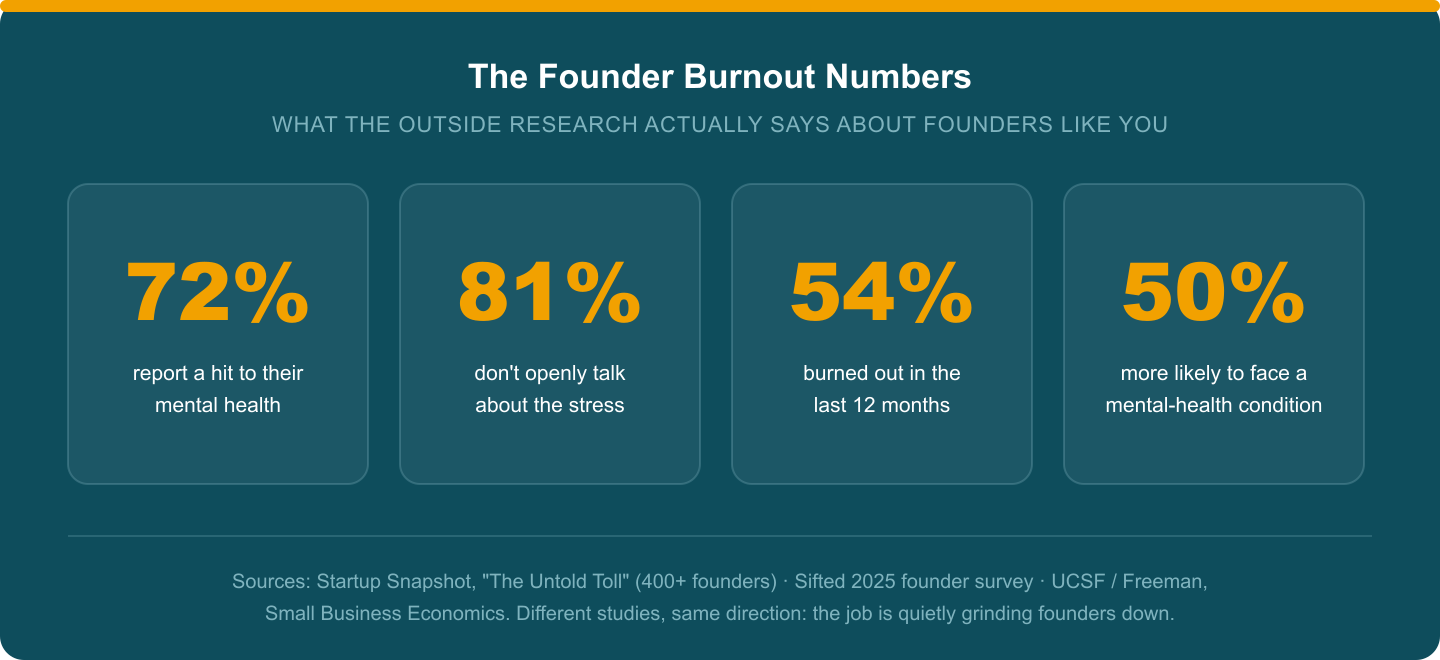
I don't show you these numbers to depress you. I show them because once you accept that burnout is the predictable output of an overloaded system, you stop trying to fix it with discipline and start trying to fix it with subtraction. You can't out-grind a load that's too heavy. The only move is to make the load lighter.
You will not discipline your way out of burnout. You'll subtract your way out of it. The question isn't "how do I push harder," it's "what do I take off my plate first."
The Specific Thing That's Burning You Out
Here's where I diverge from the general "founder wellness" advice. I'm a Fractional Sales Leader. I work with founders between $1M and $10M ARR, and I can tell you with high confidence where the heaviest weight sits in your business. It's sales. Specifically, it's the fact that you're still the one carrying it.
You're a victim of your own competence
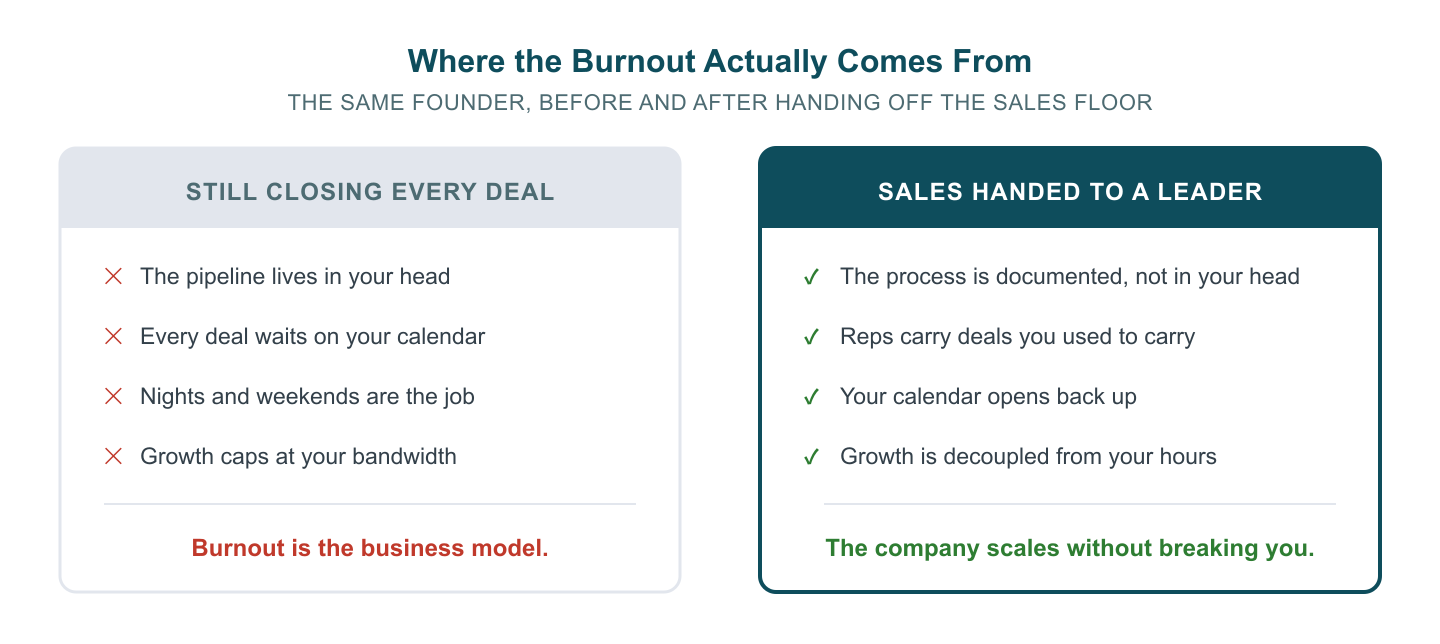
You got to $1M, $3M, $5M because you're a great closer. You know the product, you believe in it, and prospects feel that. So every important deal still routes through you. Every big proposal, every "can you just hop on this one call," every renewal that matters. Your competence created a dependency, and now the company can't sell without you in the room.
Sales is the one function that never lets you rest
Product has a roadmap. Finance closes the month and the month ends. But sales never sleeps. Pipeline is always either too thin or too full. There's always a deal slipping, a forecast to hit, a rep who needs help, a customer threatening to churn. It's the function with the most emotional volatility and the least natural off-switch, and you've made yourself the off-switch. That's why your brain won't quiet down at night.
Founder-led sales has a hard ceiling, and you've hit it
There are only so many hours, and you're spending them in deals instead of on the business. Growth is now capped at your personal bandwidth, which means the harder you work, the more trapped you get. You can feel it. The company needs you to be the closer and the CEO at the same time, and nobody can do both well for long. That tension, that's not a personality problem. That's a structural one, and structural problems get solved structurally.
Grab the Reins: Four Moves That Actually Take the Weight Off
Stopping burnout isn't one big dramatic decision. It's a handful of deliberate moves that shift load off you and onto a system. Here are the four I'd start with.
1. Get your sales process out of your head and onto paper
Right now the playbook lives in one place: your head. That's why nobody can run a deal without you. Write down how you actually sell. The questions you ask in discovery, the way you handle the three objections you always get, the steps from first call to signature. The moment it's documented, it's transferable. The moment it's transferable, it stops being your job alone.
2. Define accountabilities, not just a job description
When founders finally hire a salesperson, they hand over a vague title and hope for the best. Then they end up re-closing every deal anyway, more exhausted than before. Don't do that. Build an Accountability Document that spells out exactly what the role owns, the activity it's responsible for, and the outcomes it's measured on. Clarity is what lets you actually let go, because you can hold someone to something specific instead of hovering over everything.
3. Protect the work only you can do
There are a few things in your company that genuinely require the founder: vision, key partnerships, the biggest strategic bets. Closing your forty-eighth mid-market deal of the year isn't one of them. Make an honest list of what only you can do, and treat everything else as a candidate for handoff. Most founders are stunned by how short the "only me" list actually is.
4. Bring in sales leadership before you bring in more reps
This is the one founders get backwards. They hire a rep or two to "take sales off my plate," then discover those reps need managing, coaching, and a system to work inside, none of which exists yet. So the founder becomes the sales manager on top of everything else. The right order is leadership first. Someone who builds the system, then hires and runs the reps inside it. That's the move that actually gets you out, instead of deeper in.
Why Handing Off Sales Is the Highest-Leverage Move You Can Make
When founders hear "hand off sales," their mind jumps straight to a full-time VP of Sales. Then they see the number. All-in, a real VP runs you north of $300K once you factor in base, commission, and equity. At $1M–$10M ARR, that's a bet you can't afford to get wrong, and most founders who make it too early get it wrong. I've watched it happen plenty of times. The VP needs a system to manage, the system doesn't exist yet, and six months and a quarter-million dollars later you're back to closing deals yourself, now with a hole in the budget.
That's the gap a Fractional Sales Leader fills. You get senior sales leadership, the person who's built and run sales teams before, for a fraction of the cost and commitment. They take the sales weight off your shoulders now. They document the process, build the Accountability Document, install the pipeline discipline, and hire and coach the reps. Your job shrinks back down to being the founder. The point isn't just revenue. It's that your company's growth stops being chained to your personal hours, which is the actual root of the burnout.
Resilience is infrastructure. You build it before you need it, not during the crisis. The most resilient thing you can do for yourself as a founder is build a sales engine that runs without you in every seat.
I learned that in 2008 the expensive way. The founders I work with now don't have to. Taking sales off your plate isn't giving up control. It's the move that gives you your company, and your nights and weekends, back.
Frequently Asked Questions
Q: What are the early warning signs of founder burnout?
It rarely shows up as a dramatic crash at first. Watch for the quieter signals: dreading the work you used to love, a constant low-grade resentment, trouble sleeping because your brain won't stop running deals, cynicism creeping into how you talk about customers and your team, and the feeling that you're working harder but moving slower. In the research, 36% of founders report outright burnout and 44% report high stress, but most never say it out loud. If you recognize yourself in those signs, you're not at the edge yet, you're already in it, and that's the moment to act, not push through.
Q: Isn't burnout just part of being a founder?
Stress is part of it. Burnout isn't, and treating it as a badge of honor is how founders end up flattened the way I did in 2008. There's a real difference between the healthy intensity of building something and the slow erosion of running a system that was never survivable. The first energizes you. The second hollows you out. If you've normalized exhaustion as "just the cost of the dream," that's exactly the belief that keeps you from fixing the structural problem underneath it.
Q: Why is sales the thing to hand off first instead of operations or finance?
Because for most early-stage B2B founders, sales is the function with the highest emotional load and the least natural off-switch. Operations and finance have rhythms and endpoints. Sales never closes. Pipeline anxiety, slipping deals, and forecast pressure run in the background twenty-four hours a day, and if you've made yourself the only closer, all of that lands on you personally. Take that one weight off and you'll be surprised how much mental room opens up for everything else.
Q: I can't afford a $300K VP of Sales. What are my options?
You don't need one, and at $1M–$10M ARR you probably shouldn't hire one yet. A full-time VP is a large fixed cost and a long commitment, and hiring one before you have a system for them to run is how founders burn six months and a quarter-million dollars. A Fractional Sales Leader gives you the same senior experience, building the process, the accountabilities, and the team, at a fraction of the cost and with none of the long-term lock-in. It's leadership sized to where your company actually is right now.
Q: If I hand off sales, won't I lose the founder magic that closes deals?
No, and this is the fear that keeps founders stuck the longest. The goal isn't to remove you from sales entirely. It's to extract what makes you effective, your instincts, your story, the way you frame the problem, and build it into a repeatable process your team can run. You stay involved where you add the most, the biggest strategic deals and key relationships, while the system handles the volume. Done right, your magic gets multiplied across a team instead of trapped inside your calendar.
Q: How fast can handing off sales actually relieve the pressure?
Faster than you'd think for the mental load, slower for the full system. The relief of no longer being the single point of failure on every deal can land within the first month, once the process is documented and someone else is accountable for pipeline. Building the full engine, the playbook, the hires, the discipline that holds without you, is a quarter or two of focused work. But the psychological shift, the part that lets you sleep, often comes early, because the moment the weight stops being yours alone, your nervous system knows it.
You don't have to carry the whole sales floor anymore.
If you're a $1M–$10M founder running on fumes because every deal still runs through you, let's talk. Thirty minutes. We'll find the heaviest weight you're carrying in sales and map out how to take it off your shoulders, without a $300K VP and without breaking what's already working.
Schedule a 30-Minute CallAbout the Author
Louie Bernstein
Fractional Sales Leader with 50 years of sales experience helping $1M–$10M ARR companies build scalable, repeatable sales systems. Founder of MindIQ (INC 500). LinkedIn Top Voice in Sales Management, Sales Operations, and Sales Coaching.